
![AS Roma Vs SS Lazio [2–0] – Serie A 2025/2026: Gian Piero Gasperini's Winning Derby Della Capitale Tactics – Tactical Analysis](https://cdn.mymidnight.blog/77f959f119f4fb2321e9ce801e2f5163/size/w1000/2026/05/AS-Roma-Vs-SS-Lazio-20252026.png)
AS Roma Vs SS Lazio [2–0] – Serie A 2025/2026: Gian Piero Gasperini's Winning Derby Della Capitale Tactics – Tactical Analysis

Gameweek 37 in Serie A saw an entertaining Derby della Capitale, which ended with a 2-0 AS Roma win over SS Lazio, confirming I Giallorossi as serious competitors with AC Milan for third place going into the last fixture.
The win gives Roma a crucial boost ahead of their last match against Hellas Verona, an important advantage over Como and Juventus, who are just behind them in the standings.
The win in the derby was perhaps the most important of the season for Gian Piero Gasperini as it prevented his team from falling out of the UEFA Champions League spots at a crucial time, thereby protecting their seasonal objective and increasing their chances of achieving it.
On the other hand, Maurizio Sarri and his team stand in ninth place in an overall negative season, during which Lazio failed to even battle for European spots.
The latest loss in the Coppa Italia Final against Inter Milan was painful, and the team’s issues were aggravated with a disappointing derby loss, too.
All the signs suggest that a lot of changes need to be made at Lazio during the summer break ahead of next season, whether in terms of squad reinforcement or coaching staff upgrading, in order to return to being more competitive next season.
In this tactical analysis, we look at how Roma overcame Lazio's attacking threats and exploited their set-piece efficiency to punish them.
The analysis also explores Roma's creative build-up solutions and use of space in behind Lazio's defenders.
AS Roma Vs Lazio Lineups & Formations
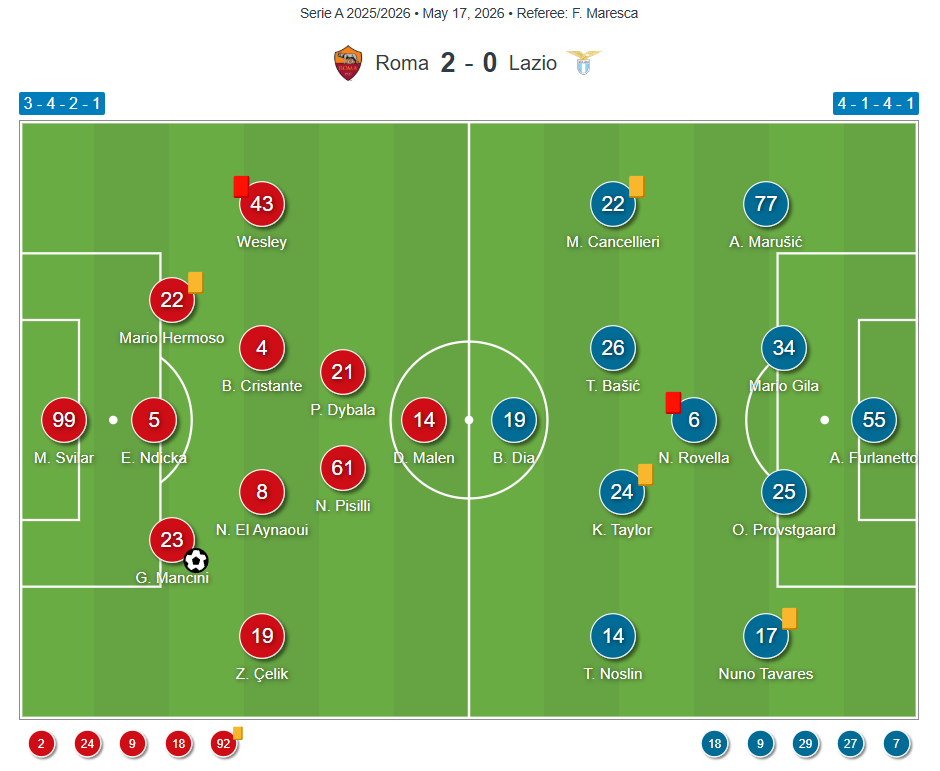
AS Roma Lineup Vs Lazio
Gasperini started the match in his preferred 3-4-2-1 formation, with Mile Svilar in goal and a defensive line of three centre-backs: Gianluca Mancini on the right, Evan Ndicka in the centre, and Mario Hermoso on the left.
The midfield line featured Wesley França and Zeki Çelik as left and right wing-backs, with Bryan Cristante and Neil El Aynaoui as central midfielders.
In attack, Gasperini used both Paulo Dybala and Niccolò Pisilli as right and left-sided wide playmakers, with Donyell Malen as the team’s striker.
Lazio Lineup Vs AS Roma
Sarri started the match using his preferred 4-3-3 formation, with Alessio Furlanetto as goalkeeper, Adam Marušić as right-back, Mario Gila and Oliver Provstgaard as centre-backs, and Nuno Tavares as left-back.
The midfield line consisted of Nicolò Rovella as a defensive midfielder, with Kenneth Taylor and Toma Bašić as central midfielders.
Up front, the attacking line was composed of Tijjani Noslin and Matteo Cancellieri as wingers, with Boulaye Dia as the team’s main striker.
AS Roma Creative Build-Up From The Back
Roma started the match better than Lazio, thanks to their strong execution of the high press, as well as via rotations in possession to gain numerical superiority in key areas and succeed in advancing smoothly upfield.
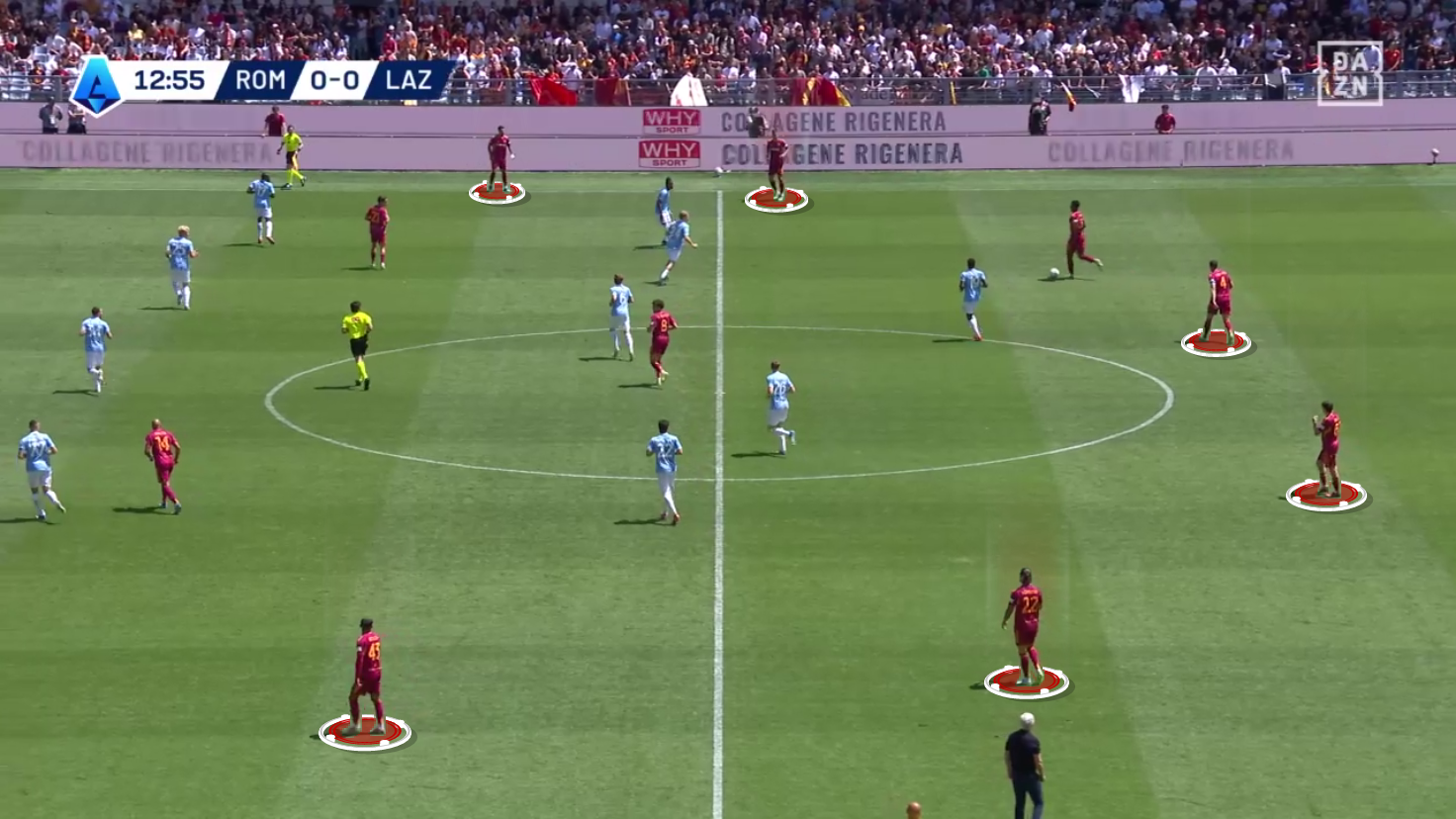
Roma’s build-up from the back was entertaining and effective due to the rotations and Gasperini's instructions for midfielders, and even Pisilli, who was playing as a left winger, to retreat and progress from the back rather than the defenders doing so.
We saw both Pisilli and Cristante form a defensive line at the back on numerous occasions and take responsibility for providing the first vertical passes, mainly towards the wings.
This was done to disrupt Lazio’s high-pressing system and its potential consequences for Roma’s defenders’ passing, as relying on the midfielders for the build-up and playmaking was safer than using defenders, given the midfielders' ability to resist pressing and build up from the back with greater ease.
The positional rotations were also made to create numerical superiority on both wings, with Hermoso leaning towards the left flank and playing as a left-back, and Mancini playing as a right-back.
This not only gives the ball holder more options but also allows the wing-backs, Wesley and Çelik, to advance further and become wingers in this case.
The impact of these changes on Roma's attacking line is mainly creating the possibility for Dybala to get closer to Malen and form an attacking duo with him inside the final third, as shown in the picture below.
Despite the creative use of midfielders in the build-up from the back, Roma failed to be as dangerous as needed, as their attacking players continued to be tightly marked by Lazio’s defenders and had little margin for getting the ball in key areas or being able to advance with the ball.
Malen, in particular, was not allowed to receive passes easily and had to move a lot without the ball, sometimes retreating to touch it, as he was prevented from doing his usual dangerous accelerations.
Almost the same applies to Dybala, who had to retreat each time in order to touch the ball and opt for backward or horizontal passes mostly.
Until the minute, Roma failed to play vertically in their usual quick way and were obliged to keep possession in a relatively passive way, without finding concrete solutions up front.
SS Lazio Vertical Passing & Exploitation Of Space Behind Roma's Defensive Line
As Roma were occupied in trying to find attacking solutions while applying continuous high pressure on Lazio, I Biancocelesti were opportunistic enough to use that situation to their advantage by relying on vertical passes to try and surprise Roma’s high defensive line.
Lazio’s attempted plan worked and could have led to a goal.
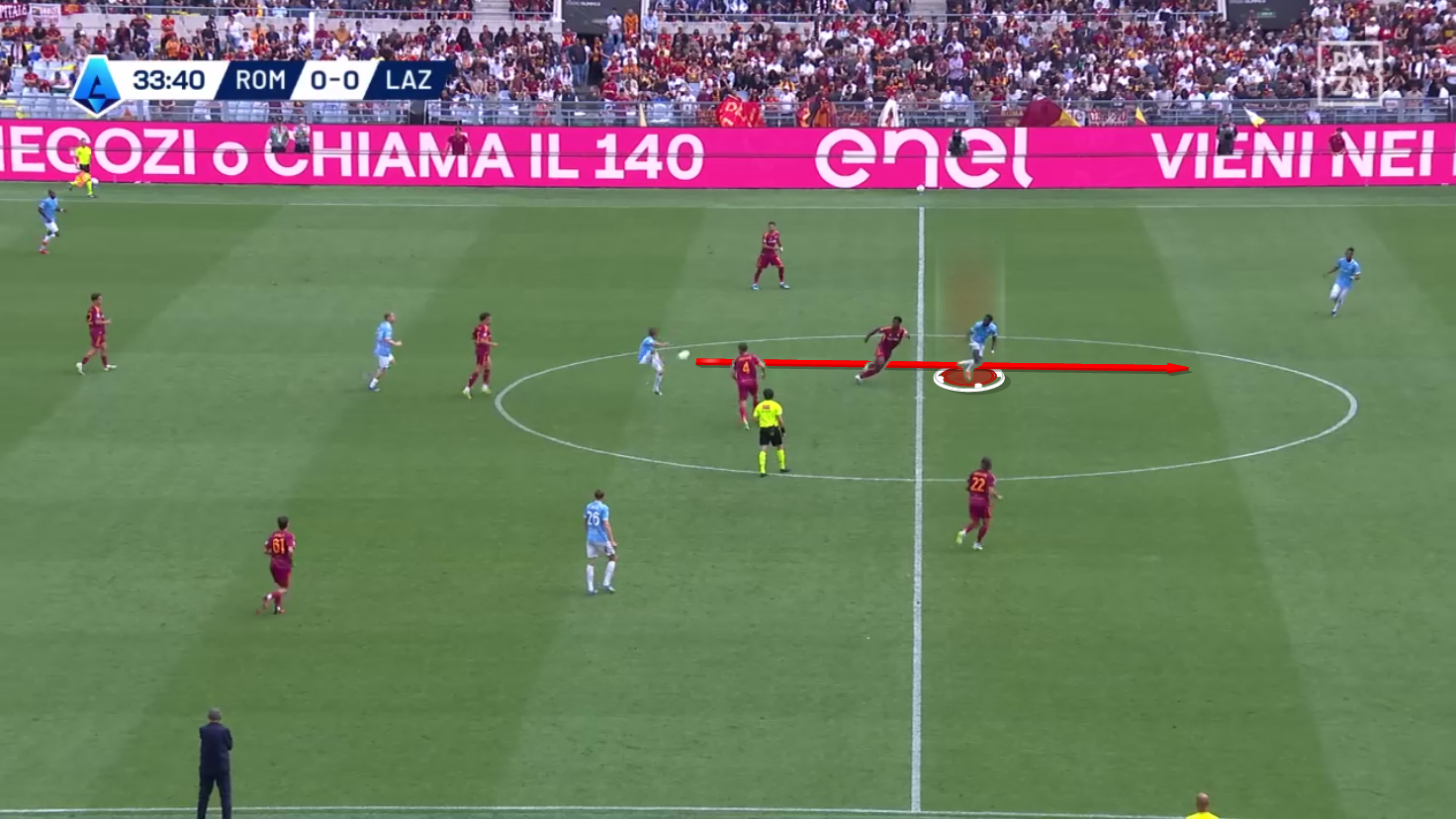
Dia’s off-the-ball movement created issues for Ndicka and was crucial in creating goalscoring situations for Lazio.
In fact, Dia won his duel against Ndicka in more than one action, and this helped him in being the playmaker in Lazio’s actions.
In the situation below, Dia positioned himself well enough to receive a vertical pass and was able to provide a backward pass despite Ndicka’s disturbance.
Then he quickly ran forward and received a pass from Rovella to get away from Ndicka and accelerate before serving Noslin, who had the time needed to opt for a shot on goal.
Unfortunately for Lazio, however, Noslin’s left-footed shot was not accurate enough to be on goal; otherwise, it would have been complicated for Svilar to save.
Noslin could have made a better shooting decision by cutting inside quickly and opting for a curved shot with his right foot, which would have made his shot much more dangerous.
But he preferred the safer option to ensure his shot would not be deflected or blocked.

![Scotland Vs Switzerland [0-3] UEFA Nations League 2026/2027: How Aggressive Pressing Backfired & Murat Yakin Took Advantage - Tactical Analysis](https://cdn.mymidnight.blog/77f959f119f4fb2321e9ce801e2f5163/size/w600/2026/10/Scotland-Vs-Switzerland-20262027---Tactical-Analysis.png)
![Olympique De Marseille Vs PSG [1-2] Ligue 1 2026/2027: How Bruno Génésio Transitions Troubled PSG - Tactical Analysis](https://cdn.mymidnight.blog/77f959f119f4fb2321e9ce801e2f5163/size/w600/2026/09/Marseille-Vs-PSG-2026_2027---Tactical-Analysis.png)
![Fulham Vs Manchester United [1-1] Premier League 2026/2027: How Álvaro Arbeloa Tactics Exposed The Red Devils' Problems - Tactical Analysis](https://cdn.mymidnight.blog/77f959f119f4fb2321e9ce801e2f5163/size/w600/2026/09/Fulham-FC-Vs-Man-United-2026_2027---Tactical-Analysis.png)
![AS Roma Vs Inter Milan [2-2] Serie A 2026/2027: When Undefeated Giallorossi Attack Met Nerazzurri Comeback Resilience - Tactical Analysis](https://cdn.mymidnight.blog/77f959f119f4fb2321e9ce801e2f5163/size/w600/2026/09/AS-Roma-Vs-Inter-Milan-2026_2027---Tactical-Analysis.png)
![Real Sociedad Vs Bournemouth [1-2] Europa League 2026/2027: How Do Marco Rose Pressing Tactics Work? - Tactical Analysis](https://cdn.mymidnight.blog/77f959f119f4fb2321e9ce801e2f5163/size/w600/2026/09/Real-Sociedad-Vs-Bournemouth-20262027---Tactical-Analysis-1.png)
![AC Milan Vs Benfica [0-2] Europa League 2026/2027: How Marco Silva Tactics Exposed Rúben Amorim Defensive Problems - Tactical Analysis](https://cdn.mymidnight.blog/77f959f119f4fb2321e9ce801e2f5163/size/w600/2026/09/AC-Milan-Vs-Benfica-20262027---Tactical-Analysis.png)
![Sunderland Vs AZ Alkmaar [1-0] Europa League 2026/2027: Why The Black Cats Make Better Underdogs - Tactical Analysis](https://cdn.mymidnight.blog/77f959f119f4fb2321e9ce801e2f5163/size/w600/2026/09/Sunderland-Vs-AZ-Alkmaar-20262027---Tactical-Analysis.png)