How To Coach Controlling Possession Like Arrigo Sacchi - Tactical Theory

Coaching philosophies in football set teams apart, adding complexity to the game and ultimately making it more intriguing.
Every single one of us has our favourite style of play, and on-field coaching is the main way to realize your idea in material form.
Controlling possession is one of the most popular game plans, and it is often used by the 'bigger' teams, who want to be all over the game and in control of every detail throughout the 90 minutes.
Also, this style could be of great importance to all teams, regardless of their initial game plan, because the security of the ball is a key factor in the modern game.
This tactical theory piece will show you 3 soccer drills that could help you train the control-possessing style, along with other segments of the game that could fit your tactics.
What Is Controlling Possession In Football?
Controlling possession is a philosophy based on short passing and good positional play.
The key idea is to create numerical advantages in restricted areas of the pitch so you can progress with your play, always having an available option to pass.
The drills we have lined up are typically based on "keeping the ball" in surplus scenarios, along with the counter-pressing and defensive transitions parts, which are closely related to possession-based play.
In this analysis, we will break down the drills that could be used in the main part of the practice and that help players feel more comfortable with the ball while forcing them to maintain the structure after the ball is lost.
Communication between the players is also important when playing this way, so it should be encouraged throughout those sessions.
Arrigo Sacchi’s Double Rondo
The first drill we are going to discuss was created by the legendary Italian coach Arrigo Sacchi during his time at AC Milan.
The setup of the session is quite simple - a bigger rectangle 40 meters in length and 25-30 meters in width, with a smaller square in the centre of it that is shaped by 12x12 meters.
The initial setup includes ten players, but the number could vary depending on the number of players you have in training.
Throughout the variations you’re making to the exercise.
The first thing you do is the asymmetrical division of roles as you create two teams—Red and Blue players, as it will be addressed from now on—with Blues having six players in their team and Reds having four.
The game starts with the Red team in possession of the central square.
The four players play a 4v2 rondo against the two Blue players who are chasing the ball.
The Reds' number of touches is limited, and it can change depending on your idea, but the initial task is for them to play a two-touch game.
They get a point whenever they come up with 15 passes, so the game has its competitive character.
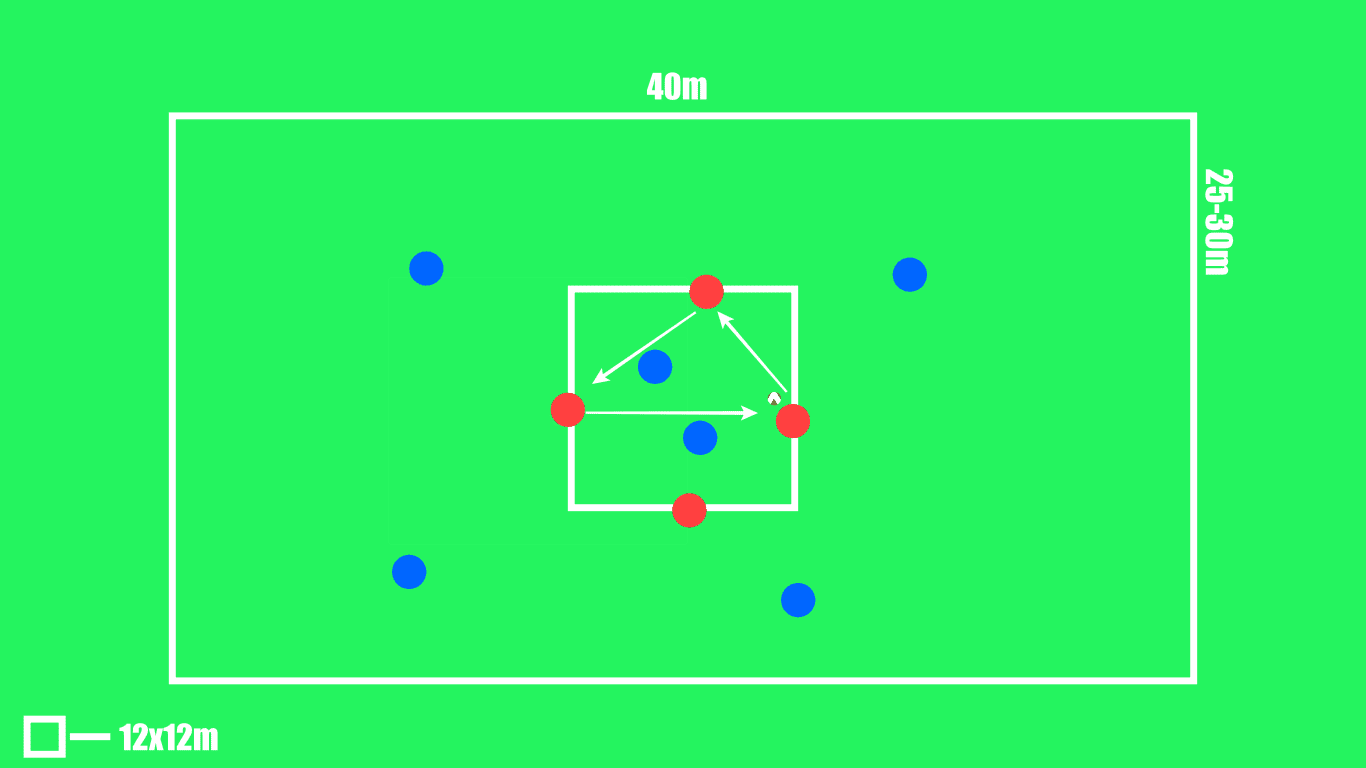
Here we can see the visual of the game with the Red team playing the rondo and two of the Blues trying to win the ball.
Whenever the ball is lost, it comes to the switch in possession, but in the bigger area of the two, now making Blues the numerically superior side, who try to keep the ball in the 6v4 scenario.
The task for them is also to get to the 15 passes, but playing the three-touch game, which can and should be reduced to the two and one-touch throughout the series.
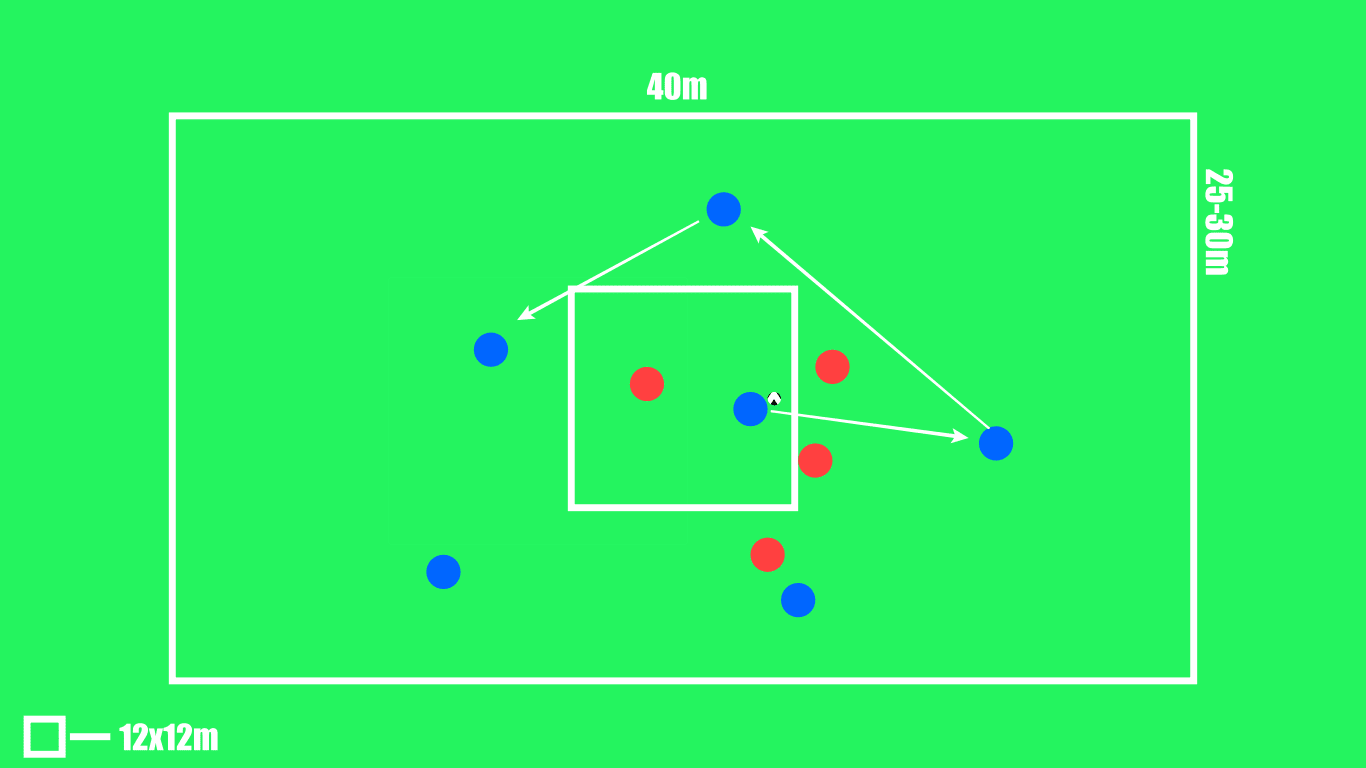
When the Reds lose the ball, it is important for them to switch in the state of mind for counter-pressing, but from a numerical inferior position.
They need to cooperate and communicate with each other to create the best possible defensive structure, which will make it difficult for the surplus opposition to pass through.
Aggression by the defending players is one of the key factors in out-of-possession games, along with compactness and teamwork.
Once again, when it comes to another possession switch, teams return to their initial positions, with the other two Blues in the square rondo chasing for the ball.
The two of them also need to communicate and to find the best balance between pressing the player with the ball and closing down the in-between passing lane.
It is encouraged that the Red players are all from the same branch of the team - four midfielders (with the same or different roles in the team, defensive four, four attackers, etc.), whilst the six Blue players could be a mixture of two lines of the team, which will help them build understanding.
This drill can be varied not only in terms of the number of players but also in terms of concept.
The more complex way to exercise is to have goalkeepers on both ends of the rectangle and to use them when the initial 4v2 rondo is broken.
The tasks remain the same in the square (they can be modified slightly, for example, by reducing the number of touches or passes to win a point), but the main change happens in the 6v4 game, where the key modification is related to the directness of the play.
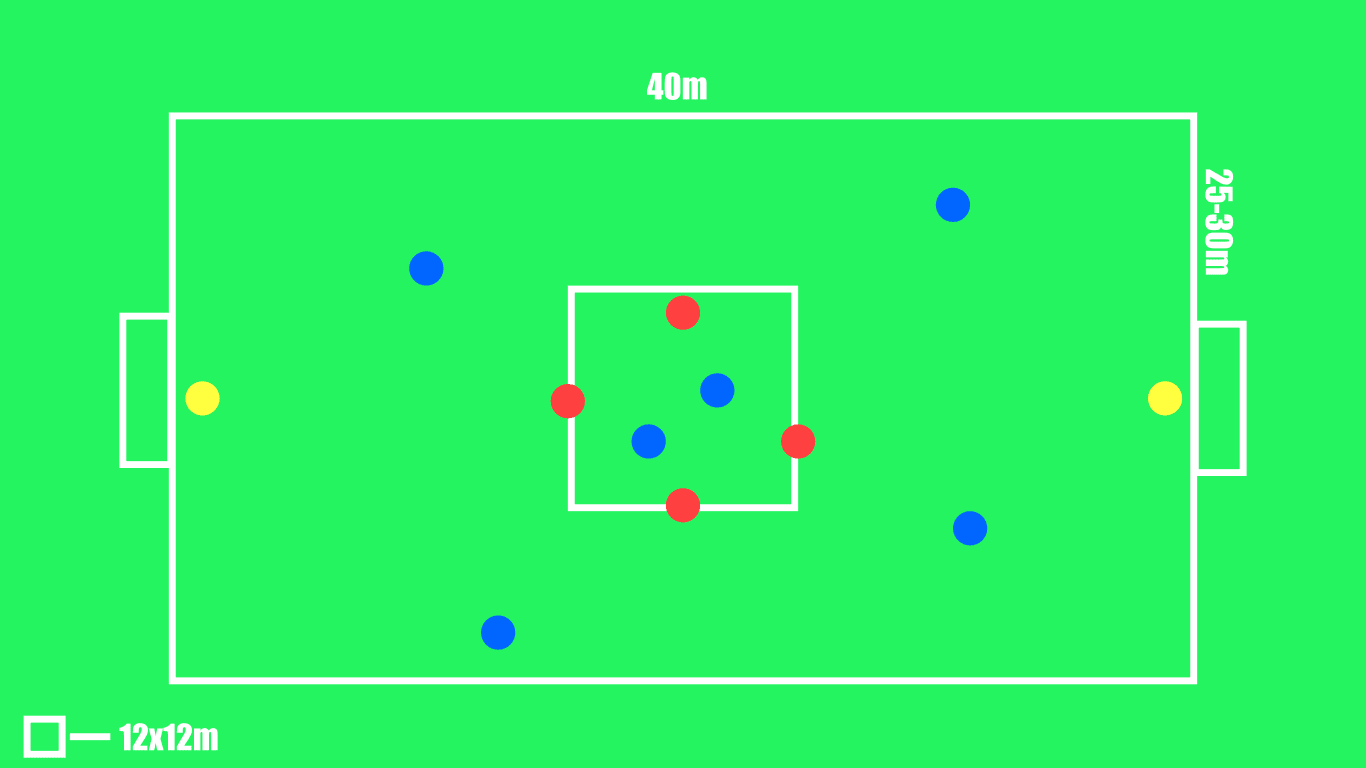
When the Blues get the ball, they are encouraged to pass the ball faster, with the add-on of finishing.
They need to produce seven passes between themselves - not 15 anymore - and after the seventh pass, they can go for a shot on whichever goal they want.
Also, they don’t need to hurry to shoot right after the seventh pass, but it is wanted for their side to play a more direct game when goalkeepers are in their places.
The field size can also be restricted if you want to encourage your players to think faster in smaller areas and speed up the game.
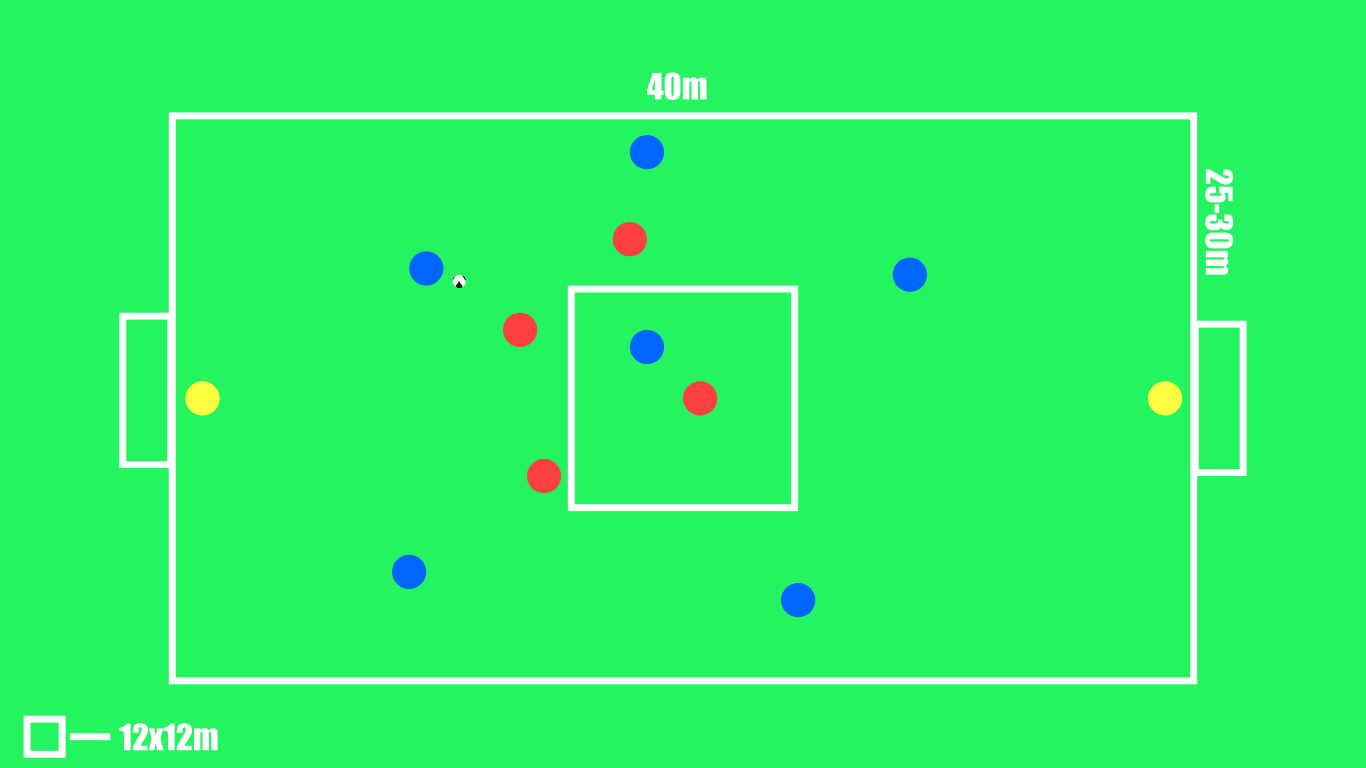
When the initial rondo breaks down, the Red side's defensive tasks remain the same.
They need to defend tightly and in a well-organised shape, but they also need to be aware of defending both goals at the same time.
Depending on the pitch situation, the drill can be executed with many more or fewer players.
It can be useful for controlling possession, communication between the players, and counter-pressing coaching.
Three-Colours Possession
This exercise modifies classical two-sided possession games in a restricted area, with the clear intention of improving on-ball security for your players.
It is happening in the marked 25x15m box with cones at the half of each "length" line and at the end of them, marking the operational space for players on the sidelines.
The game is played by three teams made of five players, with every team having three of them inside the rectangle and two outside of it in the marked areas, as you can see in the picture below.
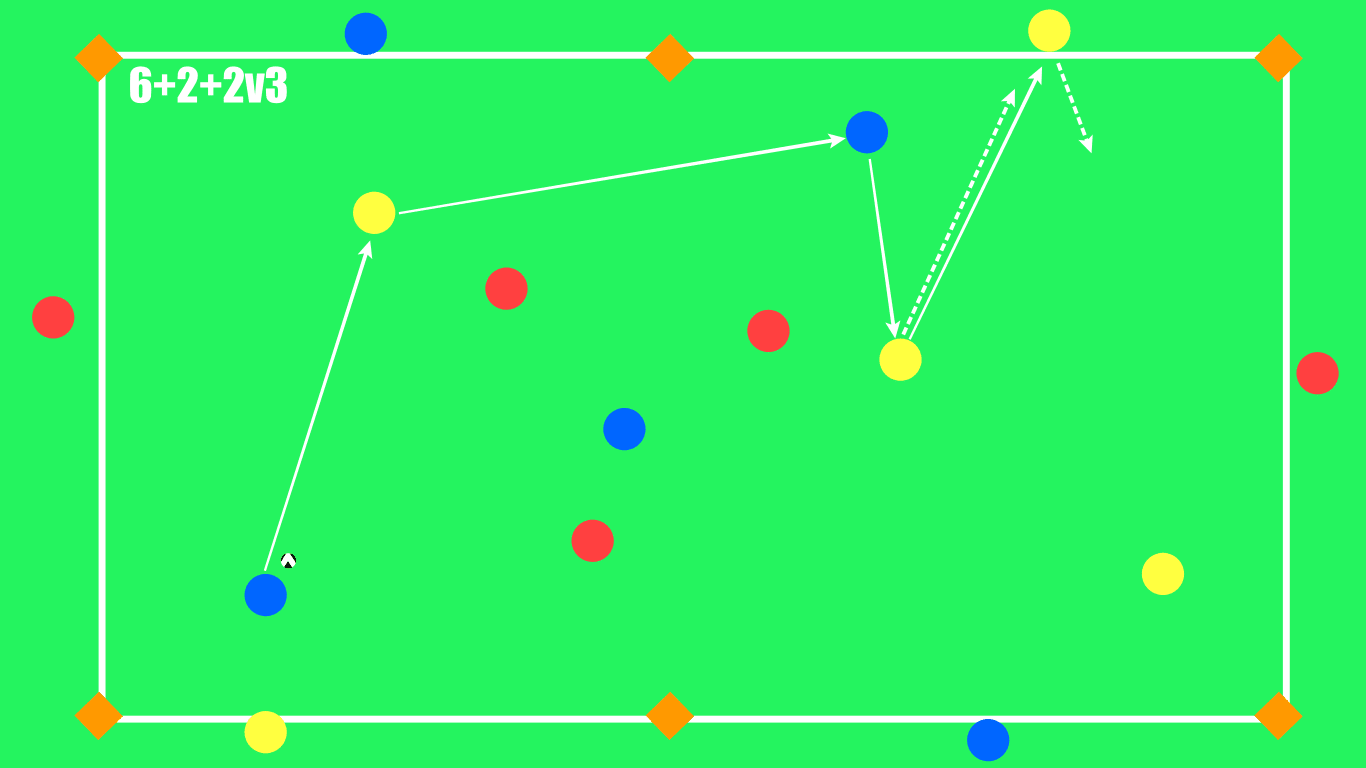
Here is the game's initial setup, along with some tasks that will be explained further in the analysis.
We have three teams - Blues, Reds and Yellows, which are all set inside and outside the box, with outside players from the same team being positioned diagonally to each other.
The main task is for the inside players to play „two colours against one“ three-touch (later reduced to two-touch and one-touch) game in a 6+2+2v3 setup.
For example, we have Reds defending and trying to win the ball, while Blues and Yellows are in possession.
At first glance, it looks like an easy possession for the numerically superior teams, since they also have help from their players outside the box, but as the game intensifies, it gets more and more difficult for them to keep the ball.
Also, the fact that the field is small makes it difficult and forces players to think faster.
To cut down the easy part, Blues can only pass to the Blues outside the box, taking their spot after they sent the pass, whilst the outside player enters the action after he receives the ball.
Outside players have the same number of touches as the players inside the field.
When the Reds win the ball, their team keeps possession from the team they haven’t won the ball from, for example.
If they get the ball from Blues, Blues will start trying to win the ball, and Yellows will still be the possession team.
The main factors of the game for in-possession teams are fast thinking and security on the ball.
They have various options since they are in a surplus situation all the time, but the small area of the play leaves a very small amount of free space, so their decisions need to be on a very high level and perfectly timed.
This drill involves modifications for the defending team, which complicates the game even more for both in- and out-of-possession sides.
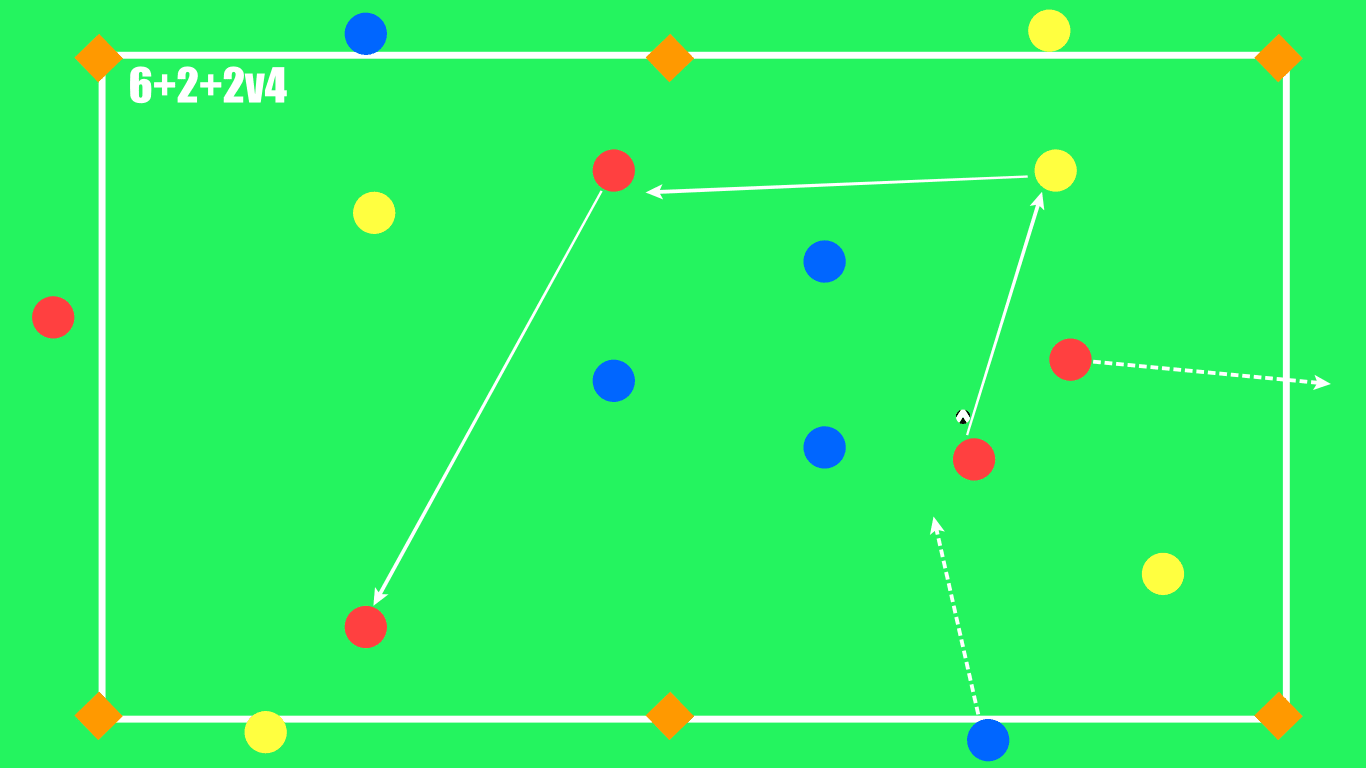
The main change in the variation is the sideline player entering the box when his team loses possession, which creates a 6+2+2v4 set-up in the box.
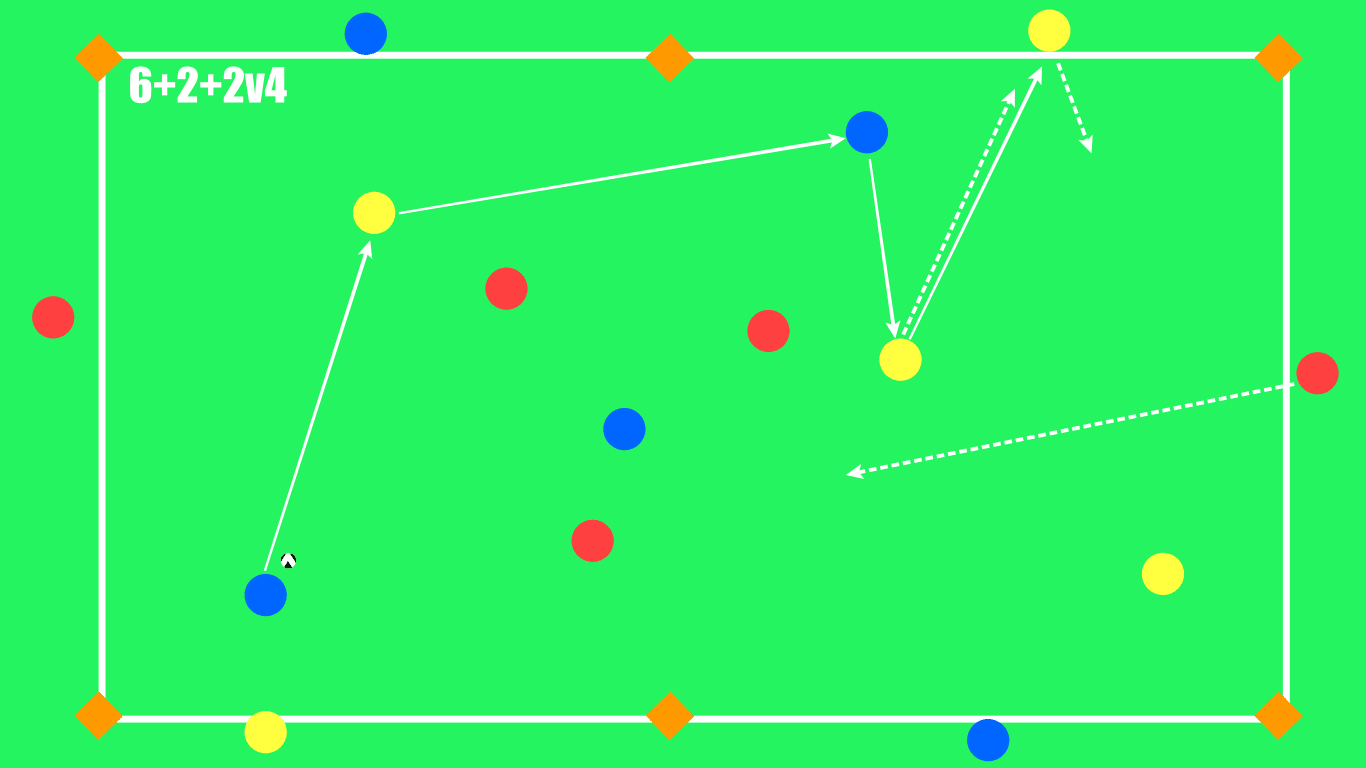
In the picture above, we can see the modification of the game with a Red player entering the pitch in order to make it more complex for the players with the ball to pass through the defending team.
Once again, the Reds need to communicate and stay in shape to disrupt the opposition’s passing game.
The possession side's tasks remain the same, with potential changes in terms of touches and the "no long ball" rule.
When Reds win the ball, one of their players needs to exit the pitch as fast as possible since they have one more player in the box, and the player from the team that has lost the ball is free to enter in order to help his teammates regain possession.
It is encouraged to play in the small field, as mentioned earlier in the analysis, in order to train your players to think faster and to become more comfortable under pressure.
Also, the counter-pressing segment remains as important as it was in the previous drill, with aggression and communication as its key parts.
Offensive Surplus Play
The third drill is the best of the three mentioned for playing it in the main part of the training, as it is based on the patterns used in the regular game.
First of all, it is set on one half of the pitch, with a regular goal on one side and two small ones on the opposite side, with players participating in a two-way game.
One team is made of six defenders (it is good to have, for example, the whole defensive line made of four and two midfielders, or five defenders and a defensive midfielder, etc.) and a goalkeeper, who try to defend the big goal, whilst the other side is filled with seven attackers (this team should be made out of mixture made of midfielders and forwards).
Teams are encouraged to play a 'free game', with some restrictions in terms of touches given, shots coming only out of the first touch, after crosses, etc.
The main idea is that the attackers - Red team - always have numerical superiority over the defenders - Blue team - which can be of great importance for them to become more secure on the ball.
They will always have a free player, a possible passing option, but with the task of circling the block if the situation is not open, not to force forward passes.
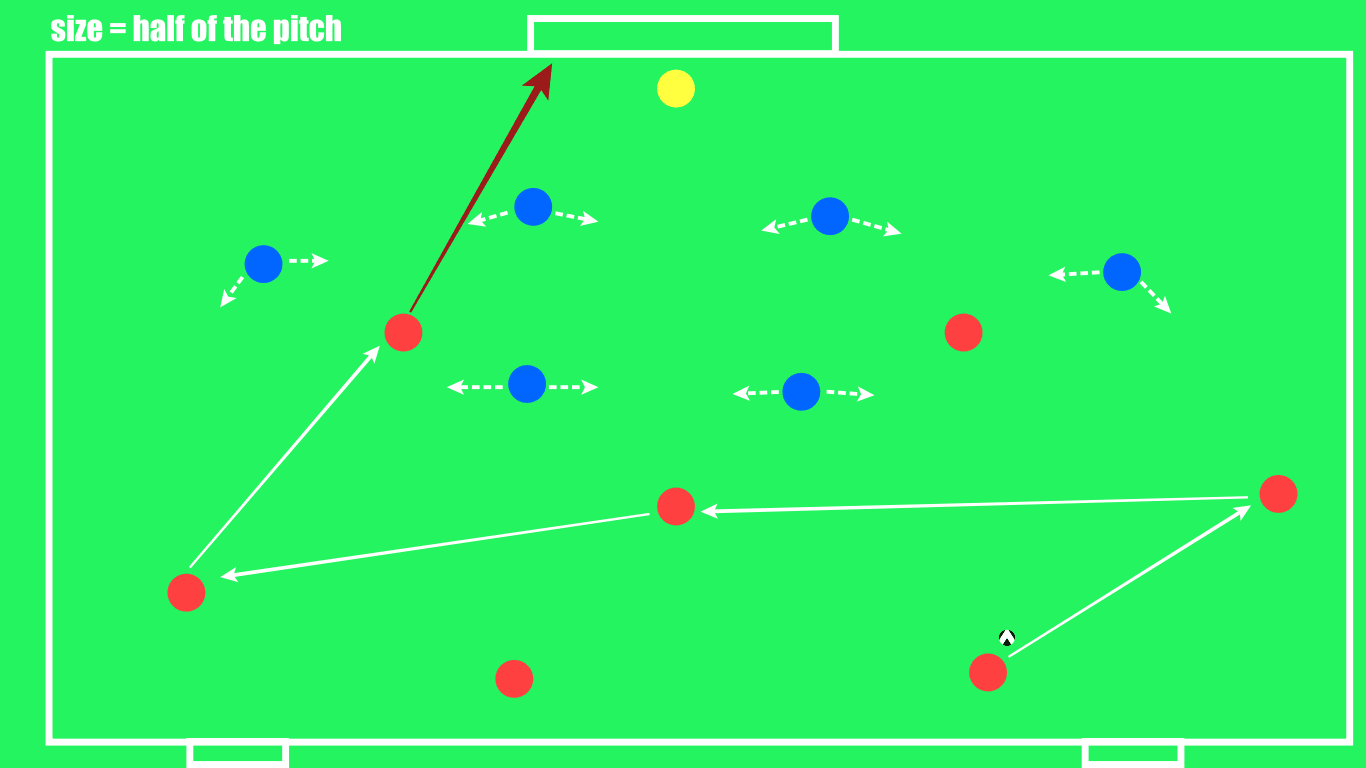
Reds are working on their control possession, whilst the Blues are encouraged to move together and to communicate, trying to keep the discipline in the block and disable opposition from coming into goal-scoring opportunities.
The attacking team can go for an attempt whenever they see fit, but with the initial intention of securing the possession and breaking line by line with their passing and scoring out of clear situations.
When the attackers lose the ball, the task the Blue side have is to get to the two small goals as quickly as possible, but with no long balls.
There lies the idea of "brave possession", where the numerically inferior team doesn’t step away from the passing game even though they have a player deficit in some area of the pitch.
That makes them think more, and think better under pressure, trying to find an optimal solution, and not just give the ball back to the opposition.