
Vincenzo Italiano Tactics At Bologna 2025/2026: Building On A Historic Foundation – Tactical Analysis
Vincenzo Italiano Bologna combine fluid build-up rotations and wide crossing patterns with aggressive man-oriented pressing. The analysis explains how their high line, pressing traps and direct distribution shape the system.

How Does Vincenzo Italiano Set Up Bologna?
Vincenzo Italiano entered his second season at Bologna FC 1909 following a historic debut campaign that delivered the Coppa Italia and ended a 51-year wait for silverware.
His appointment came after Thiago Motta had guided Bologna to UEFA Champions League qualification, with Italiano chosen for his progressive work at ACF Fiorentina, where he reached two UEFA Conference League finals and a domestic cup final.
This season has not matched those heights, though a quarter-final run in the UEFA Europa League reflects their competitiveness.
An inspiring performance against AS Roma saw them reach the Europa League quarter-finals, where they were eventually eliminated by Aston Villa.
In this tactical analysis, we examine Vincenzo Italiano tactics for the 2025/2026 season, analysing his team’s behaviour both in and out of possession, along with their underlying statistical performance.
Bologna Formation & Key Players 2025/2026
Bologna FC primarily line up in a base 4-4-2/4-2-3-1 shape, on paper.
At the back, Juan Miranda has accumulated the most minutes at left-back, offering consistency on the flank.
Despite missing a significant portion of the campaign through injury, Łukasz Skorupski has remained the first-choice goalkeeper under Italiano, underlining his importance when available.
In central defence, the preferred pairing has been Jhon Lucumí alongside Torbjørn Heggem, with Nadir Zortea occupying the right-back role.
In midfield, Remo Freuler initially formed a partnership with Nikola Moro, but the eventual return of club captain Lewis Ferguson, following a serious injury, saw Moro benched.
Out wide, Riccardo Orsolini and Jonathan Rowe have been the primary options, providing width, creativity, and goal threat.
Federico Bernardeschi, who returned to Italy after a spell in Canada, has largely played a supporting role, operating as an alternative rather than a regular starter.
Leading the line, Santiago Castro has established himself as the undisputed first-choice striker since his promotion to the senior side.
Bologna Tactics In-Possession
Bologna utilise a fluid and adaptable build-up structure designed to manipulate opposition pressure through positional rotations and controlled circulation.
The centre-backs split very wide in the first phase, stretching the opposition’s front line horizontally and increasing the distances they must cover.
This spacing allows the goalkeeper to advance and function as an auxiliary outfield player, creating a temporary numerical superiority.
Beyond offering an additional passing option, the goalkeeper also improves passing angles, which is particularly useful against teams pressing with two forwards.
A core aspect of Bologna’s approach is the rotational flexibility between the defensive and midfield lines.
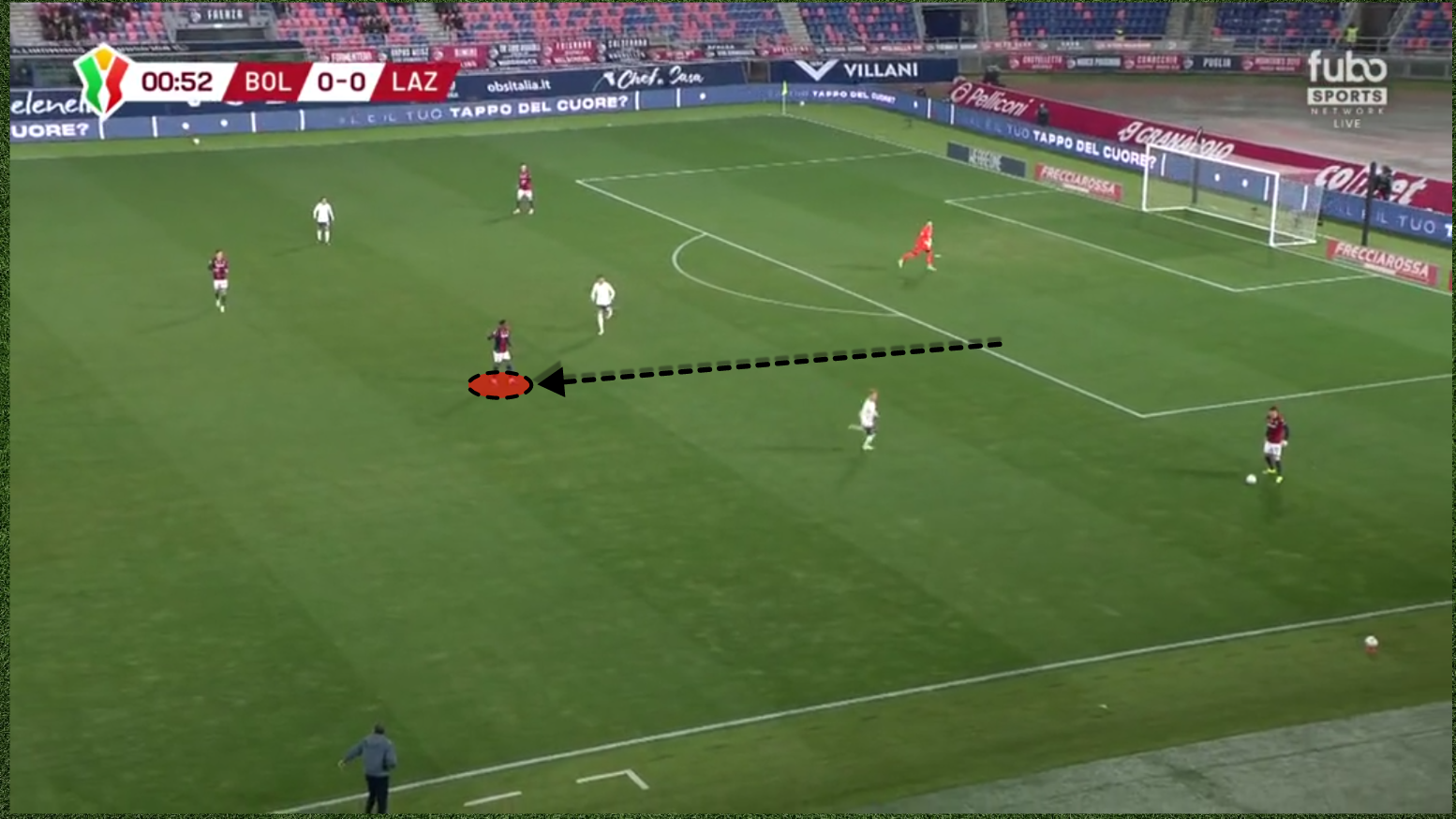
There are phases where both centre-backs step into midfield, as seen in Figure 1, while a central midfielder drops into the backline and occupies a wide centre-back position.
These rotations are highly effective against man-marking systems, as they force defenders to continuously adjust their reference points and often drag them out of their natural zones.
This disruption creates pockets of space that Bologna can exploit either through direct progression.
The main objective during build-up is to create overloads that free a player in space.
When successful, Bologna can progress through ball carries into less congested areas.
If forward options are limited, they remain patient, recycling possession while deliberately baiting the press.
This strategy encourages opponents to step out, increasing the vertical gaps between defensive and midfield lines.
Bologna’s midfielders and inverting wingers are particularly effective at identifying and occupying these spaces, receiving on the half-turn and accelerating attacks.
The full-backs play a crucial structural role by maintaining very wide positions.
Their width stretches the opposition horizontally, making it difficult to remain compact and opening central passing lanes.
It also ensures that switches of play are always available, adding another layer of complexity for the pressing side.
Against mid-blocks, Bologna incorporates more direct distribution.
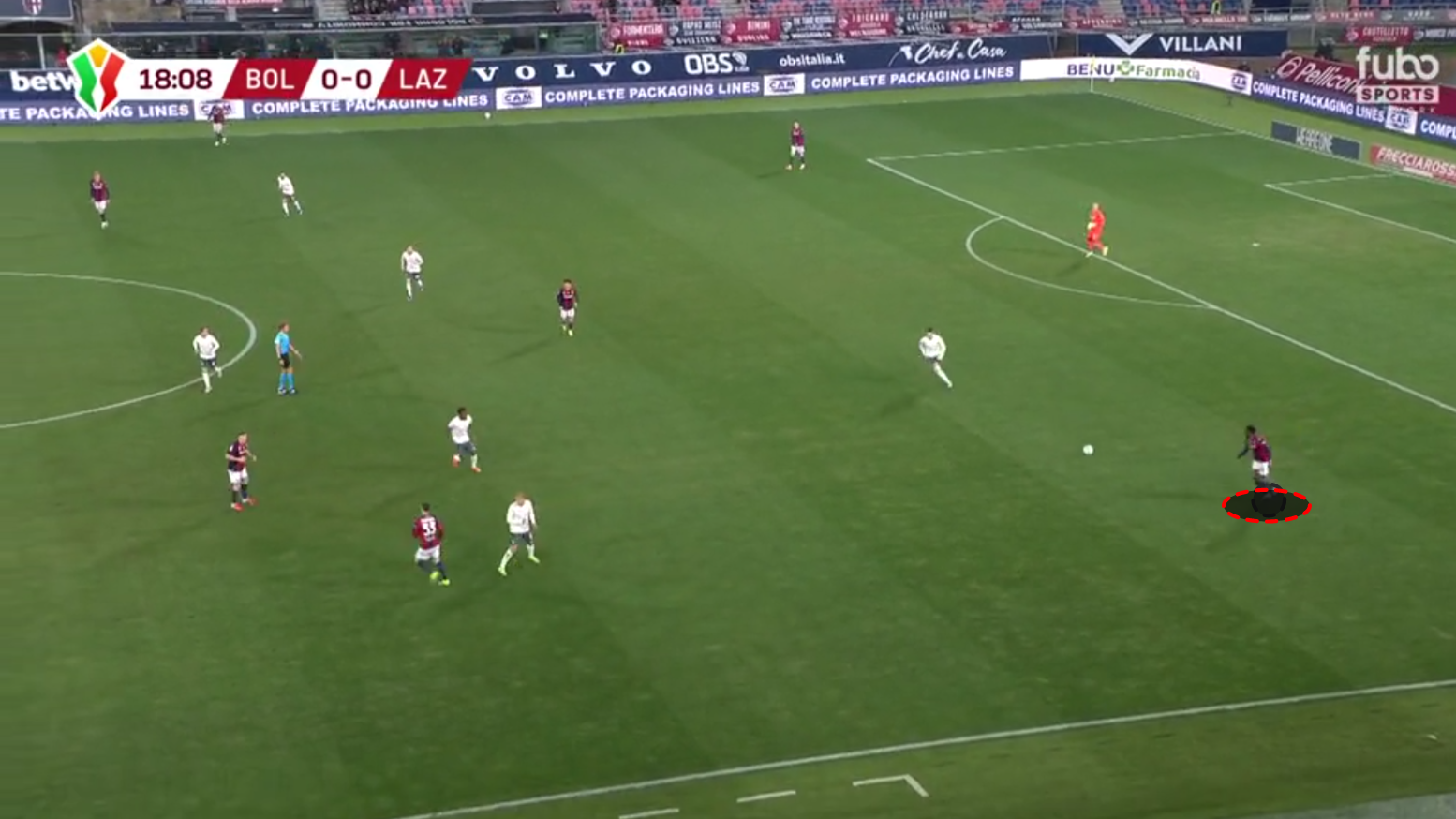
Centre-backs and the goalkeeper look to play clipped passes into advanced areas, targeting attackers positioned between defensive lines, as seen in Figure 3.
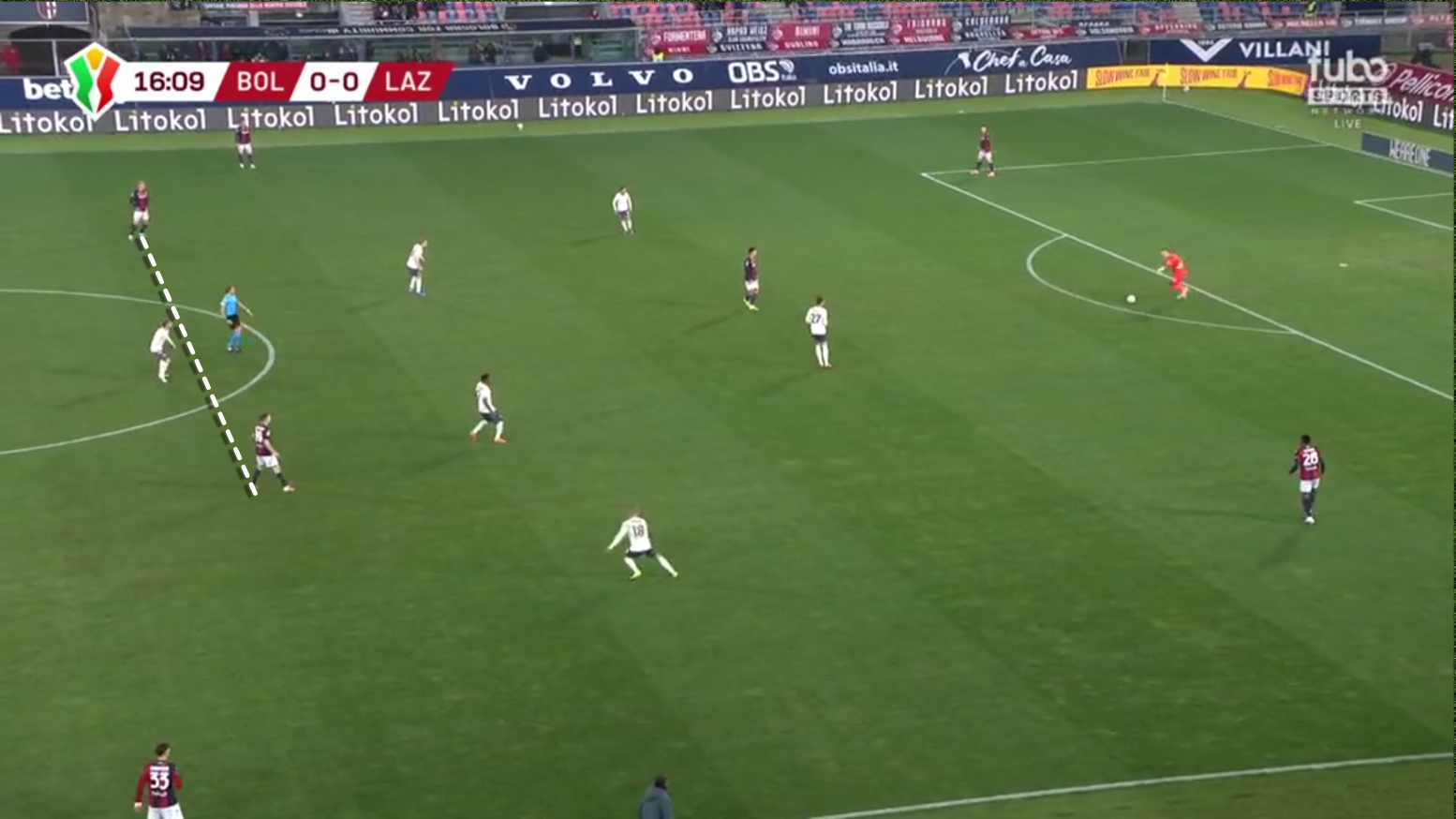
When facing a low block, Bologna shift towards sustained attacking pressure in the final third.
They commit more players forward to overload the defensive line and create numerical advantages.
The aim is to pin the opposition deep and force errors through constant movement and occupation of key zones, as seen in Figure 4.
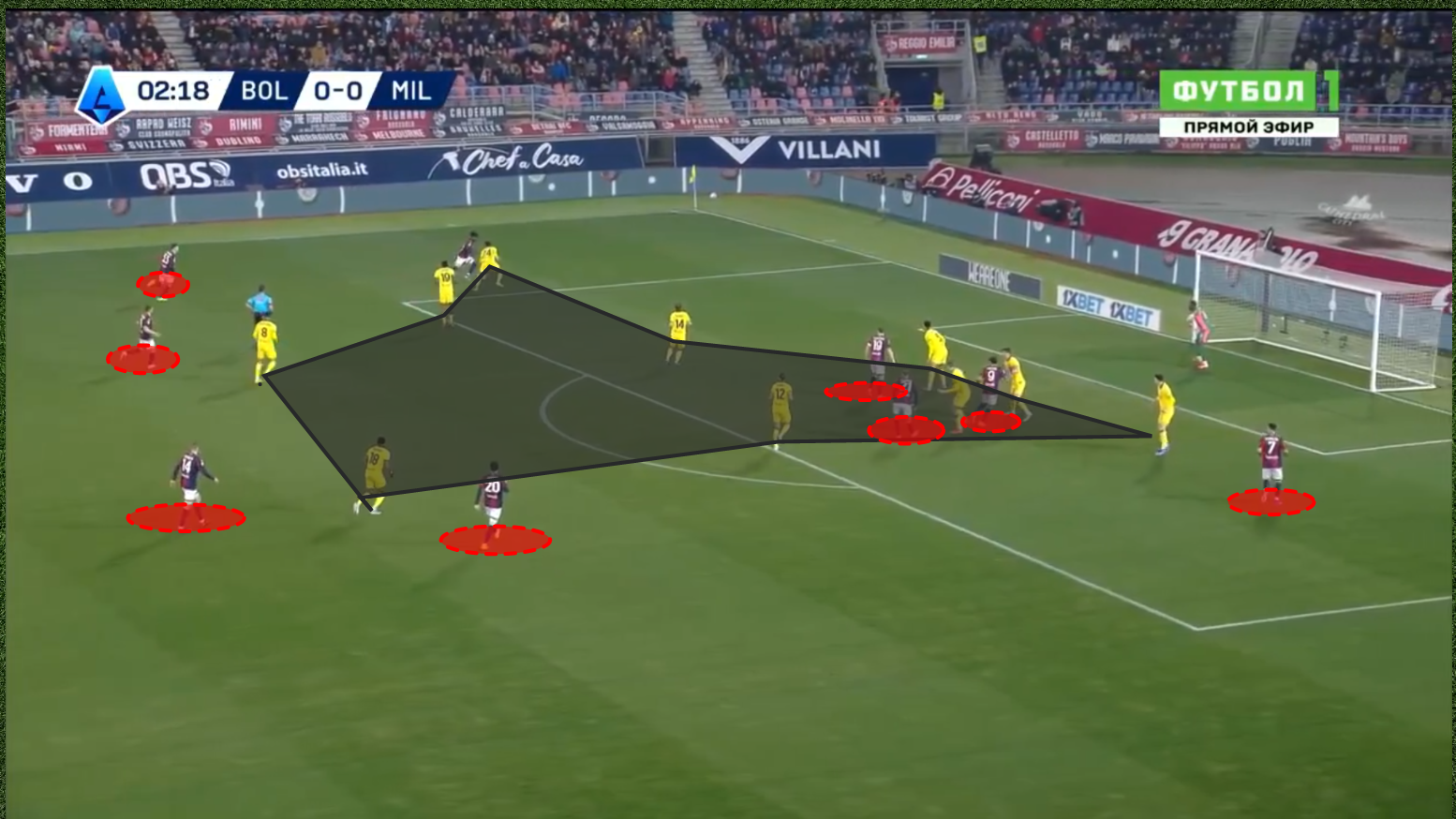
Crossing is a key chance-creation tool in Italiano’s system, often aimed at the far post to exploit blind-side runs.
This targets weaker matchups on the back side and stretches the defence, increasing the likelihood of high-quality chances.
Bologna place significant emphasis on wide combinations, particularly through interactions between the winger and the full-back to manufacture space along the flanks.
This is further reinforced through positional rotations that are designed to manipulate defensive references.
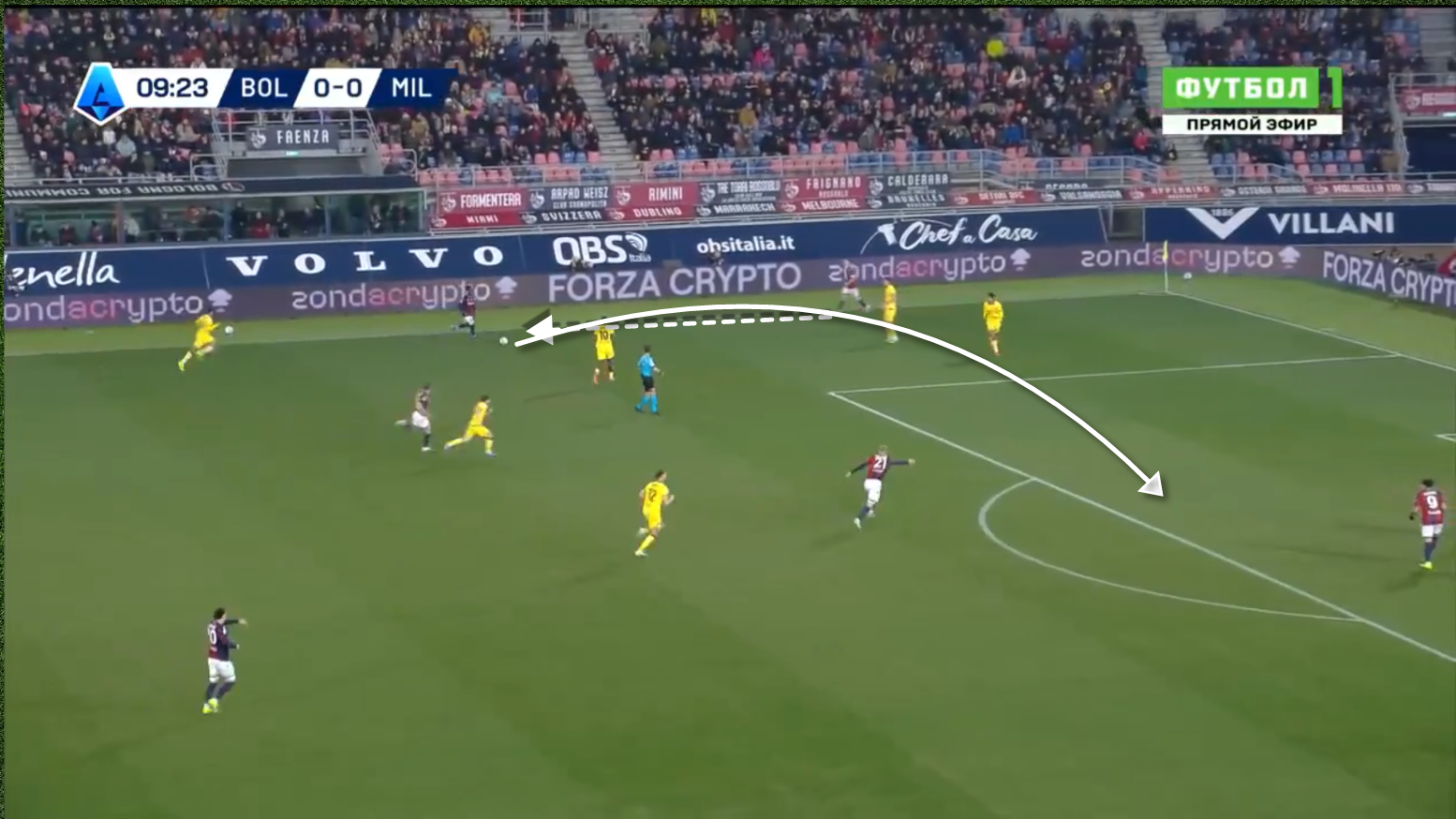
In Figure 5, Bologna use intelligent movement to open space against AC Milan, allowing Rowe to deliver a cross into the box for Jens Odgaard to attack aerially.
The sequence highlights how rotations can pull defenders out of their zones, creating momentary gaps that are quickly exploited through direct wide service.
There is also a clear vertical dynamic within these patterns.
Ferguson often stretches the pitch with forward runs, pinning the opposition back line and increasing the depth of the attack.
At the same time, Rowe can adopt a deeper, almost auxiliary full-back position on the left, providing a stable passing option during the build-up.
This role allows him to receive from deeper players, assess the defensive shape, and deliver crosses from more controlled positions.
The contrast between Ferguson’s vertical movement and Rowe’s deeper positioning creates both depth and balance, ensuring Bologna can sustain attacks while maintaining access to wide delivery zones.
Bologna Tactics Out-Of-Possession
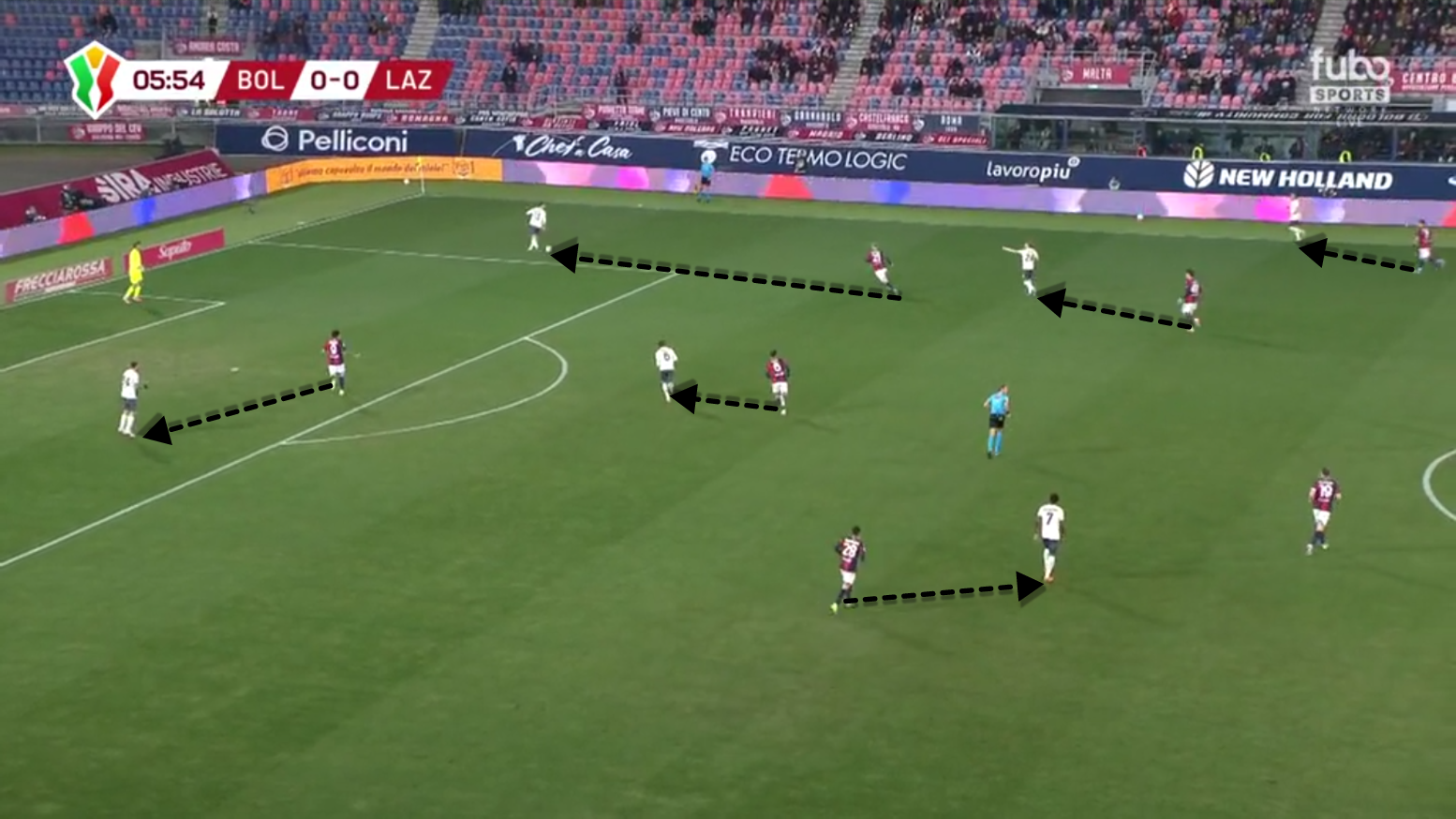
Bologna employ an intense man oriented pressing system in which each player is primarily responsible for tracking a direct opponent.
Their out-of-possession structure is not rigid; instead, it alternates between a 3-5-2 and a 4-4-2, depending on how the opposition moves and how individual marking references evolve.
The overall shape is therefore reactive rather than fixed, constantly shifting in response to the opposition's positioning and rotations.
![Olympique De Marseille Vs PSG [1-2] Ligue 1 2026/2027: How Bruno Génésio Transitions Troubled PSG - Tactical Analysis](https://cdn.mymidnight.blog/77f959f119f4fb2321e9ce801e2f5163/size/w600/2026/09/Marseille-Vs-PSG-2026_2027---Tactical-Analysis.png)
![Fulham Vs Manchester United [1-1] Premier League 2026/2027: How Álvaro Arbeloa Tactics Exposed The Red Devils' Problems - Tactical Analysis](https://cdn.mymidnight.blog/77f959f119f4fb2321e9ce801e2f5163/size/w600/2026/09/Fulham-FC-Vs-Man-United-2026_2027---Tactical-Analysis.png)
![AS Roma Vs Inter Milan [2-2] Serie A 2026/2027: When Undefeated Giallorossi Attack Met Nerazzurri Comeback Resilience - Tactical Analysis](https://cdn.mymidnight.blog/77f959f119f4fb2321e9ce801e2f5163/size/w600/2026/09/AS-Roma-Vs-Inter-Milan-2026_2027---Tactical-Analysis.png)
![Real Sociedad Vs Bournemouth [1-2] Europa League 2026/2027: How Do Marco Rose Pressing Tactics Work? - Tactical Analysis](https://cdn.mymidnight.blog/77f959f119f4fb2321e9ce801e2f5163/size/w600/2026/09/Real-Sociedad-Vs-Bournemouth-20262027---Tactical-Analysis-1.png)
![AC Milan Vs Benfica [0-2] Europa League 2026/2027: How Marco Silva Tactics Exposed Rúben Amorim Defensive Problems - Tactical Analysis](https://cdn.mymidnight.blog/77f959f119f4fb2321e9ce801e2f5163/size/w600/2026/09/AC-Milan-Vs-Benfica-20262027---Tactical-Analysis.png)