
Choosing Between A Lone Striker And A Strike Partnership - Tactical Theory

What's The Best Striker System?
The choice between a two-striker system and one with a central forward supported by two wide attackers represents one of a coach's most significant tactical decisions.
Each approach offers advantages and presents challenges, profoundly influencing offensive dynamics, defensive structure, and the team's overall balance.
Analysing the pros and cons of each solution helps us better understand the strategies coaches adopt to maximise their players' qualities and effectively respond to their opponents' characteristics.
The Historical Evolution Of Attacking Systems
A combination of tactical and regulatory factors has shaped the evolution of offensive structures in football.
Starting from the pyramidal system (2-3-5) used by Nottingham Forest in 1883, which was characterised by direct and offensive play, the game transitioned to more sophisticated formations.
The Danube School of Hugo Meisl introduced off-the-ball movements and passing networks.
The change in the offside rule in 1925-26, which reduced the number of defenders required to keep an attacker onside to two, increased the danger of offensive actions, prompting teams to develop new defensive and offensive strategies.
Herbert Chapman responded with the W-M (3-2-2-3), which ensured greater defensive solidity without sacrificing offensive effectiveness.
Later, Gusztáv Sebes adapted this structure into the M-M (3-2-3-2), promoting the use of the withdrawn centre-forward as a playmaker, foreshadowing the modern role of the attacking midfielder.
The introduction of Charles Reep’s POMO concept brought an analytical approach to the offensive phase, focusing on the areas of the pitch with the highest probability of scoring.
In the 1970s, the Dutch "Totaalvoetbal" emphasised fluidity and versatility, with a three-pronged attack constantly moving to destabilise opposing defences.
Johan Cruyff epitomised this, representing the positional freedom that characterised this philosophy.
In contrast, Arrigo Sacchi's AC Milan adopted a system with two central strikers while maintaining collective organisation principles and coordinated pressing.
These two attackers worked complementarily, with synchronised movements to create space and finish the actions.
These two schools of thought left a significant legacy, influencing the choice between two-striker systems or one with a central forward supported by two wide attackers.
In this tactical theory piece, we will analyse the pros and cons of each system, evaluating how player characteristics and tactical needs determine the most suitable offensive approach.
The Two-Striker System
The two-striker system, despite being influenced by modern football's transformations, continues to represent a significant tactical choice.
Compared to the increasing adoption of a single forward supported by wide attackers or attacking midfielders, the offensive duo offers different solutions.
It is often aimed at creating numerical superiority and exploiting combined movements to manipulate the opponent's defensive lines.
The effectiveness of this system depends on the complementarity between the strikers.
Combinations such as a physical forward and a quick, technical striker can challenge high defences.
In contrast, two mobile and dynamic strikers favour creating space through continuous off-the-ball movements and positional rotations.
Physical Striker + Mobile Second Striker
One of the most classic combinations in the two-striker system features a physical forward who specialises in holding the ball up alongside a more mobile and versatile second striker.
The first, often a central reference point, is tasked with protecting the ball, winning aerial duels, and serving teammates through lay-offs and quick passes.
The second striker, on the other hand, uses their agility to move around their partner, looking for lay-offs or attacking the space created.
When the centre-forward holds the ball up with their back to the goal and quickly lays it off, the second striker can make runs into the spaces opened up or provide an additional lay-off for midfielders.
Furthermore, the team's ability to alternate between short passes and direct attacks allows it to maintain unpredictability in its offensive play.
A recent example of this dynamic is the pairing of Romelu Lukaku and Lautaro Martínez, used by Antonio Conte at Inter Milan.
Lukaku acted as the physical reference point, and Lautaro attacked spaces with quick and incisive movements.
Lukaku, with his ability to protect the ball and win aerial duels, served as the central offensive reference, drawing in central defenders and freeing space for Lautaro.
Lautaro exploited these spaces to make runs or finish actions thanks to his agility.
Their complementarity led Inter to win the Serie A title in the 2020/2021 season, making the duo one of the most feared attacking partnerships in Serie A.

Two Mobile Strikers
A recent example of this dynamic is the pairing of Antoine Griezmann and Julián Álvarez at Atlético Madrid.
Griezmann, with his game vision and ability to move between the lines, and Álvarez, fast and incisive, created an unpredictable attack where constant rotation and movement between positions freed up crucial spaces for midfield runs.
This type of dynamic attack, without fixed reference points, forces opposing defences to adopt a deeper block to avoid being overwhelmed by the speed and unpredictability of the movements.
The lack of a static centre-forward makes it more difficult for defenders to maintain tight marking, increasing the chances of creating gaps to exploit.
This constant mobility between the two strikers allows the team to maintain a fluid attacking game, always creating new options.
Their complementary movements not only destabilise the opposing defence but also encourage the involvement of midfielders, who can make runs into spaces opened up and either finish or support the offensive play.
The team thus gains unpredictability, which is hard to counter with traditional defensive setups.
Double Centre-Forward
In the case of two more static, physical strikers, this combination is often used as an option during a match where the opposing team is well-structured and difficult to break down through build-up play.
A typical example is the pairing of Zlatan Ibrahimović and Olivier Giroud at AC Milan.
Ibrahimović, with his imposing physical presence, served as the central reference point, holding the ball and winning aerial duels.
While having a similar style of play, Giroud moved less than a more mobile striker, focusing mainly on hold-up play and supporting his partner.
In situations where the opponent sets up with a compact defence, the team can resort to this more static option, utilising the strikers' height and strength to search for goals through crosses from the flanks.
Lay-offs and headers become crucial for maintaining possession and creating chances, even in the absence of rapid movements or tight combinations between players.
In the defensive phase, the two strikers play a crucial role in high-pressing and compact defensive setups.
They become the first line of pressure in high-pressure situations, attempting to limit build-up play from the back and intercept crucial passes into the centre or the opposing playmaker.
Their coordination is key, with one striker directing pressure onto the defender with the ball and the other covering passing lanes or forcing the play out wide.
This synchronised pressing increases the chances of winning the ball back near the opponent’s goal, creating opportunities for a quick attack.
Statistics confirm that teams using two strikers in pressing recover the ball 2.4 times closer to the goal compared to those with a single striker (Opta, 2023).
The strikers maintain a compact position in a low block, ensuring that any ball recovery can be used for quick counterattacks.
Even though they need to stay deeper, their fluid movement is essential to quickly attack the depth and exploit any gaps.
Their ability to attack the defence with rapid bursts after regaining possession is key to transforming a defensive phase into an attacking opportunity, allowing the team to transition quickly to offence.
In recent years, football has transitioned from the classic two-striker setup to a system with a single central forward supported by a central attacking midfielder (CAM).
The role of the second striker, who once moved between the lines to support the central forward, has gradually been integrated into the midfield.
The CAM provides greater fluidity, acting as a link between the midfield and attack, with the ability to drop deeper to receive the ball and assist in the build-up play.
This role has made the single-forward system more dynamic, allowing for better balance and increased fluidity in offensive transitions.
The CAM has also enabled the system to be transformed into a single central forward setup, maintaining offensive solidity while ensuring the forward is not isolated.
Instead, it receives continuous support throughout various phases of the game.
A Lone Striker With Two Wide Players
The system with a central forward and two wide attackers is a tactical configuration that, despite evolving in the context of modern football, continues to remain relevant for its ability to create dynamic and unpredictable offensive solutions.
The effectiveness of this setup depends on the players' ability to execute fluid and coordinated movements.
The wingers are not just wide players; they become additional attackers tasked with creating and exploiting space for the central forward.
In this system, the central forward must be a complete player, capable of acting both as an offensive reference point and as a link between the midfield and attack.
His ability to play with his back to goal, protect the ball, make lay-offs, and create space for the wingers and midfielders is essential.
The traditional role of a striker focused solely on finishing in the penalty area is now outdated.
In this configuration, the central forward is also involved in build-up play, often dropping deeper to participate in the buildup and supporting the combined play with the midfielders.
The wingers are skilful dribblers, able to take on defenders in one-on-one situations.
These players can often create numerical superiority, bypassing their direct marker and cutting inside towards the goal.
Dribbling allows them to generate danger and open up space for the central forward, who can exploit the created space, and for the midfielders, who can make late runs into free spaces.
Their ability to beat defenders and manage the ball under pressure makes the team more unpredictable and dangerous.
A key aspect of modern wingers is the use of the inverted foot.
Playing with their stronger foot on the opposite side allows them to cut inside with the ball, seeking shooting opportunities from distance or through balls for the central forward or arriving midfielders.
This movement offers a dual advantage: On the one hand, it draws defenders towards them, freeing up space for teammates; on the other hand, it leaves room for the full-back to overlap.
The full-back's advance is often a direct consequence of these movements, as the winger cuts inside, allowing the full-back to push forward unmarked.
This enables the team to maintain the necessary width to stretch the opposition's defensive line, creating further openings in the centre.
However, in some situations, the wingers play on their natural foot, preferring linear movements toward the byline to deliver crosses.
This approach is particularly useful against low and compact defences, where the central forward's physical superiority can be maximised.
Natural-footed wingers, with the ability to cross on the run, allow the team to increase presence in the box, forcing the defence to deal with dangerous balls into the area.
The wingers' effectiveness in creating width and destabilising the opponent’s defence is directly linked to the midfielders' runs.
When the wingers manage to maintain width or attract defenders with their movements, valuable spaces open up for central runs.
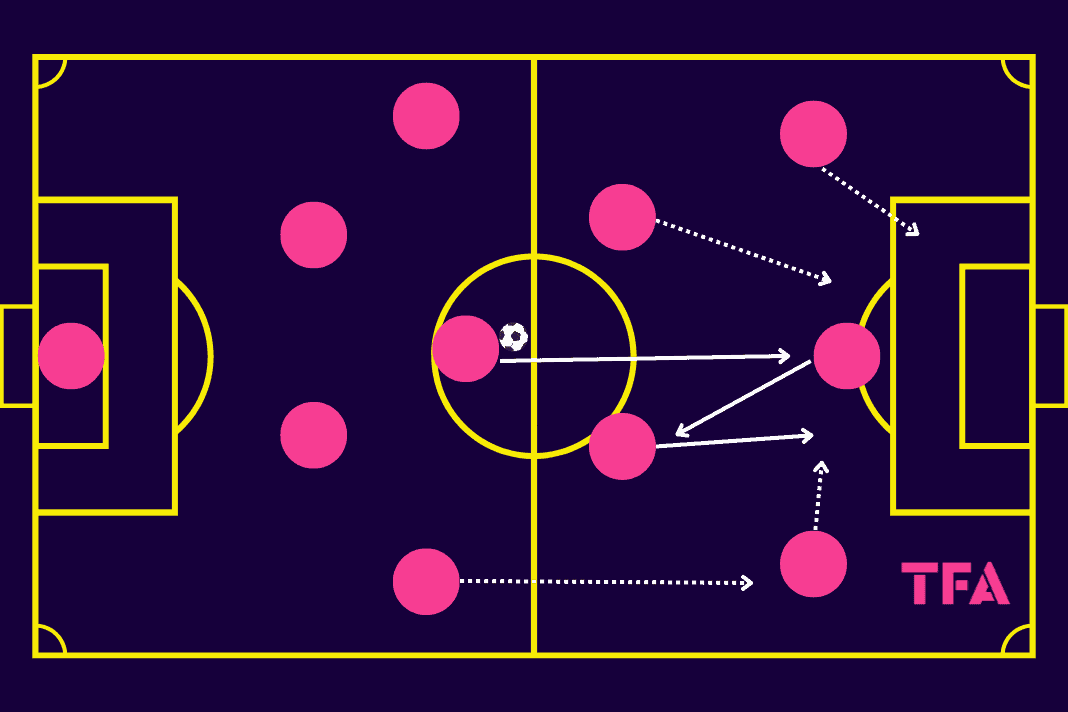
A hybrid solution is also effective when a team wants to increase its offensive presence without sacrificing defensive balance.
A striking example is Mario Mandžukić at Juventus under Massimiliano Allegri during the 2016/2017 season.
Defensively, Mandžukić played as a left winger, contributing to the coverage and ensuring numerical superiority in defensive situations.
However, his positioning changed radically in attack: Mandžukić would push forward to partner with Gonzalo Higuaín in the penalty area, effectively forming a two-man attack.
This movement allowed Juventus to have a greater aerial presence and increased their chances of scoring from crosses coming from the opposite flank.
As the system with a single forward and two wide attackers evolves, the false nine figure can emerge.
Instead of acting as a traditional central reference point, the false nine drops deeper to receive the ball between the lines, creating numerical superiority in midfield and destabilising the opponent's defensive structure.
This movement opens up valuable spaces for the wingers, who can cut inside or attack the depth, and for the midfielders, who have more opportunities to make runs into the box.
A prime example is Lionel Messi at Barcelona under Pep Guardiola, whose false nine role highlighted the team's offensive dynamism.
Similarly, Roberto Firmino at Liverpool under Jürgen Klopp played this position with great tactical intelligence, facilitating Mohamed Salah's and Sadio Mané's runs and contributing to the system's attacking fluidity.
In defence, the system with a single central forward and two wingers requires precise organisation and coordinated movements to ensure compactness and cover spaces.
The central forward often assumes the role of the first defender, applying direct pressure on the opposition’s centre-backs or playmaker to slow down the build-up.
However, being the only offensive reference, his pressure must be intelligent, directing the opponent’s play towards the flanks or less dangerous areas.
The wingers play a crucial role in the defensive phase, contributing to both high pressing and lateral coverage.
When the team chooses to press forward, the wingers must close passing lanes into the centre and direct the opponent’s play towards the flanks, where collective pressure becomes more effective.
Their ability to recover the ball and their speed in tracking back is key to preventing quick counterattacks from the opposition.
In a low or medium-block defence, the wingers drop back to form a five- or four-man line, depending on the situation.
This defensive setup provides greater coverage on the flanks, protecting the full-backs and limiting the opponent's crossing or attacking runs.
Additionally, the wingers must be ready to quickly transform a defensive situation into an offensive transition, utilizing their speed to counterattack.
Teams that use this defensive system often show higher effectiveness in quick transitions, with an average of 32% of ball recoveries turning into offensive opportunities within 10 seconds (source: Opta, 2023).
Advantages & Disadvantages
The comparison between the two-striker system and the single central forward supported by two wingers highlights distinct advantages and disadvantages, determining the choice based on the team's characteristics and tactical objectives.
The two-striker system provides greater offensive presence, with two players working together to create space and finish actions.