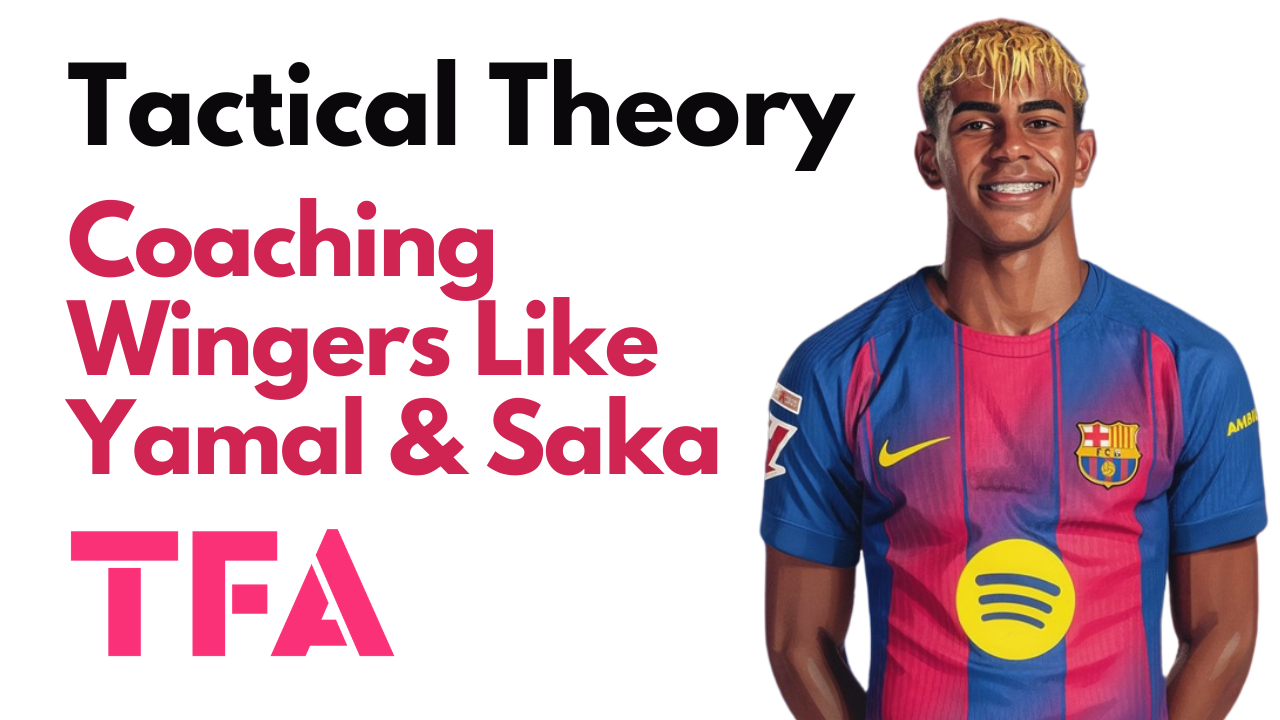
How To Coach Attacking Wingers Like Lamine Yamal & Bukayo Saka - Tactical Theory

As we have seen with many of Europe's top teams this season, attacking wingers can often be the difference-makers in close matches.
With many teams defending deep, inside their own defensive third, and crowding out the central areas, having a player who can go by a full-back and take defenders out of the game is almost an essential weapon.
This tactical analysis will provide examples of how coaches can develop their wingers' attacking attributes on the training ground.
This includes developing their individual skills and techniques, as well as involving their wide playmakers in combination play.
The football training exercises are designed to develop the key individual skills required of top-level attacking wingers, as previously analysed in this tactical theory on wingers.
The movements and traits of high-level players, such as Barcelona’s Lamine Yamal, Leicester City’s Jeremy Monga, and Belgian international Malick Fofana, were analysed.
This football analysis examines the individual characteristics of Arsenal's Bukayo Saka and Aston Villa’s Leon Bailey, as well as how Celtic’s Brendan Rodgers utilises his wingers to combine centrally.
Coaching Saka Stop-Starts
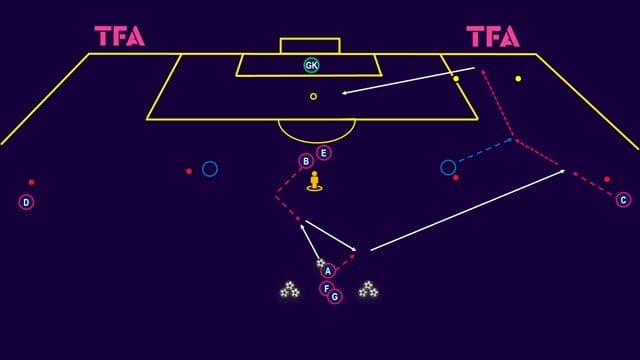
The above practice is designed to work on wingers' one-on-one abilities against a recovering defender arriving from a central area.
Specifically, the technique involved in controlling a drilled pass and being able to ‘freeze’ an opponent before dribbling beyond them and delivering a cross into the box.
The exercise can be developed to target additional skills that improve wingers' attacking capabilities.
This training exercise setup can be used as a stand-alone drill to work on this specific component, or, as will be shown here, incorporated into a single exercise to encompass multiple facets of wing play.
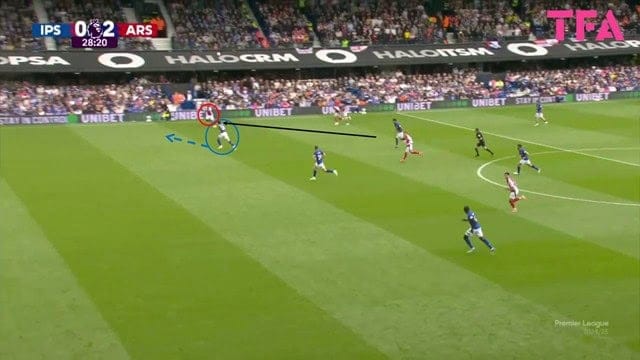
The drill is based on the phase of play above, where Arsenal’s Saka receives the ball in the wide area, beyond Ipswich Town’s full-back, with the opposition centre-back closing him down.
As Saka takes an aggressive, forward touch, the centre-back sprints back diagonally to position himself between the attacker and the goal.
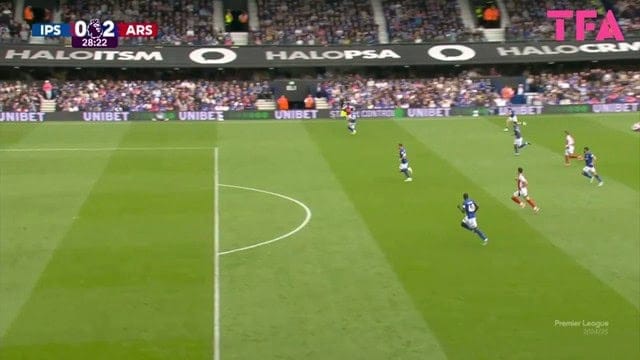
As the centre-back gets close enough to engage with the England international, Saka stops, freezing his direct opponent.
This halts the defender's momentum.
From a standing start, Saka knows he is faster than most defenders by over five to 10 yards.
He then knocks the ball past the standing centre-back and sprints towards the goal line with the ball.
This is similar to the La Pausa technique performed by Yamal, described in a previous analysis, and allows fast-wingers to exploit their pace.
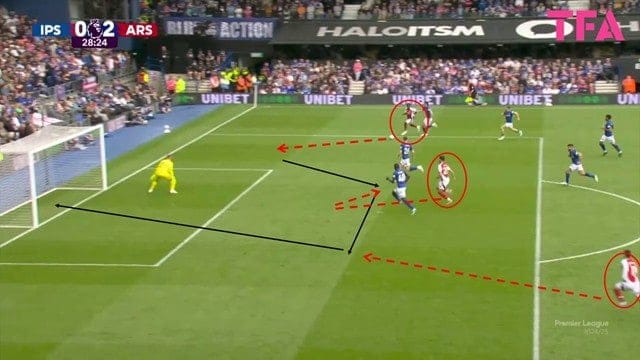
Now beyond his man, Saka can deliver a cutback to his supporting attackers.
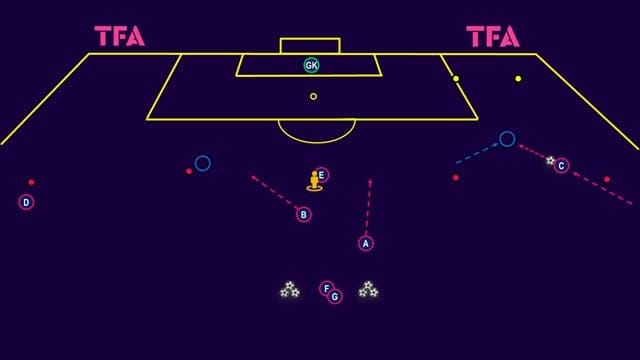
The first phase of the drill sees player ‘A’, representing a central midfielder, playing a bounce pass with their striker ‘B’ before spraying the ball out wide to winger ‘C’.
Coaches should encourage the winger to take an aggressive inside of the pitch touch and drive towards the near post.
Defenders should be coached to press correctly, positioning themselves between the ball and the goal and not charging directly at the ball.
When the defender gets close enough to be able to affect the play, the attacking player should put their foot on the ball to bring the defender to a full stop.
As the ball travels towards the wide area, the striker should make an initial movement away from the ball, keeping them on the blind side of the hypothetical defenders.
The midfielder should make a supporting movement towards the edge of the box.
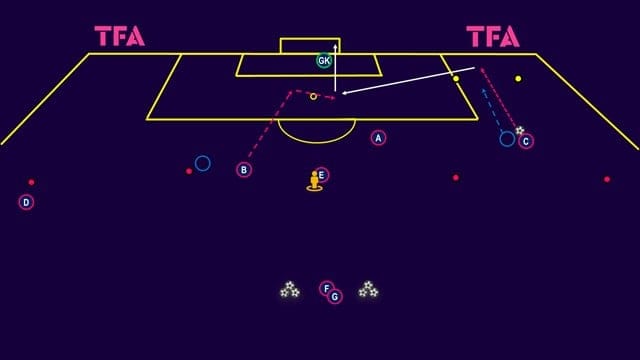
The winger should then take a big touch to burn past the stalled defender to beat him to the yellow ‘gate’, placed six yards from the goal line, before delivering a cross.
Like Saka against Ipswich, the aim is to get to the cut-back zone, having created enough separation to deliver the cross.
This final phase of the first repetition allows the supporting players to make similar movements to Saka’s teammates, attacking the cutback, having pushed the defenders back towards their own goal before cutting to meet the ball.
The drill can then be repeated on the opposite side using players ‘F’, ‘E’ and ‘D’.
How to Cut Inside Like Yamal
This same setup and rotations can be used to work on wingers cutting inside and shooting from the edge of the box.
Adding this element and being able to go on either side of the defender brings unpredictability to their game, making them far harder to defend against.
In this adaptation of the drill, the winger must reach the yellow box before deciding whether to cut inside and shoot from the red zone or to continue with their run and deliver a cross.
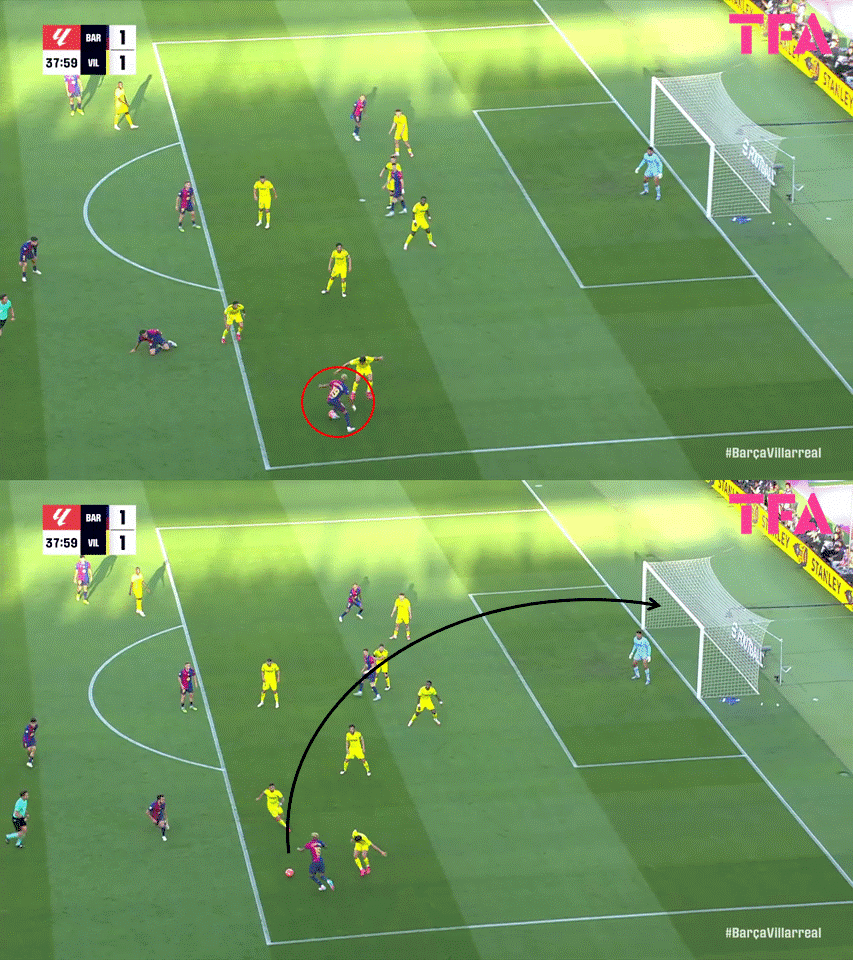
When cutting inside, just like Yamal here in the Blaugrana's La Liga defeat to Villarreal, the winger should be encouraged to drop their outside shoulder before taking a big, diagonally backwards touch with the outside of their opposite foot.
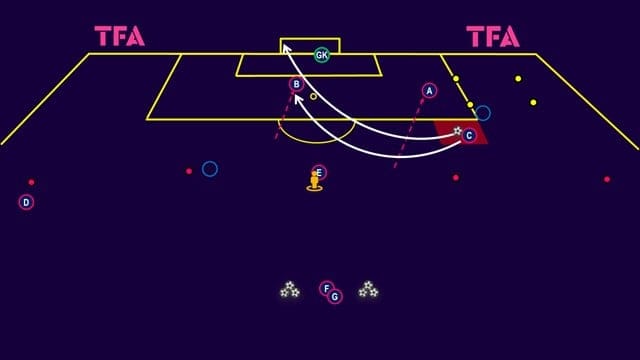
When the winger elects to cut inside to shoot, the midfielder positioned on that side of the box (‘A’) should make a decoy corner run to clear the space.
The striker, ‘B’, should remain on the far side of the goal, poised to react to any rebounds on that side of the goal.
This positioning of the striker also provides the opportunity for a half-space cross to be delivered into the box.
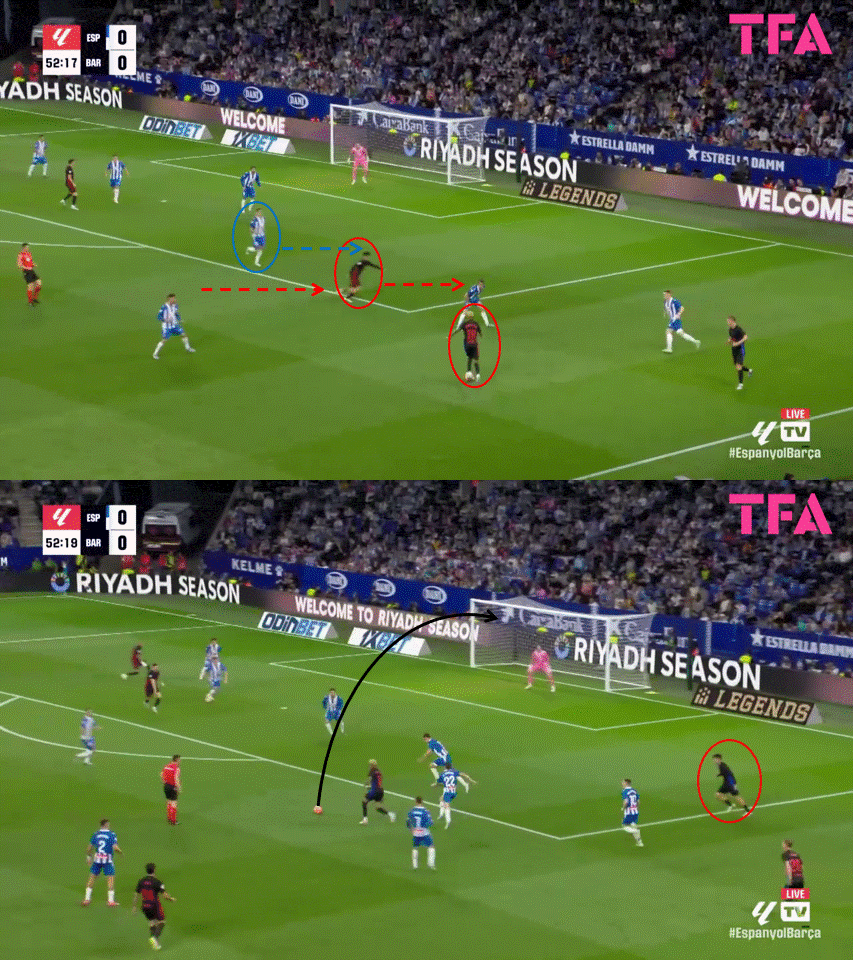
This decoy run, shown here against their Catalan rivals Espanyol, is regularly performed by Hansi Flick's men to give Yamal the extra yard or so to get his shot away.
How Can Wingers Overcome Defenders Doubling Up?
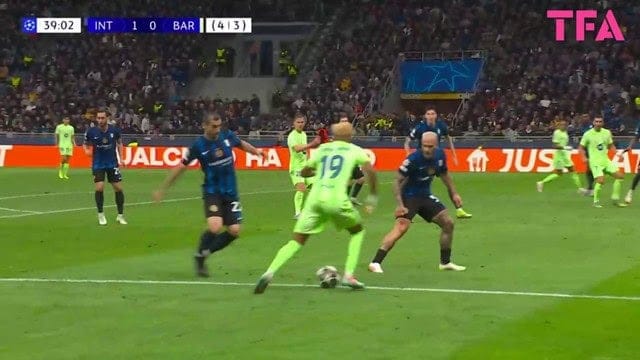
A final adaptation or progression in this phase of the drill is the addition of a second defender.
A standard practice for sides playing against top attacking wingers is using a midfielder to double up with the full-back as the winger receives the ball.
Inter Milan, who played against Barcelona in the UEFA Champions League semi-final last season, engaged Yamal first with their wing-back, Federico Dimarco, before being supported by midfielder Henrikh Mkhitaryan, who arrived from a central position.
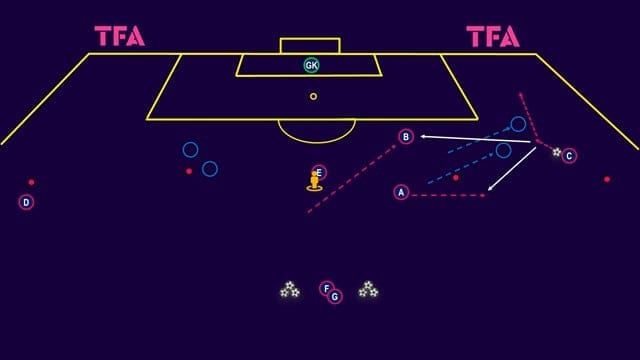
The exercise begins the same way: the central midfielder and striker combine, and the ball is played wide ahead of the winger.
Positioned five yards apart, the two defending players in blue should close down the winger as Wolves have in the image below.
Players ‘A’ and ‘B’ should then make supporting movements towards the ball to create a two-on-three.
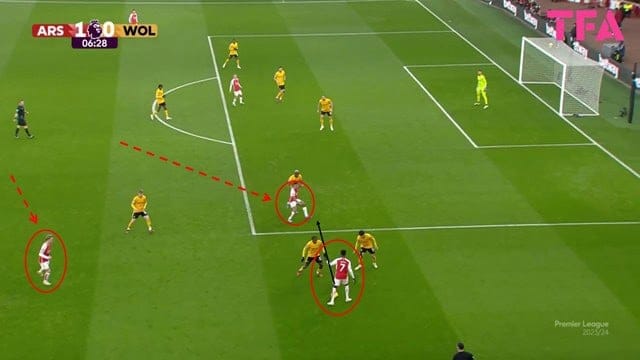
These movements should create a similar triangle to the one formed by Mikel Arteta's side when Saka receives on the side of the box.
Here, Saka passes between the two defenders after a clever drop of the shoulder, but the triangle positioning provides many alternatives in this situation.
This progression of the drill can also be used for the defensive aspect, where players work on defending in pairs.
Important components to consider when working defensively are the two players doubling up quickly to avoid a one-on-one and then shaping themselves to dictate where the attacking player goes next.
Coaching An Outside To Inside Run
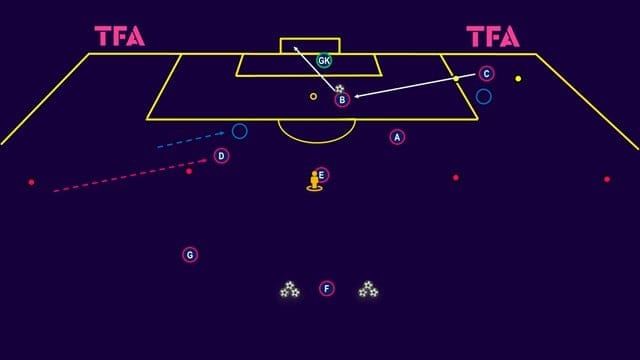
After completing the drill down one side of the pitch, another phase can be added on the opposite side.
This progression of the same drill introduces movements that drag full-backs out into wider areas before making runs to receive inside the pitch.
In the first phase, player ‘D’, representing a left-winger, joins the attack and is positioned on the far side of the box while being tracked by the defending player, who represents a full-back.
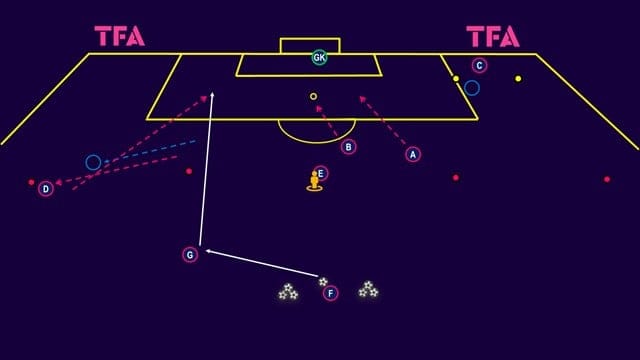
As soon as the first play finishes, the next ball is put in play, travelling to ‘G’, a central midfielder or inverted left-back.
The left winger should engage with their marker by running across them before sprinting to the wide area and calling for the ball.
This movement is designed to attract the full-back out wide, creating a gap between them and their centre-back.
The winger should then run across the full-back, blocking their path to intercept the ball, before receiving in behind.
Adding a bounce pass between ‘G’ and ‘D’ may be preferable to draw the full-back even closer to the winger before the through ball is played.
Players ‘A’ and ‘B’, who were both involved in the first phase of the attack, should attack the box for a cut-back.
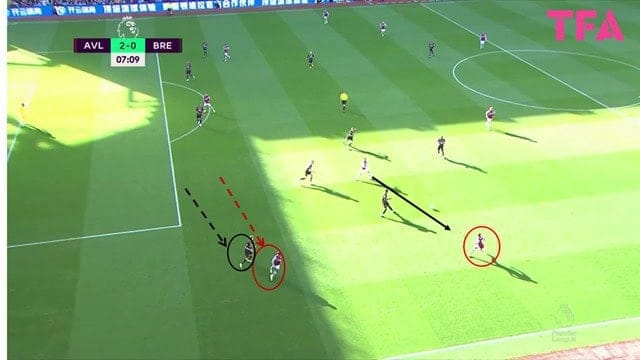
This phase is designed to mimic the movements of Aston Villa’s Winger Leon Bailey, who, as seen here, drew Brentford's widest defender to the wide area as the ball was being switched.
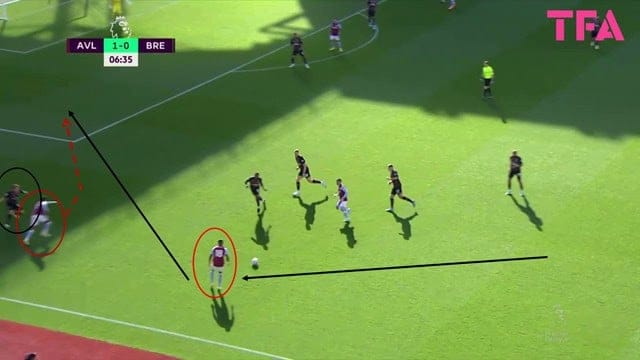
Bailey then sharply changed the direction of his run, cutting back and running across the defender.
Leon ensured he would get to the ball first by running in front of, not behind, the defender.
The Villans winger then ran onto the ball before providing a cutback that resulted in his side's second goal of the game.
How To Involve Wingers In Combination Play
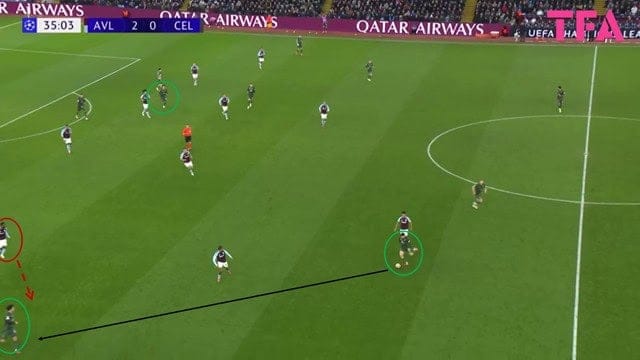
The following drill is designed to work on wingers' combination play, specifically, their ability to move inside to combine with their central forward or central midfielder.
The drill is based on the image above from Celtic’s Champions League match against Aston Villa earlier this season, which led to the Hoops’ opening goal.
This attacking phase began with a switch of play to Celtics left-back, Greg Taylor (circled), who was in an inverted position.
This positioning by Taylor helped isolate Celtics’ winger, Yang Hyun-jun, in a one-on-one situation with Villa’s right-back.
Circled at the top of the image is midfielder Reo Hatate.
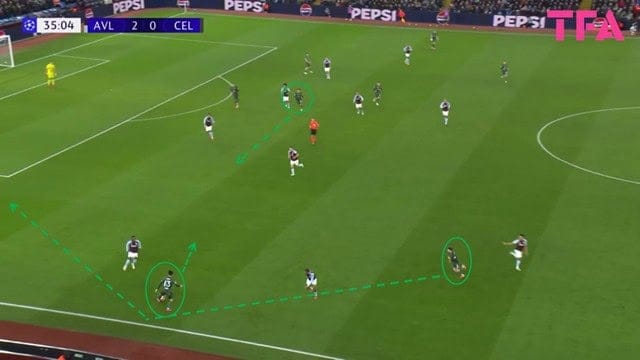
Yang’s first touch inside the pitch acts as a trigger for Taylor to overlap.
It also triggers midfielder Hatate to burst from the opposite side of the pitch into the pocket of space between Villa's defence and midfield.