How To Coach Wide-Area Defending: Preventing Overloads, Protecting The Channels And Defending Crosses - Tactical Theory
This Tactical Theory session uses three progressive practices to improve wide-area defending, helping full-backs and wingers prevent overloads, delay attacks, protect space, support midfield cover and defend crosses more effectively.

This tactical analysis presents a set of practices designed to enhance a team's ability to defend effectively in wide areas.
This session will initially focus on how we should approach defending the width of the pitch using our full-backs and wingers working in tandem.
It will provide plenty of opportunities for them to develop their understanding of working as a pair and understanding the key principles of defending on the wings.
We want them to move across at speed and delay the opponent, and prevent them from being able to access the space behind them in the wide channel.
We will then progress this to allow them to see this in the context of a developed defensive phase.
However, the focus will still be on gaining repetitions in a relatively restricted practice, not quite moving into a phase of play.
Can the central midfielder closest to them drop into the backline if necessary to protect the space between the full-back and centre-back and prevent any through passes into this area, and track a run of any attacking midfielders into this space?
Equally, we will focus on ensuring that the backline drops back and adequately protects different spaces in front of their own goal.
However, the final practice will then move this on so the entire team can see how to apply these exercises to a game situation, where the attacking team will have the freedom to attack as they please and make their own decisions.
The defence will then look to adjust their shape and make their own decisions to deal with this.
Defending In Wide Areas Exercise 1
To introduce the topic, we can put our players into 2v2s.
Up to 8 pairs can be present per channel, with one pair attacking and the next set of pairs ready to attack from the opposite end as soon as the previous repetition finishes.
It isn’t overly important how this one is organised, but it does need to represent a full-back and a winger attacking against a winger and a full-back, and the players need to be aware of this context.
A simple channel can be used, like the one below.
If you are coaching by yourself, it makes sense to have the channels near each other so you can easily coach both groups.
However, if you have a coaching team, placing both channels on either side of the pitch would be pertinent, giving the players the appropriate context of the situation through pitch geography.
There should be small end zones at either end, and the coach should vary how they play the pass in, either to the full-back or winger, and move around to provide different pass angles.
We can see this shown below.
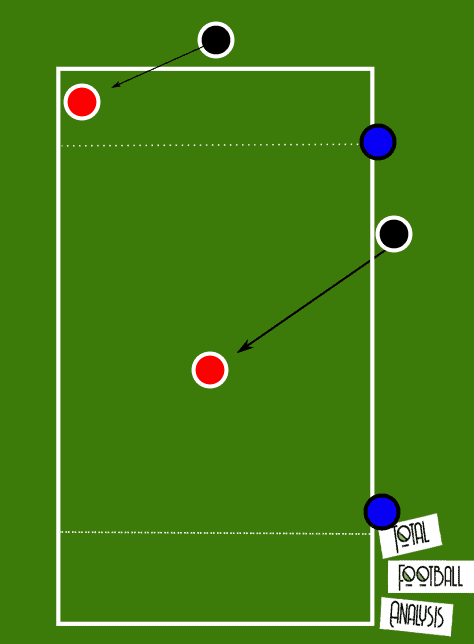
The two defenders should start outside the grid, goal-side if using both wings, replicating a winger and full-back starting in a narrow, compact position before shifting into these wider areas to defend.
The attacking team aims to combine to advance possession into the end zone, preferably.
This can be done with either a pass or a dribble.
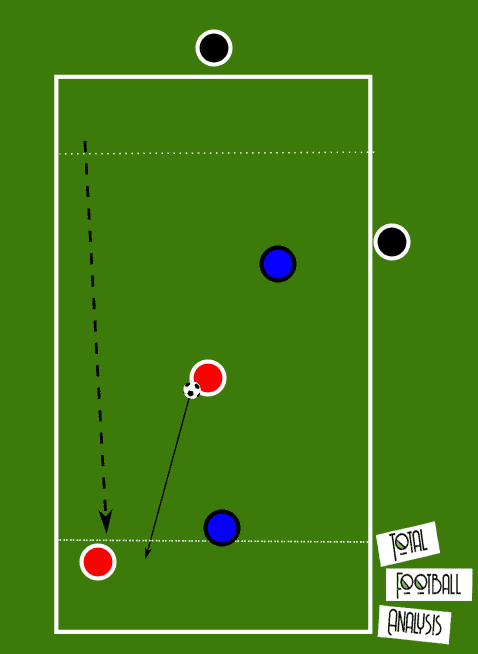
However, of course, we want our two defenders to prevent this from occurring.
The defenders should be given time to find solutions, but it’s important that the player representing the full-back, aka the deepest defender of the two, isn’t drawn into a 2v1.
The example in the image below presents an easy situation for the attacking team.
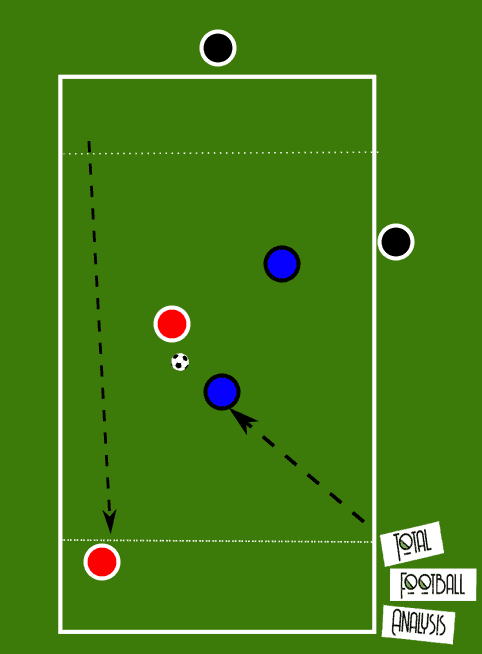
One of the first coaching points we must address is the defensive winger's impact on the attack.
If they react quickly, getting across and ensuring they get the goal-side of the ball carrier, or at the very least goal-side of the opposition full-back if they are unable to cover the opposition winger, then they can prevent the 2v1.
However, they will also delay the attack, slowing the opposition duo down, and providing a greater chance for the defensive pair to win the ball, or at the very least, in a game situation, allow their teammates time to adjust their defensive shape in the central channel.
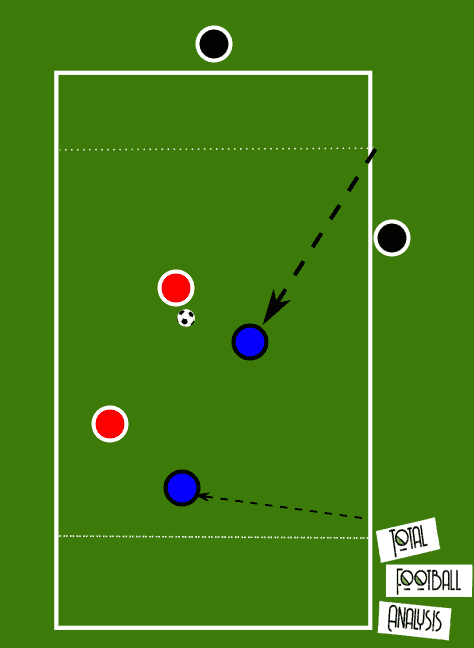
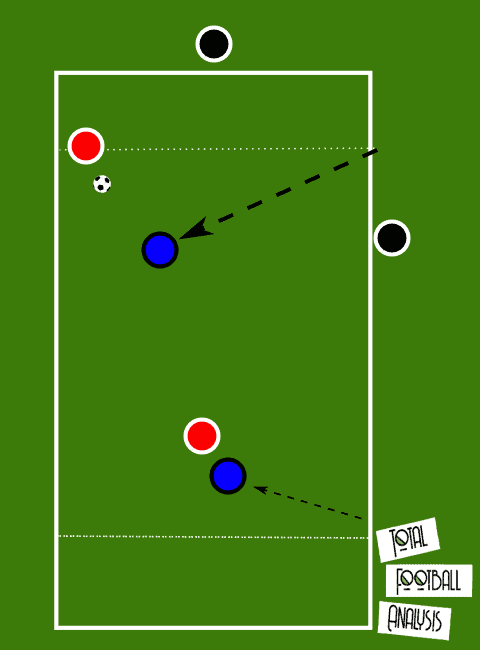
The image above demonstrates a run the winger can make to delay the opponent, whilst the picture below shows them pressing the full-back once they have possession.
Here, not only is it in their best interest to press this player quickly and delay the attack, but if the defensive pair can communicate effectively, the full-back can instruct his winger to position themselves where they can block a forward passing line.
Defending In Wide Areas Exercise 2
If we are using the full width of the pitch already, we can move on to the next practice without laying down any more cones or picking any up.
We want to put this into more of a game context where, should the attacking team break into the end zone, they can now put a cross in.
I have used one forward in the example shown, but working with two is not an issue.
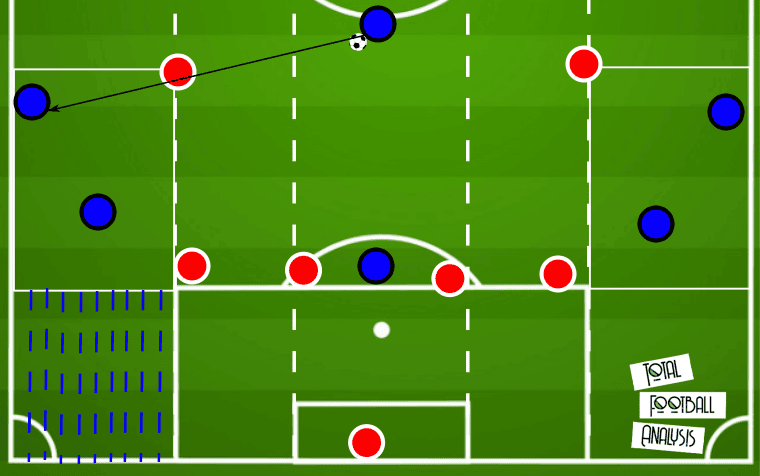
If the attacking duo can break into the end zone, highlighted in blue, can they then create a crossing opportunity?
We can see the red team’s defence reacting to this development in the image shown below.
Note how they all move closer to the ball.
We want them to cover the front and back posts and the central area of the goal, too.
This means the far-side full-back needs to show a quick reaction to move back, but also attempt to get inside the back post.
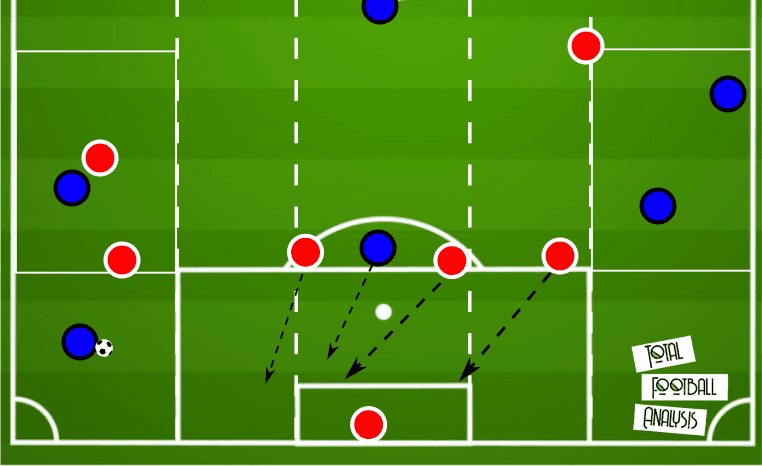
When one attack occurs from one wing and the defence is back in its starting position, the ball can be played to the other wing, and the practice can be replicated from the other side.
A progression to this practice is to introduce two central midfielders for either side.
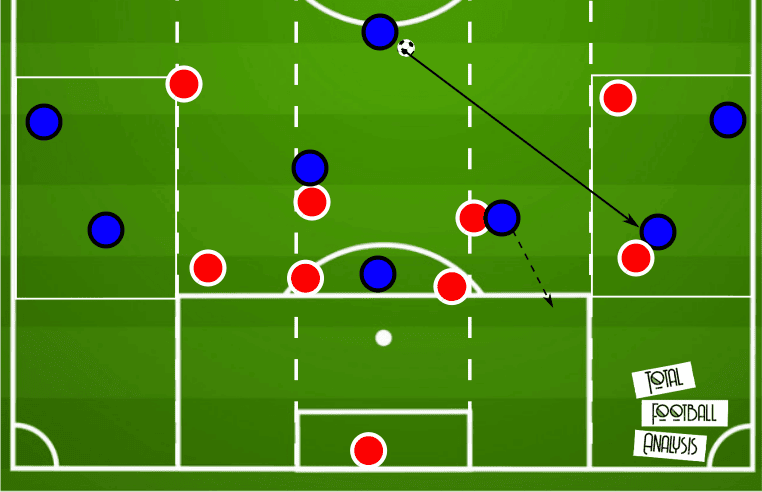
Can the ball-side attacking central-midfielder look to hit the space between the ball-side full-back and centre-back, created by the full-back going wide to press the opposition winger?
Without prompting, we want to see the defensive team’s central midfielder dealing with this run by shifting into this space along with the attacking midfielder to cover any through pass played in behind.
Defending In Wide Areas Exercise 3
We can now move onto an 8v8 phase of play with two mini goals for the defensive team to seek to access with a pass once possession is turned over.
The defensive team will continue to be asked to defend within three channels; preferably, the wingers and full-backs shouldn’t move into either wide channel until the ball has been moved into this area of the pitch.
Should they get stretched over more than three channels, and the attacking team gain success in playing centrally, we need to address why this is an issue.
By forcing the opponent out wide, we force them away from the goal, making it more difficult for them to forge an attacking opportunity if we defend correctly.
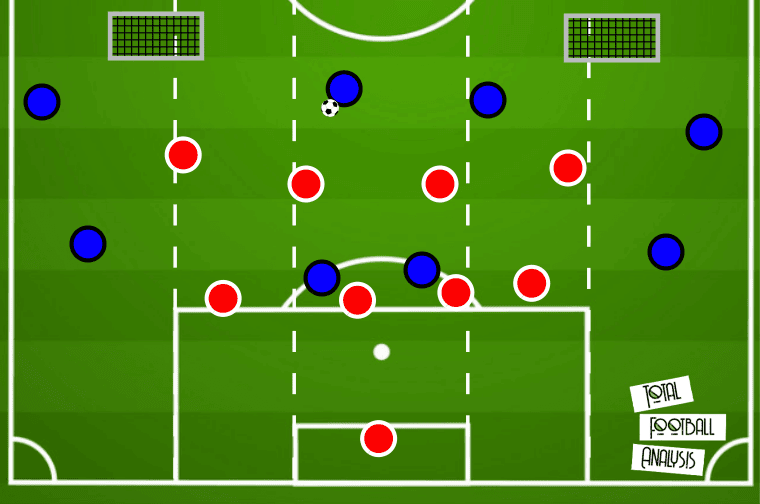
As the ball is played wide, we will continue to look for our midfielders to protect the space between the full-back and centre-backs, particularly if the opposition tries to thread through passes into this area of the pitch.
As the ball is played wide, can the winger get across and delay the attack, supporting their full-back as much as possible?
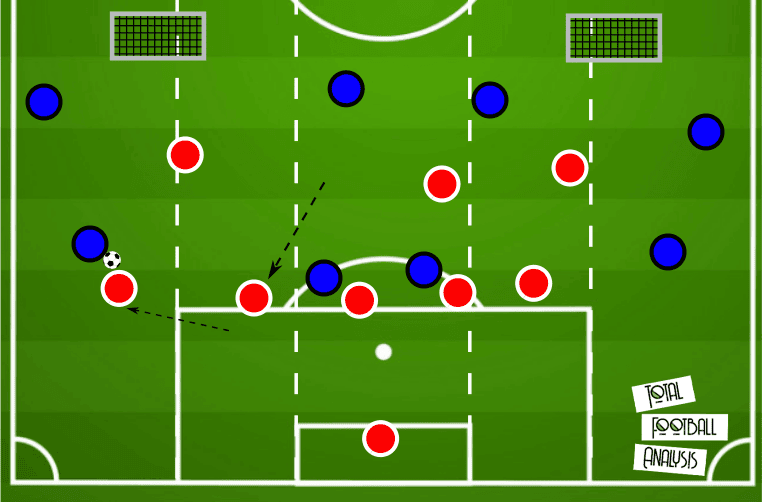
Finally, as the ball is out wide, can the far-side full-back tuck inside, getting as close as possible to the back post while keeping an open body orientation, as shown in the image below?
The far-side attacking winger should be encouraged to be aggressive in attacking the back post, forcing the full-back to take a good defensive position where they can easily see the ball and the winger's run on their blind side.