How To Coach Patterns Of Play In 4-3-3 Formation - Tactical Theory

What Are Patterns Of Play?
Perhaps you were watching a Premier League or UEFA Champions League match this past season and heard the commentator say, "What an excellent training ground move from…"
Or perhaps you were reading our tactical analysis, and the writer emphasised a particular passing and movement sequence by the team in possession with images.
These moments, provided they are executed in open play, are what we refer to as 'patterns of play'.
Patterns of play are a tactical strategy involving predetermined passes and movement in attack to penetrate the opponent's defence and either score or create a scoring opportunity.
Below, we look at six patterns of play you can learn and use in the 4-3-3 formation.
Three are for central penetration, while the other three are for wide penetration.
If you coach the 4-3-3 system or participate in any high-level coaching, such as the UEFA A or UEFA B licence, where patterns of play are a requirement, you may find the information below useful.
First, we look at the patterns, but more importantly, we show you how to succeed on the training ground through field mapping and the discovery of 'what if's.
Why Train Patterns Of Play?
The beautiful game is not short of clichés; whether it's the emphasis of the half-yard in a foot race or champagne football, sometimes these expressions highlight the margins in the game that separate the teams.
When two sides cannot be separated, and a deadlock does not seem likely to be broken through open play, it is often the execution of a training-ground move at high speed that gives one team the advantage.
If you are a coach, also consider the confidence of both individuals and teams.
When the attacking team plays only in reaction to one another, it means they are trying to discover moments and gaps by pure chance to succeed.
At the same time, the opponent can anticipate and defend.
The likely outcome is a high number of technical and tactical errors, which subsequently lead to more turnovers and potentially lower a player's confidence.
On the other hand, when you have a team that knows the system and can execute plays with minimal touches at high speed, the opponent cannot always react, which in turn increases the chance of success.
It seems that if you want to show a good example of any aspect of the game today, Pep Guardiola Manchester City will provide one in droves.
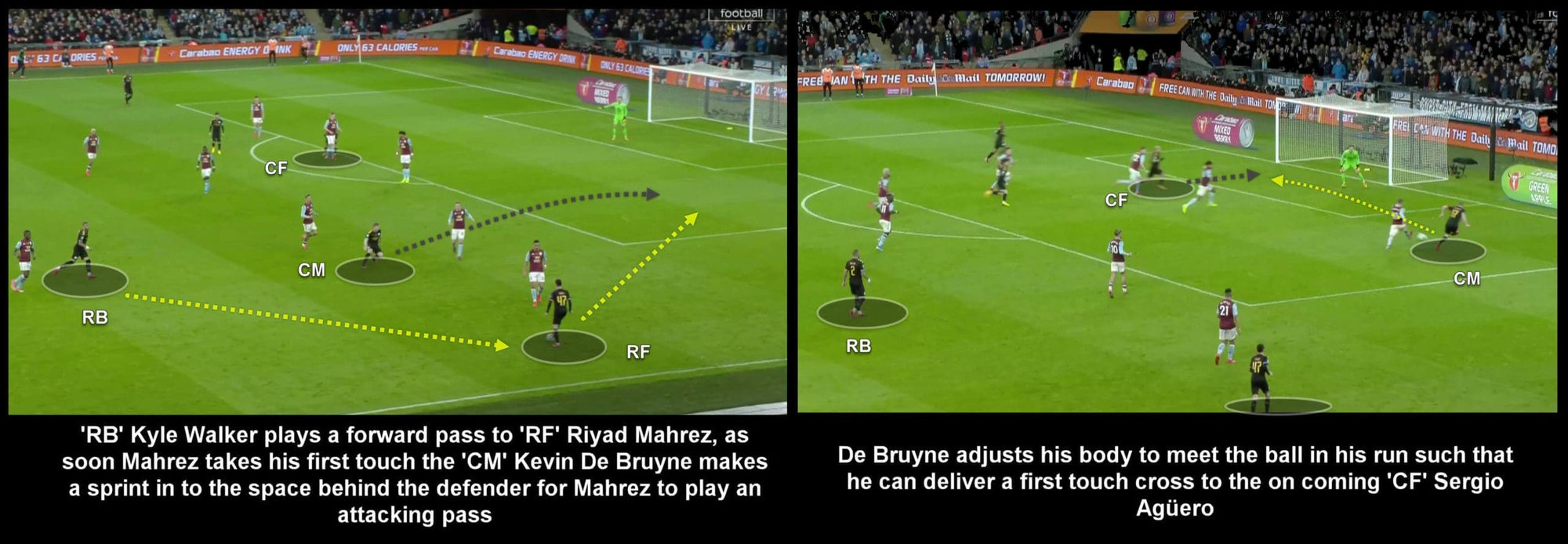
Let's look back to a famous example of picture-perfect patterns of play at the Carabao Cup Final between Aston Villa and Man City.
Observing the two images above, we first see 'RB' Kyle Walker play a pass out to 'RF' Riyad Mahrez.
Mahrez takes one touch and observes Kevin De Bruyne's quick burst of acceleration into the space behind the defender.
On his second touch, the French forward plays a through ball for De Bruyne to meet in the box, and he delivers a dangerous cross to the 'CF' Sergio Agüero.
Like other top-level teams, Manchester City tactics use many predetermined combinations, which allows them to play through or penetrate the opponent's defence to create high-value opportunities.
This tactical strategy is attributed to teams that score a high number of goals from open play.
Through the proper adaptation and application of your training, you too can achieve similar, relative success.
4-3-3 Formation Pattern Of Play
All of the patterns below are based on the 4-3-3 formation.
The midfield is set up as one holding and two attacking central midfielders.
The following will still work on any variation of the midfield; however, for the purposes of this article, we will use this format.
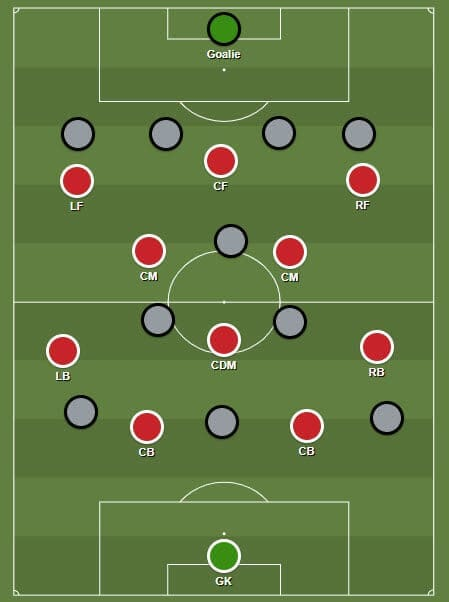
Become familiar with the acronyms per position, such that the left forward of the front three is represented by 'LF' and so on.
Central Patterns In 4-3-3
We have three options for central penetration.
Two of these combinations are in the opponent's half, while the third is an option to attack from a deep position.
The primary difference between central and wide penetration is that central patterns in the opponent's half generally result in players arriving in good goal-scoring positions.
Wide patterns that come to fruition typically result in wide crossing positions or dribbling opportunities into the box from a wide position.
That is, unless the pattern includes the final ball in the box.
Note that all patterns of play can be mirrored on both sides of the field.
Central A
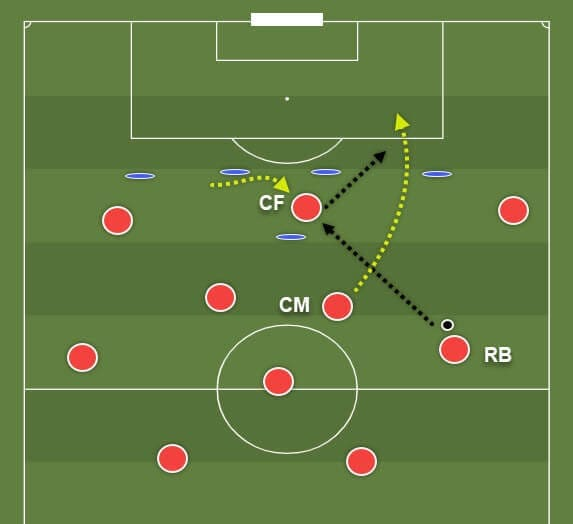
- RB looks up to play a pass forward, the CF's run is the trigger to pass
- As the ball is travelling to the CF the CM makes a run at full sprint
- The CM must offer a good distance from the CF so the CF has an angle to pass
- The CM must keep his run between the opposition centre-back and full-back
- The quality of the first pass is key to allow a one-touch pass for the CF
- The RF must hold the width to be a wide option when the final pass cannot be made
- The CM should angle his run so that he receives the final pass facing the goal
Central B
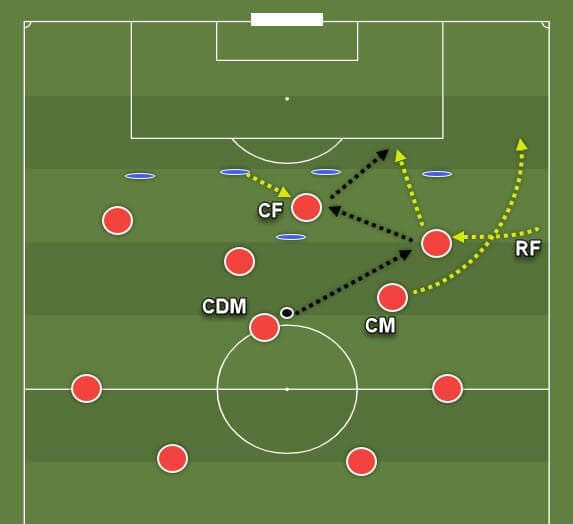
- A three-pass combination which requires good pass quality and timing of movement
- The RF makes a run centrally, which is the trigger for the CDM to make the first pass
- At the same time, the CM makes an angled run to the wide channel
- As the RF receives the ball, the CF then make a short run to be able to receive a pass
- As the RF plays a firm ground pass to the CF, he immediately makes a run forward
- The RF must try to offer a pass that the CF can play one-touch, if necessary.
- The CF then lays off a soft pass forward for the RF to meet on his run into the box.
- The CM should remain wide as a secondary option in the game
- The RF should arc his run, so he meets the ball facing the goal.
Central C: Long
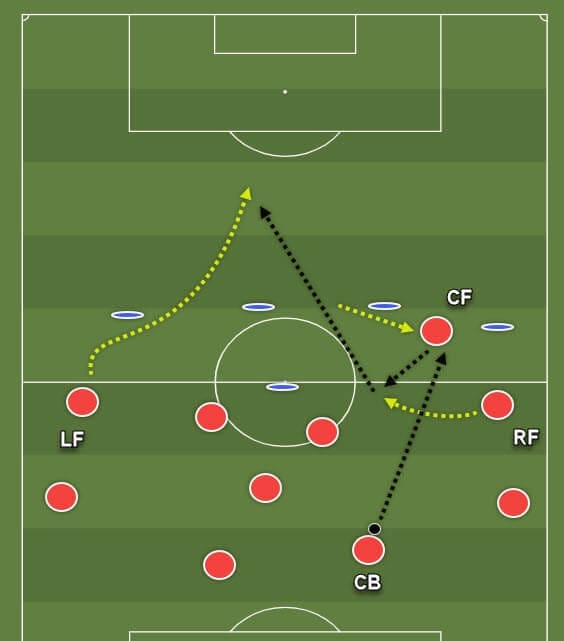
- A combination which starts from deep, because of longer passing distances, one-touch may not and should not be an option in relation to good timing and movement.
- CF makes an angled run into the half-space, and that is the trigger for the CB to make the pass
- The CF should be higher than the RF, so there is room to lay off the ball on his second touch
- The RF receives the ball on his run inside the field at a comfortable distance from the CF
- As the RF receives his pass, that triggers the LF to make his sprint forward.
- The LF's role is key; he must sprint, not run. He must also aim to beat the offside trap with perfect timing as the ball is released from the RF for the third pass.
- To achieve minimal touches, the trigger for the offside trap and final pass should be on the RF's second touch, which is the final pass.
- The LF must angle his run across the face of the full-back and behind the centre-back.
- Meanwhile, the RFs should pass through the gap between the two centre-backs.
Wide Patterns In 4-3-3
We have three options for wide penetration.
Two of these combinations are in the opponent's half, while the third is an option to attack from deep.
Again, all patterns can be mirrored on both sides of the field.
The 'blue' icons on the field represent mannequins.
Work at your own pace; you may want to gradually introduce one, two, or three defenders, along with the mannequins, over time.
Wide A
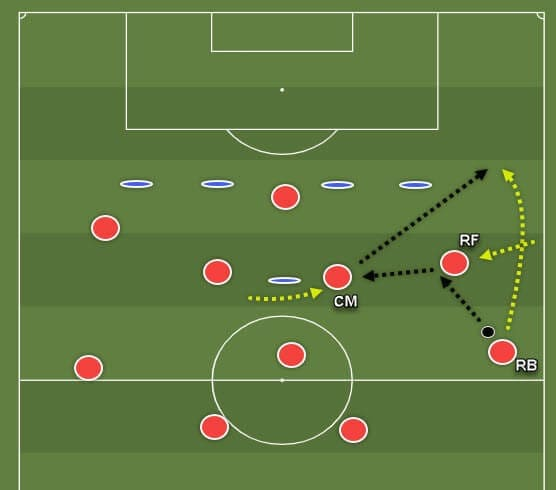
- The RB takes one touch forward to trigger the RF to make a run centrally.
- The RB plays a pass into the RF's run and then sprints forward in the channel.
- As the RF receives the CM makes a short run away from the defender to receive a pass
- The RF should give the CM a pass that he can use to play a one-touch pass forward
- The RB should angle his run wide so that he can meet the forward pass still facing the box
- Assuming the opposition will be transitioning to defend the CF, the opposite forward (LF), and the CM's should make runs into the box to meet a potential cross
Wide B
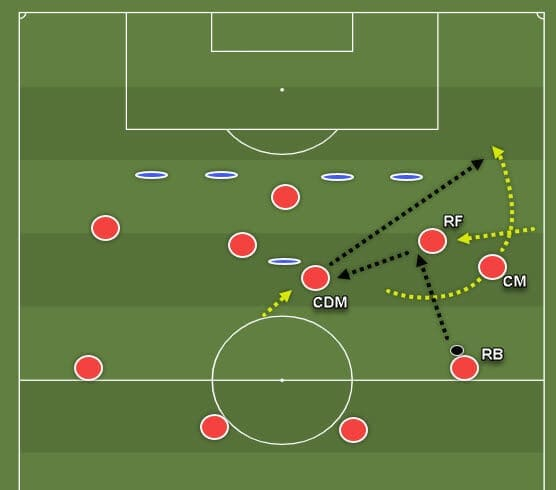
- The RF makes a run centrally as a trigger to receive the first pass from the RB
- As the RF makes his run inside, that is also the trigger for the CM to overlap out wide
- The CDM make a short run in good timing to receive a pass unmarked from the RF
- The CDM then plays a pass forward to meet the run of the CM with minimal touches
- The CM should angle his run so that when he receives the pass, he is facing the box
- Assuming the opposition will be transitioning to defend the CF, the opposite forward (LF), and the CM's should make runs into the box to meet a potential cross
Wide C Long
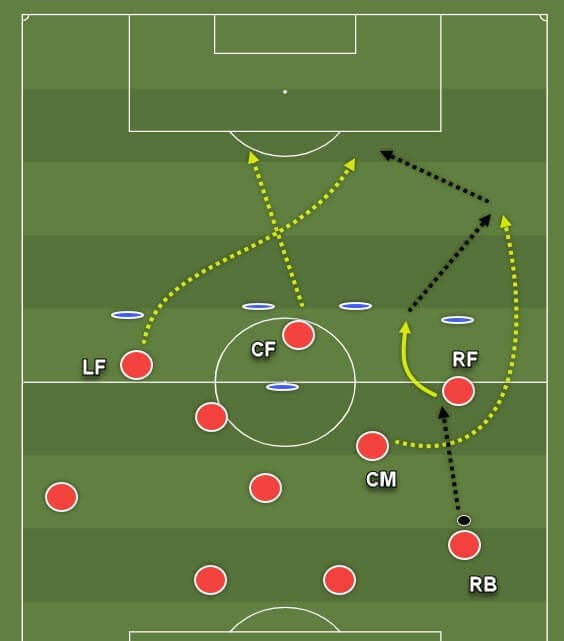
- A combination that starts from deep, because of longer passing distances, one-touch may not and should not be an option, given the need for good timing and movement.
- The RB plays a forward pass to the inset RF from deep.
- Simultaneously, the CM makes an overlapping run and continues forward into space
- The RF makes an inside turn and dribbles high enough to offer an angle for a forward pass
- The CM about to receive the pass must play to beat the offside when sprinting for the pass
- As the RF makes the forward pass, that is then the trigger for the LF and the CF to make a crossover run
- Depending on the picture facing the CM in possession and the opposition's recovery defending, the CM must have good control and observation to play a well-timed pass to meet either forward in the crossover run.
- Timing and movement, as well as the weight of the pass, are crucial factors for the success of these patterns
For all of the above patterns, I would recommend gradually introducing one defender at a time, along with mannequins, to offer a realistic challenge to the attacking team.
The Training Ground
Here, we look at the implementation of effective learning.