SV Elversberg, Hannover 96 & SC Paderborn’s Three-Way Fight For 2. Bundesliga Promotion 2025/2026 – Tactical Analysis

As the final whistle approaches on the 2025/2026 edition of 2. Bundesliga, the script has narrowed to a singular, high-stakes afternoon that threatens to rearrange the hierarchy of German football.
While FC Schalke 04 have already confirmed their return to the elite as champions, reestablishing themselves among the giants after a season of dominant, high-budget reconstruction, the identity of the team that will join them, and the one that will face the purgatory of the promotion play-off against the 16th-placed Bundesliga side, remains very much up in the air.
SV Elversberg, Hannover 96, and SC Paderborn enter Matchday 34 locked on 59 points, a statistical bottleneck that reflects the extreme stylistic diversity of this year's promotion race.
It is a three-way standoff where the margin for error has been reduced to the width of a goal post, and the goal-difference columns are being scrutinised with the intensity of a forensic investigation.
This is not a race defined by a single dominant trend or a league-wide tactical consensus, but rather a clash of three distinct footballing philosophies that represent the various schools of thought currently permeating the German second tier.
Elversberg have surged into the top two on the back of a newfound verticality and a ruthless killer instinct that has turned them into the league's most efficient scoring machine, proving that a modest club can bridge the resource gap through surgical execution.
Hannover 96, under the dogmatic and often controversial guidance of Christian Titz, have doubled down on a possession-heavy model that seeks to control the inherent chaos of the second tier through technical superiority and extreme positional discipline.
Meanwhile, SC Paderborn continue to operate as the league’s primary disruptors, utilising an entropic positional play and a breakneck attacking pace that defies traditional defensive organisation and leaves opponents in a state of cognitive overload.
The stakes could not be higher for these three institutions.
For Elversberg, promotion would represent the culmination of a fairy-tale rise that defies the traditional gravity of German football.
For Hannover, it is the long-awaited return of a sleeping giant that has spent too many years wandering the wilderness of the lower leagues.
For Paderborn, it is a chance to prove that their unconventional, high-risk methodology is a viable path to the top flight.
As we look toward the simultaneous kick-offs on Sunday, it becomes clear that the winner will not necessarily be the team with the best players, but the team whose tactical identity survives the immense psychological pressure of the final 90 minutes.
This tactical analysis will dissect the tactical mechanisms that have brought these three sides to the precipice of the Bundesliga, examining the structural foundations and individual catalysts that have defined their respective seasons.
Verticality & Killer Instinct: The Elversberg Evolution
The most surprising development of the 2025/2026 season has been the tactical maturation of SV Elversberg.
Once a side characterised primarily by their underdog grit and a defensive-first mentality that served them well during their initial ascent, they have evolved into a high-octane offensive entity that thrives on the principle of minimal passes for maximum impact.
Under their current regime, the SVE has moved away from the more cautious, safety-first build-up of their early second-division days to embrace a system of extreme verticality.
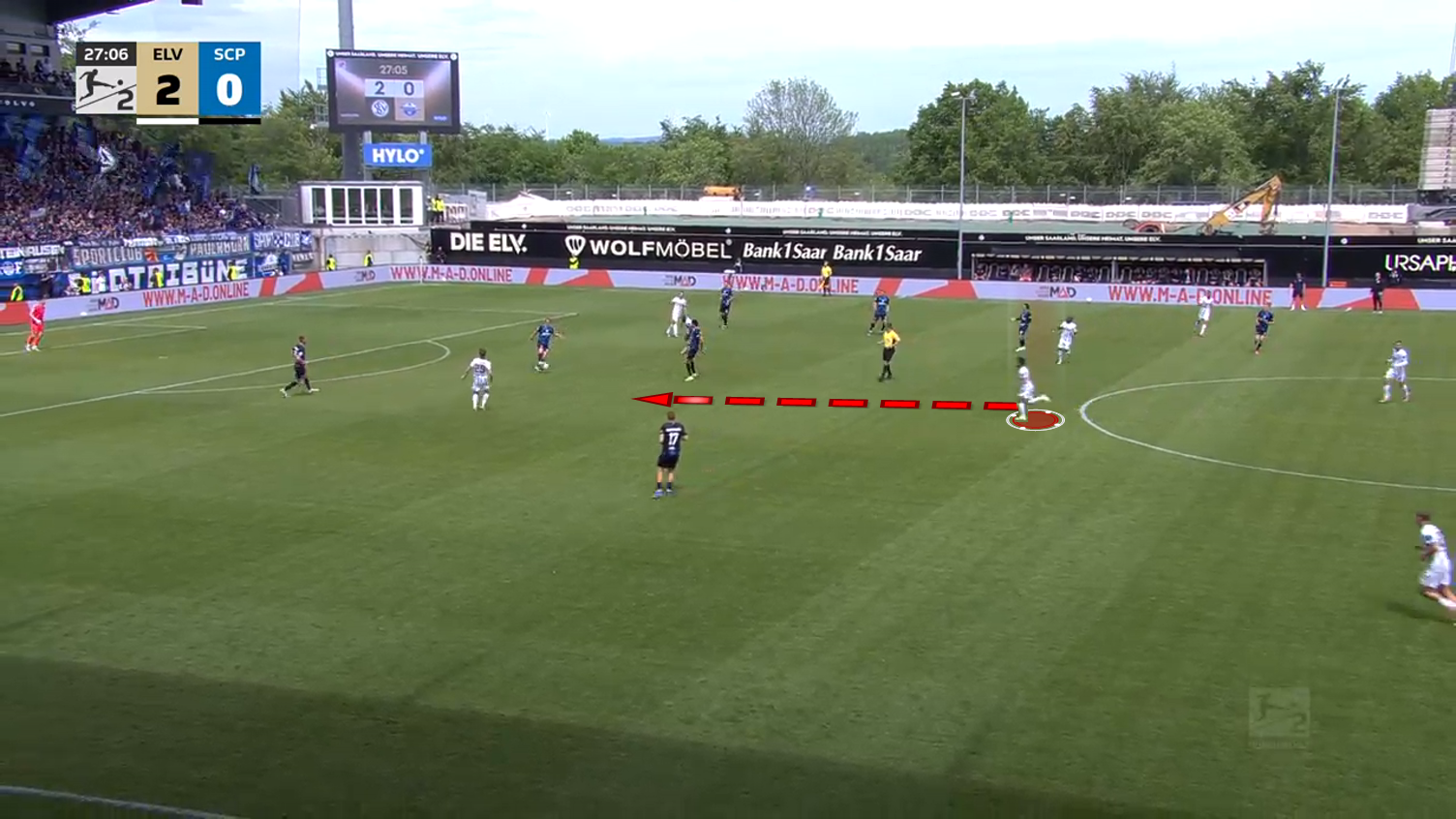
They do not seek to tire the opponent with long spells of possession; they seek to kill them with pace, directness, and an unerring ability to exploit the smallest of defensive fissures.
Elversberg’s verticality is anchored in their ability to bypass the midfield in a single, surgical movement.