

AC Milan Vs Inter Milan [2-1] Serie A 2026/2027: How Ruben Amorim Tactics Outmanoeuvred Cristian Chivu In The Derby - Tactical Analysis

AC Milan hosted Inter Milan in Gameweek 10 of Serie A 2026/2027 in a special derby clash, following Inter Milan’s strong Serie A form and AC Milan’s more inconsistent results, notably their latest home loss to Bologna.
Still, AC Milan continued the trend of “the weaker side before the Derby wins the Derby”, emerging with a 2-1 victory to end Inter Milan’s run of positive results and take another step toward a top-four finish.
With this crucial win, AC Milan hold fifth with 21 points, two points behind Como and three points behind Roma, who are fourth and third, respectively.
It was a particularly useful win for Ruben Amorim to silence critics already calling for his sacking and to gain further confidence, belief, and support from his players, making it easier to implement his ideas in the coming period.
As for Inter Milan, the team is obviously negatively impacted by this painful loss, both mentally and practically.
In other words, this loss might impact the team’s performances going forward as the players and Cristian Chivu himself might have more doubts about their ability to complete comebacks against their next opponents especially if they continue conceding early goals, which is already a weakness that needs to be fixed as soon as possible.
On the practical level, the loss of these three points kept Inter Milan in second place on 25 points, as it allowed Roma to get much closer (only one point away).
Furthermore, the loss helped Lazio climb to the top spot with 28 points and put them three points clear of Inter Milan after their win against Cagliari.
Therefore, Inter Milan’s position in the table has shifted from being the top team everyone is striving to reach to a team chasing the top spot, with more than one challenger behind them.
In this tactical analysis, we focus on both teams’ initial match plans, the defensive marking errors of both teams especially during set-pieces, and the tactical tricks used by Amorim to prevent Inter Milan from completing a comeback.
AC Milan Vs Inter Milan Lineups & Formations
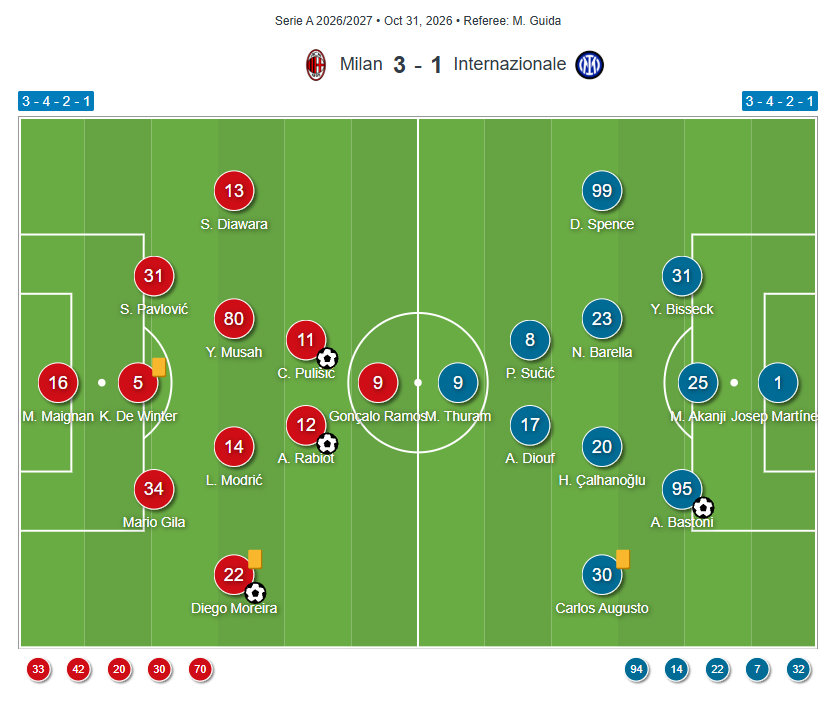
AC Milan Lineup Vs Inter Milan
Amorim started the match in a 3-4-2-1 formation, with Mike Maignan as goalkeeper and a back three of Mario Gila, Koni De Winter, and Strahinja Pavlović.
In midfield, he used Luka Modrić and Yunus Musah as central midfielders, Sankhoun Diawara and Diego Moreira as wing-backs, Christian Pulišić and Adrien Rabiot as wide playmakers, and Gonçalo Ramos as the striker.
Inter Milan Lineup Vs AC Milan
Chivu also relied on a 3-4-2-1 formation, with Josep Martínez in goal behind centre-backs Alessandro Bastoni, Manuel Akanji, and Yann Bisseck.
Carlos Augusto and Djed Spence started as the two wing-backs, while Nicolò Barella and Hakan Çalhanoğlu made up the midfield.
In attack, Andy Diouf and Petar Sučić played as wide playmakers and sometimes moved inside as central playmakers to support the striker, Marcus Thuram.
AC Milan Vs Inter Milan Initial Tactical Plans
Amorim adopted a tricky lineup for this Derby, relying mainly on centre-backs in the back line and using five players there during the defensive phase.
He believed a back-five defence would be more useful against Inter Milan’s wing-backs and help cope with their continuous advance, whether they used an attacking duo or not.
More importantly, relying on pure centre-backs for these roles (with the exception of Moreira) was a deliberate choice to ensure the back five would be defensive and strong in 1v1 duels, which explains the risk of choosing Diawara at the expense of Davide Bartesaghi and Pervis Estupiñán.
At the same time, with three midfielders in the lineup on paper, Amorim could use them to match Inter Milan’s three midfielders in the defensive phase when needed, while keeping Rabiot as a wide playmaker just behind Ramos and on the same line as Pulisic in the attacking phase.
In other words, Amorim used a 3-4-2-1 formation that he could easily shift into a 5-2-2-1 in the defensive phase.
As for Inter Milan, Chivu tried to surprise Milan by avoiding two strikers and using only Thuram up front, with both Diouf and Sučić playing behind him in a 3-4-2-1 formation that lets Inter attack with three players, not just two, on the front line.
He also opted for Augusto as the starter at left wing-back to benefit from his excellent run of form, while leaving the more experienced Federico Dimarco on the bench.
That said, Amorim’s match plan predicted such scenarios from Inter Milan, as he preferred to secure the defensive line by defending with five players in the defensive phase, not just the back-four announced on paper.
This was done by forcing Moreira to constantly retreat in the defensive phase, allowing Gila to become the third centre-back alongside De Winter and Pavlović, with Diawara being the fifth defender on the left flank.
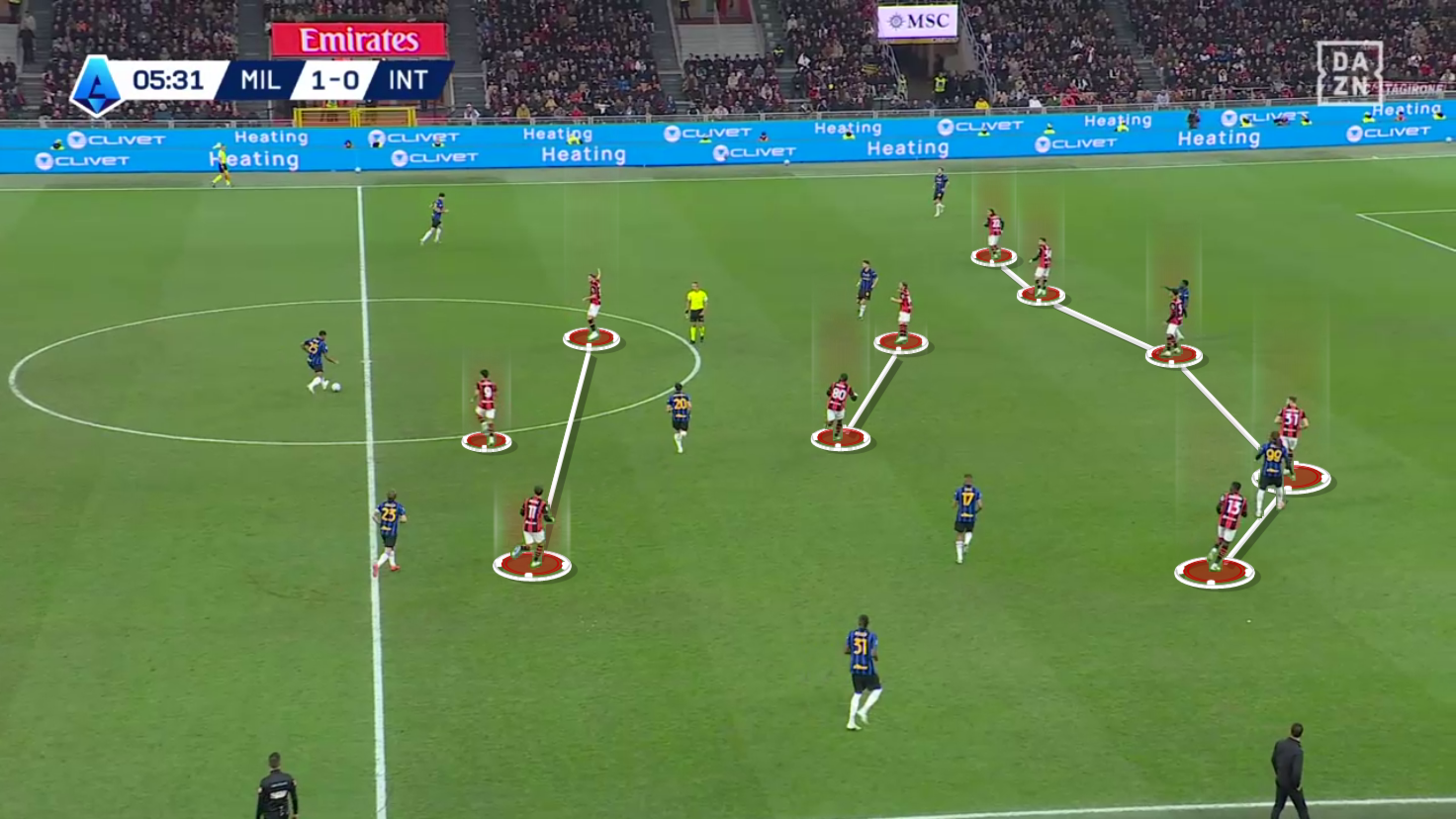
AC Milan Intensity & Exploitation Of Superiority In Duels
AC Milan knew how to exploit the momentum they created in the first minutes and used it to their advantage by immediately forcing Inter Milan into 1v1 duels in key areas.
This allowed Milan to win such duels and create the dangerous chances they were hoping for.
The goal build-up began with Milan in possession inside Inter Milan’s half, ending with a gradual switch from left to right until it reached Moreira.
Moreira was opportunistic and explosive enough to provoke the confrontation against Augusto, knowing that Moreira could have avoided the duel and gone for simpler solutions.
Instead, Moreira fixed Augusto and quickly accelerated to pass his direct opponent, knowing he was more agile.
This allowed Moreira to use a body feint and prepare to cross with his left foot, while benefiting from Augusto’s passive, weak defending in this situation.
Although Moreira’s cross into the box was accurate and decisive, since both Pulisic and Diawara were well-positioned there, Bisseck’s man-marking of Pulisic was extremely disappointing.
Bisseck saw that Pulisic was distant at the moment of the cross.
Still, he avoided closing him down and preferred to stay static, moving only toward the ball when it was too late, and Pulisic had already positioned himself behind him.
Milan scored thanks to intense attacking and explosive right-wing penetration.
At the same time, Inter Milan's left-back defending was very passive, followed by poor and unacceptable man-marking in the air inside the box at this level.