Bayern Munich Vs Borussia Dortmund [2-2] Bundesliga 2026/2027: How Niko Kovač 3-4-2-1 Tactics Stood Up To Bayern Pressure - Tactical Analysis
Bayern Munich and Borussia Dortmund shared a dramatic 2-2 Der Klassiker. This tactical analysis examines Bayern’s territorial control, Dortmund’s compact block, Kovač’s second-half pressing adjustment and the late attacking shift that earned an equaliser.

Der Klassiker has long served as the central structural and philosophical benchmark of German top-flight football, an ideological crucible where institutional financial hegemony and tactical engineering collide on the grandest domestic stage.
Entering this eighth matchday fixture of the 2026/2027 Bundesliga campaign at a raucous Allianz Arena, both Bayern Munich and Borussia Dortmund arrived deadlocked at the absolute summit of the league table with identical point tallies, transforming a historic rivalry into a direct tactical duel for early-season supremacy.
The stakes were heightened further by unusual touchline circumstances for the hosts, as head coach Vincent Kompany was forced to miss the fixture due to acute illness, leaving assistant coach Aaron Danks to marshal the technical area and oversee Bayern’s tactical execution against a formidable domestic rival.
Bayern entered the high-stakes encounter with the division's most fluid positional possession metrics.
At the same time, Borussia Dortmund arrived under Niko Kovač with the league's stingiest defensive record, setting up a classic structural clash between elite offensive circulation and deep defensive compactness.
The resulting 2-2 draw reflected an intense tactical chess match where Bayern’s territorial domination and wide half-space overloads collided directly with Dortmund’s deep block density, aggressive second-half pressing triggers, and relentless late-game resilience.
For this tactical analysis, this encounter provided a masterclass dataset on how elite structural blocks behave under high-intensity transition swings, physical attrition, and sudden shifts in defensive rest-structures over 90 minutes.
Bayern Munich Vs Borussia Dortmund Lineups & Formations
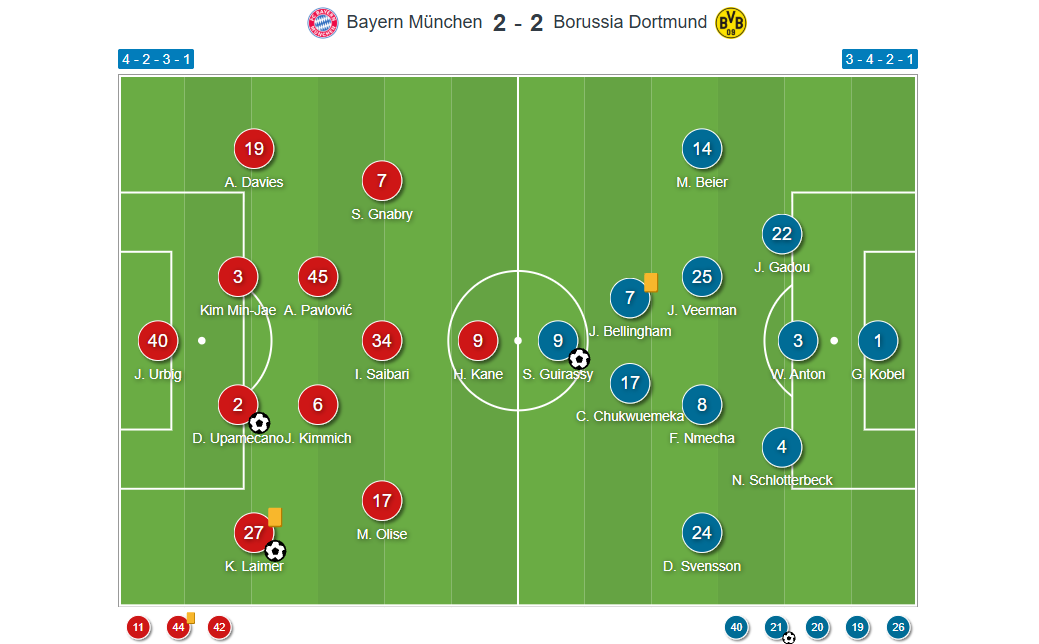
Bayern Munich Lineup Vs Borussia Dortmund
Acting manager Aaron Danks fielded FC Bayern in their customary 4-2-3-1 base shape, placing Jonas Urbig in goal behind a disciplined back four: Konrad Laimer at right-back, Dayot Upamecano and Kim Min-jae forming the central defensive partnership, and Alphonso Davies occupying the left-back channel.
Joshua Kimmich and Aleksandar Pavlović formed the central double pivot, tasked with dictating the tempo of possession and anchoring the team's defensive structure against potential counterattacks.
This central pair supported an advanced attacking line featuring Michael Olise on the right flank, Ismael Saibari centrally as an advanced interior playmaker, and Serge Gnabry on the left, all operating directly behind focal target striker and recent Ballon d'Or recipient Harry Kane.
Early physical attrition heavily disrupted Bayern's bench, forcing Danks into premature structural alterations when Ismael Saibari pulled up injured and was replaced by Nathaniel Brown in the 28th minute, followed immediately by Serge Gnabry making way for Josip Stanišić in the 30th minute.
Bayern made one final late change in the 84th minute, with young Lennart Karl replacing Michael Olise after the French winger picked up a knock.
Borussia Dortmund Lineup Vs Bayern Munich
Borussia Dortmund countered under Niko Kovač with a flexible 3-4-2-1 out-of-possession structure, deploying Gregor Kobel between the posts behind a central defensive trio of Joane Gadou, Waldemar Anton, and Nico Schlotterbeck.
In midfield, Kovač deployed Joey Veerman alongside Felix Nmecha as the central engine room, with Daniel Svensson holding the left wing-back corridor and forward Maximilian Beier tasked with operating as an asymmetrical, hardworking right wing-back.
Ahead of the double pivot, Jobe Bellingham and Carney Chukwuemeka functioned as dual interior attacking midfielders, operating directly behind lone target striker Serhou Guirassy.
Dortmund managed their structural rotations efficiently across the second half, bringing on Konstantinos Karetsas and Marcel Sabitzer in the 67th minute for Beier and Chukwuemeka, introducing Fábio Silva for Nmecha in the 76th minute, and sending on Julian Ryerson and Samuele Inácio in the 87th minute for Gadou and Bellingham.
Phase One Mechanics: Territorial Domination Vs Spatial Choking
During the opening 45 minutes, Bayern established total territorial control, dictating spatial terms through high possession volume while Dortmund systematically compressed their central shape into an uncompromising defensive block.
Bayern utilised Joshua Kimmich to drop deep between or beside the central defenders during early build-up phases, constructing a temporary 3-1 positional base that allowed full-backs Konrad Laimer and Alphonso Davies to push aggressively high into the opposition half.
This rotational movement was specifically designed to drag Dortmund's wing-backs out of position, opening up valuable half-space passing pockets for Michael Olise and Ismael Saibari to receive on the half-turn between the opponent's midfield and defensive lines.
However, Dortmund’s defensive architecture remained remarkably disciplined, dropping into a compact 5-4-1 mid-block that prioritised absolute central protection over high ball recovery.