Alejandro Garnacho Scout Report At Aston Villa 2026/2027: Can Unai Emery Tactics Revive The Manchester United & Chelsea Outcast? – Player Analysis
Alejandro Garnacho gives Aston Villa elite one-on-one threat and ball progression, but his output hinges on better composure after beating defenders. The analysis explains how Unai Emery can turn that raw advantage into consistent end product.

Who Is Alejandro Garnacho?
Alejandro Garnacho has become one of the Premier League's most polarising young talents.
Still only 22 years old, he emerged as a bright prospect out of Manchester United’s famed academy before the narrative shifted in a pessimistic direction.
The doubts that sprang up around Garnacho were rarely about his ability.
It was more about mentality and attitude.
Last summer, Garnacho departed Old Trafford, joining the Red Devils’ Premier League rivals Chelsea in a €46.2m deal.
However, the Argentinian failed to make the most of the lifeline offered by another Premier League giant, and after a fairly underwhelming season, he now finds himself on his way to Aston Villa in a loan move which could become permanent upon meeting certain conditions, per reports.
Villa's decision to sign Garnacho has been met with as much scepticism as excitement, reflecting the general vibe that’s surrounded Garnacho for basically his entire senior career.
Unai Emery has publicly praised the winger’s talent and decision to join the Villa Park project, but sections of the club’s fanbase have expressed uncertainty over the gamble.
Though he’s young and talented, Garnacho is running out of chances to make the most of his ability at the top level, and this move feels like it could be a pivotal career moment.
At Aston Villa, he may, whether through luck or by design, have landed on the perfect environment to reverse a negative trajectory.
There are few coaches with a stronger reputation for refining talented but imperfect attackers than Unai Emery.
It’s a highly desirable skill great managers possess in that they can often nurture even the most volatile of personalities to extract the player’s quality.
The 54-year-old is effectively betting that he can help transform a gifted but raw and volatile winger into a consistently decisive Premier League player by providing the right environment, on and off the pitch, for Garnacho to refine his game.
The public narrative surrounding Garnacho doesn’t necessarily reflect the entire story that the underlying data tells.
While Garnacho produced extremely modest numbers on the surface during his 2025/2026 campaign at Stamford Bridge, scoring just one goal and providing four assists in the league, his statistical profile remains exceptional in several key areas.
This Alejandro Garnacho scout report and player analysis aims to provide a balanced assessment of the 22-year-old winger via data analysis and video analysis, comparing the 22-year-old with the Villans’ 2025/2026 left-wing options and determining whether Villa may have completed one of the shrewdest moves of the summer.
Alejandro Garnacho Stats
Firstly, we compare Alejandro Garnacho's data with that of other wingers and attacking midfielders who played at least 800 minutes across Europe's top-five leagues during the 2025/2026 season, using custom-built metrics derived from weighted combinations of Wyscout data.
These six metrics combine multiple weighted performance indicators into broader scouting categories, helping to provide a more holistic assessment of each player's attacking profile.
Garnacho's attacking profile is all about volume and directness.
He records one of the highest dribble volumes in the dataset (6.45 per 90), completing 58.8% of those attempts.
He stands out as one of the most prolific progressive ball carriers in Europe.
Alejandro Garnacho Percentile Ranks 2025/2026
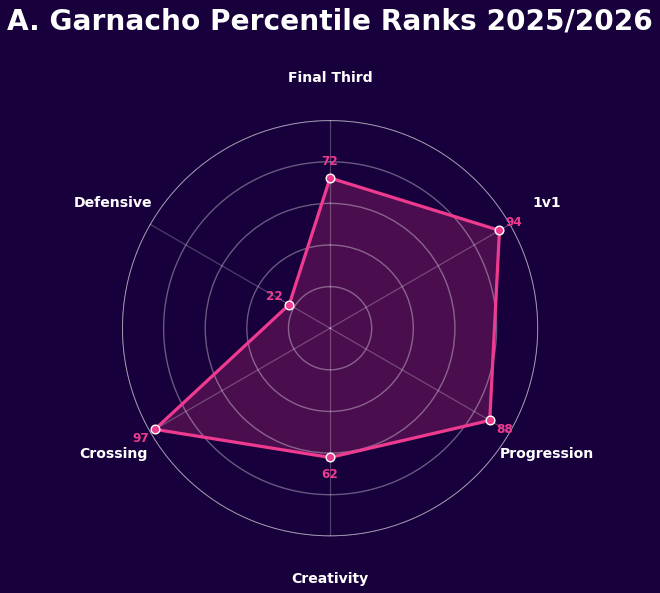
Strong scores in our 1v1, Progression and Crossing metrics paint the picture of a player whose primary objective on the pitch is to consistently advance possession through individual actions before creating dangerous deliveries into the box.
His Final Third Impact remains above average, but does not reach the elite levels of Europe's most productive wide forwards.
Garnacho is capable of combining ball progression with a significant goalscoring and chance-creation threat, but this is an area where he and the Aston Villa coaching staff should be looking to make progress if the Argentinian is to kick on and fulfil his world-class potential.
Garnacho presents an unusual creative profile.
His chance creation mainly comes from carrying the ball deep into attacking areas before delivering crosses or cut-backs, rather than progressing possession through incisive passing combinations.
Garnacho's crossing profile further supports this interpretation.
He attempts crosses at one of the highest rates in the dataset, though his accuracy leaves room for improvement through better decision-making over when and where to cross.
This doesn’t necessarily reflect poor delivery so much as it is a result of both the volume and difficulty of the situations from which he crosses, with deliveries often coming early or under pressure after beating a defender 1v1.
In Garnacho’s case specifically, a lot of his crosses come straight after he’s created separation, often from difficult positions or under pressure.
Evidently, Garnacho could also provide a lot more defensive work for his side.
As we’ll come to analyse further in the video analysis sections, Garnacho's output is not limited by his ability to generate dangerous situations, but more by what happens immediately after doing so.
He consistently beats defenders and accesses high-value positions, but the execution of the final action is where the quality has fallen off.
The underlying data indicates he consistently creates high-quality opportunities but has not managed to convert them at the expected rate.
A comparison with Morgan Rogers and Emiliano Buendía, both of whom played some games on the left for Aston Villa last season, provides useful tactical context.
Morgan Rogers, who went the other way, joining Chelsea from Aston Villa this summer, is more of a No. 10 than a winger and presents a relatively balanced attacking profile.
Morgan Rogers Percentile Ranks 2025/2026
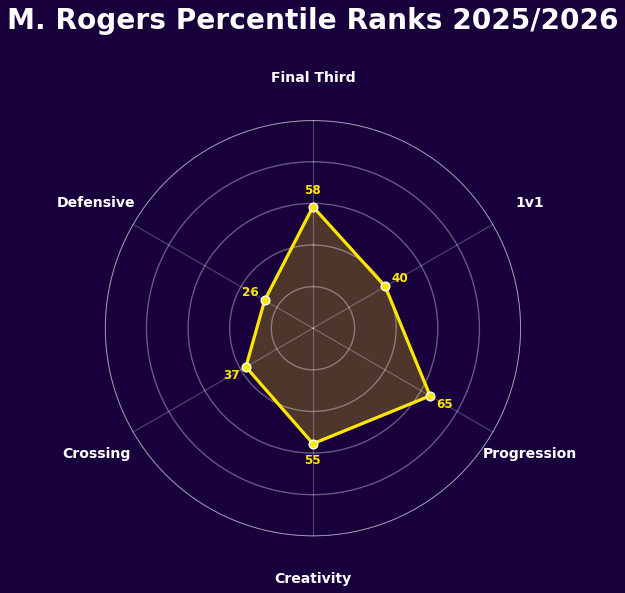
His strongest of the six areas is Progression, while respectable Creativity and Final Third Impact scores demonstrate a strong ability to contribute across several phases of possession.
He is less reliant on individual dribbling to generate attacking advantages.
His profile points more towards that of a measured ball carrier who links play effectively without consistently isolating defenders.
Emiliano Buendía offers a completely different profile again.
Emiliano Buendía Percentile Ranks 2025/2026
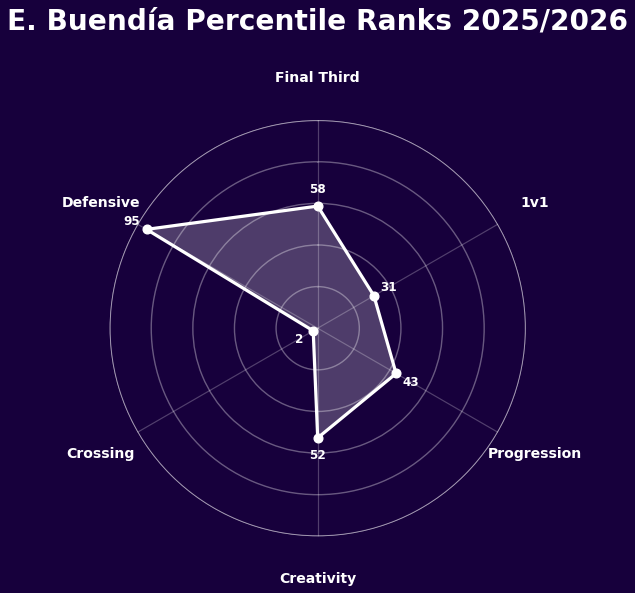
Buendía’s outstanding Defensive Score stands out immediately, highlighting his work rate and contribution out of possession, a contrast to Garnacho.
Average Final Third Impact and Creativity metrics illustrate a technically secure player capable of supporting attacking moves, but lower 1v1, Progression and especially Crossing scores reflect Buendía’s comfort in combining with teammates rather than driving attacks through explosive individual actions.
His profile is that of a possession-oriented creator rather than a direct transition threat.
The comparison radar demonstrates how Garnacho’s signing changes Aston Villa's attacking profile.
Aston Villa Winger Comparison 2025/2026
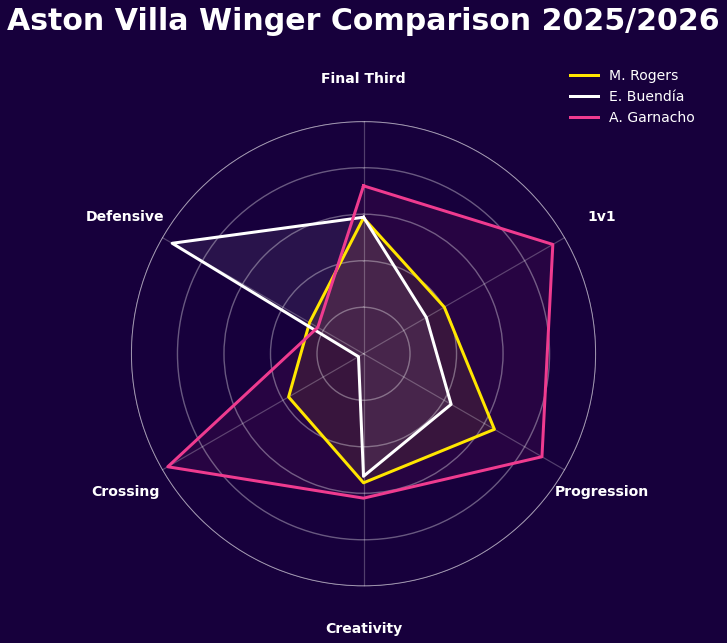
Garnacho brings a greater capacity to beat defenders, carry the ball into dangerous areas and deliver quality service into the box.
While Rogers provided a more balanced contribution, typically from more central areas, Buendía offers tactical discipline and defensive intensity.
However, neither man brings Garnacho's combination of elite 1v1 ability, ball progression and crossing to the table.
The Argentinian winger therefore fundamentally alters the profile of Villa’s potential left-sided attack.
The shot map below provides further insight, with the vast majority of Garnacho’s attempts originating from inside the penalty area, particularly from the left side of the opposition’s penalty area.
Alejandro Garnacho Shot Map 2025/2026
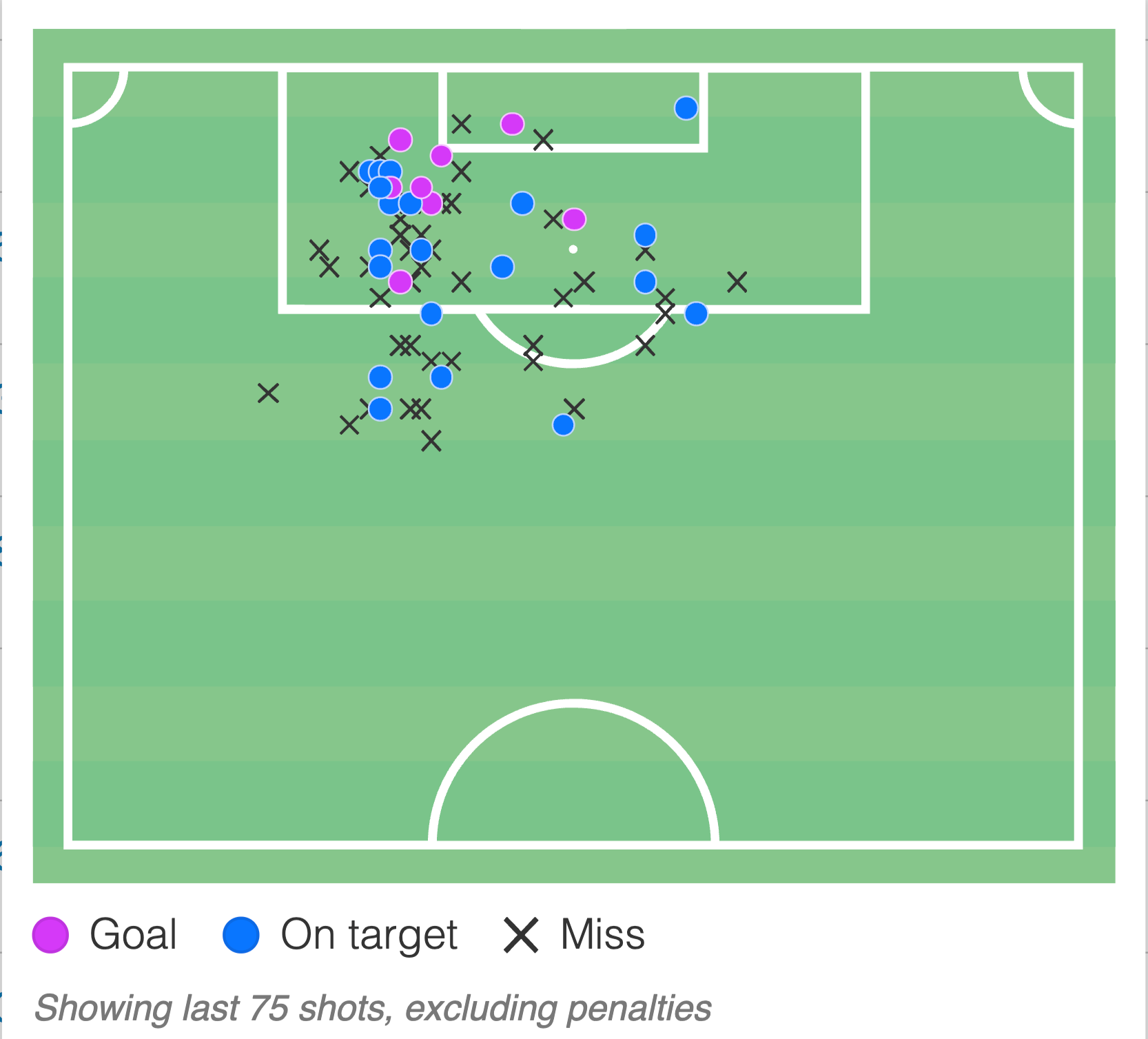
This further supports one of the key findings from the underlying data: generating chances is not a big issue with Garnacho; the main improvement lies in the execution of the final action, whether through more clinical finishing or better decision-making.
He has a tendency to drive inside from the wing before shooting early, often from narrowing angles.
This approach enables him to generate many of his attempts from inside the box, but the angles of the shots, especially from the left on his weaker foot, may also help explain why his finishing output has fallen short of his xG numbers.
Still, this is an encouraging profile for Aston Villa, as consistently beating defenders and generating high-quality opportunities are some of the hardest things to teach.
If Unai Emery can improve Garnacho's composure and efficiency in front of goal, the Argentine already has the underlying attacking process required to produce a much greater end product.
Garnacho's 2025/2026 heat map displays from where the winger typically exerts the greatest influence on the pitch.
Alejandro Garnacho Heat Map 2025/2026
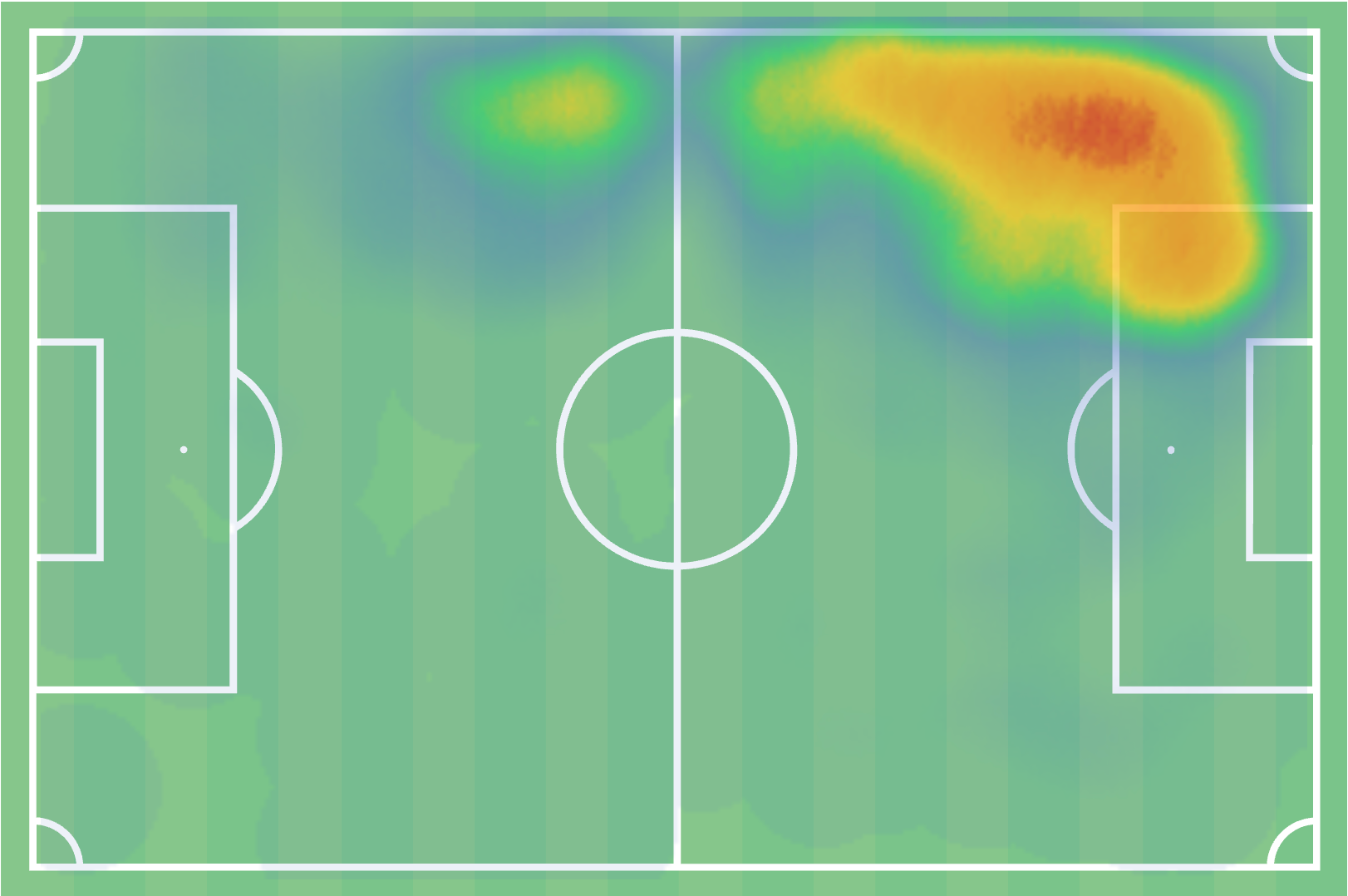
Unlike more possession-oriented wingers who like to drift into central pockets to dictate play, Garnacho largely maintains his width before accelerating either down the outside or inside onto his stronger right foot.
His positioning high and wide mirrors the way he has been used to stretch opposition backlines and create isolation opportunities against opposing full-backs.
There’s a heavy amount of activity around the left corner of the penalty area, which appears because Garnacho often carries possession into dangerous attacking zones rather than remaining a touchline winger throughout attacks.
Many of his deliveries come after the winger has beaten his marker or driven towards the byline, supporting his above-average Final Third Impact score through regular entries into the penalty area.
We don’t see any activity on the right wing.
He’s most comfortable on the left, where he can cut inside onto his right foot, but he could perform something of a more traditional winger role on the right if required, and I actually think he could be quite effective if played in such a role more often, using his pace and skill to beat his man on the outside and getting crosses in on his stronger right foot from the byline.
He could repeatedly use his pace and skill to beat his man on the outside before and put low driven crosses and cut-backs from the byline into the box from his stronger right foot.
This type of role was performed very effectively a lot of the time by Raheem Sterling under Pep Guardiola at Manchester City, for example, and it may better exploit Garnacho's elite ball progression.
Combined with his statistical profile above, the heat map reinforces the image of a high-volume transition threat who can drive Villa into advanced areas at pace.
Garnacho's ability to beat defenders and progress the ball are already at an incredibly high level.
The opportunity for development to become a truly elite winger lies in maximising the advantage once it’s been created.
Alejandro Garnacho Shooting
A common theme when observing Garnacho’s game is a tendency to execute an action immediately after beating the defender he’s up against 1v1.
His directness and decisiveness can produce spectacular finishes, but shooting at the first available opportunity, often from narrow angles pushed wide of the goal, can also reduce overall chance quality and lead to a larger-than-ideal number of low-value opportunities.
The Argentinian attacker often appears committed to the action he intended before beating the defender, rather than reassessing the attacking picture after creating separation, resulting in what can feel like rushed shots or crosses.
Below, against PSG in the UEFA Champions League, Garnacho drags the ball wide when he gets 1v1 just inside the box with Marquinhos, who does well to protect the inside channel through intelligent body positioning.