How Pep Guardiola and Luis Enrique Use Inside-Out Runs to Break Defences – Tactical Theory

In recent years, the spread of positional play has become an almost universal dogma across most of Europe's major leagues.
A period embodied, primarily, by the figure of Pep Guardiola since the beginning of his career at Barcelona, with the expansion of positional play beyond Spain's borders to manifest in some of the Santpedor-born manager's disciples.
Among them, to name just a few: Luis Enrique, Mikel Arteta, Robert de Zerbi, Enzo Maresca, and Unai Emery: all practitioners of positional play, based on the rational occupation of spaces and the control over them.
However, as an antidote to it, zonal defence has strengthened to control the customary five-player forward lines practised by positional teams (who, in turn, occupy the five lanes across the pitch).
Zonal defences can range from a four-man backline to a robust five-man defensive line.
To continue dominating matches through the control of space in static attacks, positional teams have resorted to established movements within the squares they form in midfield.
In this tactical theory, we analyse the work of inside-out runs by players in the upper vertices of the midfield square to dismantle and manipulate a five-man defensive line.
How To Counteract The Stopper
In essence, inside-out movements focus on manipulating the last defensive line, which, in this case, consists of five men.
When a team structures itself in possession in a 3-2-2-3 setup with a square in midfield, or in a 3-1-3-3, and faces a four-man defensive line, it usually has easy access to a vertical pass between the lines toward the opposition square, commonly the attacking midfielders.
What are the opposition squares?
The space formed by the opponent's full-back, centre-back, central midfielder, and wide midfielder.
That is to say, the space between the lines, situated between the opponent's last line and the second line.
However, accessing those spaces with time and room becomes much more difficult against a five-man defensive line, given the presence of a stopper who constantly looks to step up and intercept this vertical pass, with the freedom to leave his zone due to the cover provided by the sweeper.
To solve this, positional teams in possession find answers through the movements of the attacking midfielders inside these squares.
Inside-Out Runs To Confuse
Marcelino’s Villarreal is one of the teams in La Liga that most frequently builds up within a 3-2-2-3, generating a square in midfield.
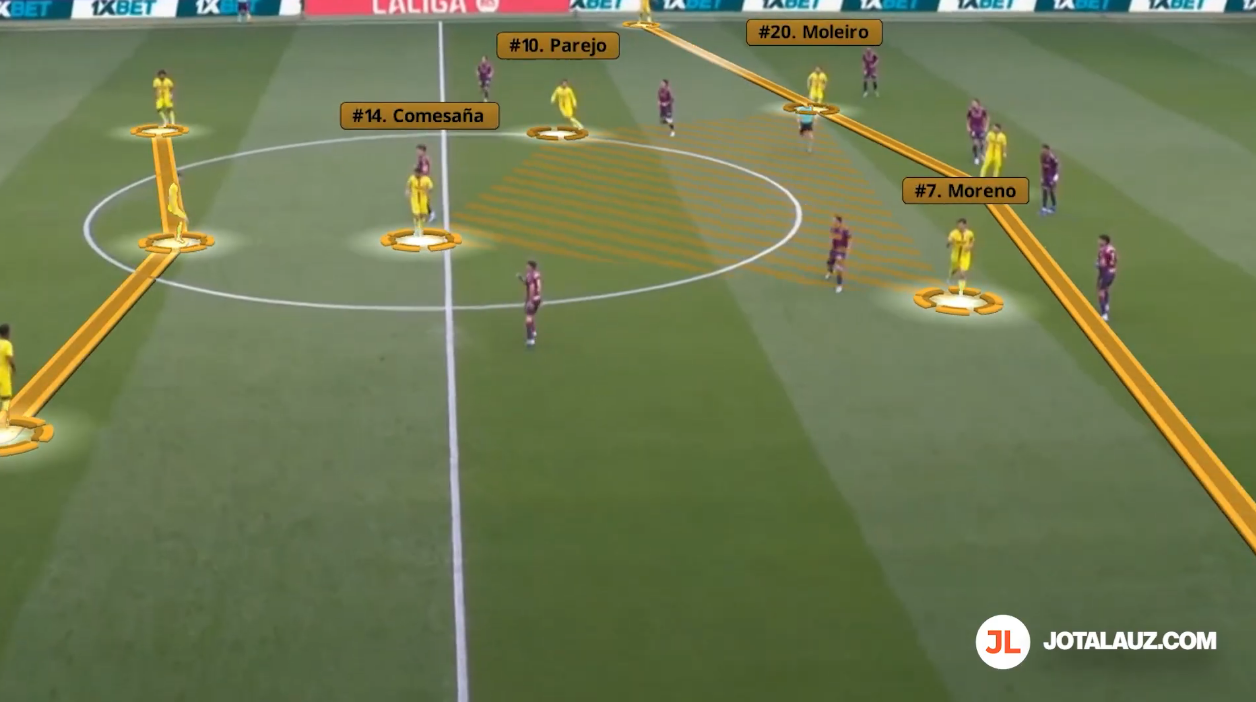
However, they face Levante's 5-4-1 mid-block, which aims to disrupt the Yellow Submarine's aspirations during the initial phases of construction.
Given the impossibility of connecting a vertical pass due to the presence of the stoppers monitoring both attacking midfielders and the sweeper covering behind them, Gerard Moreno, the attacking midfielder in the upper right vertex, makes an intelligent movement.
An inside-out movement away from the square, which creates hesitation in the stopper regarding whether to step up or not, and subsequently generates time and space for Moreno himself.
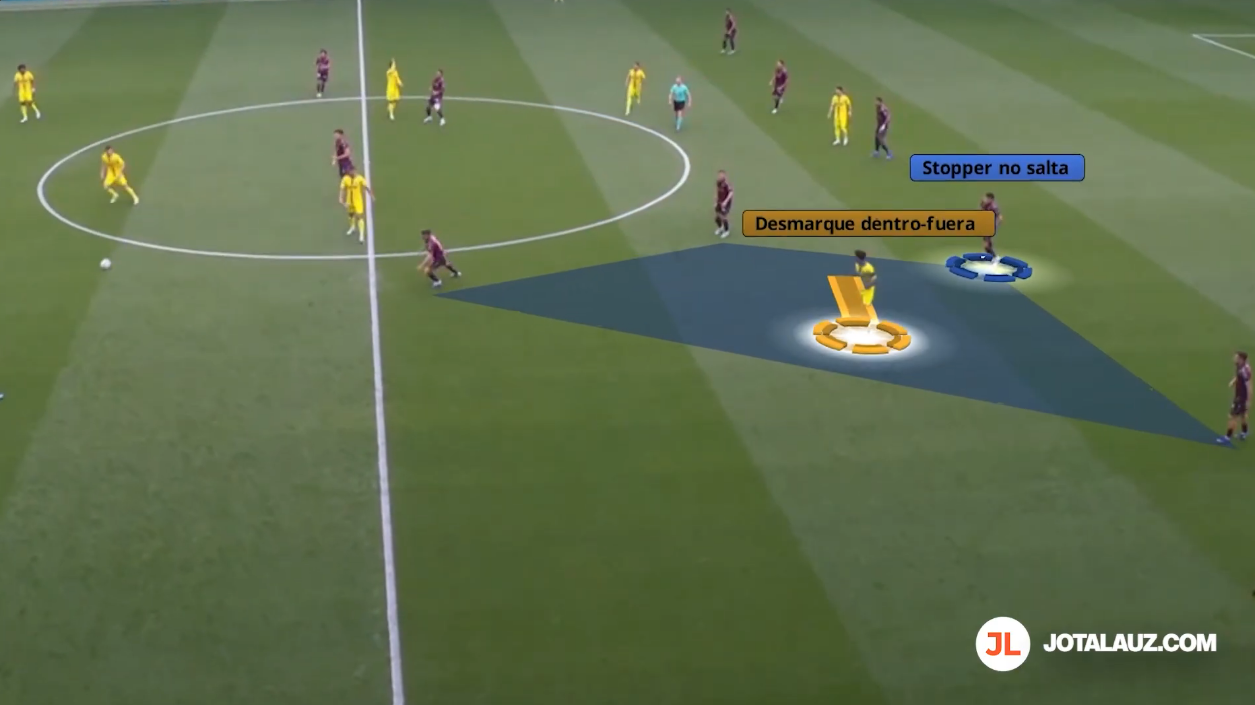
Thus, the dismantling of the backline begins to take shape through an exchange of positions, but with the foundation stone laid by an intelligent Moreno.
He positions himself outside the block and receives not a vertical line-breaking pass anymore, but a pass that allows him to escape the stopper's marking and turn to face forward.
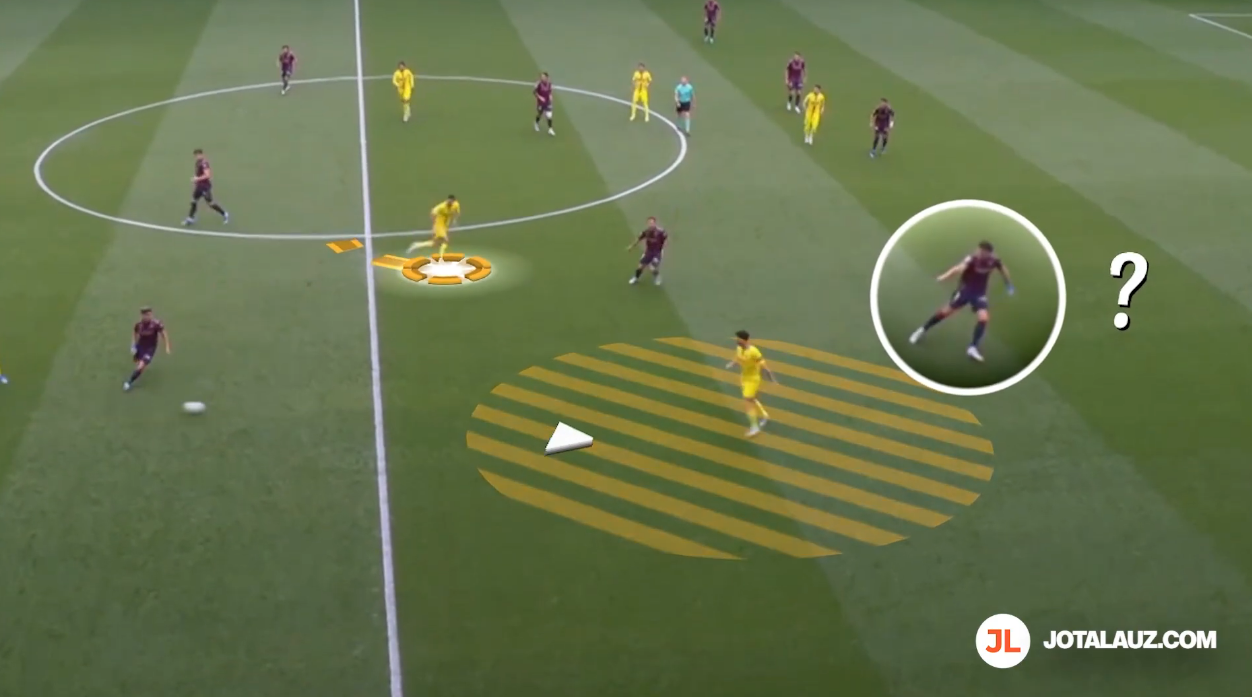
In this way, we can already deduce the effect caused by a subtle supporting movement from the attacking midfielders to drop out of the zone of influence.
Not only to generate space and time to turn and face forward, but also to create space in the defensive depth that can be exploited by our attackers.
In the case of Manchester City, during one of the final matchweeks of this Premier League season, they had to face the 5-4-1 defensive block proposed by Burnley.
Once again, the fluid movement of the attacking midfielders within the 3-2-2-3 was vital to breaking down that five-man backline and creating danger.
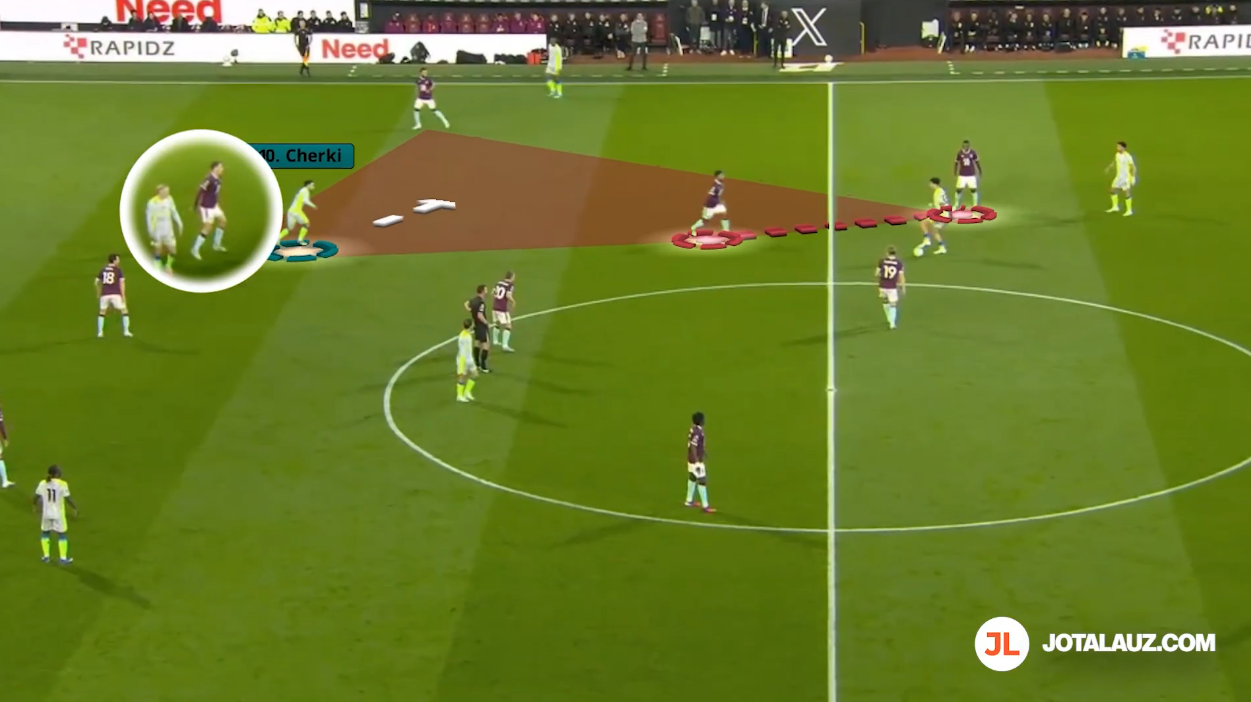
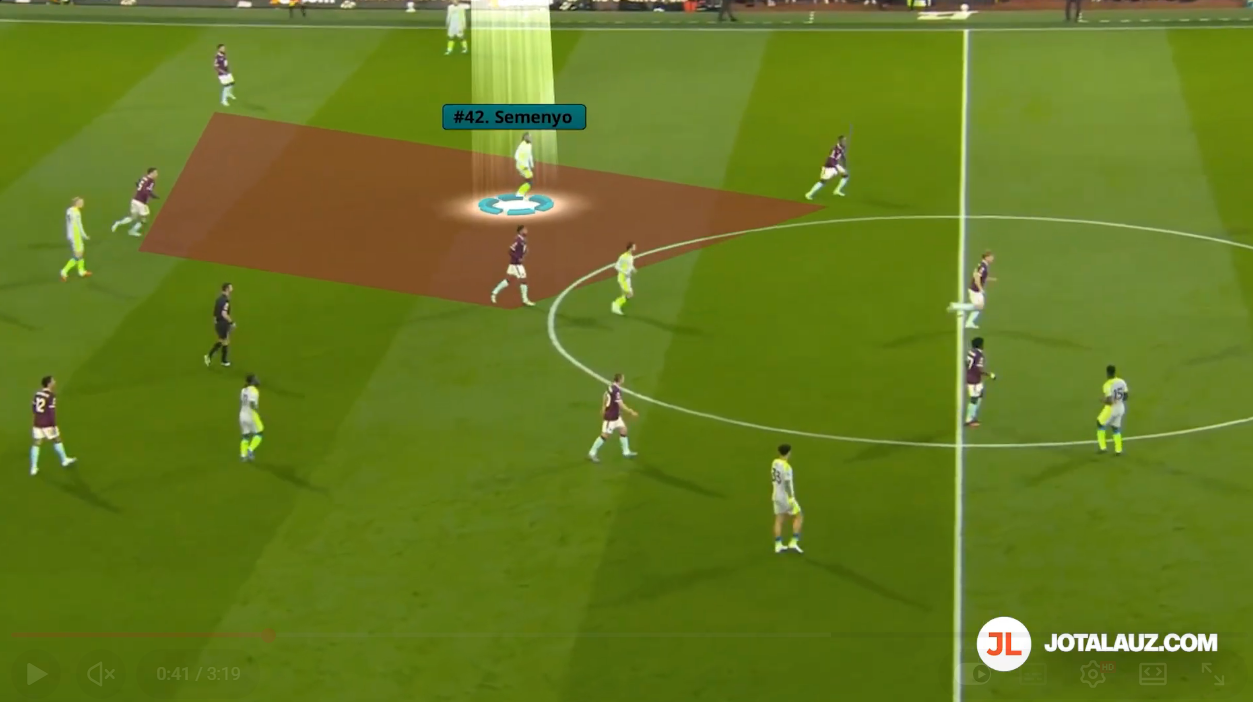
Following a sequence of horizontal circulation to shift Burnley's block, an exchange of positions occurs between Rayan Cherki and Antoine Semenyo.
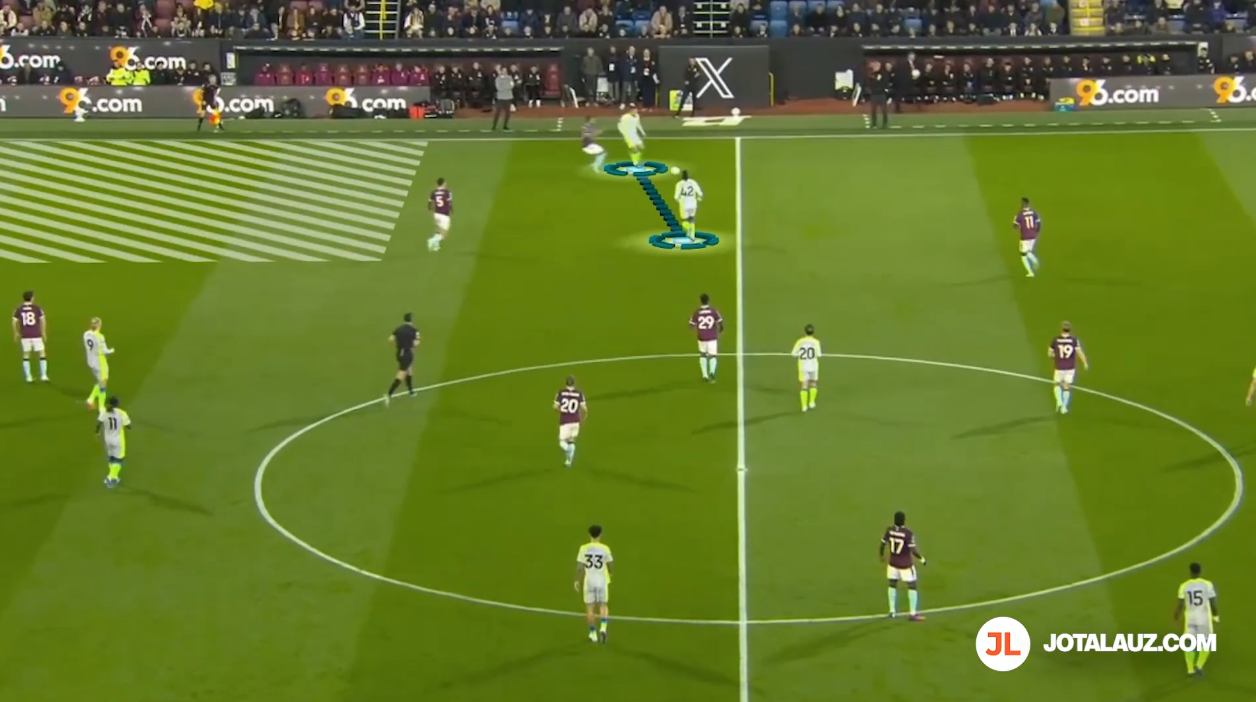
The Frenchman moves to occupy the right flank in the wide channel, while the winger moves into the inside channel to execute an inside-out run that effectively draws the stopper out of his zone.
Logically, given the presence of Erling Haaland who pins the sweeper in the centre-forward position, this creates space in behind that can be exploited if there is good chemistry among our players.
Manchester City manage to access the defensive depth and counteract the marking and tracking of the five-player attacking line.
This is achieved through this prior attraction via Semenyo’s run, which creates space behind the left stopper, and a clever one-two between both City players allows them to attack the previously generated space.