
BJ Callaghan Tactics At Nashville SC 2026: How To Build MLS Title Contenders – Data Analysis
Nashville SC have evolved dramatically under BJ Callaghan. This data analysis examines their younger squad, increased possession, clinical finishing and defensive overperformance to explain their remarkable 2026 MLS rise.

Who Is BJ Callaghan?
When BJ Callaghan took charge of Nashville SC in July 2024, he inherited a side built around defensive solidity, direct attacking and Hany Mukhtar.
Since then, Nashville have undergone an evolution.
Callaghan’s first full season brought the club its first trophy, a record 22 wins and 75 goals, while 2026 has taken their progress to another level.
The challenge is that Nashville don't resemble a dominant team when judged through the underlying numbers.
Many of their possession, chance-creation and territorial metrics remain around the middle of the MLS pack.
So, how have they reached the top of the Eastern Conference table?
In this Nashville SC data analysis, we trace Nashville’s evolution under Callaghan and use the numbers to identify the mechanisms behind their rise.
A Younger Core For A New Era
Callaghan has overseen a remarkable transformation in Nashville’s age profile.
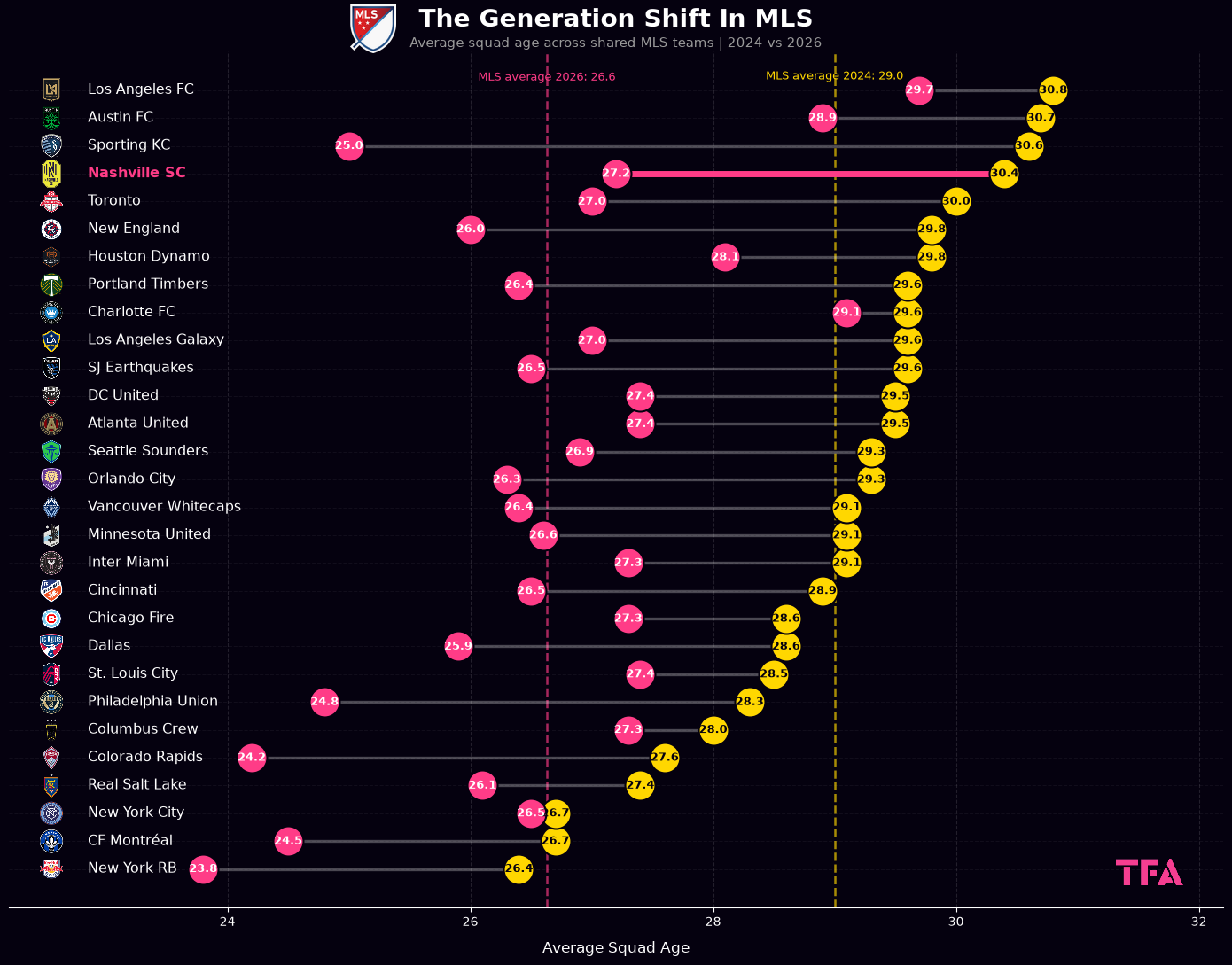
In 2024, they were one of MLS’s oldest sides, with an average age of 30.4, more than a year above the league average of 29.
By 2026, that figure had fallen to 27.2, a reduction of 3.2 years, while the league average itself dropped to 26.6.
Average Squad Age Across Shared MLS Teams 2024 Vs 2026
This wasn't simply a statistical change, but the result of deliberately integrating younger players into important roles.
Matthew Corcoran, Eddi Tagseth, Patrick Yazbek, Ahmed Qasem and Brian Schwake all became increasingly important, while Nashville also added 24-year-old defender Maxwell Woledzi and further youthful depth.
In 2025 alone, seven players made their MLS debuts under Callaghan, highlighting his willingness to trust emerging talent.
The result is a younger, deeper squad capable of sustaining Nashville’s evolution.
The Shift Towards Possession Control
Perhaps the clearest sign of Nashville’s evolution under BJ Callaghan has been the change in their relationship with the ball.
In 2024, Nashville ranked 25th in MLS for possession, averaging just 47.3%, reflecting a side more comfortable without the ball and looking to attack directly.
That figure rose to 49.8% in 2025 before reaching 55.0% in 2026, placing them sixth in the league.
MLS Possession Evolution Across Shared Teams 2024 Vs 2026
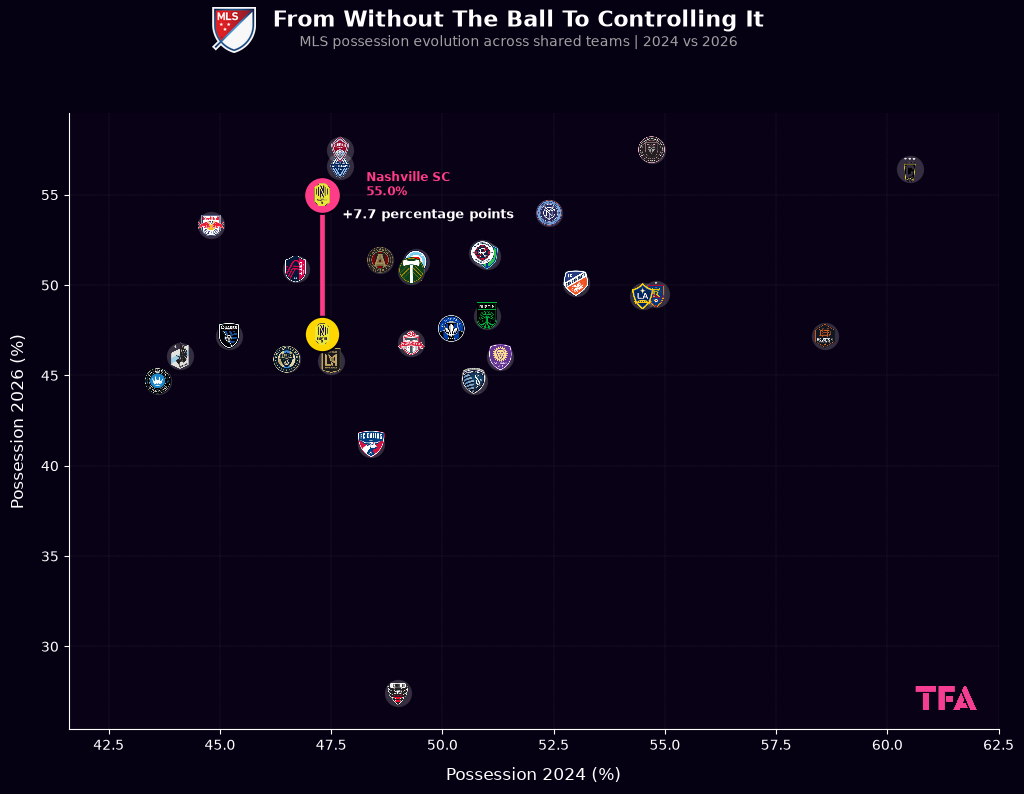
The scale of that change is significant; Nashville have moved from the bottom quarter of MLS for possession to competing with the league’s most dominant teams.
The same shift is evident in their PPDA Against, which rose from 11.92 in 2024 to 16.84 in 2026.
MLS 2024 Vs 2026 - PPDA Against Evolution
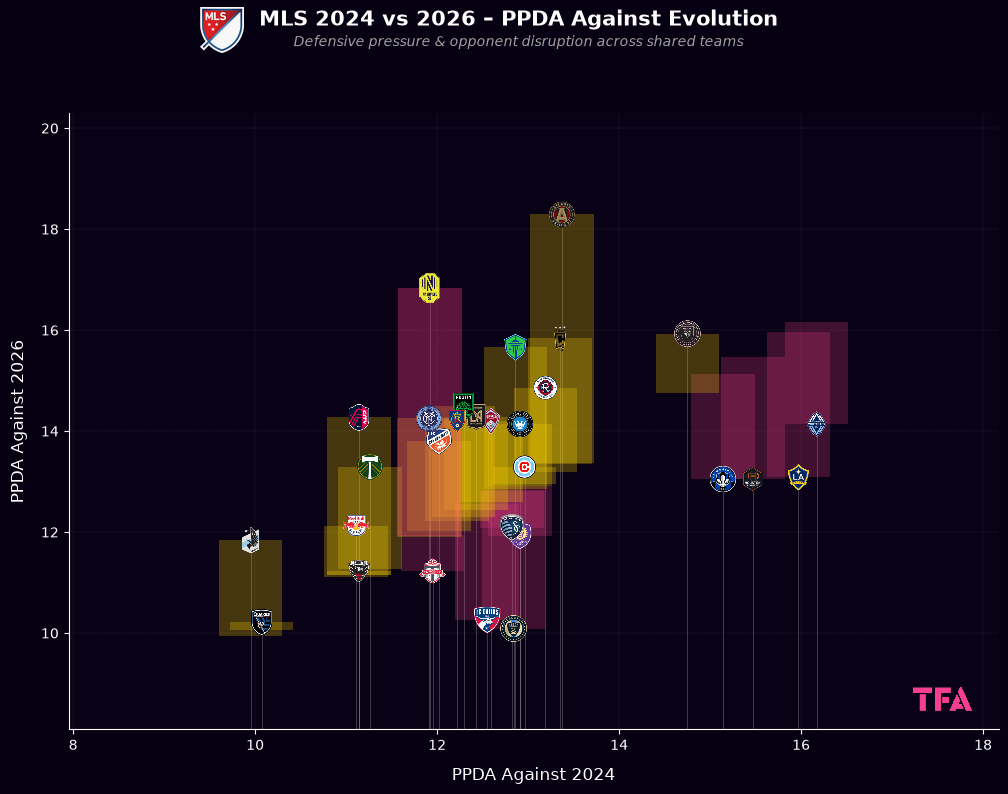
This measures how many passes Nashville complete before the opposition makes a defensive action in their own half, highlighting their ability to circulate the ball with greater freedom.
The improvement isn’t simply about accumulating possession; it reflects a deliberate shift towards controlling matches through the ball.
The Paradox Of Nashville’s League-Winning Pace
The real measure of Nashville’s transformation can be found in the gap between their results and the underlying data.
In 2026, Callaghan’s side have accumulated 46 points, the highest total in MLS, while the leaders of both conferences, Nashville in the East and Vancouver Whitecaps in the West, sit well clear of most of the competition.
Nashville’s 27.4 expected points are almost identical to the MLS average of 27.2, leaving a remarkable 18.6-point gap between what their performances would theoretically produce and what they have actually collected.