Everton Recruitment 2026/2027: Finding A New Centre-Forward For David Moyes Tactics - Data Analysis
Who could strengthen Everton’s attack alongside Thierno Barry? Using seven custom metrics and a 324-striker benchmark, this analysis compares Barry and Balogun with Mateta, Guirassy and Douvikas to assess finishing, movement, aerial threat and recruitment trade-offs.

Everton looked set to secure the signature of USMNT star Folarin Balogun on transfer deadline day to add some much-needed firepower to the Toffees’ forward line.
In the end, that move never came to fruition, as perhaps the most dramatic storyline from deadline day ultimately saw the reported £40m deal fall through.
Balogun, therefore, remains with Ligue 1 side AS Monaco, leaving the Merseyside club with just one recognised senior centre-forward, in 23-year-old Thierno Barry.
Regardless of how highly you might rate Barry, a team of Everton’s stature, who’ll be hoping to improve on their 13th-place finish last season, can’t go the entire Premier League campaign with just one recognised centre-forward, nor had they intended to do so.
The striker position has been a clear area for improvement for David Moyes’ side since last season, when minutes were shared pretty evenly between Barry and Beto, with the latter having now joined Serie A side Fiorentina.
Barring a move for a free agent, which is unlikely to give Everton the quality or immediate impact they’d desire, the nine-time champions of England will have to remain patient until January, during which time they can assess their potential options and line up a move to finally bolster their attack.
This Everton recruitment analysis and data analysis provides analysis of Barry, Balogun and three more potential options who the Toffees could realistically consider to improve their attack.
All five forwards, Barry and Balogun included, are evaluated through the lens of seven custom-built metrics derived from weighted combinations of Wyscout's raw event data, benchmarking each striker against all 324 strikers to have played at least 800 minutes in Europe’s top-five leagues over the past calendar year.
Thierno Barry: The Current Option
Thierno Barry (6’5”) provides a useful baseline against which the other Everton striker options can be assessed.
Ideally, the player Everton bring in will match or exceed Barry in the metrics we’ve deemed most important for the Toffees’ centre-forward recruitment: Finishing, Chance Generation and Box Threat.
Finishing is self-explanatory; Everton will want to sign a forward who’s going to convert the opportunities they create efficiently, and those players are the ones who our Finishing metric is designed to promote.
Meanwhile, the other two metrics named above are designed to highlight players who consistently put themselves in desirable goalscoring positions and produce encouraging off-the-ball movement.
Aerial Threat is also important, as this part of a forward’s game provides an additional route to goal and helps to ensure Everton retain the physical qualities up front, which Barry already offers, as is evident from his incredibly high percentile rank in that particular metric below.
Thierno Barry Percentile Ranks 2025/2026
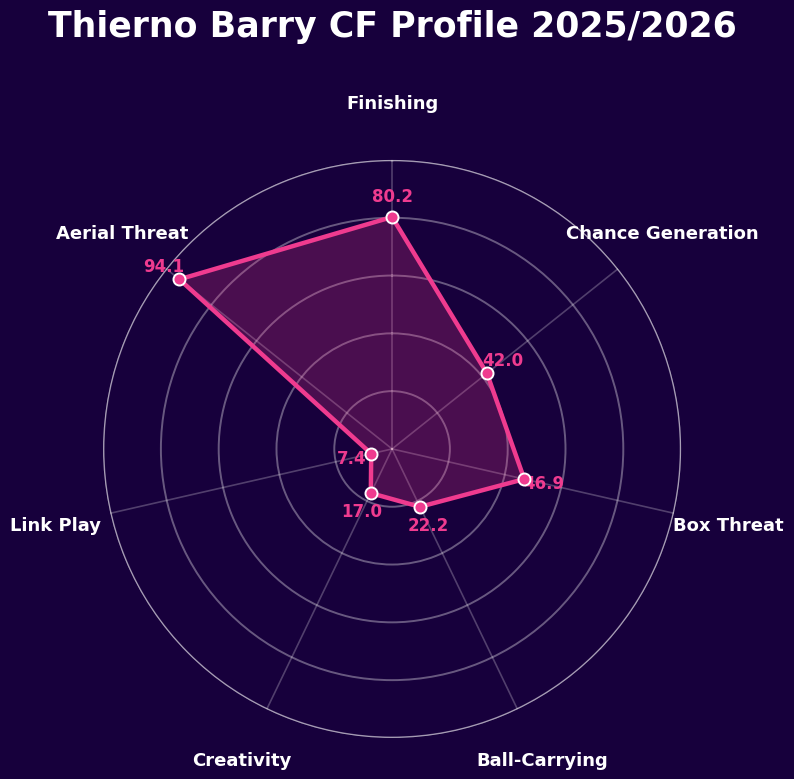
Barry’s best scores come in Aerial Threat and Finishing, highlighting a proficiency in two fundamental skills required of a Premier League centre-forward.
The rest of his profile is less encouraging, however.
While he can finish opportunities when he gets them, he isn’t consistently generating enough dangerous situations.
Part of that also reflects the team environment in which Barry has been operating, as he obviously needs supply from teammates in order to convert chances.
However, compared to Beto, who also plied his trade at Hill Dickinson Stadium last term, Barry’s percentile rank is 17 and 19 lower than his former teammate in Chance Generation and Box Threat, respectively, so finding those high-value goalscoring positions and working on his ability to provide options for the team has to remain a key area of focus for the former France U21 international.
His supporting numbers are weaker still.
Barry ranks in just the 22nd percentile for Ball-Carrying, 17th for Creativity and 7.4th for Link Play.
This paints the picture of a highly specialised centre-forward whose influence outside the box is quite limited.
Now, Barry may still develop into a useful centre-forward at Premier League level, but the data does not suggest he is currently providing the reliability expected from a first-choice striker at a team of Everton’s stature.
His profile helps to establish a fairly clear benchmark for the recruitment process: the ideal player should retain Barry’s goalscoring and physical strengths while offering greater chance generation and involvement in the rest of Everton’s attacking game.
Folarin Balogun: The One That Got Away
Analysis of Folarin Balogun (5’10”) is useful because he provides a clear solution that Everton have already deemed acceptable, and who they could even go back in for in January.
Throughout this analysis, bear in mind that the key to Everton’s centre-forward recruitment is that they aren’t tasked with replacing someone who just isn’t good enough; Barry is a promising young forward.
However, Everton can’t just rely on him, and they also need more reliable, consistent access to high-value goalscoring opportunities.
With that said, Balogun’s profile provides another highly interesting benchmark.
Folarin Balogun Percentile Ranks 2025/2026
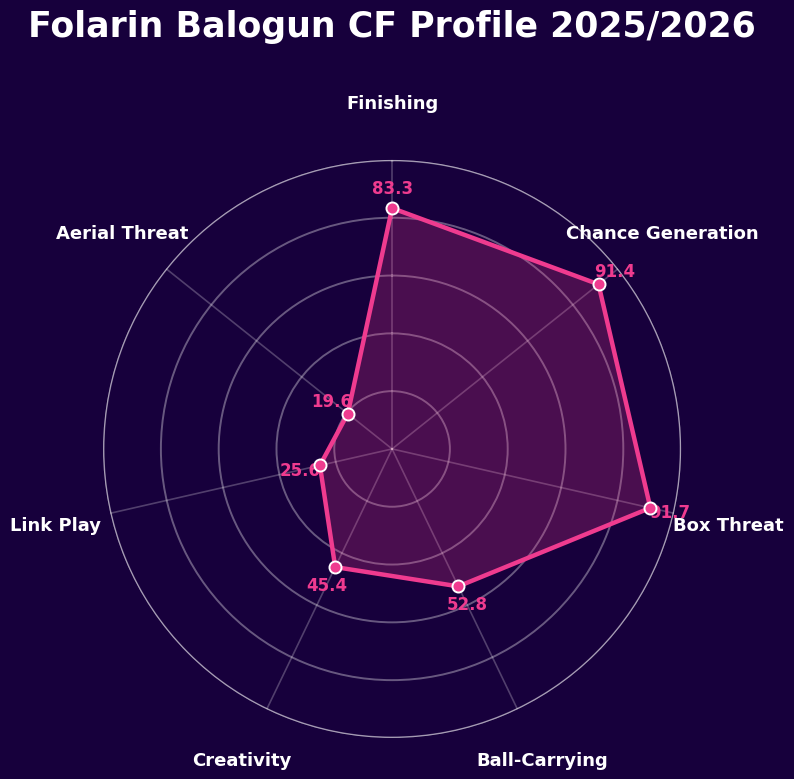
With Balogun, Everton could’ve retained the finishing quality that Barry offers or even slightly improved on it.
They also would’ve acquired a much broader goalscoring profile, with the 25-year-old United States international offering a track record of strong off-the-ball movement and attacking positioning, which Barry doesn’t currently provide.
So, Balogun doesn’t just finish off his opportunities well, but he generates plenty of them.
Again, bear in mind that league context and team environment will also have a strong influence on those exact numbers.
Balogun’s Ball-Carrying and Creativity are beyond that of Barry, which would offer Everton another dimension which their French forward doesn’t currently provide.
The trade-off comes when you look at the Aerial Threat numbers and see that Balogun pales in comparison to Barry in this area, so Everton really would’ve brought an entirely different profile of centre-forward to the Hill Dickinson Stadium if they’d signed Balogun.
That’s not necessarily a bad thing; it can help a team to have a different profile to bring off the bench who can ask different questions of the opposition, who would’ve been dealing with a different type of striker all game.
Nevertheless, Balogun can’t be described as a complete centre-forward by any means, particularly in terms of facilitating attacks with his link-up play, where, like Barry, he falls short, or providing an aerial threat.
We can still see why his profile appealed to Everton, looking at the shape of his radar above.
He still generates strong numbers in the areas that matter most for Everton in their centre-forward recruitment: Finishing, Chance Generation and Box Threat.
Balogun would’ve represented a notable improvement over Barry in the areas most likely to translate into consistent goalscoring output, even though his presence in the squad would sacrifice some of Barry’s aerial presence.
The underlying data suggests there was sound logic behind the Toffees’ interest in Balogun.
The question now, if they are unable to go back in for Balogun and get the deal done in January, is whether they can turn his failed transfer into a positive and identify an alternative who offers a comparable combination of finishing quality and consistent access to goalscoring opportunities at a potentially better price.
Balogun is currently valued at €50m per Transfermarkt, with a Monaco contract running until June 2028.
His reported Everton transfer fee was just a few million short of that Transfermarkt valuation.
The three remaining strikers considered in this analysis are all valued by Transfermarkt at a lower fee than that of Balogun; Transfermarkt fees are to be taken with a grain of salt in terms of accuracy, but they provide a useful indication of market value, nonetheless.
One has a contract expiring at the end of this season, one in 2028, like Balogun and one has a contract expiring in 2029, which will also come into play when considering transfer fees.
Nevertheless, none of these players should really be any less attainable for Everton than Balogun would’ve been.
With that said, the next section looks at our Premier League-proven centre-forward option, Crystal Palace's Jean-Philippe Mateta.
Jean-Philippe Mateta: The Premier League-Proven Option
Jean-Philippe Mateta (6’4”) is currently valued at €30m by Transfermarkt.
He’s 29 years old, and his current contract is set to expire at the end of the season, making him a potential bargain if Everton could possibly agree on personal terms with the Crystal Palace man.
Barry’s compatriot represents a fairly straightforward option given his proven track record of scoring goals consistently over the past three seasons in England’s top flight, the exact kind of reliability that Everton are crying out for up front.
With that in mind, along with the fact that he could realistically be an excellent mentor for Thierno Barry to learn from at Hill Dickinson Stadium, this is a potential move I’d be a strong advocate for if it’s workable.