

Massimiliano Allegri Tactics At Napoli 2026/2027: Can They Fix Their Pressing Problems? - Data Analysis
Napoli have struggled for control under Massimiliano Allegri. This data analysis examines their low pressing intensity, deeper defensive sequences, lack of high turnovers, possession recovery issues and over-reliance on passing for progression.

Massimiliano Allegri’s return to Serie A has produced an uneven start at Napoli, with the reigning champions struggling to reproduce the control and consistency expected from them.
Allegri has introduced a 4-3-3 structure built around patient build-up, Stanislav Lobotka’s involvement in possession and greater verticality in the final third, while the team can shift into a 4-4-2 when defending.
Napoli have already shown weaknesses in several areas, including playing out against pressure, maintaining defensive intensity and turning possession into a consistent attacking threat.
Their pressing has also lacked the intensity required to regain possession high up the pitch, while lapses without the ball have exposed the team to dangerous transitions.
With results failing to fully reflect their periods of possession and territorial control, there are several tactical questions surrounding Allegri’s side.
In this Massimiliano Allegri at Napoli data analysis, we examine Napoli’s tactical problems and their issues at pressing intensity.
Napoli Pressing Lacks Intensity
One of Napoli’s clearest problems during the opening five Serie A matches has been the intensity of their pressing.
Napoli Challenge Intensity & PPDA Compared With The Serie A Average
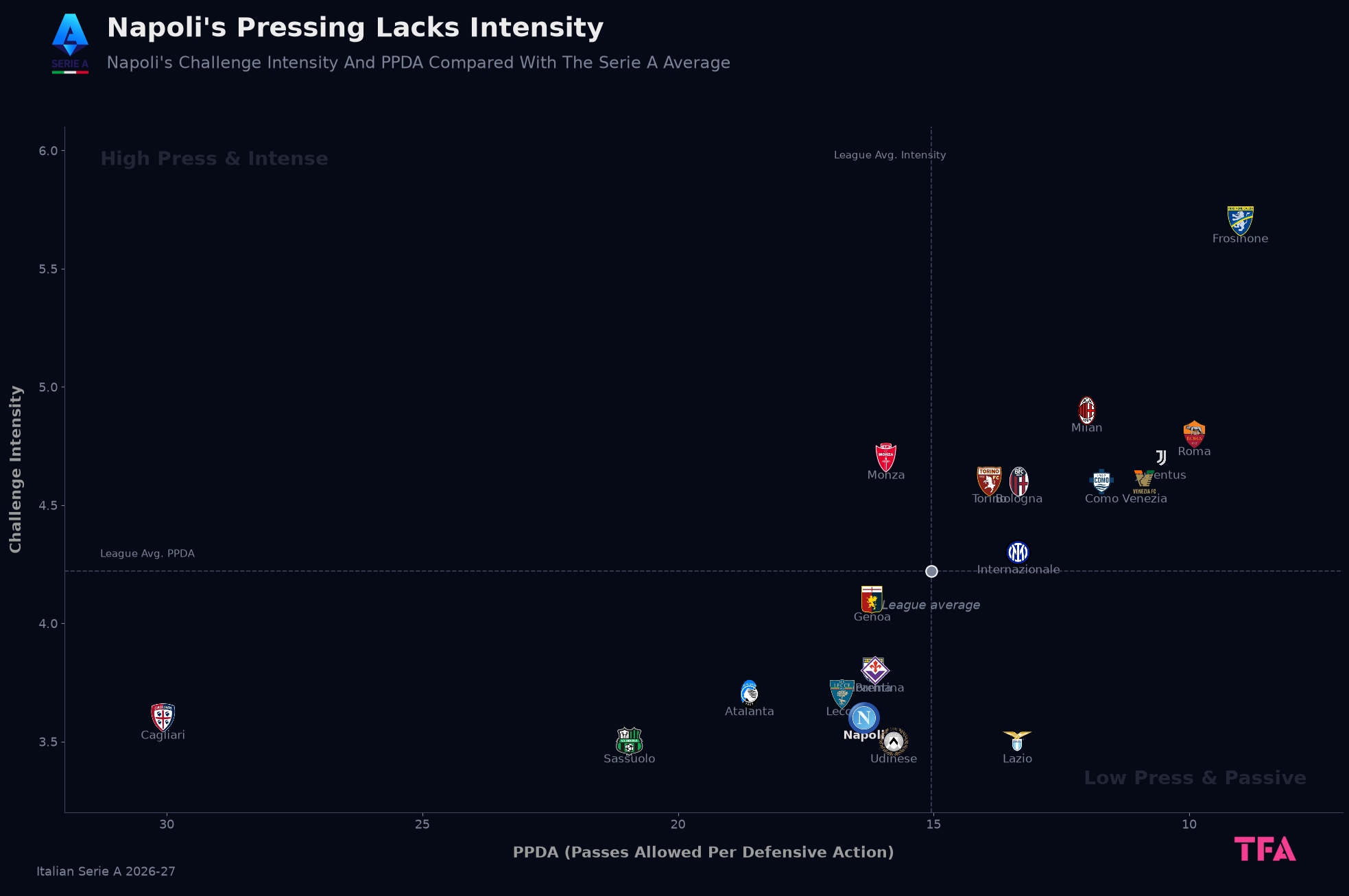
Their Challenge Intensity of 3.6, which measures defensive challenges per minute of opposition possession, is well below the league average of 4.22 and places them among the lowest-ranked sides in Serie A.
The issue becomes even more apparent when looking at PPDA, where Napoli record 16.36 compared with a league average of 15.05.
This means opponents are generally allowed more passes before Napoli attempt a defensive action, suggesting that their pressure is neither frequent nor consistently aggressive.
The contrast with several of the league’s stronger pressing sides is particularly significant: AS Roma record a 9.9 PPDA, Juventus 10.55, AC Milan 12 and Inter Milan 13.34.
Napoli’s 16.36 is therefore the weakest figure among these established sides, indicating that their defensive approach has often allowed opponents to circulate possession without being subjected to immediate pressure.
This has become an important issue in Allegri’s early tactical setup, particularly when Napoli fail to regain the ball quickly after losing it.
Napoli Pressing Sequences Start Too Deep
The location of Napoli’s pressing sequences provides further evidence of a relatively passive approach.
Napoli recorded 50 pressed sequences across their opening five matches, with only Cagliari, Bologna and Parma producing fewer.
More importantly, their average Start Distance was just 40.1 metres.
Napoli Pressing Sequences Start From Deeper Areas Than Most Serie A Rivals
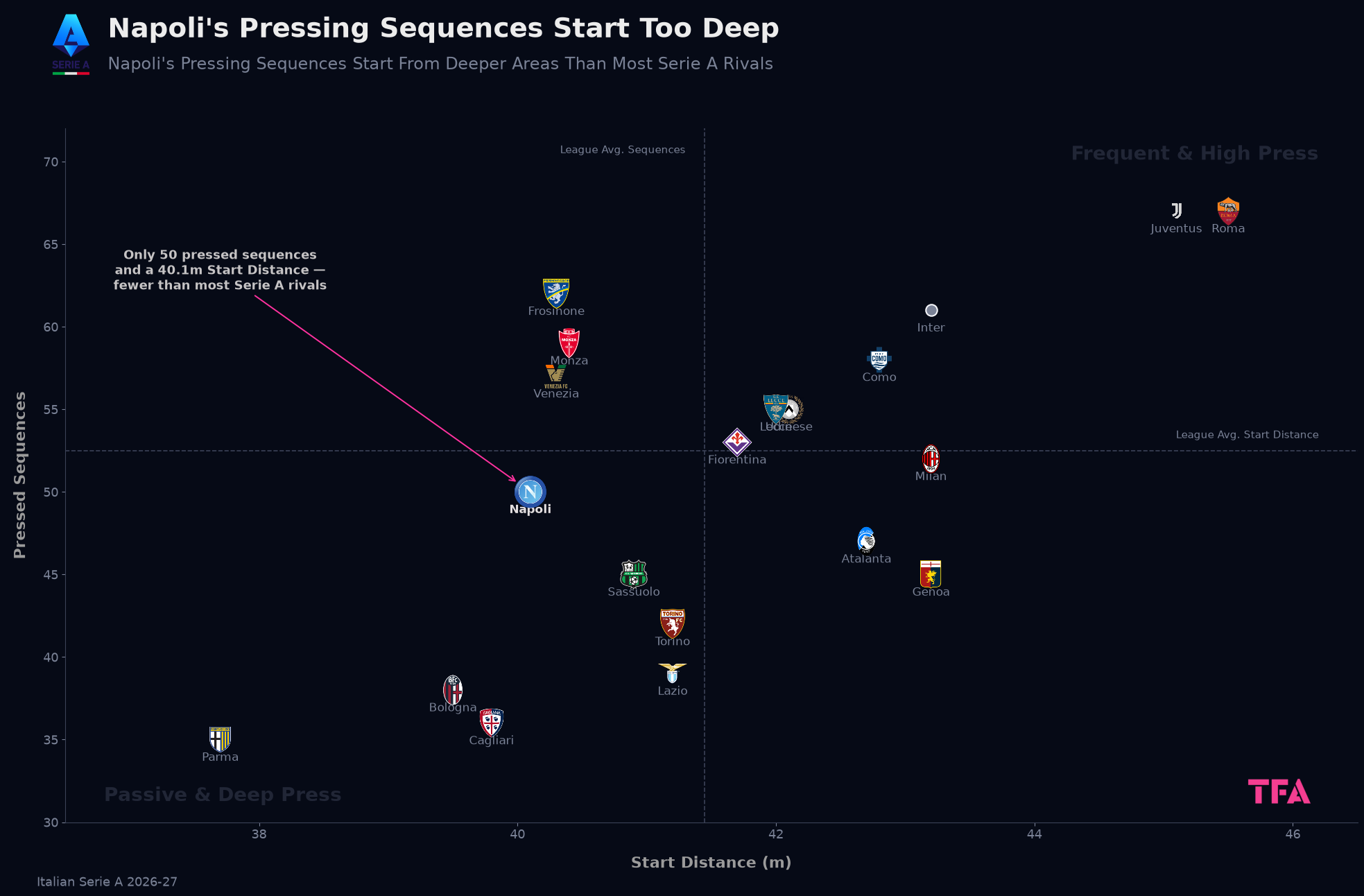
Start Distance represents how far from Napoli’s own goal the final defensive line of the pressing sequence is positioned, meaning a lower figure indicates that the sequence finishes with the defensive block sitting deeper.
Napoli’s figure is lower than Roma (45.5m), Juventus (45.1m), Milan (43.2m) and Inter (43.2m), as well as most of the league.
This suggests that Napoli are frequently allowing pressing sequences to develop without consistently pushing their defensive line high up the pitch.
Their defensive structure can retreat towards deeper positions, reducing the distance between the opposition and Napoli’s goal while making it harder to regain possession close to the final third.
Too Few High Turnovers
The consequences can be seen in Napoli’s high turnovers.
Across the first five matches, they recorded only 23 high turnovers, comfortably below Roma’s 58, Juventus’ 44 and Inter’s 36.