Carlos Baleba Scout Report At Manchester United 2026/2027: How Does His Transfer Reshape Michael Carrick's Midfield? – Data Analysis
Carlos Baleba joined Manchester United from Brighton. This scout report analyses his tactical role and skills, key defensive qualities and weaknesses, and how his profile fits alongside Youri Tielemans, Andrey Santos and Kobbie Mainoo.

Who Is Carlos Baleba?
After being heavily linked with the move for over a year, Carlos Baleba (179cm/5'10", 77kg/169lbs) has finally made the switch from Brighton & Hove Albion to Manchester United.
Baleba’s move makes him the Red Devils’ third central midfield signing of the summer, with the Cameroon international following Andrey Santos and Youri Tielemans to Old Trafford.
He’s also the most expensive of Manchester United’s three midfield summer signings so far, coming in at a reported €75.9m.
This Carlos Baleba scout report and data analysis examines exactly what kind of midfielder United have signed, using custom defensive metrics and underlying Wyscout data to assess his strengths and weaknesses, compare him with his new midfield teammates and explore the combinations that could allow him to have the biggest impact at Old Trafford.
United are not signing a complete defensive midfielder or someone whose profile is as rounded as that of the departed Casemiro.
His ability to secure possession and progress the ball after winning it remains a clear area for development.
Baleba provides Michael Carrick with a completely different profile to his existing midfield options, and the partner played alongside him has the potential to significantly alter how the Red Devils play.
Carlos Baleba Style Of Play
After accumulating a reduced 1793 minutes for Brighton during a stop-start 2025/2026 Premier League campaign, Figure 1 presents key 2025/2026 percentile ranks using custom-built defensive metrics derived from weighted combinations of Wyscout's raw event data, benchmarking Baleba against other central midfielders who played at least 800 minutes in England's top flight last season.
These metrics aim to isolate different aspects of defensive midfield play, from anticipation and ball recovery to duel efficiency, defensive activity and transition value.
Carlos Baleba Out Of Possession Data 2025/2026
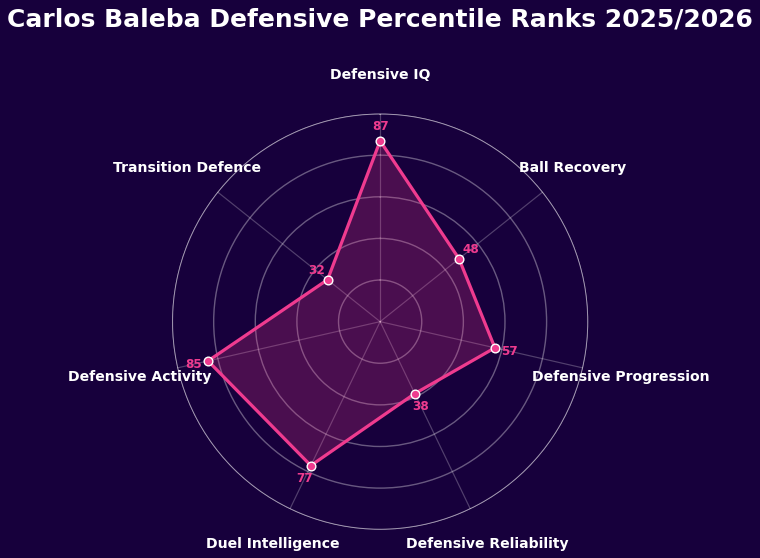
Baleba ranks in the 87th percentile in our Defensive IQ metric, the 85th percentile for Defensive Activity and the 77th percentile for Duel Intelligence, with those three standout metrics pinpointing the main defensive highlights of his game.
Meanwhile, Baleba records much more modest scores for Defensive Progression (57th percentile), Ball Recovery (48th percentile), Defensive Reliability (38th percentile) and Transition Defence (32nd percentile).
Team style and specific role requirements relative to the rest of the dataset must be taken into account alongside individual ability when interpreting this data.
At Brighton, Baleba’s main off-the-ball contribution came through active, high-risk intervention.
The Defensive IQ metric, in which Baleba records his highest score, is based on interceptions and loose-ball recoveries.
The high score indicates that Baleba’s defensive contribution is not entirely duel-dependent; he has a strong ability to read the game.
Similarly high scores for Defensive Activity and Duel Intelligence point to his high frequency of involvement in out-of-possession phases versus in-possession actions, along with his high level of success when he does opt to engage.
He actively seeks opportunities to break up the play when his team is without the ball, seeing much more involvement in such phases relative to his involvement in possession.
At the same time, the Duel Intelligence score confirms that he isn’t simply lunging into duels carelessly; rather, he’s demonstrating genuine quality to come out on top when he engages.
This all sounds really good.
However, the downsides to the profile add important nuance.
Baleba’s poor Defensive Reliability score is a result of his high foul volume.
That part of his game is a natural result of the style of play he’s employed at Brighton.
Baleba gets around the midfield and makes his presence known, aggressively putting himself in the types of high-risk situations where fouls can easily occur.
Ball Recovery will also be affected by this drawback, as that particular metric measures how often defensive involvement ends with possession for the player’s team.
Ball Recovery and the other two metrics, which yield less encouraging scores, Defensive Progression and Transition Defence, are also impacted by Baleba’s limitations in possession.
Midfielders who help their team move from defence to attack will perform well in those metrics, and Baleba is not one of them.
The 22-year-old is not (yet) a complete defensive midfielder due to his in-possession limitations.
He can break up opposition play, but doesn’t currently tend to exploit the regain and make the most of the actions that follow the defensive contribution.
Carlos Baleba Heat Map 2025/2026
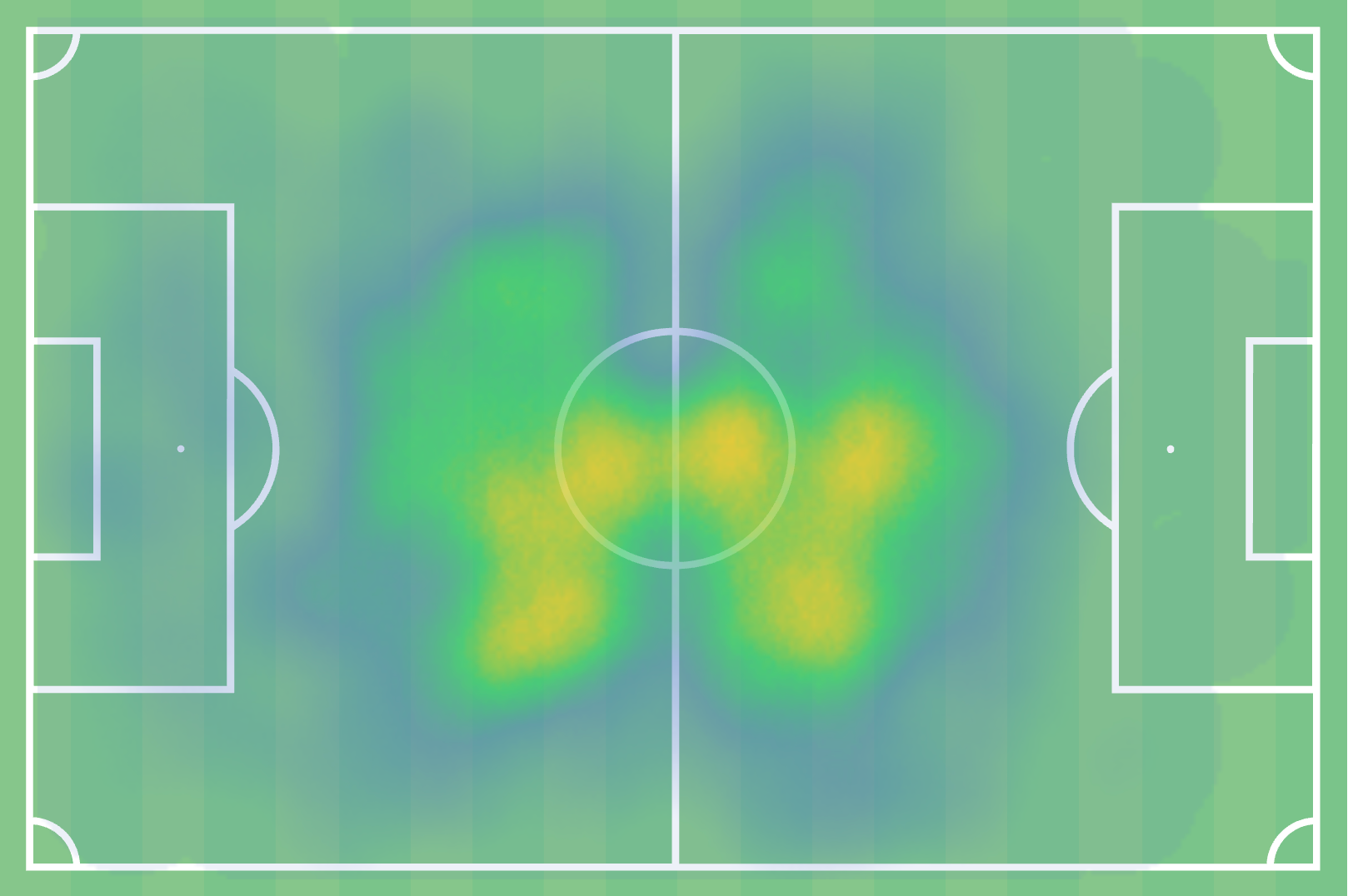
Baleba’s heat map shows how his influence is concentrated around the central midfield zones, with a notable amount of activity in both half-spaces.
This is typical of a midfielder who’s comfortable covering a lot of ground to influence play rather than protecting one fixed zone.
That mobility is valuable, especially in a double pivot which we’re likely to see Manchester United deploy throughout the 2026/2027 campaign.
If a full-back pushes forward, Baleba can move across to cover the channel as well.
If the opposition attempts to progress through midfield, he has the range to step out.
If possession is lost, his acceleration allows him to attack the ball or close the space around the receiver.
The trade-off is that such freedom requires excellent positional discipline from the player alongside him.
That’s one reason why his midfield partner matters so much and could be highly context-dependent.
How Does Carlos Baleba Compare With His New Manchester United Teammates?
The previous section established what Baleba is and what he isn’t.
This section aims to contextualise that profile within the current Manchester United midfield.
Figure 3 uses the same custom metrics analysed for Baleba in the previous section, comparing the Cameroonian with his new Manchester United teammates Youri Tielemans, Andrey Santos and Kobbie Mainoo, as well as Casemiro, who swapped Old Trafford for Inter Miami this summer.