Christian Ilzer Tactics At Hoffenheim 2025/2026: The Bundesliga’s New Pressing Machine – Tactical Analysis

TSG 1899 Hoffenheim ended the 2024/2025 Bundesliga campaign down in 15th place.
That campaign saw Pellegrino Matarazzo sacked as manager in November, when he was replaced by Christian Ilzer, who had developed a glowing reputation for himself as a league and cup winner in Austria with SK Sturm Graz.
Having joined Hoffenheim during the 2024/2025 campaign, the 2025/2026 season was going to be a real opportunity to assess Christian Ilzer tactics and leadership at a higher level than he’d been working with Sturm Graz, and he succeeded in steering Hoffenheim 10 places up the table.
Die Kraichgauer finished the season in fifth place, just on the periphery of UEFA Champions League qualification.
They’ll remember 2025/2026 a lot more fondly than 2024/2025.
Crucially, Hoffenheim’s 2025/2026 success is built on the back of a clear tactical identity instilled by Christian Ilzer.
The team is perhaps best described as an aggressive, reference-oriented, high-pressing side.
Their tactical identity is built around access, duels and central pressure more than a formation or structure.
This TSG Hoffenheim tactical analysis focuses on Die Kraichgauer’s out-of-possession performance in 2025/2026, which is where Hoffenheim have been one of Europe’s top-performing sides this season with Christian Ilzer style of play.
This team analysis looks at how Hoffenheim’s pressing has helped them put a disappointing 2024/2025 campaign well behind them and set them on the path to far better things in 2025/2026.
Christian Ilzer TSG Hoffenheim Pressing Principles
In terms of formation, TSG Hoffenheim’s shape shifts frequently between 3-4-2-1, 3-5-2, 4-2-3-1 and 4-3-3 structures depending on outer shell changes.
However, the central reference structure generally stays quite stable.
Hoffenheim’s core principles are typically as follows:
- Maintain tight central access.
- Maintain pressing connections around the ball.
- Create defensive cover behind aggressive jumps to sustain intensity.
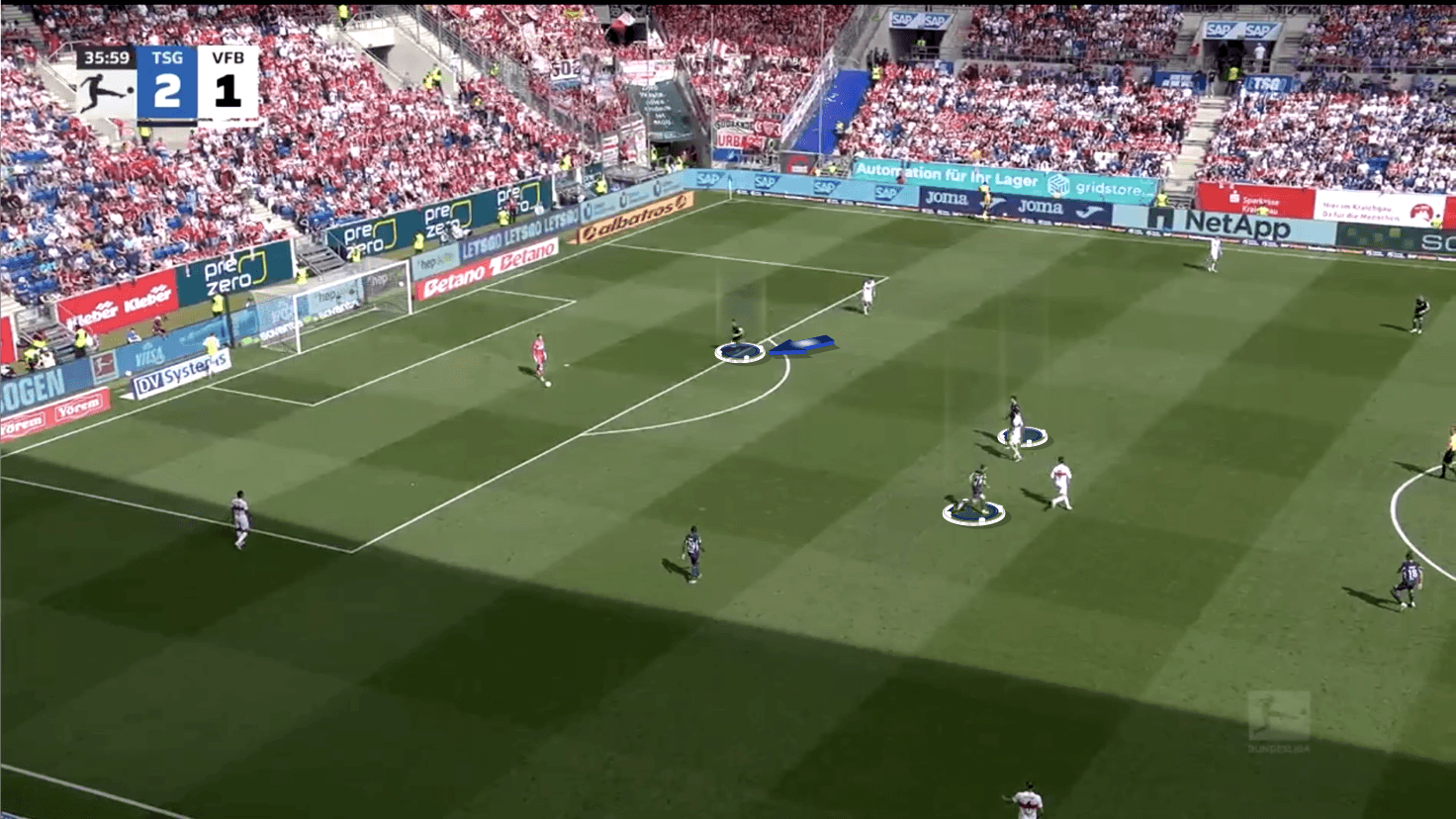
Hoffenheim’s clearest consistent principle is strong central man-orientation, as observed in Figure 1.
Hoffenheim’s central midfielders stay tight to their VfB Stuttgart counterparts.
Ilzer’s side matched up with Stuttgart’s two central midfielders, while the wingers and centre-forward maintained access to Stuttgart’s backline.
This setup makes it difficult for Stuttgart to pass the ball out from the back, especially through the centre.
They could go long, but as they discovered, like many other opponents this season, Hoffenheim’s physicality and aerial ability is a massive strength, so playing the ball out long against them doesn’t result in a lot of success.
Hoffenheim centre-back Ozan Kabak contested the most aerial duels per 90 (9.21) of any defender to have played at least 800 minutes in the Bundesliga this term, while maintaining a solid 58.71% success rate, highlighting his aerial dominance at the back for Hoffenheim this term.
Left-back/left centre-back Bernardo was similarly assertive in the air for Hoffenheim, contesting 6.39 aerial duels per 90 and winning 57.46% of them.
Importantly, Hoffenheim’s squad profile reflects the demands of Ilzer’s system.
They have a team packed with physicality, aerial strength, energy and duel capacity.
They fit Ilzer’s system and vice versa.
For defenders, in particular, the system’s success relies on the ability to cover space aggressively while maintaining physical competitiveness in direct duels.
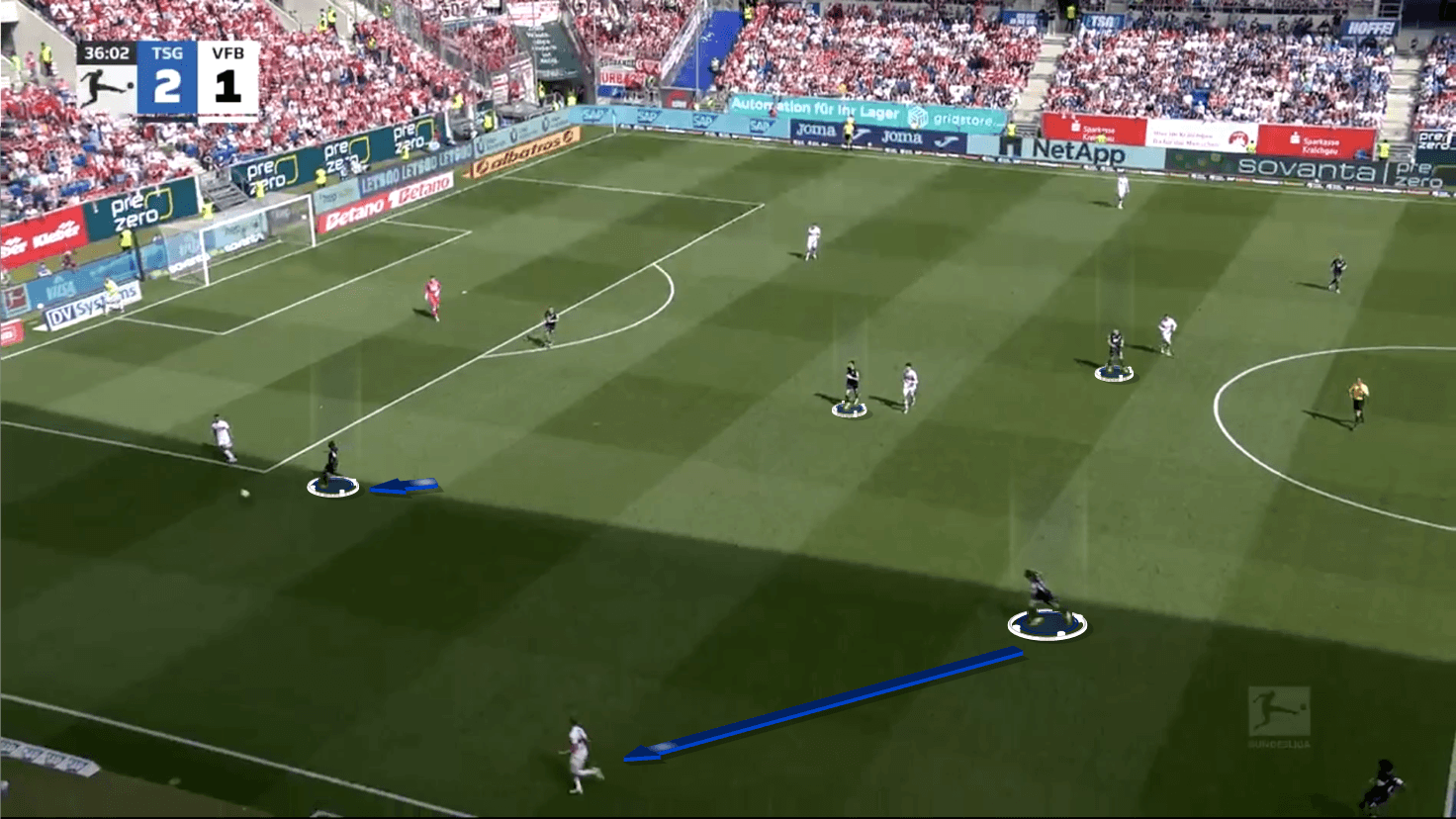
Instead of trying to contest an aerial duel with Hoffenheim’s defenders, Stuttgart try to play it out short.
With the centre very congested, they are forced wide, where space is at a premium, and Hoffenheim can intensify their press further.
Hoffenheim’s spare midfielder with no man-marking assignment in the middle of the park jumps out to the wing as Stuttgart try to play it out from the back to close that receiver’s space and put him under immediate pressure.
The aim is to either force a turnover, which can lead to a goalscoring opportunity for Die Kraichgauer, or to ultimately force the long ball, which creates a favourable scenario for Hoffenheim anyway.
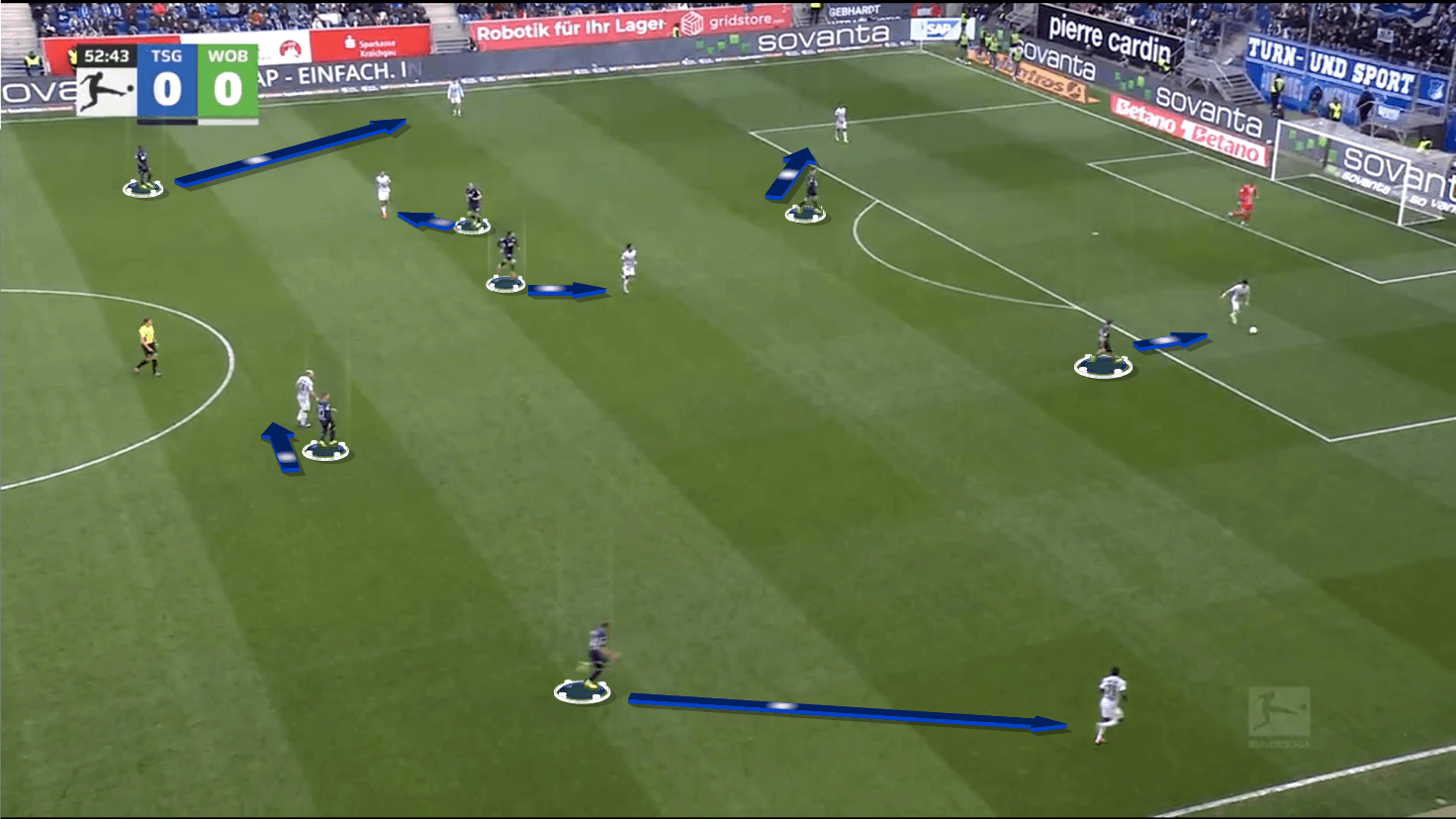
VfL Wolfsburg lined up with three central midfielders against Hoffenheim, and we see the result in Figure 3.
Hoffenheim’s shape is different in response to the opponent’s shape, but the principles of tight central access and pressure around the ball remain evident.
Once again, this forces the opponent into a hasty long ball, which creates a favourable 1v1 duel for Hoffenheim’s defenders.
It’s important to note that strong 1v1 ground defending is paramount for Hoffenheim, not just aerial duels.
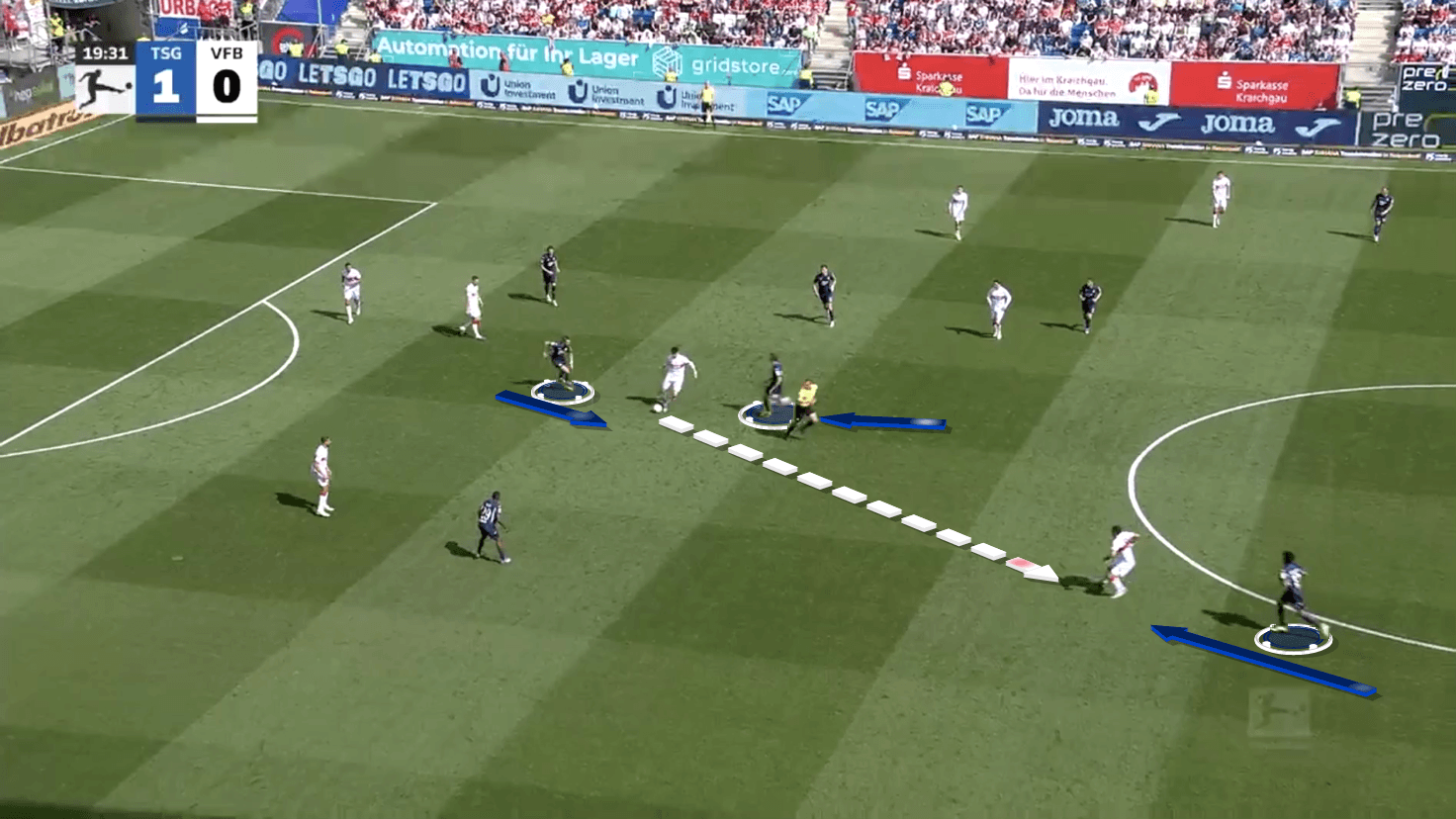
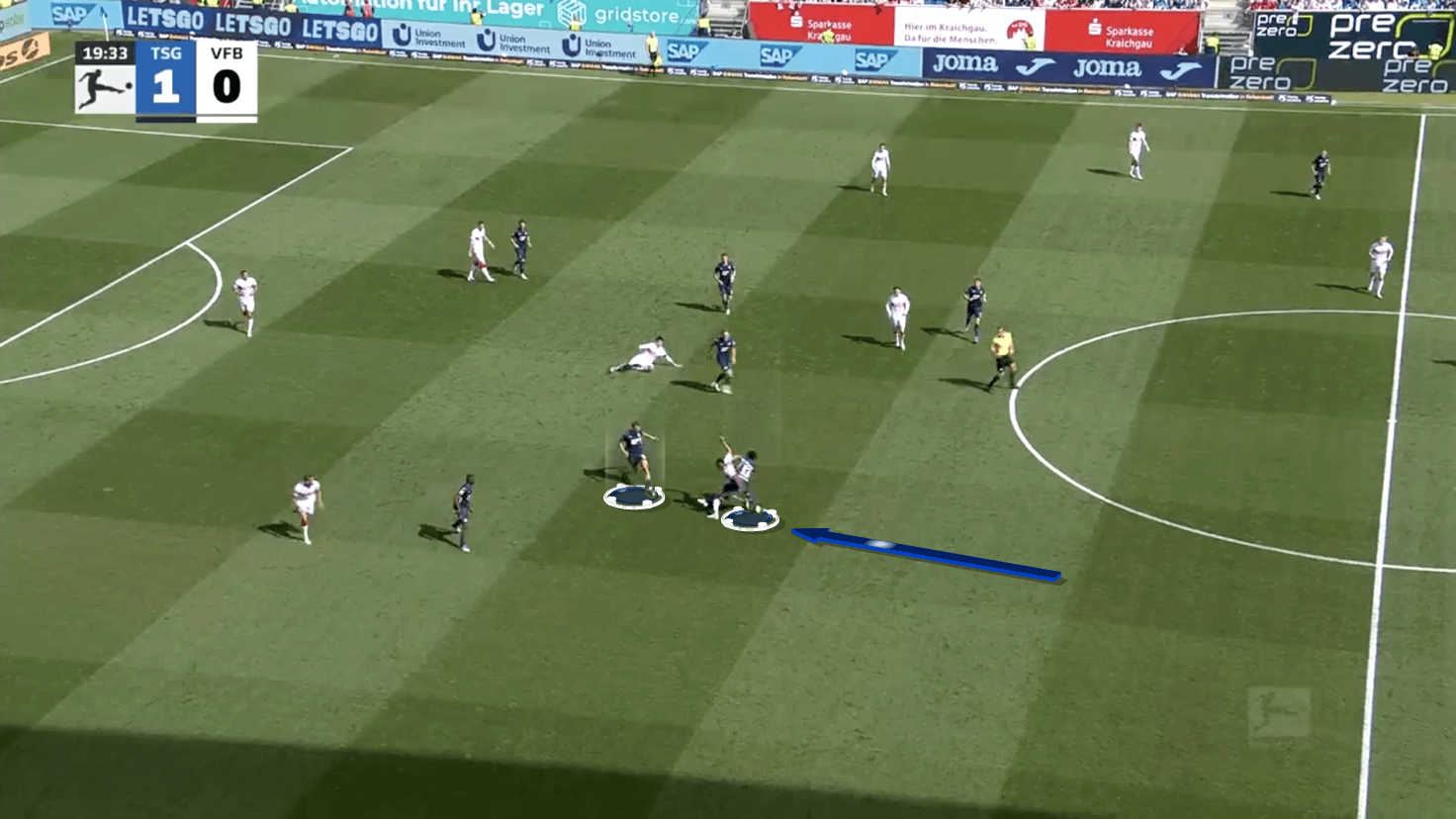
In Figure 4, we see Stuttgart in possession centrally.
The ball carrier is under immense pressure from both sides, reinforcing the third principle mentioned previously of providing strong defensive cover behind jumps to sustain intensity.
Hoffenheim’s deeper-lying players must be ready to move up, along with those positioned further forward, to guard against a lack of vertical compactness, which would make them far easier to play through.
Here, as the midfielder lines up his next forward pass, we see Bernardo jumping out behind the next intended receiver.