
How Top Teams Use Crossing Patterns To Break Defensive Blocks – Tactical Theory

Goals occurring from crossing situations, including set-plays, accounted for 12 of the 22 goals scored in the most recent Premier League weekend.
A reminder, if one was needed, that crossing remains a prominent means of creating goal-scoring opportunities.
Although just a snapshot, more than 50% of top-level goals come from just one attacking method, highlighting the importance of coaching these moments.
This tactical analysis dissects the football tactics behind successful attacks that involve crosses.
The optimal zone to cross from, the optimal number of attacking players in the box, and the optimal positioning for the second phase of crosses are all analysed in this tactical theory piece.
Also included in this analysis are training exercises that coaches can use to improve their team's chance creation from crosses.
Quick Crossing Stats
Looking at stats from this Premier League season, the average number of crosses per 90 is 13.32 per team.
Newcastle United provide the most crosses on average, with 16.77 deliveries per 90.
The least is Burnley, with 10.08 per 90, which may have as much to do with the league's second-bottom side not being able to reach positions to cross the ball as a tactical choice.
The average accuracy of a cross is 32.82%.
This means almost one in three crosses are met with a teammate making first contact.
A cross that reached its intended target area, but was not touched first by a teammate, would not count as accurate, despite going where the crosser intended.
This, of course, makes crossing far more inaccurate than passing.
However, the chances of actually scoring increase drastically, and, as will be analysed, sometimes losing the first contact and winning the second ball can be just as dangerous.
Where Do The Most Dangerous Crosses Arrive From?
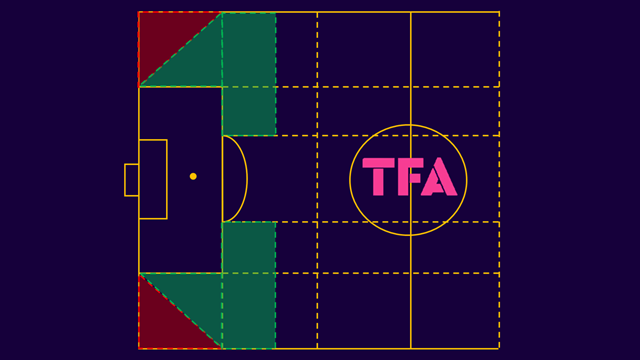
In the tactical diagram above, the green areas highlight the most dangerous areas from which crosses can arrive.
The cut-off triangle area represents an area where crosses in the modern game are rarely delivered, and when they are, they are generally ineffective.
There are several reasons for this, including timing.
Crosses in open play from this area, due to the distance the ball has to travel, take a long time to reach the goal area.
Another major explanation is that when players arrive in these areas with the ball, they are usually closed down quickly, with little room to manoeuvre to create an accurate cross.