Konstantinos Karetsas Scout Report At Borussia Dortmund 2026/2027: How Are Niko Kovač Tactics Shaping Greece’s Next Great No. 10? - Player Analysis
Konstantinos Karetsas is one of Greece’s brightest young talents. This scout report analyses his passing, dribbling, movement and creativity at Genk, before examining how his role has evolved within Niko Kovač’s structured Dortmund system.

Who Is Konstantinos Karetsas?
Greek football is set to have a golden generation coming through, and Konstantinos Karetsas could well be at the centre of it all.
The 18-year-old, who was born in Belgium, came through the academy at KRC Genk and established himself as one of the club's prodigies.
Last season, he registered three goals and 14 assists, which helped them finish third in the Belgian Pro League and qualify for the UEFA Europa League.
These performances from Karetsas attracted significant interest from European heavyweights in the summer of 2026.
Italian giants AC Milan and German club Borussia Dortmund got involved in a battle for his signature, with Dortmund ultimately winning the race for the young No. 10.
In this Konstantinos Karetsas scout report and player analysis, we analyse Karetsas' individual qualities and measure his statistical performances.
Konstantinos Karetsas Analysis At Genk
Karetsas stands tall at 1.71 metres, which allows him to have a low centre of gravity, one of the key factors behind his agility.
This allows him to orient his body in any direction or change direction quickly, making him a tricky customer for defenders to deal with, even in tight spaces.
Despite his limitations, Karetsas is not one to shy away from a challenge.
He averaged 4.99 duels won per 90 for Genk last season.
However, his lack of height is definitely a hindrance when he challenges for headers.
Although he has a decent reach for headers, his numbers pale in comparison to his ground duel success rate, as he had only a 25% success rate, making it a big limitation.
Karetsas' ability to read and occupy space is, perhaps, his strongest quality.
He constantly scans his surroundings to identify pockets of space between the opposition's line of defence, as seen in Figure 1.
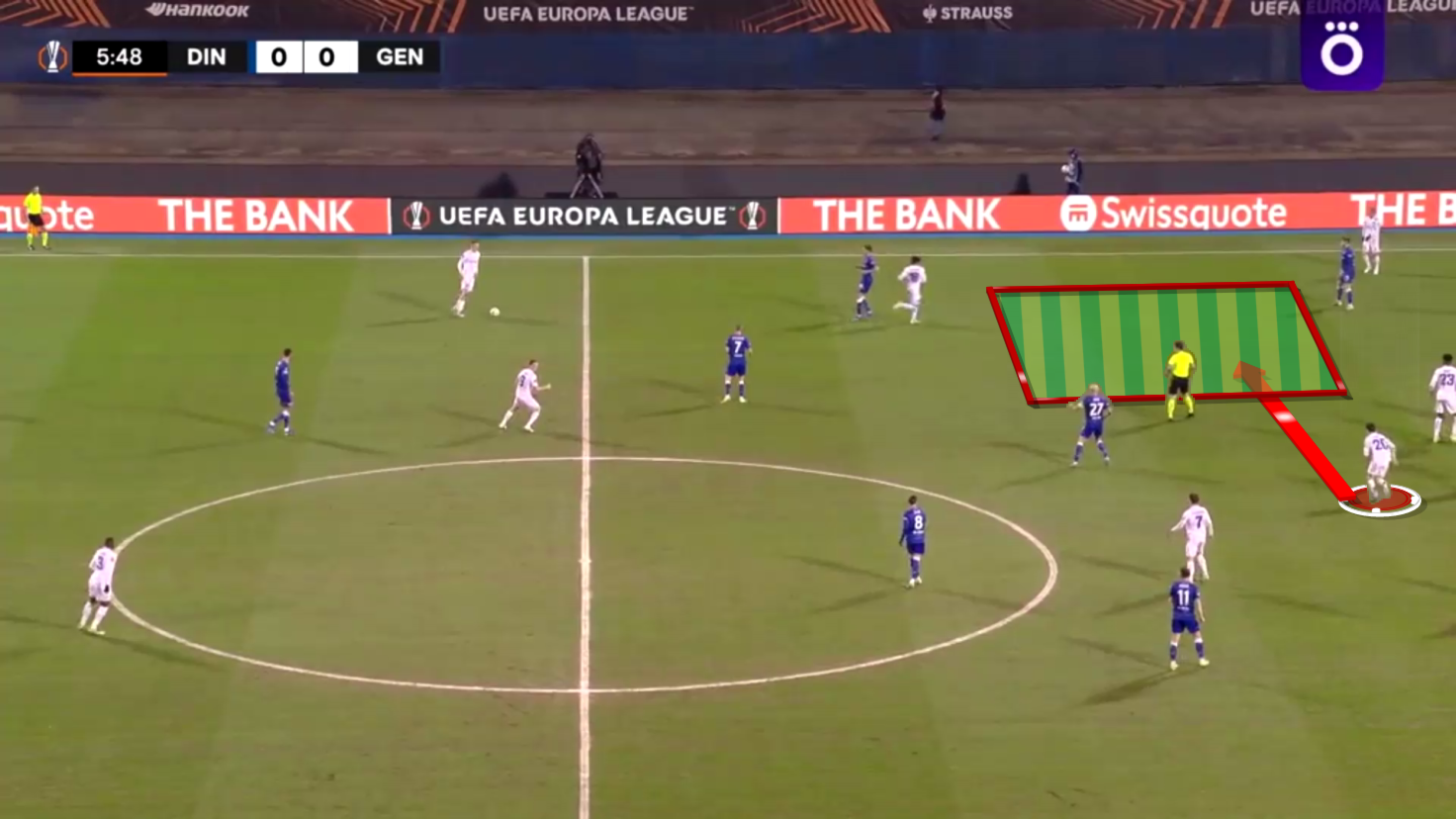
With this ability, he often acted as a vertical passing option for Genk midfielders (or defenders) looking to progress the ball.
Sometimes, if the striker drops deep to receive a pass between the lines, Karetsas would look to occupy the space vacated by the defender by making a run behind the defender.
With this quality, Karetsas gives his team different ways of progressing the ball against different types of opponents.
If the opponent chooses to sit in a low block, he could occupy the space between the lines and play through balls to the striker; if the opposition plays a high line, then he can attack the space behind the defenders.
He has a sound first touch, which constitutes another important part of his game.
He uses the inside of his foot to control the ball, but at times he uses the upper areas of his foot to move the ball along with his first touch.
Combined with his low centre of gravity, this ability allows him to shift directions easily, making him quite press-resistant.
Karetsas was also the chief set-piece taker at Genk, especially with in-swingers off his stronger left foot.
He usually targets the near post or the central part of the box.
Combined with this, Karetsas was also a good crosser, with his range of crossing ability extending well.
He had the ability to whip in crosses from advanced areas to catch the opposition off guard, floating balls into the far post or even early crosses into the space behind the box.
His 3.69 accurate crosses per 90 show that Karetsas was a threat to the opposition from the wide areas.
Karetsas' core strength lies in his passing.
With his earlier-mentioned ability to play between the lines, he is often entrusted by the coach to progress play and create separation in the final third.
Karetsas usually uses inside-of-the-foot passes and applies the right power to passes.
While playing in an advanced position in the system, Nicky Hayen usually prefers his advanced midfielders to play through the ground, reflecting high passing accuracy.
His 3.35 successful long balls per 90 show that he prefers to keep the ball on the ground.
Karetsas' standout ability is playing through balls for his teammates.
From using a simple passing technique to pierce the defence, Karetsas also uses the outside of the foot to achieve curved through balls (as seen below), which is difficult for opposition defenders to pick up.