
Lens Vs Como [1-9] Champions League 2026/2027: How Cesc Fàbregas Unleashed Fàbre-Ball In A Historic Victory - Tactical Analysis
Como produced a historic 9-1 Champions League win at Lens. This tactical analysis examines Cesc Fàbregas’ build-up solutions, dynamic off-ball movement, vertical passing and devastating counterattacks.

Lens hosted Como at Stade Bollaert-Delelis for their fourth fixture of the UEFA Champions League’s league phase, and the visitors surprised Lens with a historic 1-9 drubbing that will go down in the history books.
Como matched and surpassed the records of both Liverpool and Real Madrid, who both won 8-0 against Beşiktaş and Malmö, respectively.
Not only did Como score more goals, but they did it in an away game at a tough stadium.
Furthermore, the only team to score nine goals in a match in this competition was Bayern Munich, who faced Dinamo Zagreb and won 9-2 at home.
Compared with Como’s record, their result is still more impressive, both in terms of goal margin and in terms of playing away.
What is certain, though, is that Como can be considered officially among the top teams in Europe, and not for the sake of this win in particular but mainly thanks to their position in the standings.
Como hold fourth place in the standings, three points behind PSG and Real Madrid, one point behind Arsenal, level on points with Barcelona, Aston Villa, Manchester City, Liverpool, Club Brugge, Sporting CP, Real Betis, and Borussia Dortmund.
For Lens, things got worse after this huge loss, as it will not only hurt Yannick Cahuzac’s team morale but also their qualification chances, since goal difference will be decisive at the end of this league phase.
Lens are now in 33rd place with only three points from four games, and they still have to face tough teams like Manchester City, Bodø/Glimt, Liverpool, and RB Leipzig.
In this tactical analysis, we focus mainly on the Cesc Fàbregas team's attacking style of play, their reliance on vertical passing and off-the-ball movement to reach Lens’ penalty box quickly and in favourable situations.
Lens Vs Como Lineups & Formations
Lens Lineup Vs Como
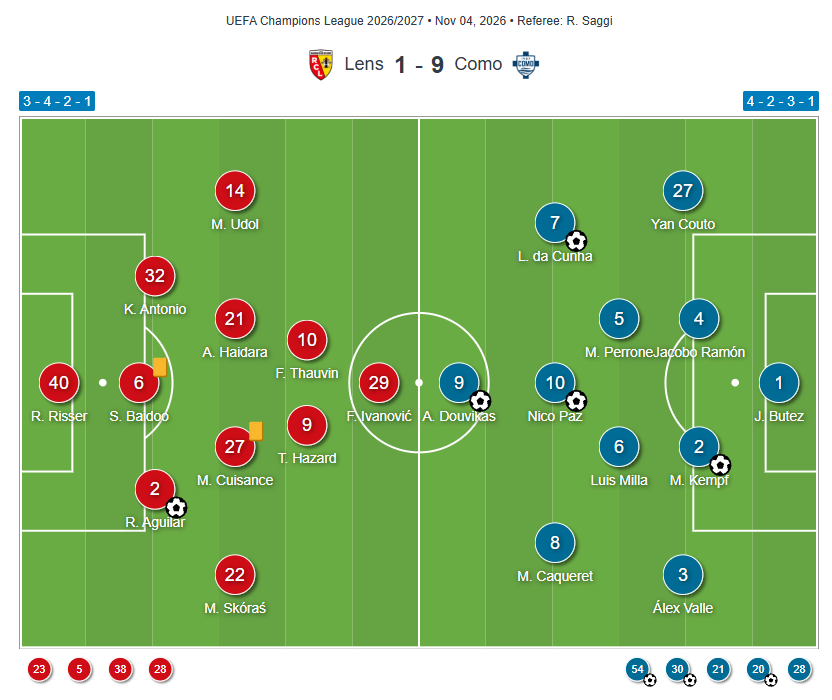
Cahuzac relied on a 3-4-2-1 formation, with Robin Risser in goal and a back three of Kyllian Antonio, Samson Baidoo, and Ruben Aguilar.
The midfield featured Amadou Haidara and Michaël Cuisance as central midfielders, Matthieu Udol and Michał Skóraś as wing-backs, with Florian Thauvin and Thorgan Hazard playing as wingers/wide playmakers to support the main striker, Franjo Ivanović.
Como Lineup Vs Lens
For Como, Fàbregas used a 4-2-3-1 formation, with Jean Butez in goal and a back line of Jacobo Ramón and Marc Kempf at centre-back, Yan Couto at right-back, and Álex Valle at left-back.
The midfield was made up of Máximo Perrone and Luis Milla as central midfielders, with an attacking trio of Lucas Da Cunha and Maxence Caqueret on the wings, and Nico Paz as the advanced playmaker behind striker Anastasios Douvikas.
Lens High-Press Vs Como Build-Up Solutions & Defensive Compactness
Lens started the match with an intense high press intended to disrupt Como’s build-up and force errors inside their own third or into long passing.
Although Como struggled a little in the first few minutes to deal with that pressure, making a few mistakes that Lens did not exploit as needed, they progressively succeeded in avoiding that high press almost every time.
Como did so mainly thanks to their consistently exceptional movement off the ball, which gave the ball-carrier reliable passing options nearby.
These off-the-ball movements from Como’s midfielders, full-backs, and attacking trio made the difference against Lens’ intense high press.
Como showed they were already used to such a press and knew how to cope with it and overcome it, despite the initial struggles.
By overcoming that press, they reached Lens’ half more often, and the French side’s high press eventually eased as they no longer believed they could disrupt Como's build-up from the back.
Scoring an early goal, thanks to Douvikas’ goalscoring instinct and his ability to exploit half-chances inside the box, made things a bit easier for Como, who started imposing their game gradually.
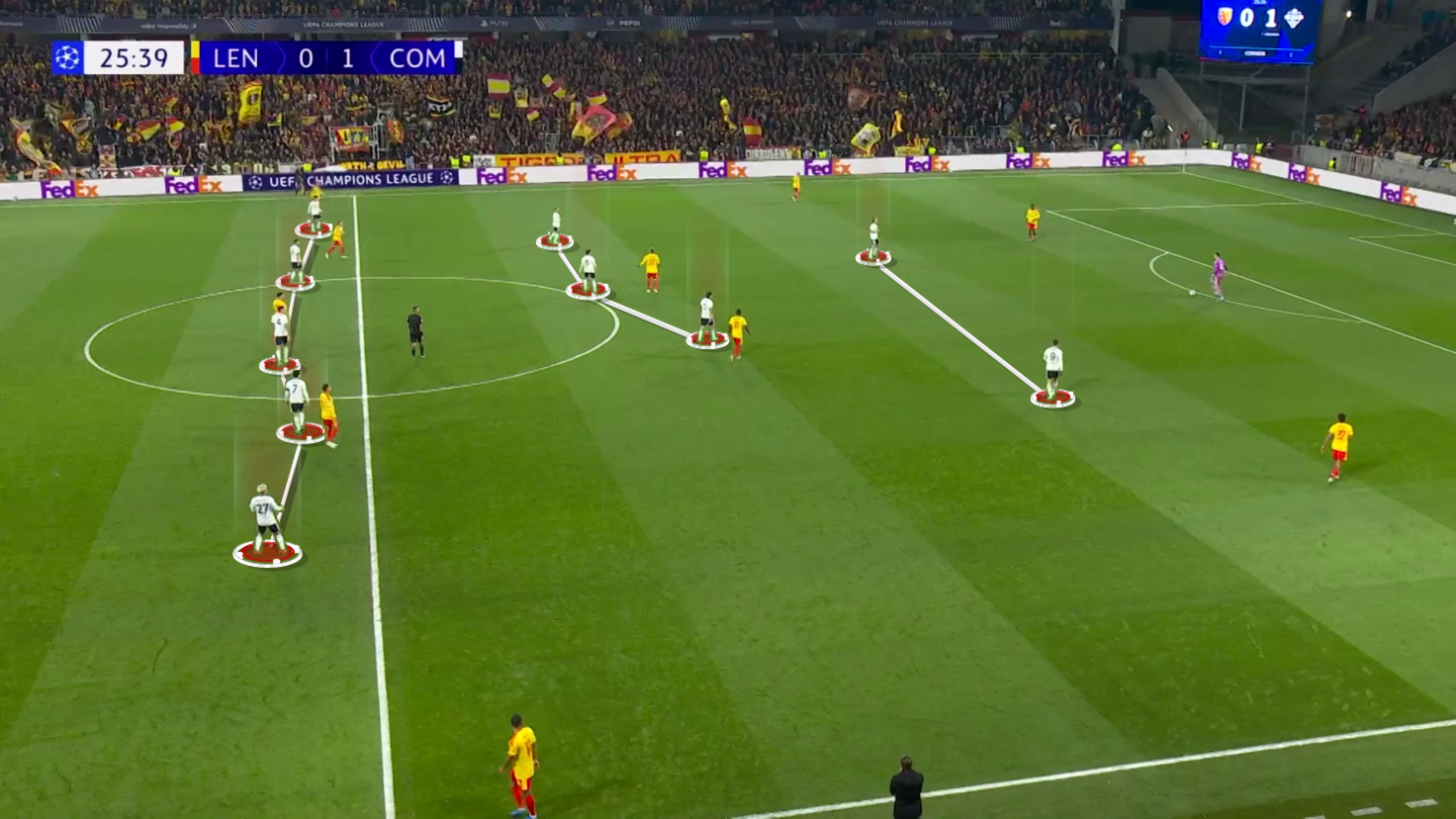
Defensively, Como used a 5-3-2 formation to try to keep their lines compact and avoid penetration into the box.
This was a useful plan in this match as it helped a lot in limiting Lens’ attacking attempts, even when that defensive line moved higher.
Furthermore, the lack of attacking solutions obliged Lens’ attacking players like Thauvin to retreat so often to contribute to the playmaking process and therefore impact the attacking depth.
Lens' main issue was the lack of attacking solutions against Como’s organised, attentive defensive line, and Thauvin and Ivanović's frequent retreats to midfield eventually complicated Lens' attack.
Como “Fàbre-Ball”
As the heading of this section suggests, Como showed glimpses of what can be called “Fàbre-Ball” in this match, as they added a second goal after a period when Lens pushed for a comeback, but without clear threats.
Como remained patient, though, and did not force their attacks.
Instead, they waited until they could create the right situation to score.
This was facilitated by excellent off-the-ball movement from the attacking players, notably Paz, who consistently avoided marking and offered passing options to teammates in both his own half and the opponent’s.
Como’s second goal started with Kempf’s movement on the left flank without the ball, as he received a long passlong pass from Butez and immediately played a vertical pass to Da Cunha, who made himself available and explicitly asked for the ball.
This tendency to ask for the ball with such dynamic movement and provide vertical passing options is what distinguishes this Como side, as they do so with extreme discipline and creativity to prevent the opponent from succeeding in their man-marking.
As the ball reached Da Cunha, Paz showed himself by accelerating on the right wing to avoid marking and receive a through pass from Da Cunha.
Then Paz cut inside and crossed towards the far post to Caqueret and Valle, whose forward movement has usually been valuable for Como.
Valle made an exceptional first-touch pass (assist) to Douvikas despite being disrupted by his direct opponent, and Douvikas was well-positioned again to receive the pass before Lens’ defenders and score with a first-touch finish.
The goal clearly highlighted Fàbregas’ playing system and attacking transition ideas, based mainly on continuous dynamic movement without the ball to invite the ball holder to make vertical passes.
Moreover, the quality of the players involved was impactful.
Everyone who touched the ball did so with talent and mastery in their positions, which has helped Como and Fàbregas apply his ideas fruitfully.
Furthermore, the interchangeability between the attacking trio (Caqueret – Paz – Da Cunha) was impressive; Paz and Da Cunha exchanged positions often, for instance, which helped them confuse Lens’ man-marking and propose new solutions frequently.