
![Olympique De Marseille Vs PSG [1-2] Ligue 1 2026/2027: How Bruno Génésio Transitions Troubled PSG - Tactical Analysis](https://cdn.mymidnight.blog/77f959f119f4fb2321e9ce801e2f5163/size/w1000/2026/09/Marseille-Vs-PSG-2026_2027---Tactical-Analysis.png)
Olympique De Marseille Vs PSG [1-2] Ligue 1 2026/2027: How Bruno Génésio Transitions Troubled PSG - Tactical Analysis
PSG beat Marseille 2-1 in Le Classique, but Bruno Génésio’s side found ways to trouble them. This tactical analysis examines how Marseille broke PSG’s press and exploited spaces behind their attacking structure on the counter.

Gameweek 5 in Ligue 1 gave us "Le Classique", with Olympique de Marseille hosting PSG.
PSG got their second win in the league after starting with two draws and one defeat.
Marseille, meanwhile, are having a difficult start to the season.
They lost their last four league games, as well as their UEFA Europa League match against Beşiktaş.
Their only league win came in the opening game against Strasbourg.
PSG dominated the game, but Marseille managed to survive the first half without conceding.
In the second half, Ferran Torres only needed seven minutes on the pitch to score the first goal of the game with a header.
Six minutes later, Angel Gomes equalised after Marseille won the ball in the attacking half and finished a quick transition.
However, Marseille's comeback did not last long.
Just two minutes later, Marquinhos scored PSG's second goal.
In the 77th minute, Marseille's full-back, Timothy Weah, received his second yellow card and was sent off, making it even harder for Marseille to find another equaliser.
PSG managed to control the final minutes and secured an important victory.
In this Marseille versus PSG tactical analysis, we look at how Marseille, under Bruno Génésio tactics, managed to break PSG’s press and took advantage of PSG’s attacking structure to create counterattacking opportunities and score their goal.
Marseille Vs PSG Lineups & Formations
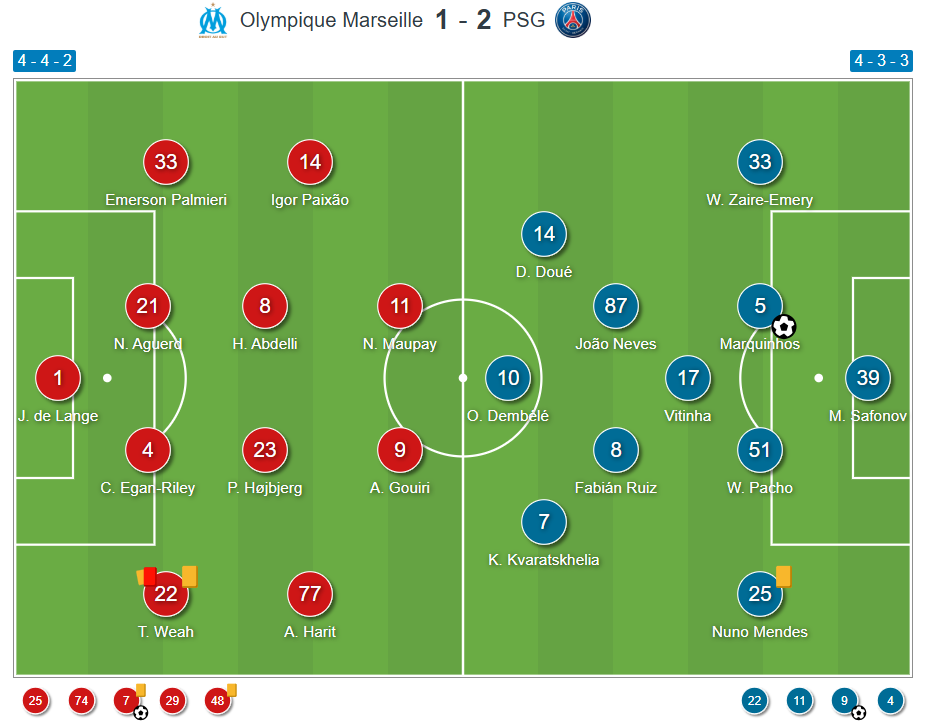
Marseille Lineup Vs PSG
Bruno Génésio set his team up in a 4-4-2 formation with Jeffrey de Lange in goal behind a back four of Weah, CJ Egan-Riley, Nayef Aguerd and Emerson, from right to left.
Pierre-Emile Højbjerg and Himad Abdelli started in midfield, with Amine Harit and Igor Paixão on the wings and the duo of Neal Maupay and Amine Gouiri up front.
The French coach made five changes.
The first change came after 30 minutes, with Paixão going off injured and Gomes coming on.
In the 63rd minute, Keyliane Abdallah came on for Harit.
Finally, in the 84th minute, he made three changes, with Kelyann Bezahaf, Faris Moumbagna and Ulisses Garcia coming on for Abdelli, Maupay and Emerson, respectively.
PSG Lineup Vs Marseille
Enrique started the match in his preferred 4-3-3 formation, with Matvey Safonov in goal, and a backline made up of Warren Zaïre-Emery at right-back, Marquinhos and Willian Pacho at centre-back, and Nuno Mendes at left-back.
In midfield, Fabián Ruiz, João Neves and Vitinha started as central midfielders, with Khvicha Kvaratskhelia and Désiré Doué on the wings and Ousmane Dembélé as the main striker.
The Spanish coach made four changes in the second half.
After one hour of the game, Torres came on for Kvaratskhelia.
Then, five minutes later, another change followed, with Ruiz coming off for Maghnes Akliouche.
Lastly, in the 79th minute, two players were withdrawn, as Doué and Dembélé made way for Lucas Beraldo and Mika Godts.
How Did The PSG Attacking Structure Create Space For Marseille Counterattacks?
In the first half, Marseille defended in a 4-4-2 across the pitch before shifting to a 4-2-3-1 in the second half.
In possession, PSG showed their usual mobility, with plenty of positional rotations.
For Enrique, the important thing was not necessarily which player occupied each position, but having the right players in the right spaces.
During the build-up, PSG often formed a 3-4-3 shape, with Zaïre-Emery moving into midfield while Neves and Fabián Ruiz moved wider to receive the ball around Marseille’s defensive block.
At the same time, the front three stayed high, pushing Marseille’s defensive line back.
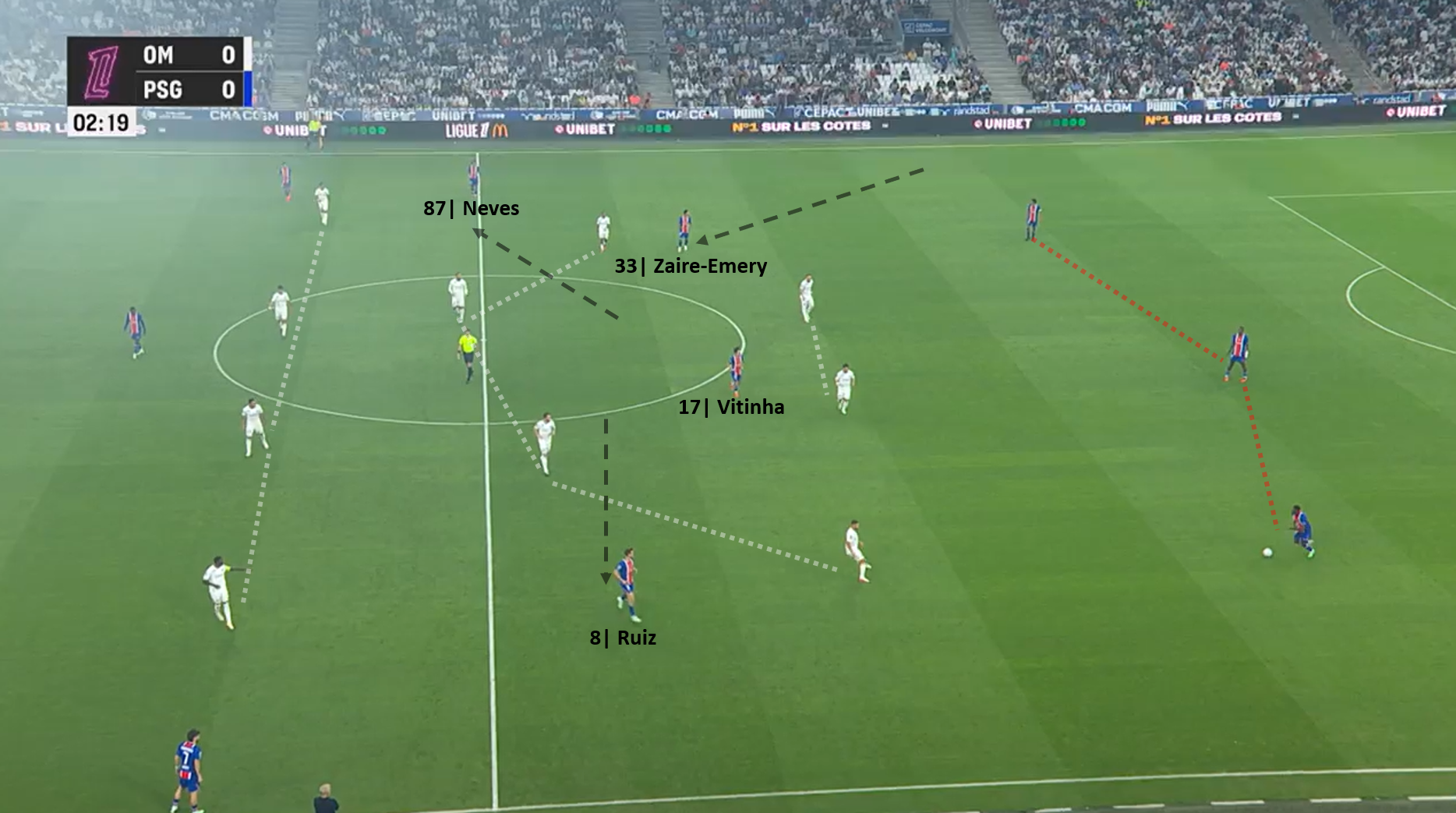
Further up the pitch, PSG looked to have five players attacking Marseille's defensive line, three in central areas, with the striker positioned between the centre-backs, while midfielders or full-backs occupied the half-spaces and the wingers stayed wide.
Closer to the ball, one player would often move inside to support the ball carrier, either the midfielder or the full-back, especially Zaïre-Emery on the right.
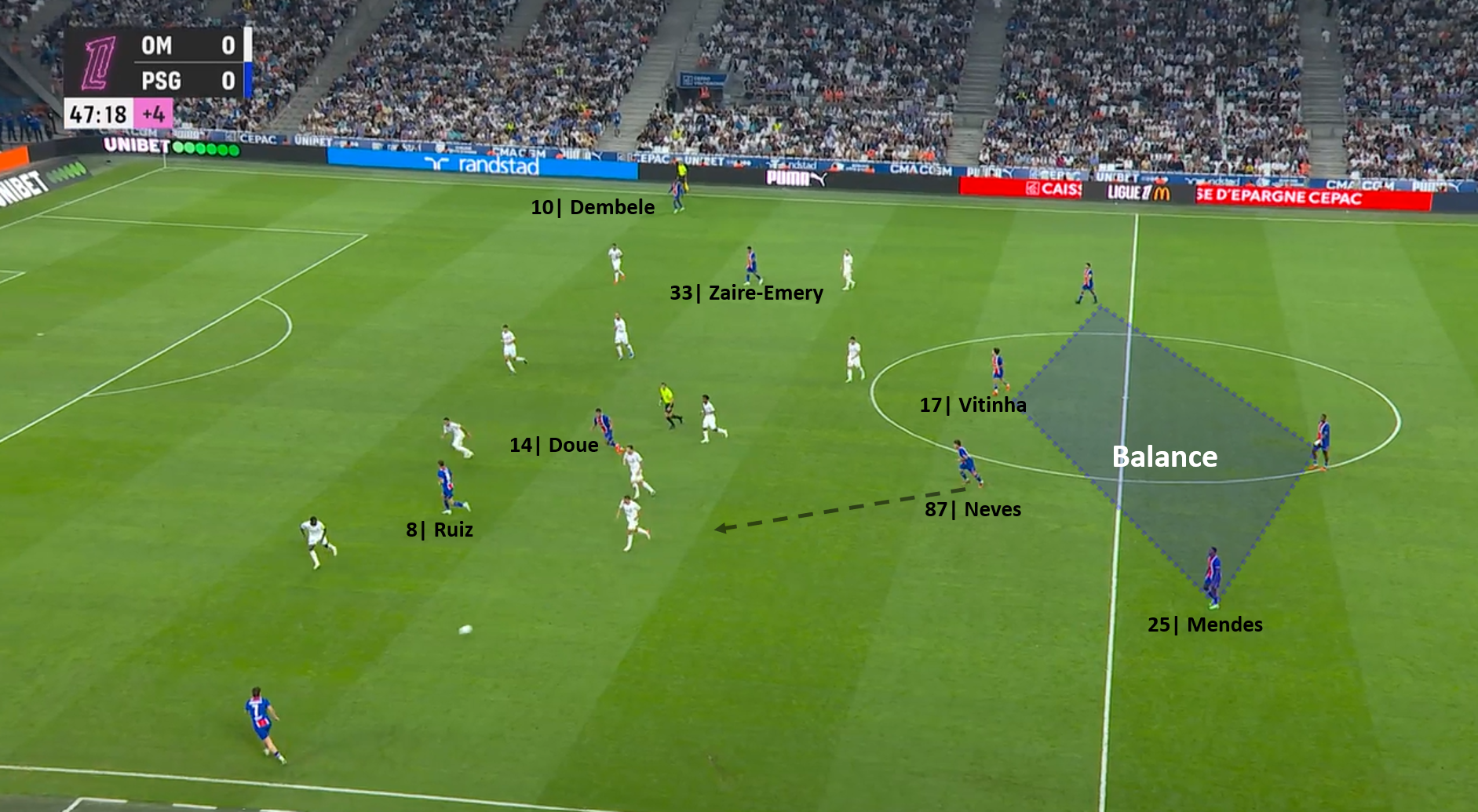
Behind them, PSG created a rhombus with four players, or sometimes a triangle with three.
This rhombus was usually formed by the two centre-backs and the full-back Mendes at the base, with Vitinha positioned higher.
When Mendes was higher, Ruiz took his position on this structure.
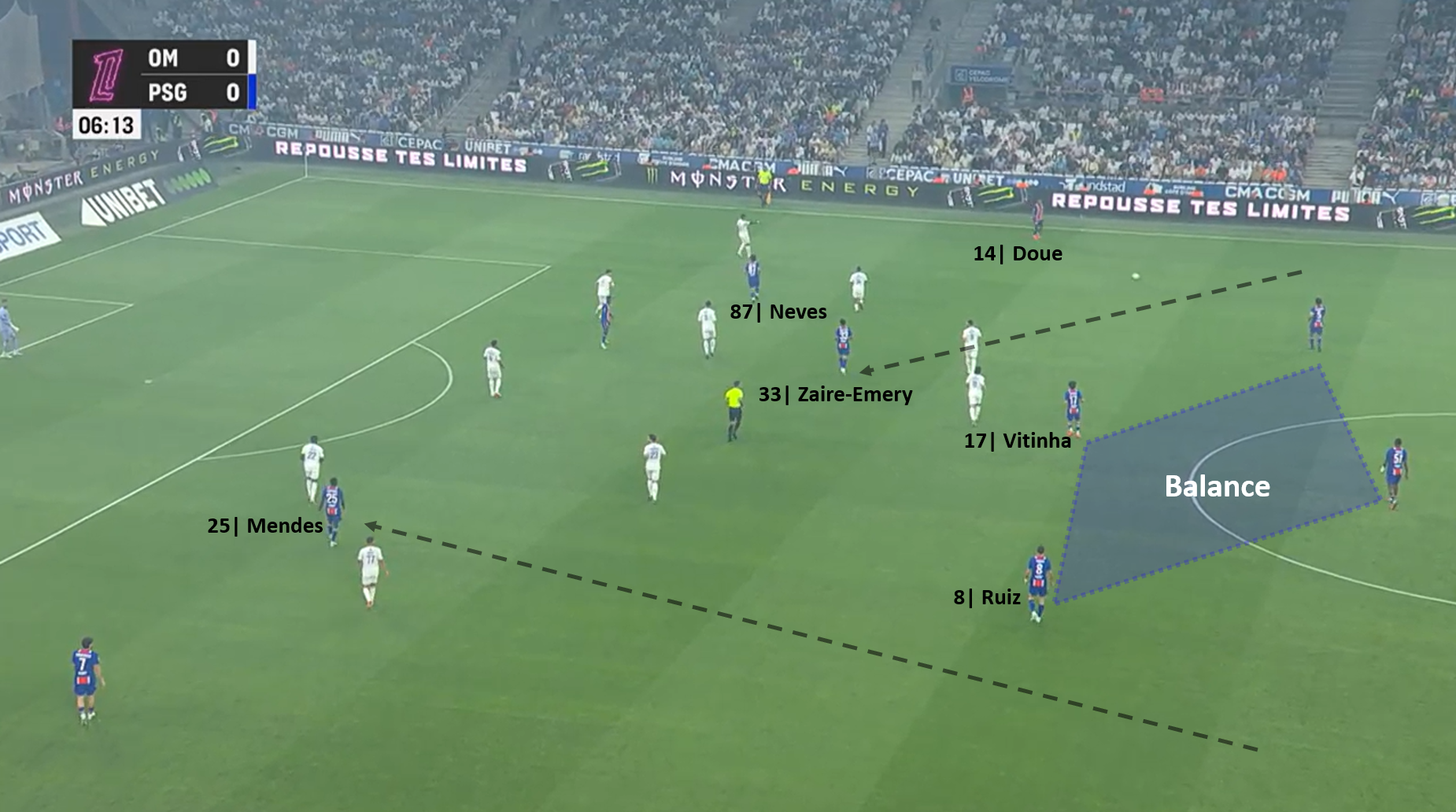
However, when both full-backs moved high, space naturally appeared behind them.
Marseille recognised this and tried to exploit these spaces whenever they won the ball, using quick transitions to attack the areas left open by PSG’s attacking structure, but then they struggled to finish the attack and create goalscoring opportunities.
![Fulham Vs Manchester United [1-1] Premier League 2026/2027: How Álvaro Arbeloa Tactics Exposed The Red Devils' Problems - Tactical Analysis](https://cdn.mymidnight.blog/77f959f119f4fb2321e9ce801e2f5163/size/w600/2026/09/Fulham-FC-Vs-Man-United-2026_2027---Tactical-Analysis.png)
![AS Roma Vs Inter Milan [2-2] Serie A 2026/2027: When Undefeated Giallorossi Attack Met Nerazzurri Comeback Resilience - Tactical Analysis](https://cdn.mymidnight.blog/77f959f119f4fb2321e9ce801e2f5163/size/w600/2026/09/AS-Roma-Vs-Inter-Milan-2026_2027---Tactical-Analysis.png)
![Real Sociedad Vs Bournemouth [1-2] Europa League 2026/2027: How Do Marco Rose Pressing Tactics Work? - Tactical Analysis](https://cdn.mymidnight.blog/77f959f119f4fb2321e9ce801e2f5163/size/w600/2026/09/Real-Sociedad-Vs-Bournemouth-20262027---Tactical-Analysis-1.png)
![AC Milan Vs Benfica [0-2] Europa League 2026/2027: How Marco Silva Tactics Exposed Rúben Amorim Defensive Problems - Tactical Analysis](https://cdn.mymidnight.blog/77f959f119f4fb2321e9ce801e2f5163/size/w600/2026/09/AC-Milan-Vs-Benfica-20262027---Tactical-Analysis.png)
![Sunderland Vs AZ Alkmaar [1-0] Europa League 2026/2027: Why The Black Cats Make Better Underdogs - Tactical Analysis](https://cdn.mymidnight.blog/77f959f119f4fb2321e9ce801e2f5163/size/w600/2026/09/Sunderland-Vs-AZ-Alkmaar-20262027---Tactical-Analysis.png)
![Leeds United Vs Newcastle United [4-1] Premier League 2026/2027: Why Did Daniel Farke Tactics Dominate The Magpies? - Tactical Analysis](https://cdn.mymidnight.blog/77f959f119f4fb2321e9ce801e2f5163/size/w600/2026/09/Leeds-United-Vs-Newcastle-2026_2027---Tactical-Analysis.png)
![Real Sociedad Vs Atlético Madrid [0-3] La Liga 2026/2027: How Diego Simeone Tactical Precision Rescued A Late Victory - Tactical Analysis](https://cdn.mymidnight.blog/77f959f119f4fb2321e9ce801e2f5163/size/w600/2026/09/Real-Sociedad-Vs-Atl--tico-Madrid-20262027---Tactical-Analysis-1.png)
![Manchester United Vs Manchester City [0-1] Premier League 2026/2027: How Enzo Maresca Tactics Secured Victory With 10 Men - Tactical Analysis](https://cdn.mymidnight.blog/77f959f119f4fb2321e9ce801e2f5163/size/w600/2026/09/Manchester-United-Vs-Manchester-City--20262027---Tactical-Analysis.png)