Mamadou Sangaré Scout Report At RC Lens 2025/2026: Why Europe’s Biggest Clubs Want Ligue 1’s Best African Player – Player Analysis
Mamadou Sangaré pairs aggressive ball recovery with progressive passing, press resistance and functional carrying. This analysis explains why his adaptable double-pivot profile is attracting elite clubs.

There has been a long lineage of African greats, but the conversation tends to circle around the same familiar names.
What has changed in recent years is the breadth and the speed of the next wave.
An influx of high-potential and top-level players has arrived from across the continent, most notably from West Africa, and they are reaching elite readiness earlier.
The likes of Victor Osimhen, Mohammed Kudus, Yan Diomande and Carlos Baleba are a few names who have been standouts in their respective leagues.
A player going from strength to strength and making real noise is Mali international Mamadou Sangaré.
After an excellent campaign with RC Lens that ended with Coupe de France glory and, on an individual level, the Marc-Vivien Foé Award for 'Best African Player in Ligue 1', he has begun to attract the attention of some of Europe’s biggest clubs.
Lens paid €8m for him, a fee that already reads like an early move in a market that has not fully caught up.
It feels imminent that whoever is lucky enough to have him next should expect a valuation that quadruples that figure and very likely more, because the underlying traits driving his influence are scalable.
This Mamadou Sangaré scout report will detail Sangaré tactics as a player, his profile, how he plays, why he is a name on many people’s lips, and what parts of his game are most likely to translate upward as the level rises.
Who Is Mamadou Sangaré?
Mamadou Sangaré is left-footed and best described as a box-to-box midfielder, though the label only has value if it is connected to specific behaviours.
He complements his tackling nous with a goal and an assist in his locker, arriving on the scoresheet here and there without giving the impression that his value is tied to constant final third numbers.
He is also unusually easy to integrate into a collective.
He has a very positive relationship with the game, the kind that makes a coach’s work simpler because the player is not fighting the match or forcing a persona onto it.
Lens coach Pierre Sage captured this when he said Sangaré “understands what a given match requires“ as he praised his adaptability and understanding of the feel of the game in terms of whether it needs to be slowed down, redirected or needs more final third impetus.
Austrian Context & Maturity Of His Aggression
Mamadou Sangaré’s out-of-possession aggression now has maturity to it.
The intensity is still there, but it is increasingly paired with selection.
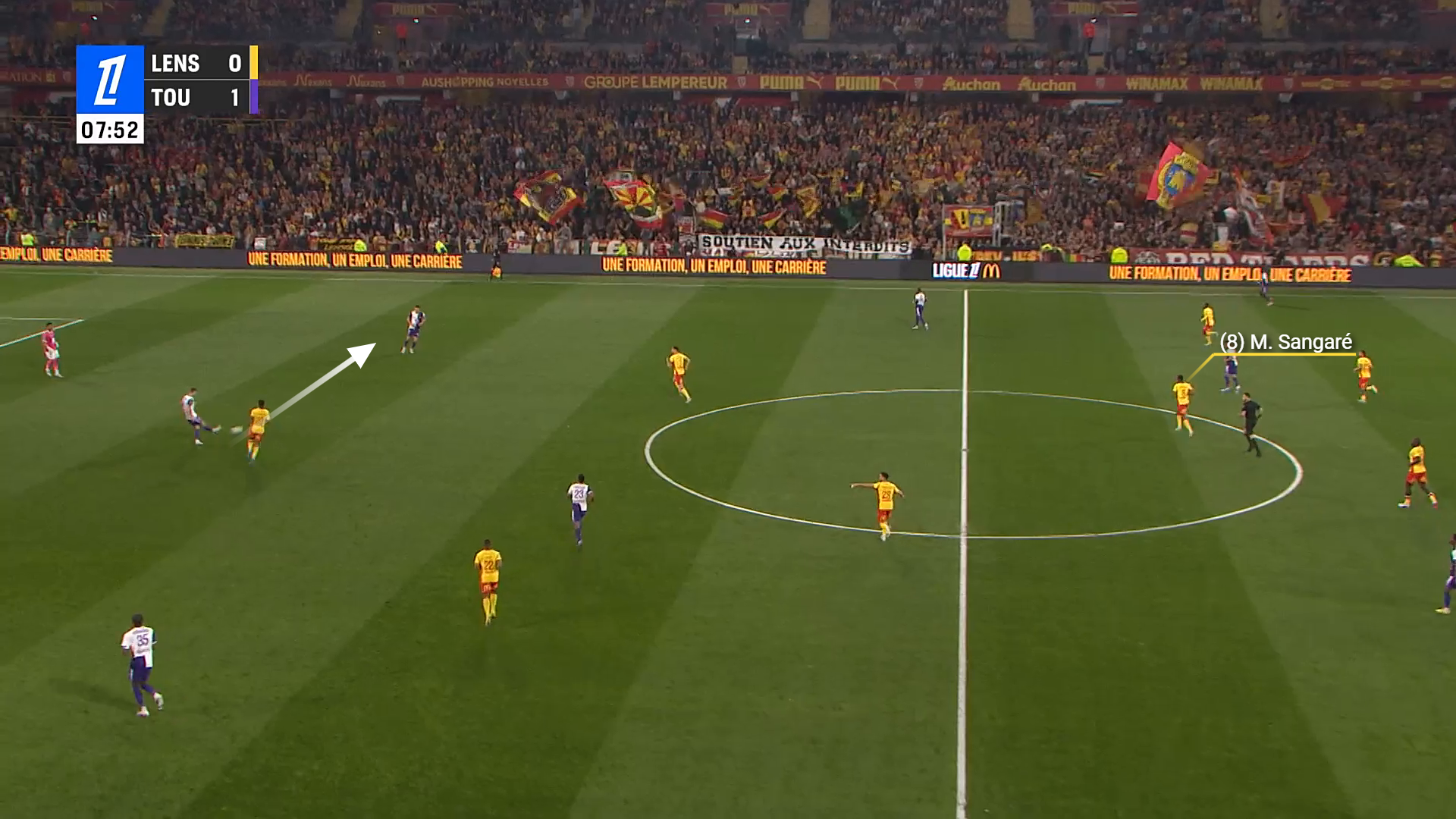
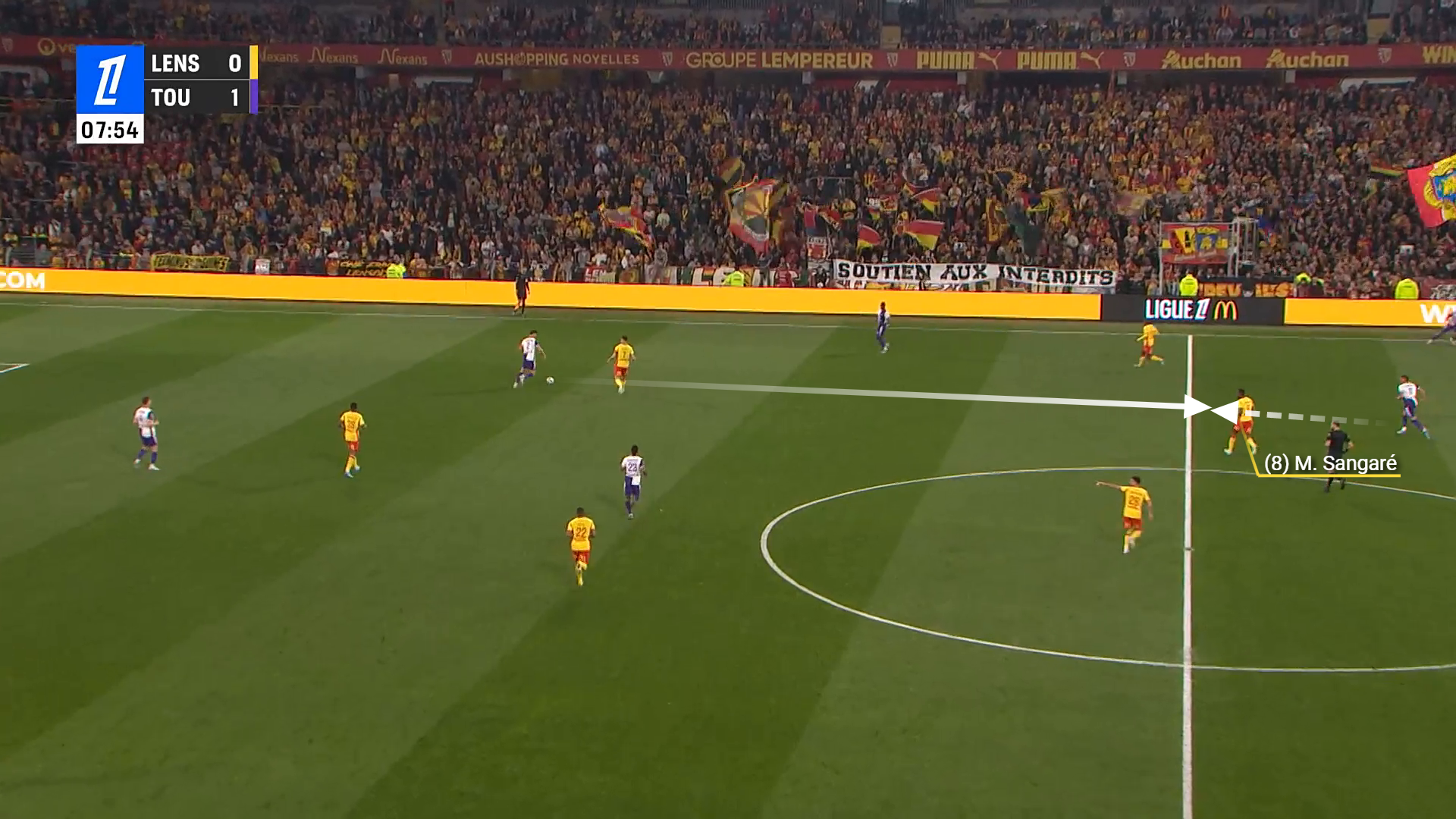
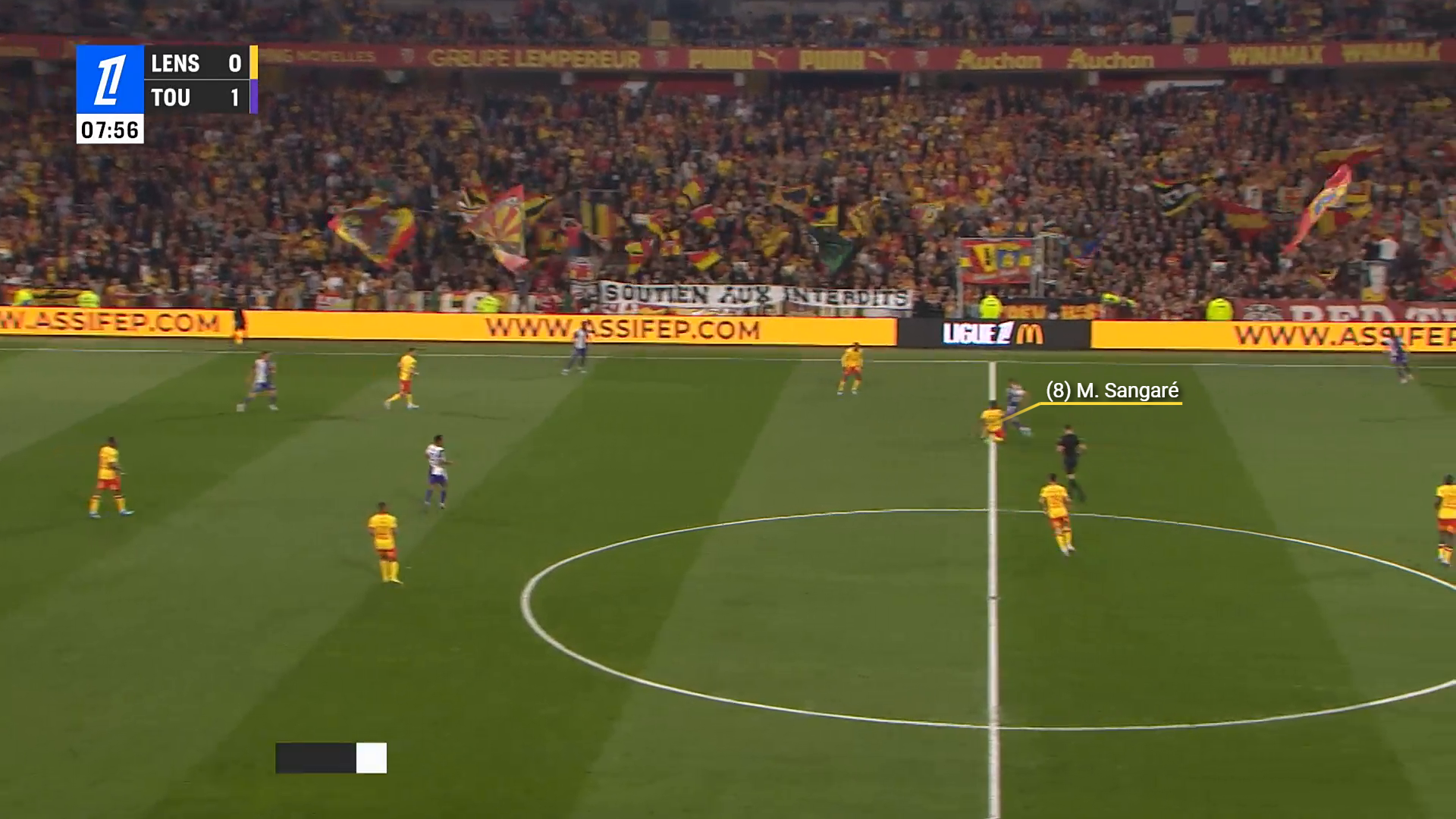
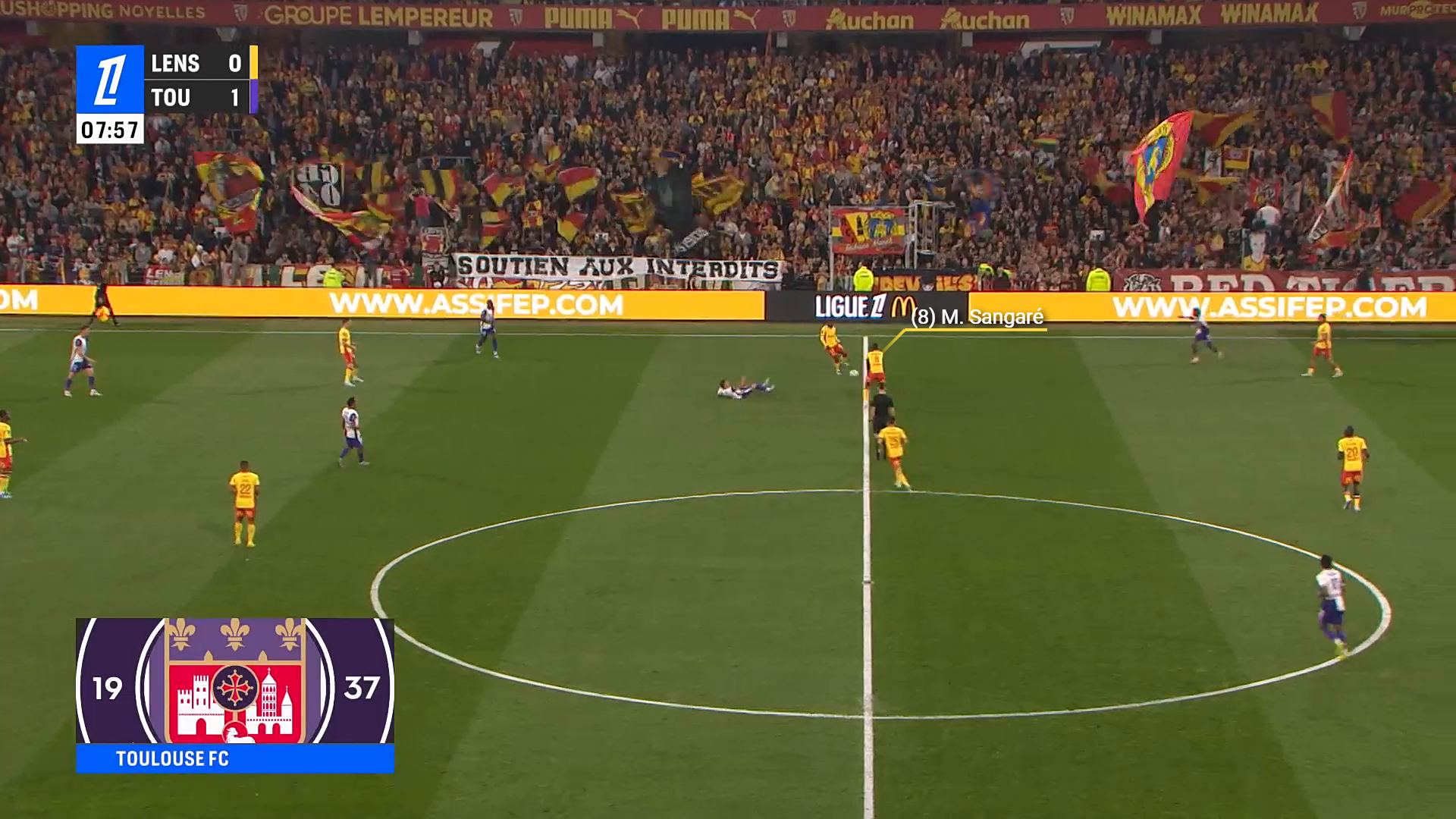
Against Toulouse FC, Sangaré combines aggression with excellent timing to read passing lanes and regain possession.
His anticipation stands out, particularly when opponents position themselves between the lines, looking to receive and turn, as he reacts quickly to intercept and disrupt the play.
His loans in Austria appear to have accelerated that development.
Country context matters, as Austrian football has been shaped by an intense, high-tempo culture of counterpressing and rapid vertical transitions, heavily influenced by the Red Bull model.
Rather than retreating into a passive block, teams crowd the ball carrier and cut off the nearest passing lanes.
They look for early regains and then play forward quickly before the opponent can reset.
That schooling can be seen in Sangaré’s instincts.
He is comfortable stepping high to contest the first pass out of an opposition regain.
Furthermore, he understands the value of arriving on time and using the press as a collective trap, as well as that the best ball wins come from denying the opposition their second option.
This is where his game has matured.
Against Toulouse, he’s extremely aggressive when pressing the ball.
This works because he reads the play early, anticipates where the pass will go, and times his tackles well.
He stays aware of the Toulouse player operating between the lines, steps in decisively, and wins possession.
He can still be aggressive in the duel, but he is more likely now to win possession in a way that keeps him connected to the next phase.
Mamadou Sangaré Lens Role In The 3-4-2-1 Double Pivot
Lens have used Sangaré in the double pivot of a 3-4-2-1.
This role requires him to be both a platform and a shield.
In build-up, he must offer angles for the backline, receive under pressure, and connect with the attacking midfielders as well as protect the team’s rest-defence and occupy positions that reduce the threat of counters when wing-backs are high.
Out of possession, he must decide when to jump, when to screen, and when to win the ball.
Sangaré’s passing volume stands out, but so does the intention inside that volume.
He is looking for penetration and shows greater attacking ambition from deep than many midfielders who also win duels at his rate.
Here, against Olympique de Marseille, Sangaré demonstrates strong composure in possession.