

Mikel Oyarzabal Scout Report At Spain 2026: Luis De La Fuente's Functional World Cup No. 9 – Player Analysis

Spain entered the 2026 FIFA World Cup with one of the most technically secure squads in the tournament, but their attacking rhythm has not always been as smooth as the names on the teamsheet might suggest.
That has made Mikel Oyarzabal one of the most interesting players to analyse in Luis de la Fuente’s system.
This Mikel Oyarzabal scout report and player analysis looks at Mikel Oyarzabal's role during Spain’s three Group H matches against Cape Verde, Saudi Arabia and Uruguay.
Across those games, Oyarzabal moved between three different contexts.
Against Cape Verde, he was the isolated centre-forward in a slow and predictable attacking structure.
Against Saudi Arabia, he became Spain’s decisive player, registering two goals and one assist inside the opening 25 minutes.
Against Uruguay, he was less spectacular, but still useful as a reference point in a more physical and controlled match.
That contrast is exactly what makes this Mikel Oyarzabal analysis valuable.
He is not a traditional No. 9 who dominates through speed, height or repeated physical duels.
Instead, Oyarzabal’s style of play is based on timing, technical security, associative movement and intelligent occupation of the penalty area.
For Spain, he is not only a finisher.
He is a functional centre-forward who helps connect the final third, create space for wide players, and provide the first point of pressure out of possession.
Mikel Oyarzabal Style Of Play
Oyarzabal is a left-footed forward who has spent much of his career operating from wide areas or as a second striker, but Spain have increasingly used him as a central attacking reference.
That role suits some of his strongest qualities, although it also exposes certain limitations.
He is not a centre-forward who constantly pins centre-backs through power or threatens the space behind with elite pace; his game is more subtle.
Oyarzabal prefers to move across the front line, receive with his back to goal, combine with nearby midfielders and then arrive inside the box when the attack reaches its final stage.
This makes him particularly useful for a team like Spain.
De la Fuente’s side usually builds with control, uses positional rotations to move opponents and relies on wide players such as Lamine Yamal or Nico Williams to generate imbalance.
In that structure, the centre-forward does not only need to score.
He must keep the attack connected.
Oyarzabal’s best qualities are his timing and his understanding of when to stay high and when to drop.
When he remains on the last line, he can fix centre-backs and open pockets for Pedri, Dani Olmo or Álex Baena between the lines.
When he drops towards the ball, he can act as a wall pass and help Spain play around pressure.
His movements are rarely explosive, but they are usually well-timed.
He often waits until the defender has fixed their body shape before moving into the blind side or attacking the gap between centre-back and full-back.
This is especially useful when Spain circulates the ball wide and then crosses or cuts the ball back into central areas.
However, this profile also depends heavily on the structure around him.
If Spain move the ball too slowly or fail to create width and depth around him, Oyarzabal can become disconnected.
That was clear in the opening match against Cape Verde.
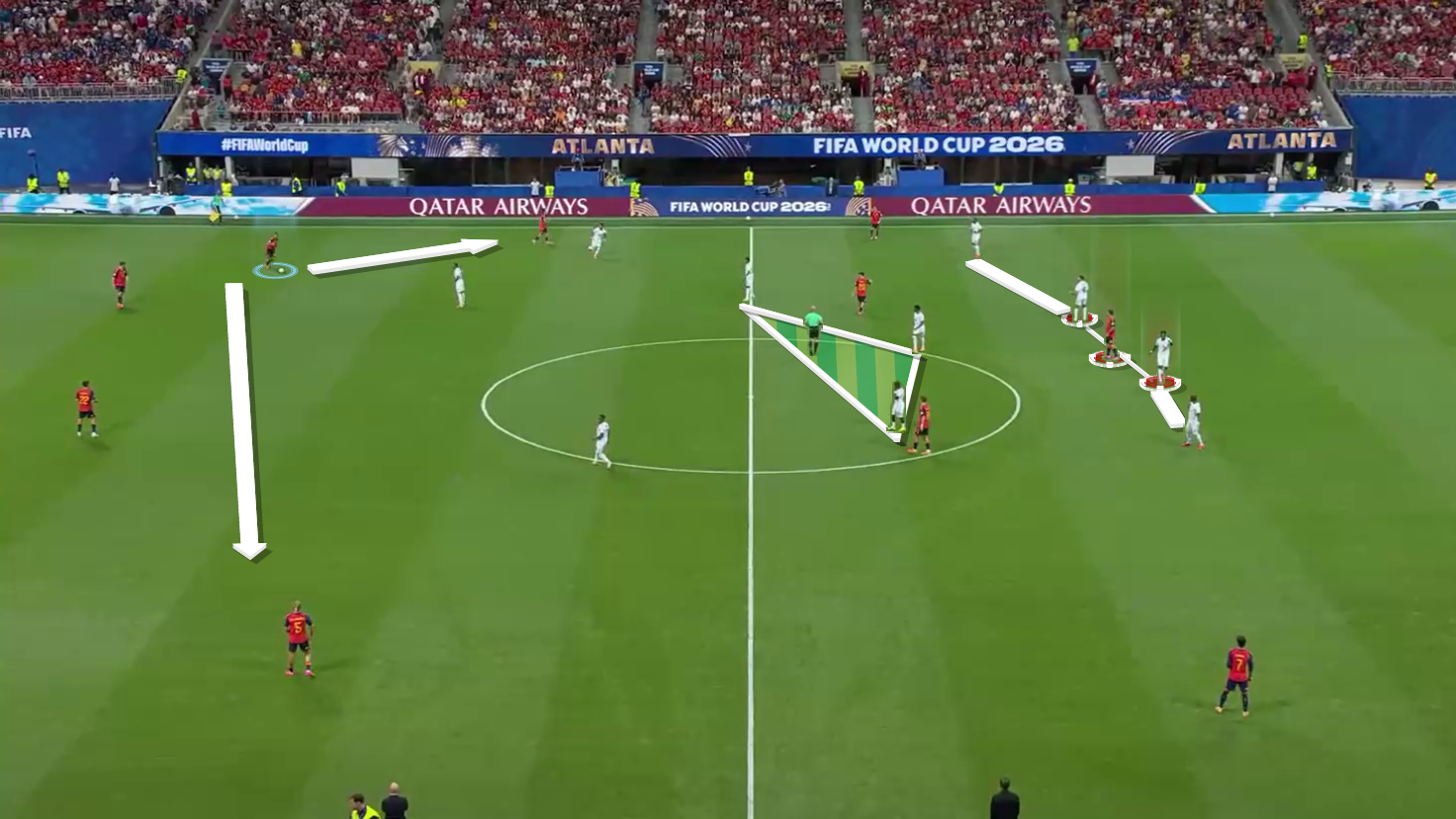
In this example, Spain circulates possession around Cape Verde’s compact block, but the central passing lane into Oyarzabal is closed.
The Real Sociedad forward remains positioned as the central reference, yet he is surrounded by defenders and cannot receive with an advantage.
This helps explain why Spain’s possession often became sterile: they reached advanced areas, but their ball circulation did not consistently create clean access into their centre-forward.
Against Cape Verde, Spain dominated the ball but did not dominate the most valuable spaces with enough clarity.
They had 65.7% possession, completed 755 of their 811 passes, produced 27 shots and generated 2.26 expected goals.
They also recorded 426 receptions in the final third and 39 crosses.
On paper, that looks like attacking control.
In reality, much of their possession became predictable.
Cape Verde defended deep and compact, forcing Spain to attack around the block rather than through it.
Oyarzabal suffered because of that.
He was positioned as the central reference, but he did not receive enough high-quality service in zones where he could combine or finish quickly.
Spain reached the final third repeatedly, but their attacks often lacked the tempo or disguise needed to give him separation from his markers.
This is an important distinction.
Oyarzabal’s quiet performance was not simply a question of poor individual involvement.
It was also a reflection of Spain’s attacking structure.
If the ball arrives slowly, and the opposition’s defensive line is already set, Oyarzabal does not have the physical profile to turn hopeful crosses into consistent chances by himself.
Mikel Oyarzabal In Possession
In possession, Oyarzabal’s role is built around three main behaviours: fixing the defensive line, connecting with the players around him and attacking the penalty area with timing.
As a centre-forward, he gives Spain a reference between the centre-backs.
This is important because Spain often use several players who want to receive between the lines.
Pedri, Olmo, Baena and Fabián Ruiz can all occupy interior spaces, while Yamal often starts wide before moving inside onto his stronger left foot.
If Oyarzabal constantly dropped away from the defensive line, Spain would risk overcrowding the midfield and losing depth.
Therefore, one of his main tasks is to maintain the last line.
This prevents the opposition centre-backs from stepping forward too aggressively and creates space for Spain’s attacking midfielders to receive in front of them.
Even when Oyarzabal does not touch the ball, his positioning can be useful because it stretches the opponent vertically.
However, he is not a static striker.
His best actions often come when he moves away from the centre-back at the right moment.
Against Saudi Arabia, that was much clearer than against Cape Verde.
Spain had more speed, more width and better connections around the box.
As a result, Oyarzabal could participate in the final action rather than simply waiting for service.
Saudi Arabia defended in a 5-4-1, but Spain found ways to move the block with quicker circulation and better occupation of wide areas.
They had 63.2% possession, produced 22 shots, generated 3.2 expected goals and completed 159 line breaks.
They also recorded 259 receptions in the final third and 28 crosses, showing a much more productive attacking structure.
Oyarzabal’s assist for Yamal after 10 minutes was a perfect example of his value as a connector.
This sequence shows Oyarzabal’s value beyond his penalty-box movement.
He first drops away from the defensive line to offer Spain a central passing option, helping connect the midfield with the attack.
After linking the play, he immediately attacks the space behind Saudi Arabia’s backline, receiving in the left channel with forward momentum.
From there, he recognises Yamal’s far-post run and delivers the ball across the box, turning his own movement away from goal into the assist for Spain’s opening goal.
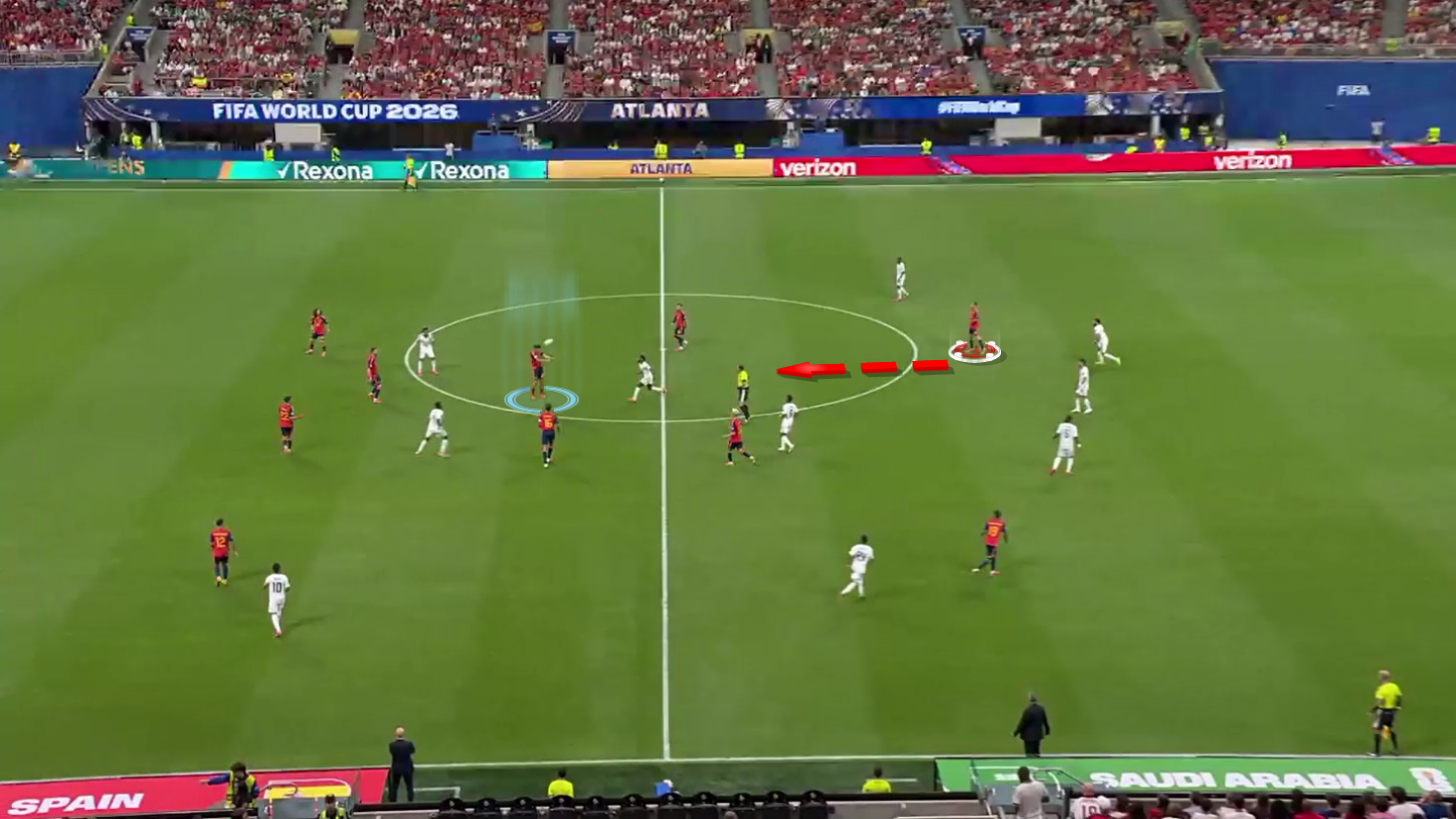
Oyarzabal drops away from the front line to offer a passing option between Saudi Arabia’s midfield and defence.
This movement gives Spain a central connection and prevents him from becoming fixed between the centre-backs.
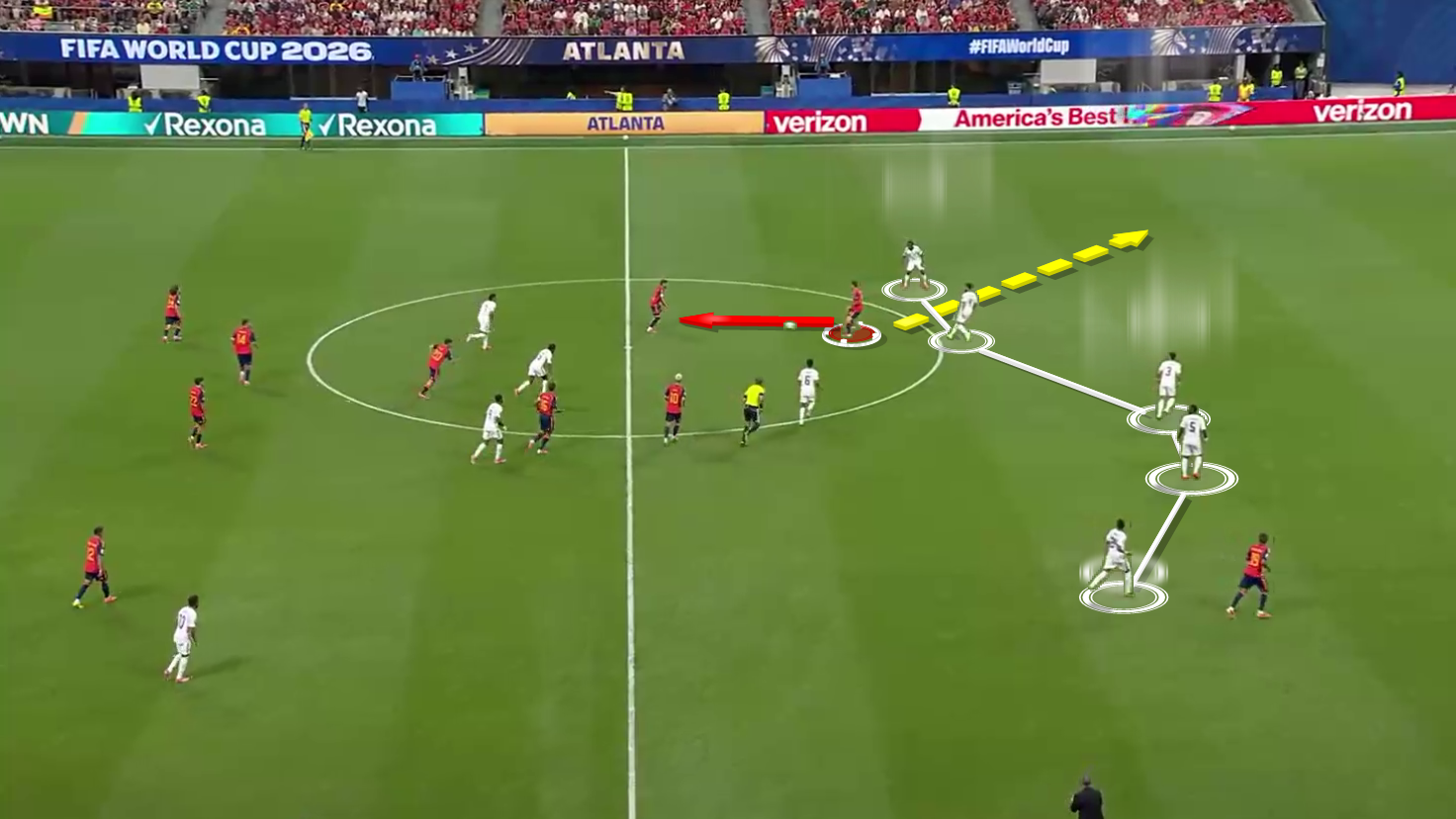
After receiving, Oyarzabal helps Spain progress through the centre before immediately preparing to attack the next space.
His movement shows the dual nature of his role: he can connect play and then become a runner.
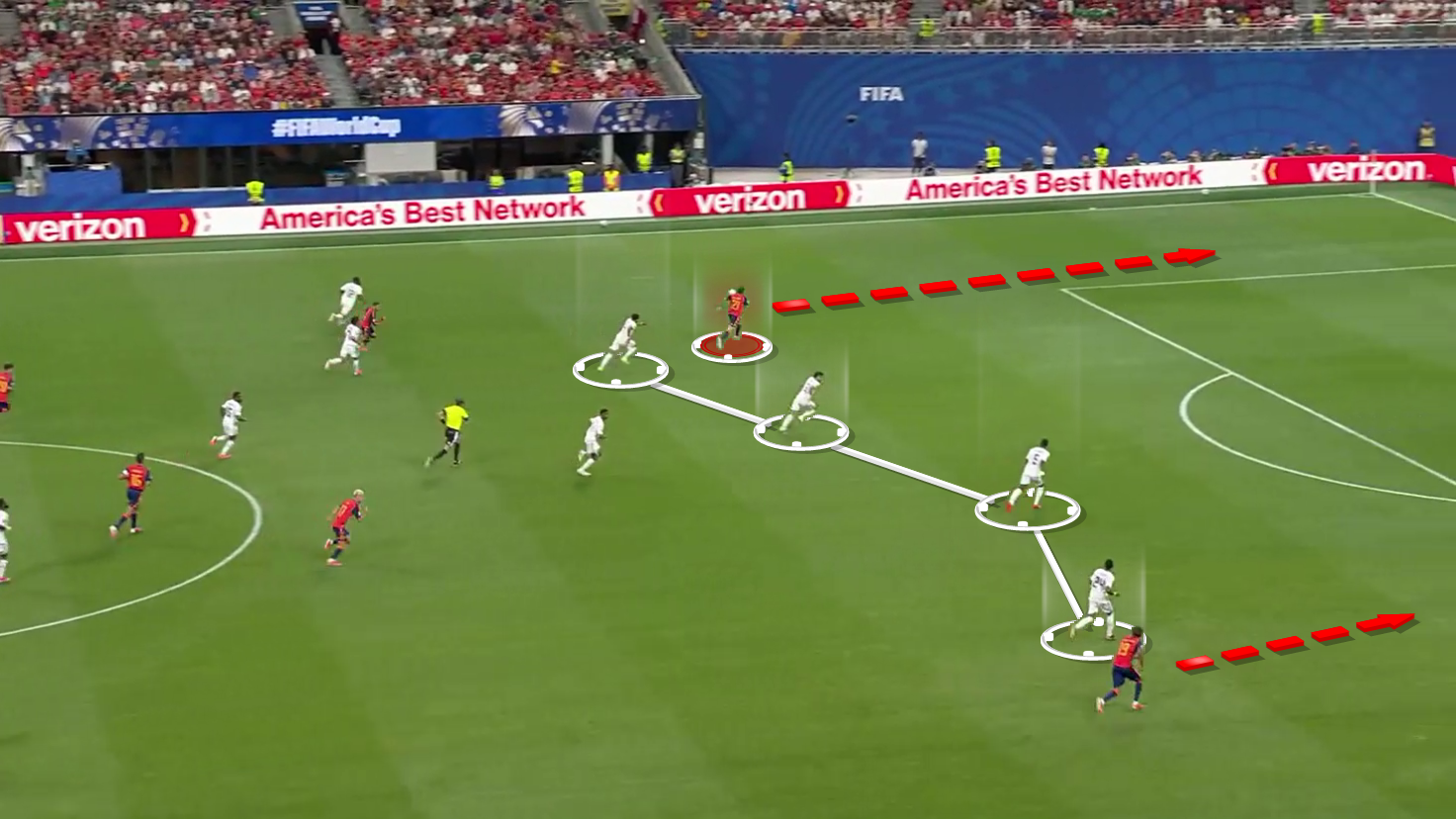
Once Spain break the first line of pressure, Oyarzabal accelerates into the left channel.
His run targets the space behind the defensive line, giving Spain a forward option outside the central congestion.
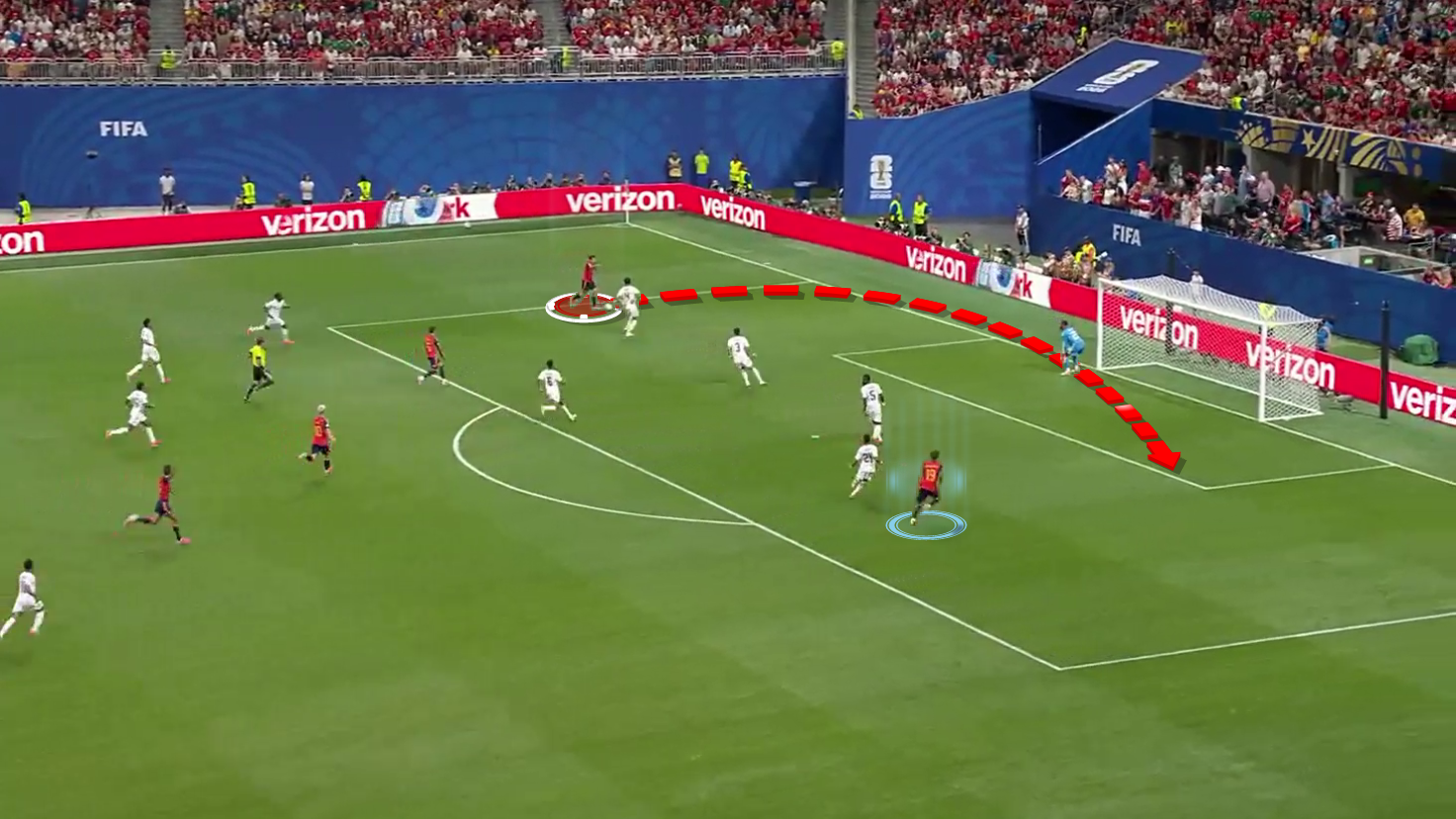
Instead of forcing a shot from a wide angle, Oyarzabal recognises Yamal’s far-post run and delivers across the six-yard box.
The action underlines his value as a connector and creator, not only as a penalty-box finisher.
The pass is simple in appearance, but tactically significant.
Oyarzabal receives outside the most crowded central zone and turns that wide reception into a high-value chance.
By doing so, he improves Spain’s right-winger.
Yamal is often the player expected to create for others, but here Oyarzabal creates for him.
This is one of the reasons De la Fuente can trust him as a centre-forward.
Oyarzabal does not need every attacking move to finish with him.
He can also connect the attack, make the correct final-third decision and provide balance to a front line that contains more explosive profiles.
Mikel Oyarzabal Goalscoring Ability
Oyarzabal’s goal-scoring ability is less about volume and more about timing.
He is not a striker who constantly creates his own shots from nothing, but he is very effective when Spain create advantages around the box.
Against Saudi Arabia, he scored twice in three minutes and almost completed a first-half hat-trick.
His first goal came from a second phase after a corner.
Dani Olmo’s effort was flicked on by Aymeric Laporte, and Oyarzabal reacted quicker than Saud Abdulhamid before finishing into the bottom-right corner.