Bilal El Khannouss Scout Report At VfB Stuttgart & Morocco 2026: The World Cup Playmaker Who Needs Freedom – Player Analysis

Morocco have made it to the last eight of the FIFA World Cup for the second edition in a row.
Back in 2022, the Atlas Lions made history by reaching the semi-final for the first time.
It’ll be tough to replicate that achievement this time around, with France waiting, at the time of writing, in the quarter-final.
Still, Morocco can be proud of their achievements in both the 2026 and 2022 FIFA World Cups.
One man who has been part of both squads is Bilal El Khannouss (180cm/5’11”, 70kg/154lbs), who’s still only 22 years old and has just completed a permanent transfer from Leicester City to VfB Stuttgart, having spent the 2025/2026 season on loan with the Bundesliga side under Sebastian Hoeneß tactics.
As an 18-year-old, El Khannouss was a squad player in Morocco’s 2022 World Cup run; he only ended up getting game time in the third-place playoff defeat to Croatia.
This time around, under Mohamed Ouahbi tactics and with four more years of experience under his belt, El Khannouss is a key man for his country, starting each match of Morocco’s 2026 FIFA World Cup run thus far.
This Bilal El Khannouss scout report and player analysis examines Bilal El Khannouss’ style of play and tactical role both with VfB Stuttgart and the Moroccan national team over the past year.
We examine how the 22-year-old playmaker’s role differs between both setups, and what the trade-offs are between those two distinct squad roles, while also examining the promising midfielder’s key strengths and areas for improvement.
Bilal El Khannouss Stats
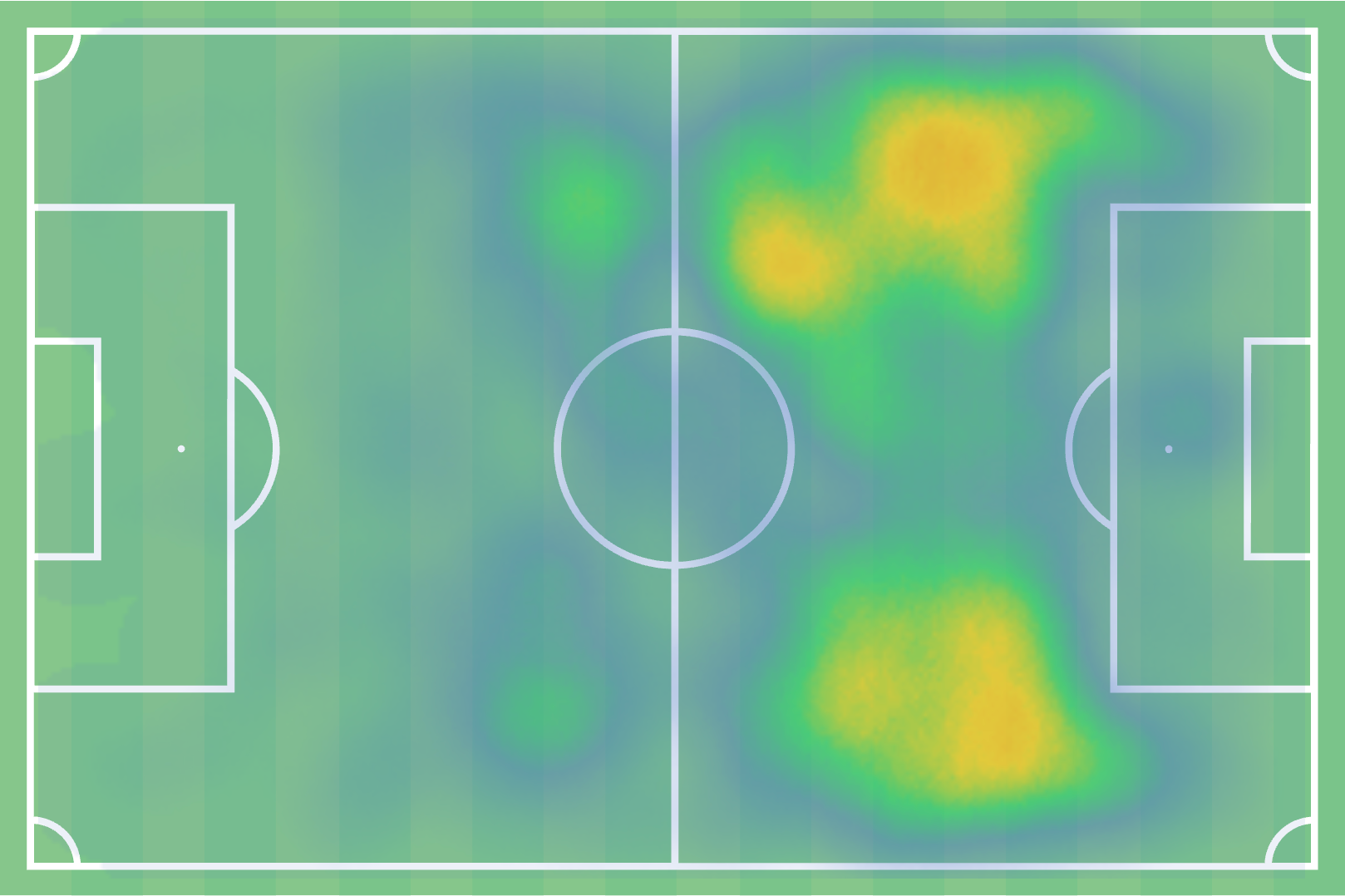
Figure 1 shows Bilal El Khannouss’ heat map from the 2025/2026 season.
What’s immediately clear from this image is that Bilal El Khannouss is not operating as a fixed No. 10 with Stuttgart, despite playing in that general role on paper.
He’s primarily found in either of the half-spaces or wider, on either wing, playing with a lot of positional freedom.
There are comparatively few touches in central zones immediately outside the opposition box, which you'd expect more of from a typical No. 10.
He isn’t frequently dropping to dictate build-up, but he does drop deep in wider channels to provide support in the build-up/progression phases.
Bilal El Khannouss Heat Map 2025/2026
This profile is well-suited to a possession-dominant side.
Rather than strictly holding a particular position with Stuttgart, El Khannouss roams about a lot.
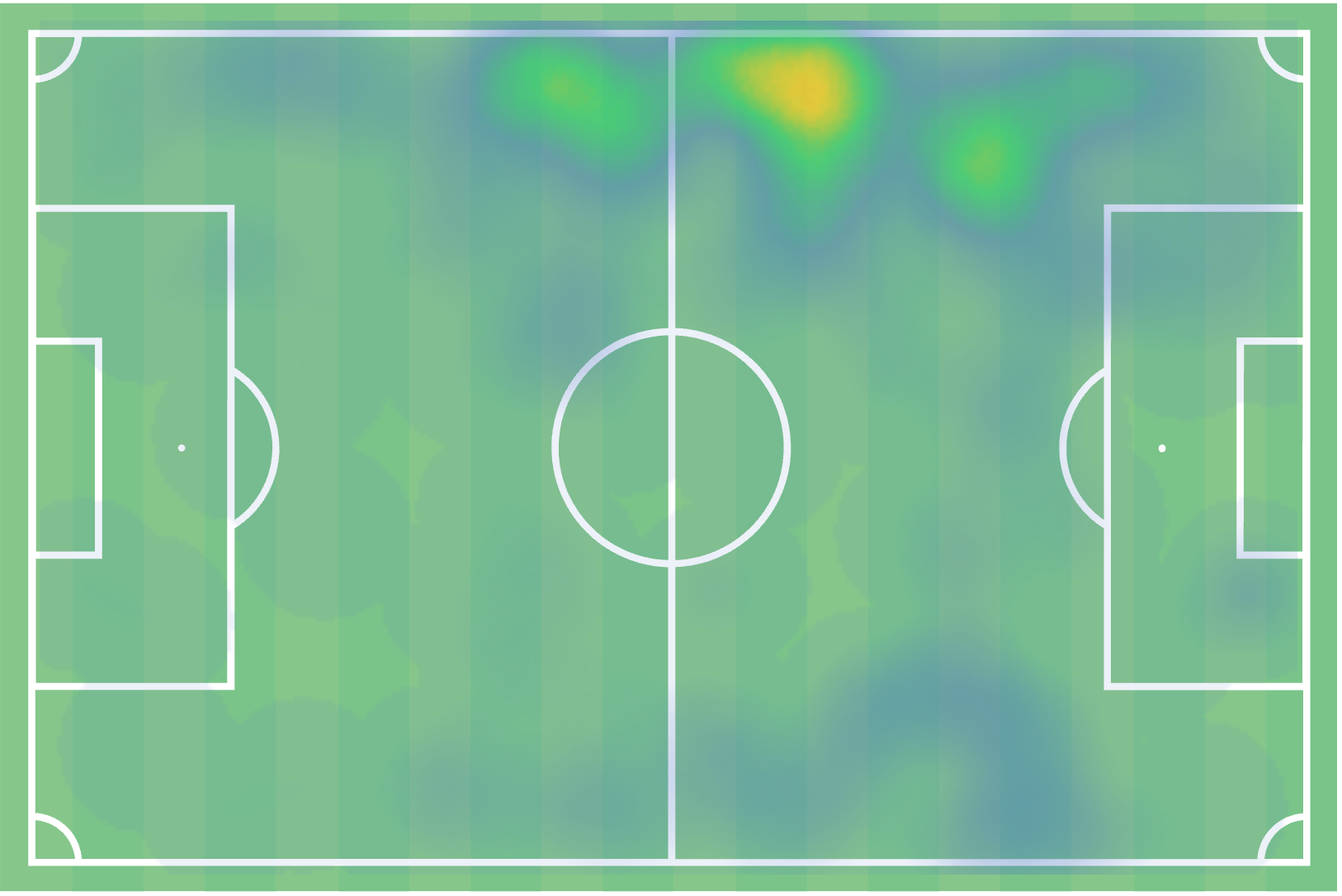
His World Cup heat map in Figure 2 indicates a more disciplined role on the left wing.
His touches are noticeably more concentrated, high and wide on the left flank as part of the Moroccan system.
Bilal El Khannouss Heat Map 2026 FIFA World Cup
Alongside the positional shift, the underlying profile has differed during the World Cup, with El Khannouss saddled with more defensive work and tasked with more dribbling than his Stuttgart role involves.
Figure 3 presents key 2025/2026 data on Bilal El Khannouss via percentile ranks for custom-built metrics derived from weighted combinations of Wyscout's raw data.
The percentile ranks benchmark El Khannouss' performance against other wingers/attacking midfielders who played at least 800 minutes in Europe’s top-five leagues this past season.
Bilal El Khannouss Percentile Ranks 2025/2026
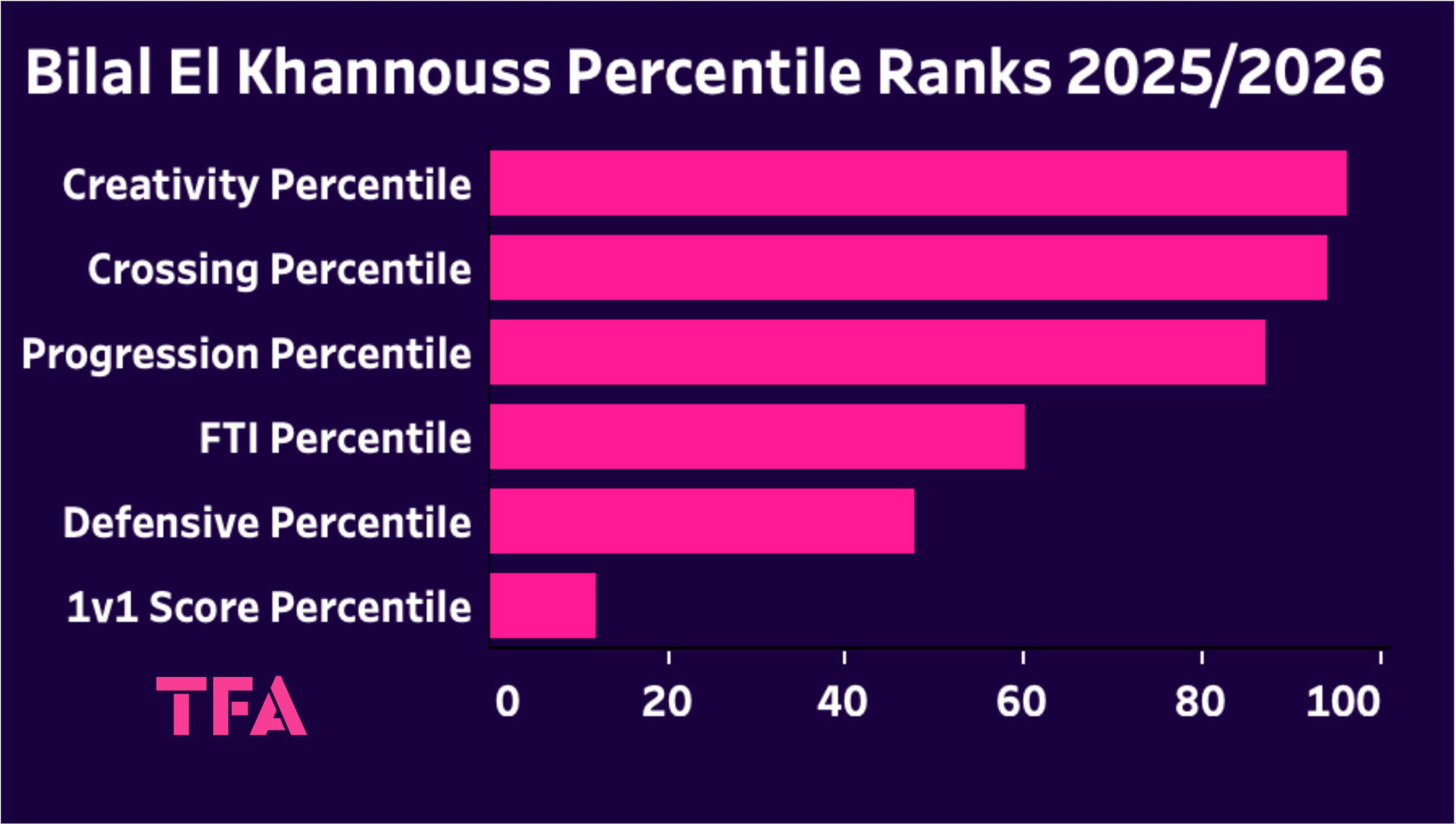
The data portrays a technically gifted attacking midfielder whose greatest strengths lie in chance creation and ball progression rather than 1v1 dribbling or goalscoring.
El Khannouss ranks near the top of the sample in our Creativity Score, Crossing Score, and Progression Score.
He's capable of contributing to the team’s chance creation in a variety of ways, including line-breaking passes and high-quality delivery into dangerous areas.
Defensive contribution isn’t a defining feature of his game, but it’s not a major weakness either.
El Khannouss can contribute well without possession within a structured system.
The most notable outlier is his 1v1 Score, which ranks well below average.
This isn’t so much an indicator of El Khannouss’ quality as much as it tells us about his squad role.
Most of the time with Stuttgart, El Khannouss’ job is to remain alert and active with his off-the-ball movement, occupy space, whether centrally or out wide, get on the ball and create a chance or break lines with his passing.
He relies mostly on his vision and technical passing quality, engaging in very few 1v1 duels.
Those he does end up engaging in are often unsuccessful; his squad role isn’t optimally designed to set him up for success in 1v1 duels.
With Morocco at the 2026 FIFA World Cup, El Khannouss has had a completely different role where he's isolated against opposing full-backs 1v1 much more often.
This has seen a notable increase in both his 1v1 duel volume and success rate, along with a drop in his creativity and crossing, highlighting the trade-off coaches have to face when deciding on El Khannouss’ role.
Overall, the data points towards a tactically flexible attacking midfield playmaker who is probably best when relying primarily on his technical quality and intelligent movement rather than individual flair, but who is still well capable if tasked with performing a more direct winger role.
Morocco have unlocked greater 1v1 involvement and success by deploying El Khannouss wider on the left flank, but is it worth the cost of his creativity and progression from the half-spaces and deeper areas?
All things considered, the player’s Stuttgart role seems to maximise the qualities that make him such an effective possession-oriented playmaker.
Bilal El Khannouss Vision & Creative Passing
Bilal El Khannouss thrives under the positional freedom which his role under Sebastian Hoeneß's tactics offers him.
He’s usually found drifting into the half-spaces or out wide, supporting teammates during the chance creation phase or occupying space to provide his team with an option to advance into the final third.
At times, El Khannouss drifts into the box via late runs, acting almost as a second-striker, while on other occasions he drops deep out on the wing, opening up space for a winger to rotate into a central position and, again, using space he finds to provide his team with a passing option as they seek to enter the opposing half.