Raúl Jiménez Scout Report At Mexico 2026: The World Cup Blueprint For Wolves 2026/2027 – Player Analysis
Mexico entered the 2026 FIFA World Cup under huge pressure, but their tournament turned out being one of the most tactically interesting stories of the competition. At the centre of that story was Raúl Jiménez.

Who Is Raúl Jiménez?
Mexico entered the 2026 FIFA World Cup under huge pressure, but their tournament turned out being one of the most tactically interesting stories of the competition.
At the centre of that story was Raúl Jiménez.
This Raúl Jiménez scout report and player analysis looks at Raúl Jiménez's role for Mexico during their World Cup run and, just as importantly, what Wolverhampton Wanderers can learn from it ahead of their 2026/2027 EFL Championship campaign.
Jiménez is no longer the same explosive centre-forward who first arrived at Molineux and became one of the Premier League’s most complete No. 9s.
His game has naturally changed with age, experience and physical context.
However, Mexico’s World Cup has shown that he remains a highly valuable striker when used in the right structure.
Across Mexico’s matches against South Africa, South Korea, Czechia and Ecuador, Jiménez played as the central reference in a 4-1-2-3 shape.
His role was based on fixing centre-backs, attacking the penalty area, competing aerially, connecting short combinations and providing the first point of pressure out of possession.
That profile should matter to Wolves.
After returning to Molineux, Jiménez will not need to be the forward who carries every transition over 40 metres or constantly creates shots for himself.
Instead, Wolves should use him as Mexico have done: as a penalty-box reference surrounded by runners, wide delivery and close support.
Raúl Jiménez Style Of Play
Jiménez’s current style of play is built around efficiency rather than constant involvement.
He is not a striker who needs to dominate possession through a high volume of touches.
Instead, his influence comes from the quality of his actions around the penalty area and his ability to give Mexico a stable attacking reference.
For Mexico, he usually starts as the central striker between the opposition centre-backs.
From there, he performs two main tasks.
The first is to occupy defenders.
By staying high, Jiménez prevents centre-backs from stepping into midfield too easily.
This creates more room for players such as Julián Quiñones, Roberto Alvarado, Luis Romo or Gilberto Mora to receive around him.
The second is to attack the box.
His shot map shows a player still focused on high-value finishing zones.
Most of his efforts come from central areas inside the penalty area or around the penalty spot, with very little evidence of him wasting shots from low-probability zones.
That is important because it shows that Jiménez is not simply increasing his volume.
He is still getting into the areas where a centre-forward should be judged.
Raúl Jiménez Shot Map At Mexico 2026
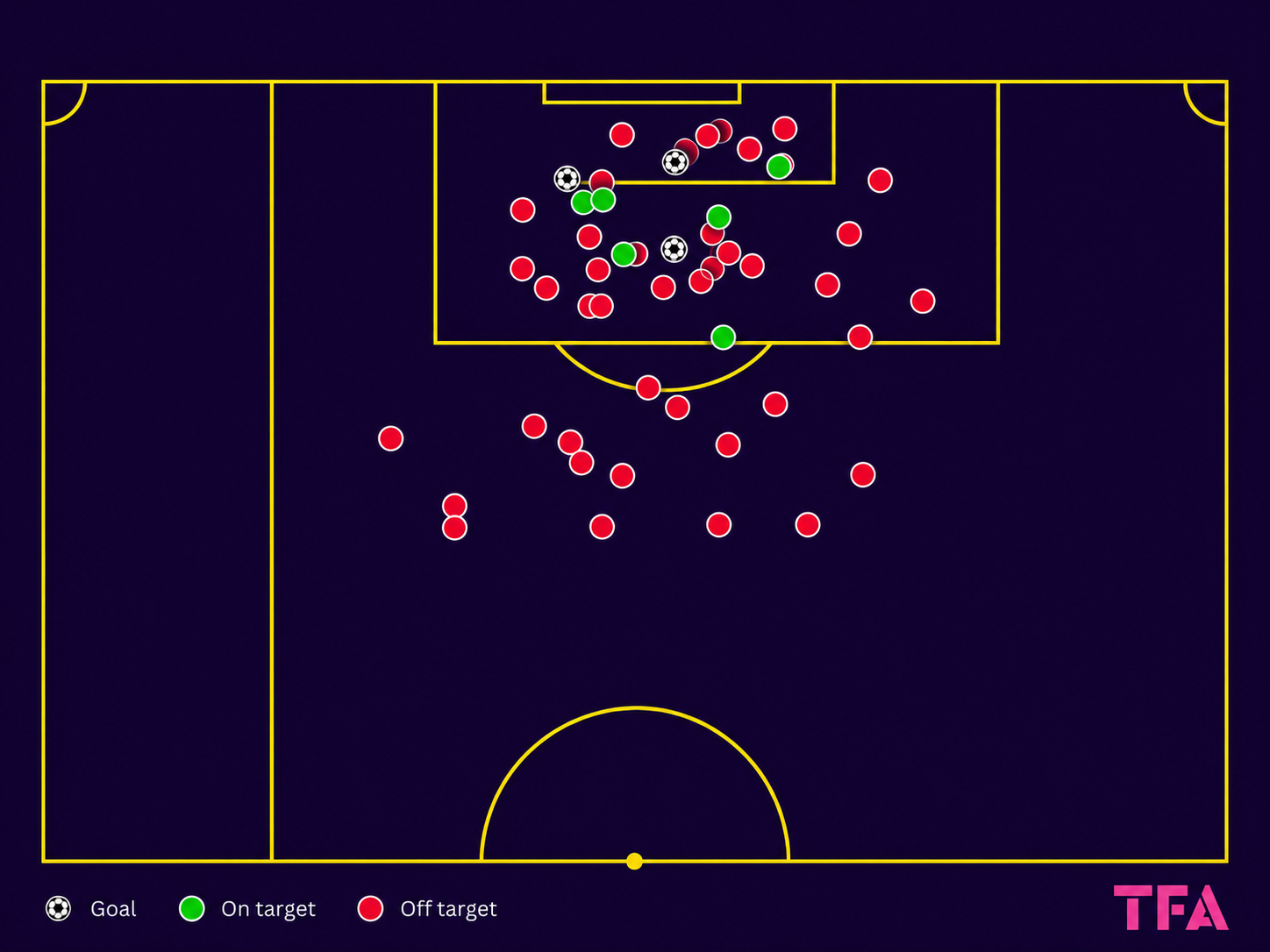
The shot map tells the story clearly.
Jiménez’s attempts are concentrated inside the box, with a strong presence in central areas close to goal.
His threat is still built on timing, penalty-box occupation and the ability to attack deliveries, rebounds or quick combinations.
The data backs that up.
Wolves are not getting a striker who does a bit of everything.
They are getting elite production in the areas where centre-forwards decide games.
Raúl Jiménez In Mexico's Tactical Structure
Mexico’s 4-1-2-3 gives Jiménez a clear framework.
The wide forwards provide the first layer of support.
Quiñones often gives Mexico a more direct, aggressive runner, while Alvarado can help connect attacks from the opposite side.
Behind them, Mexico’s midfielders provide the second layer, either by arriving around the box or supporting counter-pressing situations.
This matters because Jiménez is at his best when he is not isolated.
Against South Africa, Mexico had 57.1% possession, produced 16 shots and generated 1.78 xG.
They also recorded 117 receptions in the final third and 13 crosses.
That was the game where Mexico most clearly controlled territory, and Jiménez benefited from having the team close to the box.
His goal came in the second half, and it reflected one of his biggest strengths: attacking the box with timing rather than relying on pure speed.
Against South Korea, the match was different.
Mexico had only 40.8% possession and generated 0.34 xG, but Jiménez still started as the central reference.
In that game, his value was less about constant finishing and more about helping Mexico maintain structure when they had to defend for longer spells.
The Czechia match brought another version of his role.
Jiménez did not start, but Mexico’s attacking structure still showed the importance of the centre-forward position.
Mexico produced 2.1 xG, had 109 receptions in the final third and won 3-0, showing how dangerous they can be when their front line receives enough support.
Then, against Ecuador, Jiménez returned to the starting XI and scored after 31 minutes.
Mexico had only 37.1% possession, but they still generated 1.86 xG from 15 shots.
This was arguably the best example of why his role is so useful: Mexico did not need long spells of sterile possession to create danger.
They needed directness, timing and box presence.
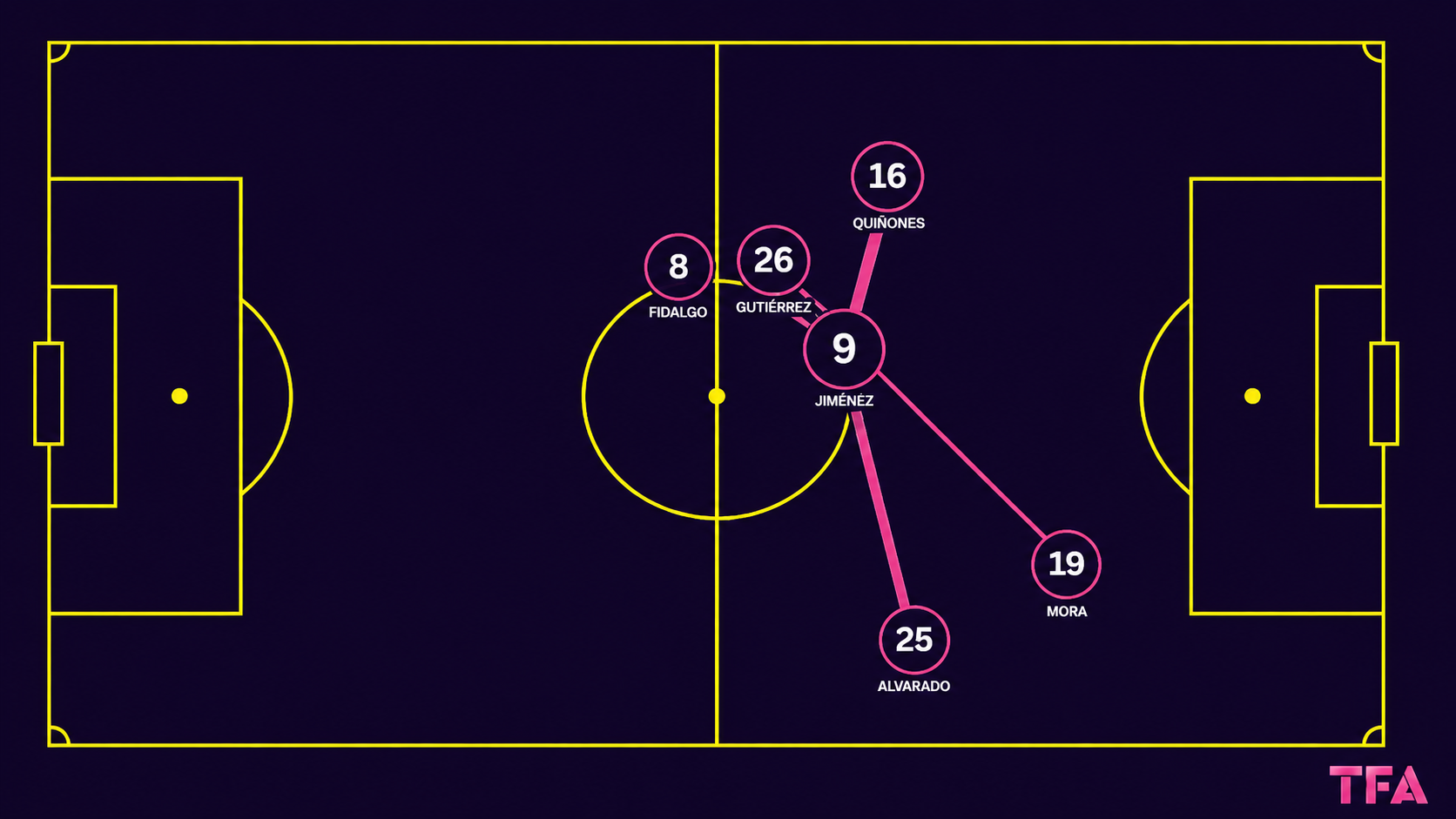
Jiménez’s pass network also supports the visual impression.
Raúl Jiménez Pass Network At Mexico 2026