
Nottingham Forest Vs Manchester City [3-1] Premier League 2026/2027: How Oliver Glasner Outmanoeuvred Enzo Maresca - Tactical Analysis
Nottingham Forest stunned Manchester City with a 3-1 win. This tactical analysis examines their compact defensive block, aggressive high press, superiority in duels and ruthless counterattacking against City’s vulnerable transitions.

Nottingham Forest met Manchester City at the City Ground in the Premier League’s 10th gameweek.
The hosts surprised the Citizens with an unexpected 3-1 win.
It was unexpected not only because Manchester City were superior on paper but also because Nottingham Forest had a very negative streak at home this season and were failing to achieve positive results whenever they played at the City Ground.
They finally reacted and ended this trend, thanks to a stellar performance built on sacrifice and discipline in the defensive phase, combined with dynamism and intelligence in defensive and offensive duels, as well as exceptional handling of their counterattacking situations.
This win slightly improves the Oliver Glasner team's position in the table, as they now sit 16th with nine points, five losses, three draws, and two wins.
Continuing to play with the same motivation and intensity will be crucial for Nottingham Forest to win more points before the first half of the season ends, to get out of the relegation zone and start thinking about a mid-table finish.
To do so, winning more points at home will be essential.
As for Manchester City, the team’s performance was not that convincing despite the late second-half reaction and unfinished comeback.
Enzo Maresca's side started the match without the required intensity and paid the price in the first half, as Forest were more intense in duels and looked better prepared for the battle.
Despite their second-half attempts, Manchester City still did not look that dangerous, and their defensive transitions were always problematic, an aspect that Nottingham Forest worked on exploiting and succeeded in doing so.
This loss allowed the Citizens' rivals to pull further ahead in the table, as Arsenal are now six points ahead of Manchester City.
In this tactical analysis, we explore Nottingham Forest’s exceptional first-half performance and how they punished Manchester City through a high press, high and mid recoveries, and counterattacking.
Nottingham Forest Vs Manchester City Lineups & Formations
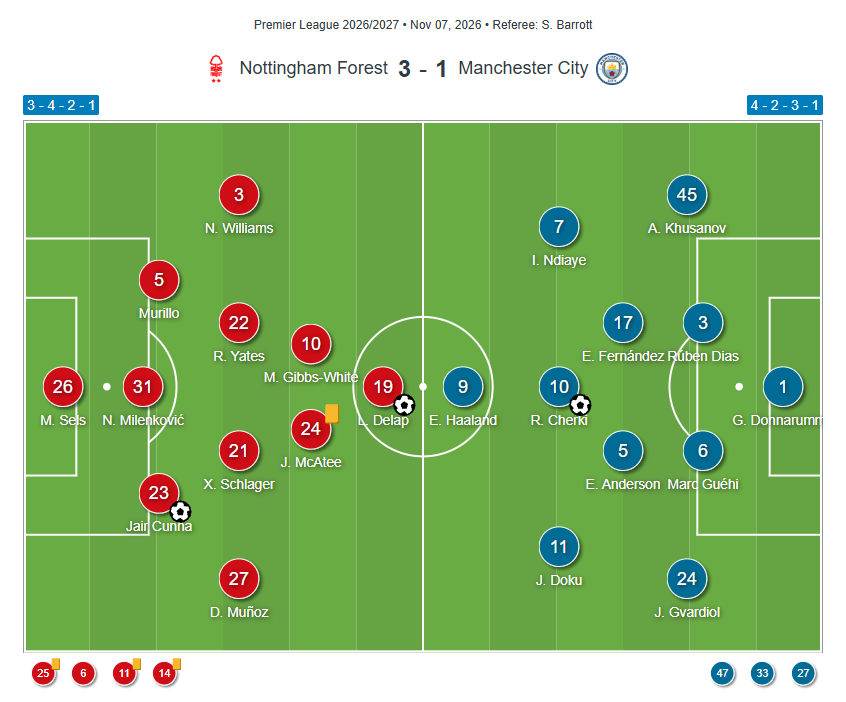
Nottingham Forest Lineup Vs Manchester City
Glasner relied on a 3-4-2-1 formation, with Matz Sels in goal and a defensive trio of Jair Cunha, Nikola Milenković, and Murillo at centre-back.
The midfield line was formed of Xaver Schlager and Ryan Yates as central midfielders, with both Daniel Muñoz and Neco Williams as wing-backs, Morgan Gibbs-White and James McAtee as wide playmakers, and Liam Delap as the main striker.
Manchester City Lineup Vs Nottingham Forest
For Manchester City, Maresca opted for a 4-2-3-1 formation using Gianluigi Donnarumma as a goalkeeper, Marc Guéhi and Rúben Dias as centre-backs, Abdukodir Khusanov as a right-back, and Joško Gvardiol as a left-back.
In midfield, he relied on Enzo Fernández and Elliot Anderson as central midfielders, Rayan Cherki as the advanced playmaker, with Iliman Ndiaye and Jérémy Doku as wingers, and Erling Haaland as the main striker.
Nottingham Forest Initial Defensive Organisation
Nottingham Forest started the match with the right attitude and showed a lot of desire to make a reaction following their poor start to the season.
More importantly, they were clearly motivated to score at home, as they have failed to do so whenever they have played at home this season.
Despite facing one of the toughest opponents in the Premier League, Nottingham Forest were very good since the start of the match and did not show signs of fear or retreating.
In contrast, they tried to push forward and reach the penalty box quickly, while also limiting Manchester City’s advance mainly by relying on compact, close lines and a relatively high defensive line.
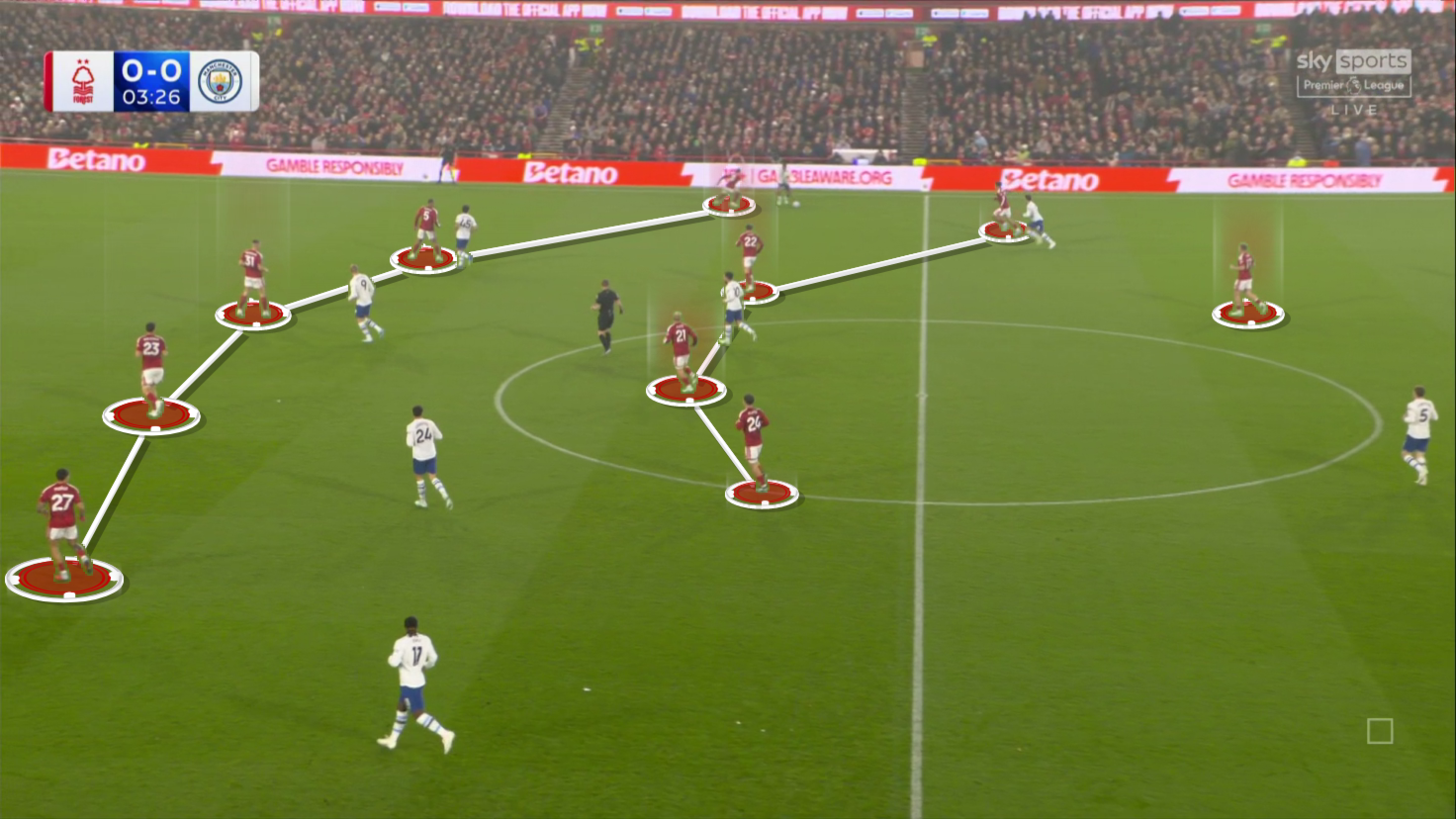
In fact, Nottingham Forest relied on a 5-4-1 formation in the defensive phase mainly to prevent Manchester City from using the wings in the way they like while also limiting their penetration from half-spaces, as the four players forming the midfield line were usually very disciplined and close to the defensive line.
This compact defensive organisation helped Nottingham Forest reduce the threat from the trio behind Haaland, as Cherki, Doku, and Ndiaye did not have enough room to dribble or play key passes inside Nottingham Forest’s half, mainly thanks to the continuous double marking applied to them.
Nottingham Forest Rewarding High-Press Plan Vs Manchester City Disastrous Build-Up & Defensive Transition
In addition to Nottingham Forest’s efficient 5-4-1 defensive organisation, their strong start was driven by an intense high press that punished Manchester City’s slow build-up from the back and surprised them with quick recoveries.
Put more simply, Nottingham Forest were more active and started the match fully focused, while Manchester City looked less prepared and less dynamic in the opening minutes, especially when they tried to build up from the back.
Nottingham Forest exploited Manchester City's slow rhythm by applying an immediate press on the ball holder inside City’s half.
They were quickly rewarded.
Nottingham Forest scored in the fifth minute after Gvardiol, who received a pass from Guéhi during Manchester City’s build-up, failed to protect the ball.
This error partly stemmed from Maresca’s reliance on Gvardiol out of his natural position, despite having a more natural left-back on the bench in Nico O'Reilly.
Maresca got punished for this choice quickly, even though choosing Gvardiol over O’Reilly was more likely with the aim of defending better in the 1v1 duel against McAtee.
That said, Maresca is not the only one responsible for this goal, as Gvardiol could have handled the situation better and avoided such risk-taking, knowing this was not the first time he played on the left.
After his first touch, Gvardiol saw Cunha and McAtee closing in and still chose to run with the ball to avoid them, even though he could have passed or crossed to avoid such a risky decision.
The credit surely goes to Cunha for pressing on Gvardiol with intensity until succeeding in intercepting the ball intelligently.
Still, Gvardiol’s inability to protect the ball in this duel, and his late, passive response, represent serious build-up issues for Manchester City.
Cunha’s solo effort gave Nottingham Forest an early goal as he continued his run after the high recovery and showed the fluidity to score with his left foot after pretending to pass to McAtee.
In this situation, the blame falls partly on both Manchester City centre-backs, Guéhi and Dias, as both were too passive and left too much space for Cunha.
That space encouraged Cunha to shoot, as he saw a possible shooting trajectory after thinking about passing.
Even if Guéhi and Dias were certain Cunha would pass, that shouldn't excuse leaving him so much space in that dangerous area.
In reality, Guéhi and Dias’s attitude and decision to wait and avoid getting closer to Cunha stem from being put in a 4v2 situation after Gvardiol lost the ball.
Therefore, the error is neither that of Gvardiol only nor of Guéhi and Dias only; it was a collective error from Manchester City’s defenders and midfielders, too.
Cherki’s reluctant retreat, for instance, kept Manchester City in a 4v3 situation instead of 4v2, and that could have changed how Guéhi and Dias approached Cunha’s penetration.