![Sweden Vs Poland [3-2] – 2026 FIFA World Cup Qualification Playoff Final – Tactical Analysis](https://cdn.mymidnight.blog/77f959f119f4fb2321e9ce801e2f5163/size/w1000/2026/04/Sweden-VS-Poland-2026-WC-Playoff.png)
Sweden Vs Poland [3-2] – 2026 FIFA World Cup Qualification Playoff Final – Tactical Analysis

Sweden faced Poland in the finals of UEFA’s FIFA World Cup qualification playoffs, and the match ended in a decisive 3-2 win for the hosts after an entertaining battle.
Sweden earned a long-awaited return to the World Cup after an absence in the most recent edition; in 2018, they reached the quarter-finals.
Poland have failed to qualify for this edition of the World Cup after being present in the last two and despite having reached the Round of 16 in 2022.
In this tactical analysis, we explore how both teams managed to exploit each other’s defensive weaknesses.
Sweden Vs Poland Lineups & Formations
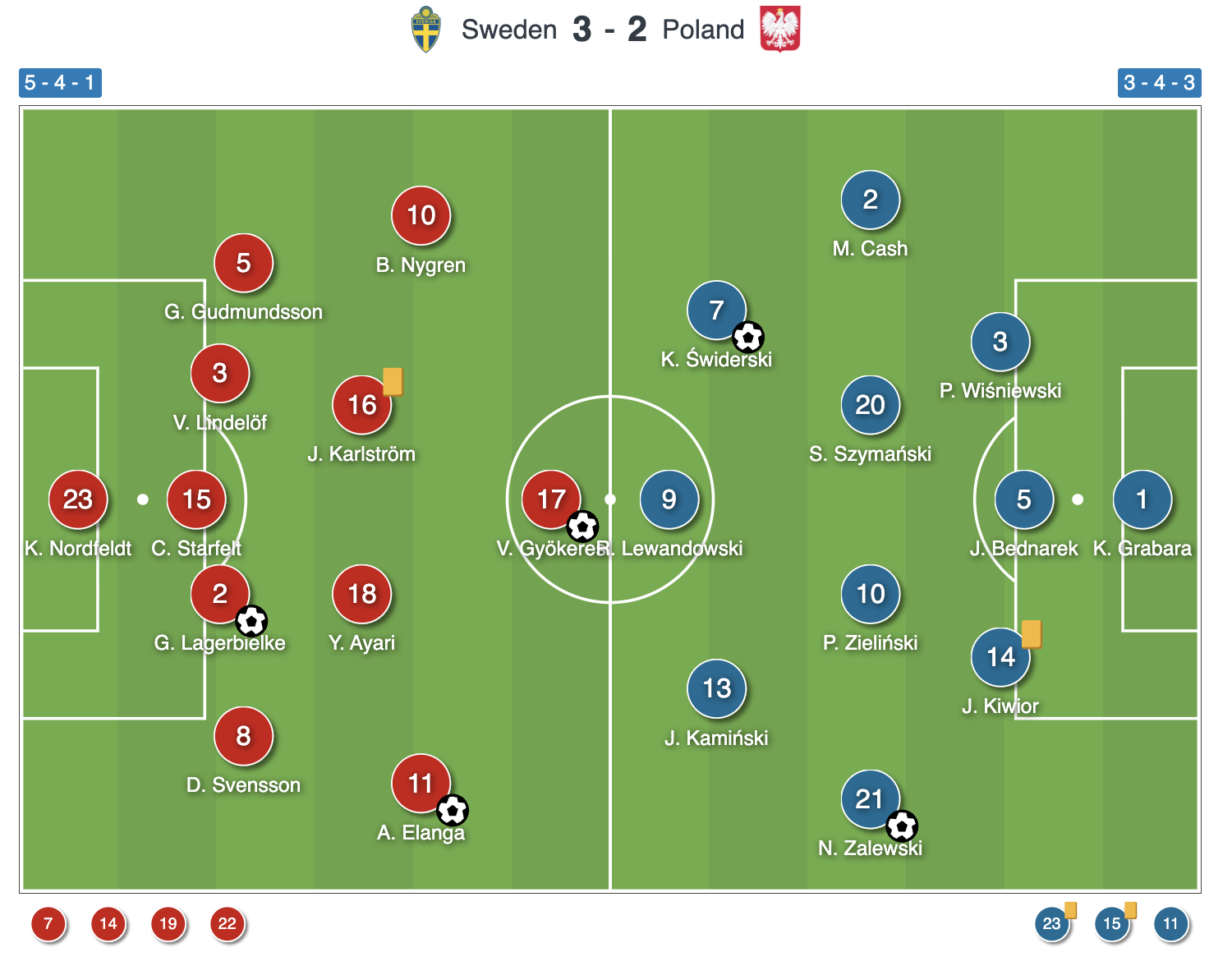
Graham Potter started the match in a 3-4-2-1 formation, with Kristoffer Nordfeldt as goalkeeper and a defensive trio of Gustaf Lagerbielke, Carl Starfelt, and Victor Lindelöf.
The midfield was made up of Yasin Ayari and Jesper Karlström as central midfielders with Daniel Svensson and Gabriel Gudmundsson on the wings.
In attack, the team relied on Anthony Elanga and Benjamin Nygren on the wings, and Viktor Gyökeres as the main striker.
On the other side, Jan Urban used a 3-4-3 formation with Kamil Grabara as the goalkeeper and a defensive line of Przemysław Wiśniewski, Jan Bednarek, and Jakub Kiwior as centre-backs.
The midfield was composed of Sebastian Szymański and Piotr Zieliński as central midfielders, Matty Cash and Nicola Zalewski as wing-backs.
Upfront, Karol Świderski played on the left wing, while Jakub Kamiński was the right winger, and Robert Lewandowski.
Sweden & Poland Attacking Solutions
Poland started the match with high pressure on Sweden’s defence and greater determination to score early.
Sweden grew into the game and found solutions to Poland’s initial high press through ball possession and especially by advancing from the wings with quick, short passes.
Poland remained dangerous, however, and relied on both Cash and Zalewski to make the difference from the wings, as they were instructed to advance more often and to opt for either penetrations or crosses towards the box.
Poland created some dangerous situations thanks to attempts that relied on wing-back solutions and numerical superiority in the box, since both central midfielders were also actively involved in most of these attempts inside the penalty area.
On the other hand, Sweden tried to rely on quick attacking transitions and to surprise Poland’s defence with such quick actions, aiming to cross towards the box as the first solution and to resort to internal passing combinations and penetrations as the second.
It counts for Poland that they did not allow Sweden to execute either of these plans successfully, at least in the first half, and were aggressive on the ball and very well-positioned when out of possession.
This defensive alert mode helped Poland a lot in preventing dangerous counterattacks from Sweden early in the game and in gaining more confidence as the match progressed.
Sweden First Goal Action & The Interchangeability Of Attacking Roles
Sweden scored after one of their first well-prepared attacking actions, following a period of possession, rather than through a counterattack as they had initially planned.
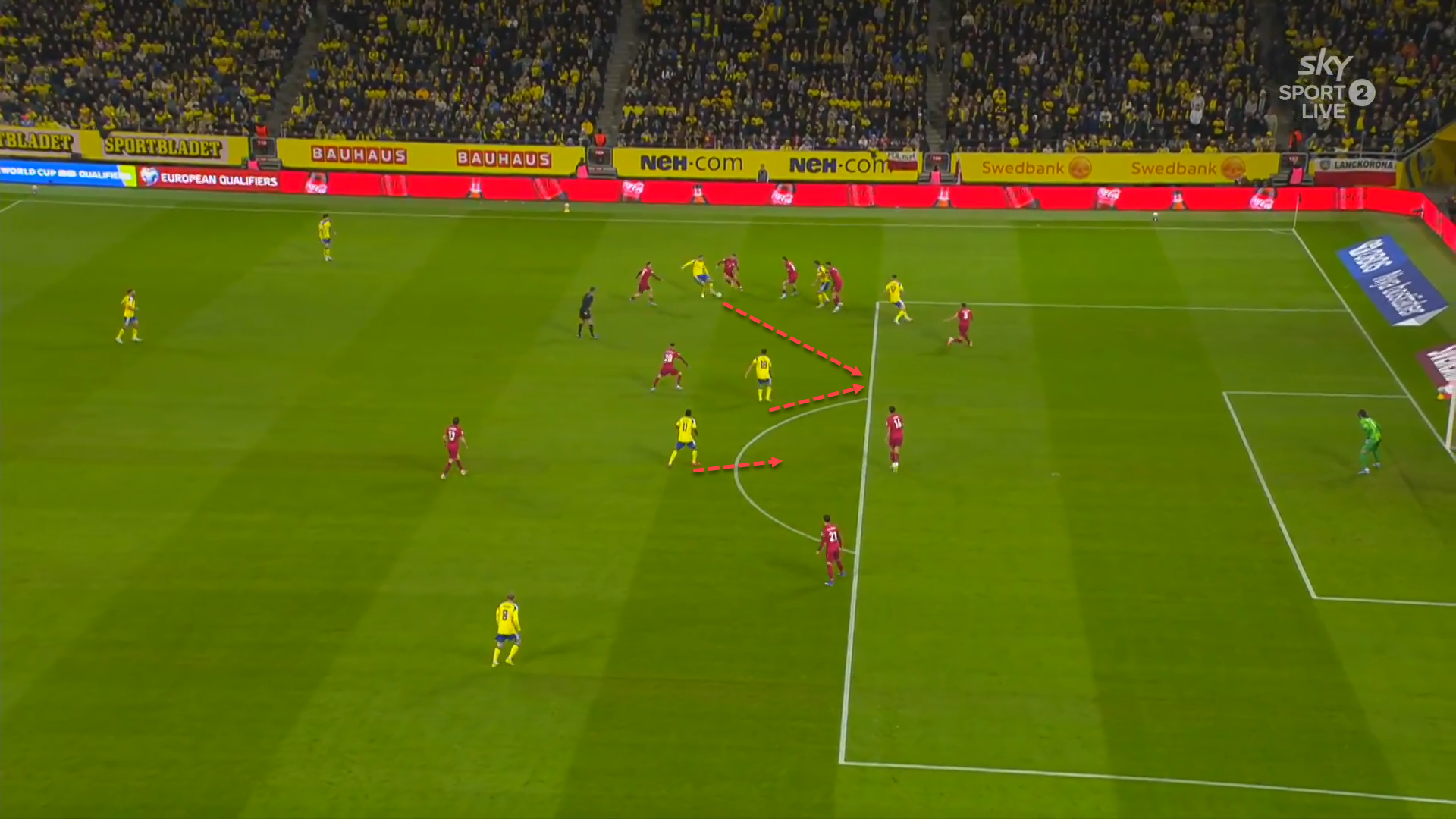
In fact, Sweden tactics attracted Poland’s players with their build-up from the back and were able to switch play to the left flank at the right time, allowing Gudmundsson to receive the ball and cut inside, finding enough space and time to do so.
Following his penetration attempt, Ayari was very intelligent in advancing towards the edge of the box and providing a passing option in that area while positioning himself away from the marker.
The central midfielder received the ball and was very intelligent, creative, and decisive, immediately opting for a first-touch back-heel pass to Elanga, who was at his back, creating a favourable shooting opportunity for the latter.
Ayari’s creativity and attacking support were extremely valuable in this action, as it was what made the difference and created issues for Poland’s defence, who were used to only finding Gyökeres in that area and not both Ayari and Elanga.
The interchangeability of attacking positions and the movements without the ball from both Ayari and Elanga, as well as their ability to deal well enough with the situation that they received the ball in and knowing how to avoid losing time while passing/finishing quickly, was vital in succeeding to convert this chance into a goal.
Furthermore, Elanga’s left-footed finishing was remarkable mainly because it was not easy at all to finish with the weaker foot, let alone do so with a first-time shot while adding power without compromising accuracy.
The goal highlights Sweden’s diverse attacking options: they have more than one reliable attacking player for assists and finishing, and they do not rely solely on their main striker and wait for him to score goals.
Poland Alternative Attacking Solutions
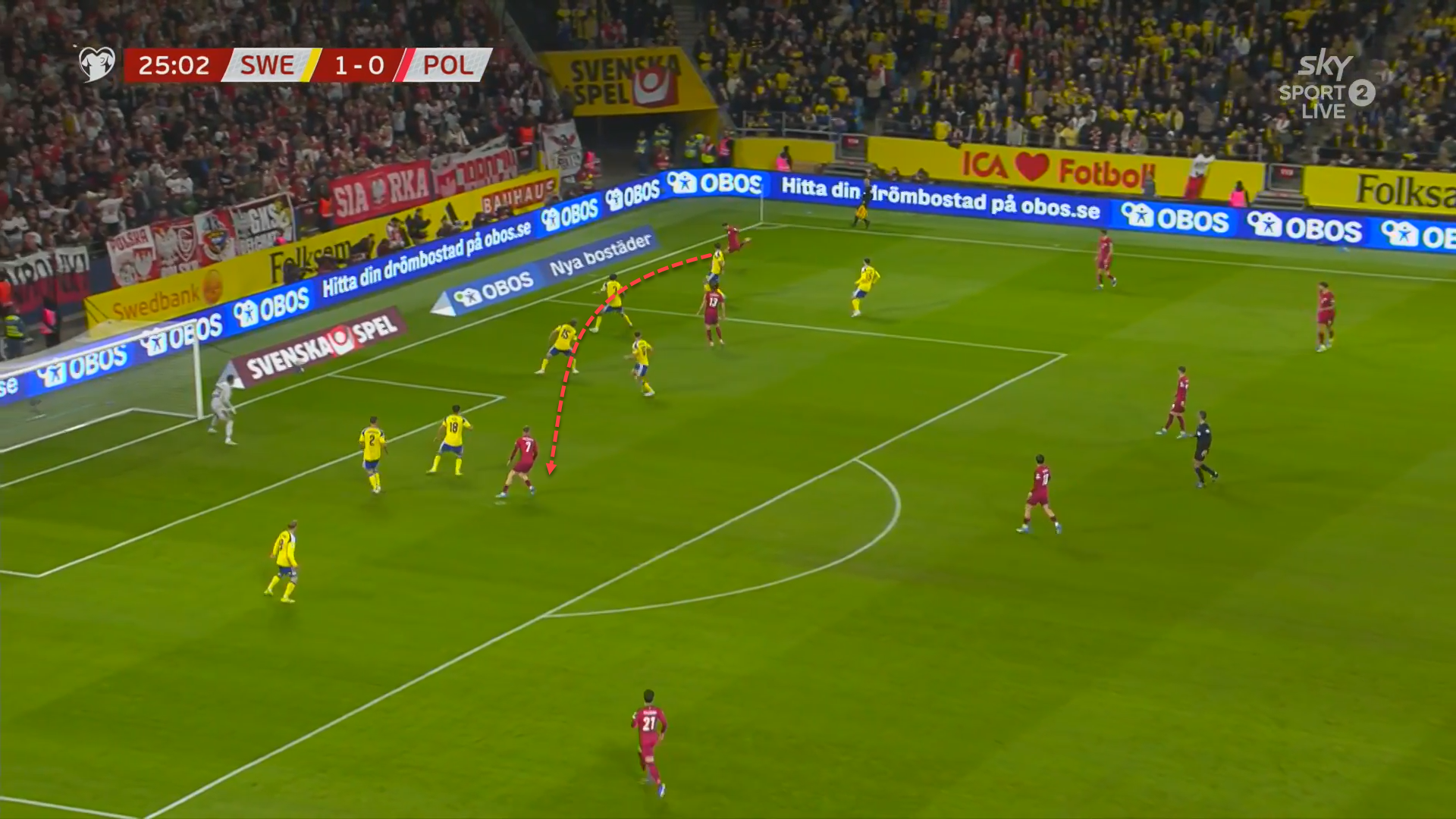
On the other side, Poland tried to reproduce a similar idea of Sweden’s goal action as they advanced from the right-wing thanks to Cash’s efforts before he crossed the ball towards the box, with Świderski acting like a main striker instead of Lewandowski and opting for a volley that was very dangerous on Sweden’s goal.
This search for alternative solutions to serving the main strikers was a successful plan for both teams, as it surprised both defences and created the needed threats.
That said, Poland and Świderski in particular were not rewarded for their alternative goalscoring solution, as the goalkeeper miraculously saved the powerful shot.
Poland Wing Penetrations
Despite that, Poland exploited Sweden’s intention to retreat, tried to buy time with ball possession, and managed to disrupt them with other attacks, including an equalising goal.
Although Graham Potter tactics tried to protect Sweden's advantage by retreating, it failed to remain organised and cautious enough in the defensive phase, as it failed to execute double marking successfully on more than one occasion, especially on the wings.
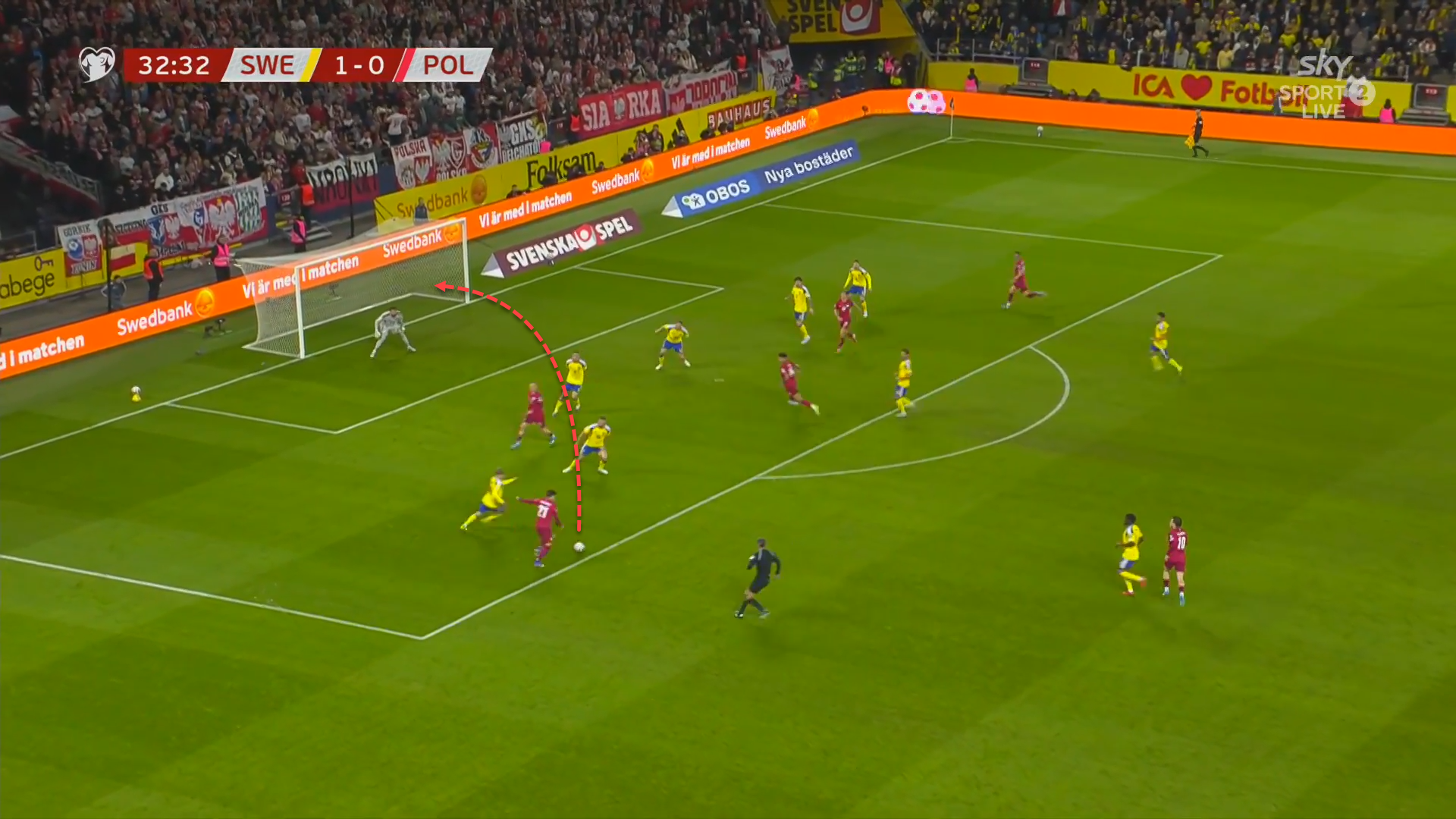
This helped Poland believe in their chances even more, and their equalising goal came soon after, mainly thanks to a solo effort from Zalewski.
The latter exploited an accurate switch of play to his left wing and advanced quickly to get past his direct marker before deciding what to do.
And as soon as he dribbled past his direct opponent, he noticed that there was no double marking on him, nor a serious attempt to prevent him from shooting or to deflect his shot.
This encouraged Zalewski to shoot from distance, and he did so with power and accuracy to score a very important goal for Poland, created mainly by Poland’s quick switching of play from side to side, especially thanks to Zalewski’s penetration and shooting skills, and by Sweden’s passive defending.
Poland Wing-Play & Chemistry Inside The Box
Despite their defensive errors, which cost them dearly in this match, Poland showed impressive attacking play and potential that could be further developed.
In particular, the second goal action further confirms their reliance not only on Lewandowski but also on the rest of the attacking players in creating goal-scoring opportunities.
This helps the team a lot in finding solutions, especially because Lewandowski is often marked, as all opponents are aware of his goalscoring threat.


![Scotland Vs Switzerland [0-3] UEFA Nations League 2026/2027: How Aggressive Pressing Backfired & Murat Yakin Took Advantage - Tactical Analysis](https://cdn.mymidnight.blog/77f959f119f4fb2321e9ce801e2f5163/size/w600/2026/10/Scotland-Vs-Switzerland-20262027---Tactical-Analysis.png)