
![Cardiff City Vs Wrexham [1-1] EFL Championship 2026/2027: How Phil Parkinson Tactics Targeted Cardiff Weaknesses – Tactical Analysis](https://cdn.mymidnight.blog/77f959f119f4fb2321e9ce801e2f5163/size/w1000/2026/08/Cardiff-City-Vs-Wrexham-Analysis-Championship.png)
Cardiff City Vs Wrexham [1-1] EFL Championship 2026/2027: How Phil Parkinson Tactics Targeted Cardiff Weaknesses – Tactical Analysis
Cardiff City struggled defensively in their 1-1 draw with Wrexham. This tactical analysis examines Wrexham’s attacking strategy, Cardiff’s positioning errors, second-ball issues and how Phil Parkinson’s side repeatedly exploited the Bluebirds’ high defensive line.

Cardiff City hosted Wrexham for their first fixture of the 2026/2027 EFL Championship season, and the match ended with a 1-1 draw.
The Red Dragons could arguably be coming away even more disappointed than the Bluebirds about this draw, as they had the lead throughout the match before conceding a last-minute goal from a free kick.
Wrexham knew how to exploit Cardiff City’s weaknesses and played on them to score their goal and create several other valuable goalscoring situations.
However, Phil Parkinson’s players were unable to be clinical enough in front of goal in order to further secure their win, leaving the door open for Cardiff City to equalise at any time.
With that said, the way Wrexham played in this away match can only be positive for the team, as they showed a lot of desire to score and willingness to defend well enough throughout the match, except for those final minutes.
That lack of discipline to concede the free kick late on in the game is something they'll need to address in order to find themselves in the promotion fight this season.
On the other hand, Cardiff City should also be disappointed both with the result and with their overall performance.
Brian Barry Murphy's side struggled to create dangerous actions against Wrexham, and they were unable to secure their defensive line from Wrexham’s attacks and counterattacks.
A lot of defensive errors were recurrent in this match too, and that is already worrying for the rest of the season.
In this Cardiff City vs Wrexham tactical analysis, we focus mainly on these defensive issues and how Wrexham succeeded in exploiting them in their favour.
The analysis will try to identify these defensive weaknesses in detail and show how Wrexham were able to intelligently build on such errors to create dangerous attacking actions.
Cardiff City Vs Wrexham Lineups & Formations
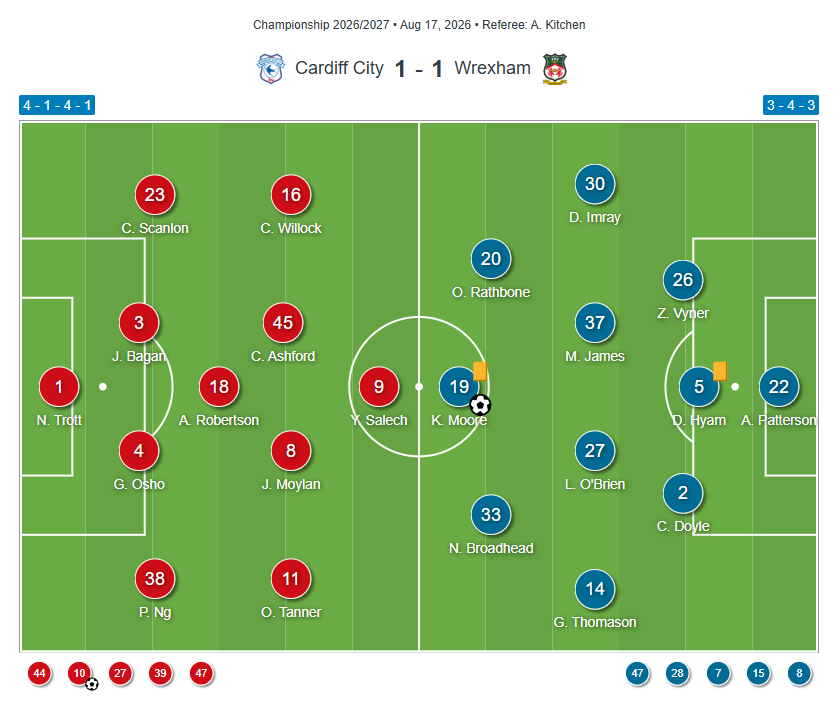
Cardiff City Lineup Vs Wrexham
Murphy started the match using the 4-1-4-1 formation with Nathan Trott in goal, Perry Ng at right-back, Gabriel Osho and Joel Bagan as centre-backs, with Calum Scanlon at left-back.
The midfield was made up of Alex Robertson as the defensive midfielder, with Cian Ashford and Jack Moylan as central midfielders.
In attack, both Chris Willock and Ollie Tanner played on the wings, with Yousef Salech as the main striker.
Wrexham Lineup Vs Cardiff City
For Wrexham, Parkinson relied on a 3-4-3 formation with Anthony Patterson as the goalkeeper, Zak Vyner, Dominic Hyam, and Callum Doyle as centre-backs, with both Daniel Imray and George Thomason playing as wing-backs, while retreating when necessary to form a back-five defence.
In midfield, Parkinson used Matty James and Lewis O'Brien as central midfielders, with Nathan Broadhead and Oliver Rathbone as wingers, and Kieffer Moore as the main striker.
Wrexham Opportunistic Attacking Strategy
The match started with Wrexham taking the attacking initiative and trying to disturb newly-promoted Cardiff City’s defence early in the game in order to push them into committing errors.
Their plan was eventually successful after they won a free-kick, executed it and knew how to exploit the second ball to surprise the advancing defensive block.
In fact, Wrexham exploited Ashford’s clearance and gave no time for Cardiff City’s defenders to reorganise themselves and get on the same line.
The quick first-time long pass of Imray towards Cardiff City’s box, specifically to Moore, made all the difference in this action and led to a very dangerous situation.
But even though Imray’s pass was surprisingly accurate and quick, the blame should be put on Cardiff City’s defence for conceding this goal.
First, Osho was not quick enough to advance and position himself within the same line where his defence teammates were standing.
This kept Moore in play and allowed him to receive that long pass in a regular position and not in an offside one.
Second, Bagan, who had to mark Moore, was focusing on the linesman and waiting for him to raise the offside flag rather than following Moore in order to intercept the ball or at least prevent him from shooting/push him towards the wide areas.
This poor defensive behaviour during such a crucial action also contributed to making Wrexham’s action successful.
Furthermore, Bagan was unable to disturb Moore physically, as a slight hand push from Moore was sufficient for him to make Bagan stop and let the Welsh striker advance freely with the ball.
Third, Moore made things complicated for the whole Cardiff City defence as he was very quick and opportunistic in his finishing.
Letting the ball bounce twice and shooting with accuracy and power towards the opposite angle as soon as the ball hit the ground for the third time made it nearly impossible for Osho and Bagan to prevent or block the shot.

![Scotland Vs Switzerland [0-3] UEFA Nations League 2026/2027: How Aggressive Pressing Backfired & Murat Yakin Took Advantage - Tactical Analysis](https://cdn.mymidnight.blog/77f959f119f4fb2321e9ce801e2f5163/size/w600/2026/10/Scotland-Vs-Switzerland-20262027---Tactical-Analysis.png)
![Olympique De Marseille Vs PSG [1-2] Ligue 1 2026/2027: How Bruno Génésio Transitions Troubled PSG - Tactical Analysis](https://cdn.mymidnight.blog/77f959f119f4fb2321e9ce801e2f5163/size/w600/2026/09/Marseille-Vs-PSG-2026_2027---Tactical-Analysis.png)
![Fulham Vs Manchester United [1-1] Premier League 2026/2027: How Álvaro Arbeloa Tactics Exposed The Red Devils' Problems - Tactical Analysis](https://cdn.mymidnight.blog/77f959f119f4fb2321e9ce801e2f5163/size/w600/2026/09/Fulham-FC-Vs-Man-United-2026_2027---Tactical-Analysis.png)
![AS Roma Vs Inter Milan [2-2] Serie A 2026/2027: When Undefeated Giallorossi Attack Met Nerazzurri Comeback Resilience - Tactical Analysis](https://cdn.mymidnight.blog/77f959f119f4fb2321e9ce801e2f5163/size/w600/2026/09/AS-Roma-Vs-Inter-Milan-2026_2027---Tactical-Analysis.png)
![Real Sociedad Vs Bournemouth [1-2] Europa League 2026/2027: How Do Marco Rose Pressing Tactics Work? - Tactical Analysis](https://cdn.mymidnight.blog/77f959f119f4fb2321e9ce801e2f5163/size/w600/2026/09/Real-Sociedad-Vs-Bournemouth-20262027---Tactical-Analysis-1.png)
![AC Milan Vs Benfica [0-2] Europa League 2026/2027: How Marco Silva Tactics Exposed Rúben Amorim Defensive Problems - Tactical Analysis](https://cdn.mymidnight.blog/77f959f119f4fb2321e9ce801e2f5163/size/w600/2026/09/AC-Milan-Vs-Benfica-20262027---Tactical-Analysis.png)
![Sunderland Vs AZ Alkmaar [1-0] Europa League 2026/2027: Why The Black Cats Make Better Underdogs - Tactical Analysis](https://cdn.mymidnight.blog/77f959f119f4fb2321e9ce801e2f5163/size/w600/2026/09/Sunderland-Vs-AZ-Alkmaar-20262027---Tactical-Analysis.png)