Italy Vs France [3-1] UEFA Nations League 2026/2027: How Roberto Mancini Tactics Exploited France Defensive Weaknesses - Tactical Analysis

Italy faced France at San Siro in Milan for their fifth fixture of the UEFA Nations League group stage, and the match ended with a 3-1 win for the Azzurri.
It was an unexpected result given France's excellent form and Italy's inconsistent results in recent times.
Moreover, Italy have been going from failure to failure in the last few years, including several absences from FIFA World Cup tournaments, which confirm the issues that surround this national team.
That said, Italy bounced back in this match and turned the tables on France after conceding an early goal, climbing to the top of the group with 10 points alongside France, but with the goal-difference advantage.
With one match remaining against Belgium, Italy have a strong chance of qualifying for the knockout phase, especially if they get a positive result in that last match.
At the same time, France will have to face Türkiye at home.
Although France’s qualification mission sounds relatively straightforward, given that they play at home against a Türkiye side that has not been doing well lately, their poor defending against Italy was worrying.
In fact, it revealed a vulnerability in Zinedine Zidane’s side that he needs to fix as soon as possible, especially before facing teams with powerful attacks.
In this tactical analysis, we explore the Roberto Mancini team's attacking solutions while also shedding light on France’s defensive mistakes that allowed Italy to score three times.
Italy Vs France Lineups & Formations
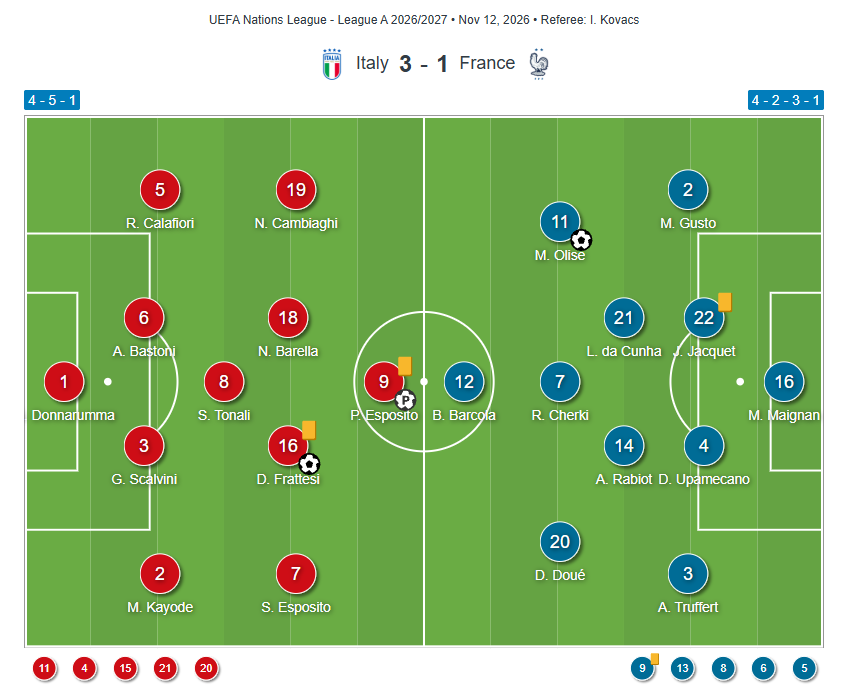
Italy Lineup Vs France
Mancini started the match with a 4-3-3 formation that with4-5-1 formation with Gianluigi Donnarumma in goal and a defensive line of Giorgio Scalvini and Alessandro Bastoni as centre-backs, Michael Kayode at right-back, and Riccardo Calafiori at left-back.
The midfield was made up of Sandro Tonali as the defensive midfielder, with both Davide Frattesi and Nicolò Barella as right and left midfielders.
In attack, Nicolò Cambiaghi was used as a left winger, Sebastiano Esposito as a right winger, and Pio Esposito as the main striker.
France Lineup Vs Italy
On the other hand, Zidane started with a 4-2-3-1 formation, using Mike Maignan as goalkeeper, Jérémy Jacquet and Dayot Upamecano as centre-backs, Malo Gusto as right-back, and Adrien Truffert as left-back.
In midfield, Zidane relied on Lucas Da Cunha and Adrien Rabiot as central midfielders.
In the attacking line, both Michael Olise and Désiré Doué played on the wings; Rayan Cherki was used as the advanced playmaker, while Bradley Barcola was the main striker.
Italy Compact Defending Vs France: Unexpected Solutions
France started the match with more possession, trying to impose their dominant attacking style on Italy, who accepted this and played more often in their own half.
Italy accepted playing in their own half while staying ready for quick counterattacks and without retreating excessively.
At the same time, they made sure France couldn't find penetration or break the defensive line through intense tight marking and double marking on the ball holder, especially against the attacking trio.
In fact, Italy’s formation shifts to a 4-5-1 in the defensive phase, with Sebastiano Esposito and Cambiaghi retreating to support, marking Barcola and Olise, and ensuring double marking on these dangerous players.
That said, this defensive discipline was not enough to limit France’s threats or prevent them from reaching Italy’s goal, as they quickly found solutions despite the tight marking on most of the dangerous players.
France did so thanks to quick passing and dribbling, before finding the best possible key pass after unexpected and confusing positioning and penetration from Rabiot.
In fact, Rabiot positioned himself on the right wing during this action and was moving just beside Olise a few seconds before Doué’s cross.
Rabiot’s movement towards the right wing and his penetration without the ball towards the box invited Doué to deliver an excellent cross into his running lane, with Donnarumma reactive enough to save the shot.
What is remarkable, though, is not only Rabiot’s positioning and Doué’s flexible movement in the final third, but also Italy’s crucial marking error in this action.
Calafiori lost Olise completely before the cross and defended in a zonal position while instructing Barella to mark Olise at the moment of the cross.
Barella, in turn, hesitated between advancing to mark Olise and retreating to mark Rabiot tightly.
In the end, he also played in a zonal position and failed to reach the ball, as he also failed to follow Rabiot.
It was a complete mess, and a lack of communication led to two of France’s most dangerous players being left completely unmarked in that dangerous area.
Indeed, Italy looked collectively disciplined and compact defensively, but they still committed some disastrous marking errors from time to time, exactly like in this one.