How To Coach Midfield Runs In Behind: Why Midfielders Like Jude Bellingham Keep Breaking Defensive Lines – Tactical Theory

One of the most difficult movements in football to defend against is a midfielder running beyond their forwards and attacking the space behind an opposing backline.
This is perhaps a dying art, with many modern midfield players preferring to have the ball delivered to their feet rather than threatening in behind.
This tendency makes it easier for opposition teams to hold a high line when pressing or, when playing in a lower block, for defenders to sit with little disruption to the backline.
This tactical analysis analyses the most dangerous runs that midfielders can make, with examples from Europe’s top-five leagues, including Antonio Conte’s Napoli, La Liga’s Real Madrid, and UEFA Europa League winners, Aston Villa.
Also included in this tactical theory piece is how coaches can develop midfielders’ attacking runs to add another goal-scoring threat to their side.
Practice exercises that focus on players' movement and the timing of those movements are presented.
Corner Runs
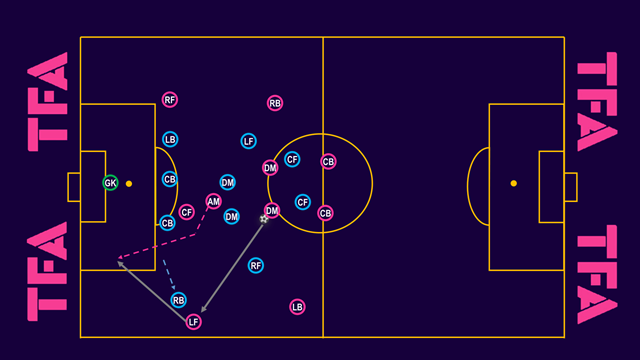
A corner run, as shown above, typically involves a midfield player, making a run from a central position down the outside of a centre-back.
This movement causes significant disruption, as it is particularly hard for opposition teams to track.
It is not always obvious who should be following the runner, either the nearest centre back or the midfielder.
A general rule for defenders is that if the ball is far from the goal, a centre-back would track the midfielder.
This prevents the opponents from being able to make this run and empty out the defending team's midfield.
When closer to the goal, as the diagram above shows, the defending team may want a midfielder to stay with the runner.
This allows the centre-backs to remain in front of the goal area and not become too stretched.
Of course, this can change depending on the coach's philosophy.