How To Coach Build-Up Play From Goal Kicks Like Roberto De Zerbi & Cesc Fàbregas - Tactical Theory
This coaching guide breaks down how Frankfurt, Marseille and Como use wide rotations, short-to-long patterns and quick restarts from goal kicks, then turns those ideas into a practical exercise for safer build-up play.

What Is Goal-Kick Build-Up Play?
Building out from the back via goal kicks is so commonplace in the modern game that it is hard to remember that, until relatively recently, this was regarded as a very high-risk strategy.
The sight of teams playing across their six-yard box would often be greeted with groans from the stands and managers having to justify their strategy in post-match interviews.
Now, although the majority of top-level sides still play short and in mostly rehearsed patterns, the trend may be reversing slightly.
Teams continue to find new ways to build from goal kicks, with an increasing number mixing long and short options to make it more difficult to set up a press.
This tactical theory analyses recent goal-kick tactics employed by Europe’s top coaches, with examples from Ligue 1, the Bundesliga, and Serie A.
The examples included analyse short goal kicks and goal kicks that are designed to draw the opposition close to the goal before kicking long behind them.
A practical training exercise that allows coaches to implement these build-up tactics is also included with this tactical analysis.
This game-related practice enables coaches to develop patterns and principles for building from goal kicks and to prepare their sides to respond to dangerous turnovers in these scenarios.
Exploiting The Wide Area From Goal Kicks
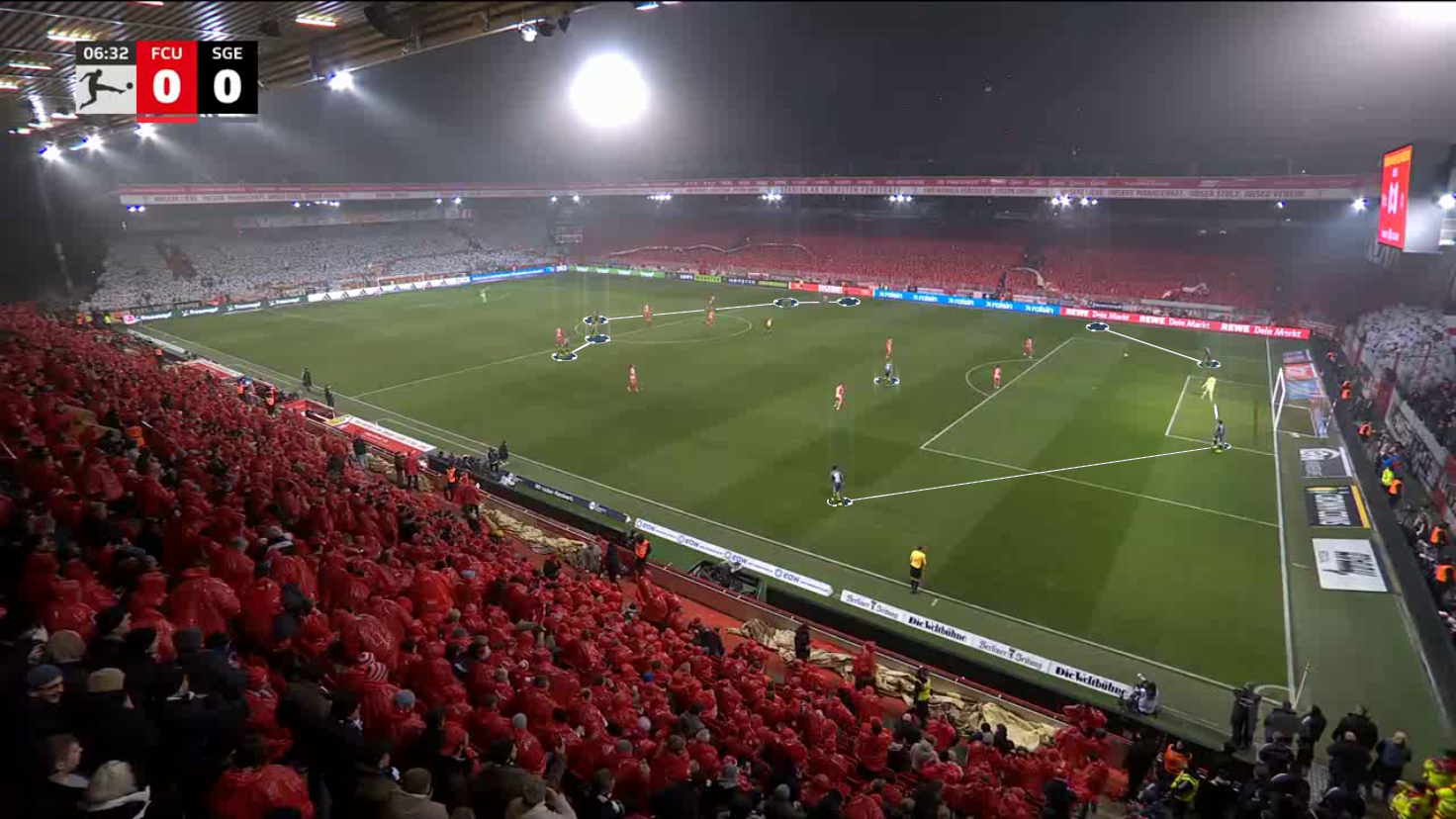
The image above shows how Albert Riera set up his former side's goal kicks to build out in his debut as manager of Eintracht Frankfurt, in their 1-1 draw at Union Berlin.
In Riera’s first two matches, Frankfurt have lined up for goal kicks in a 4–1 (though in slightly different positions), with 5 players high at the halfway line.
In both matches against Union Berlin and Borussia Mönchengladbach, Frankfurt have, albeit not exclusively, attempted to exploit the wide areas before getting in behind their opponents.
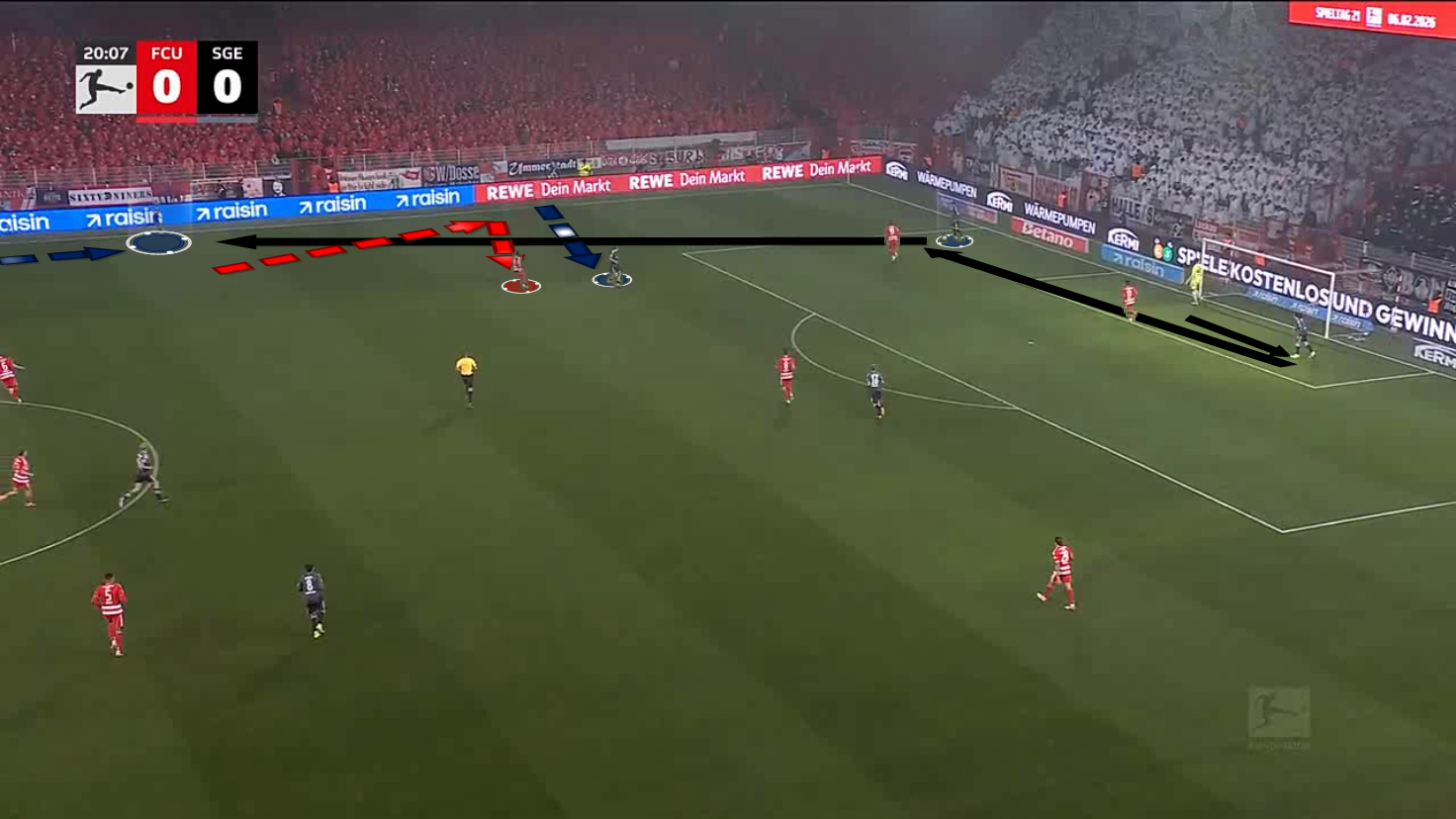
As shown in the above image, Frankfurt's goalkeeper takes the goal kick by passing to one of his centre-backs.
The ball is then quickly switched to the opposite centre-back.
This switch draws the pressing forwards to one side, forcing them to adjust their run when the ball is passed across them, giving the second receiving centre-back slightly more time on the ball.
In this instance, the aim is to get the ball to a player in space in the wide area.
The opposition had read this and changed their pressing structure from the first goal kick, with a full-back starting higher, and jumping to Frankfurt’s right-back when the right centre-back received the ball.
Frankfurt’s immediate reaction was for their full-back, Rasmus Kristensen, to become inverted, dragging the opposition's left-back inside, and allowing their winger, highlighted at the top of the image, to drop down and receive alone.
The winger is aided by another attacker, just out of shot, occupying the widest defender, making it hard for the defender to drop down with the winger who receives the ball.
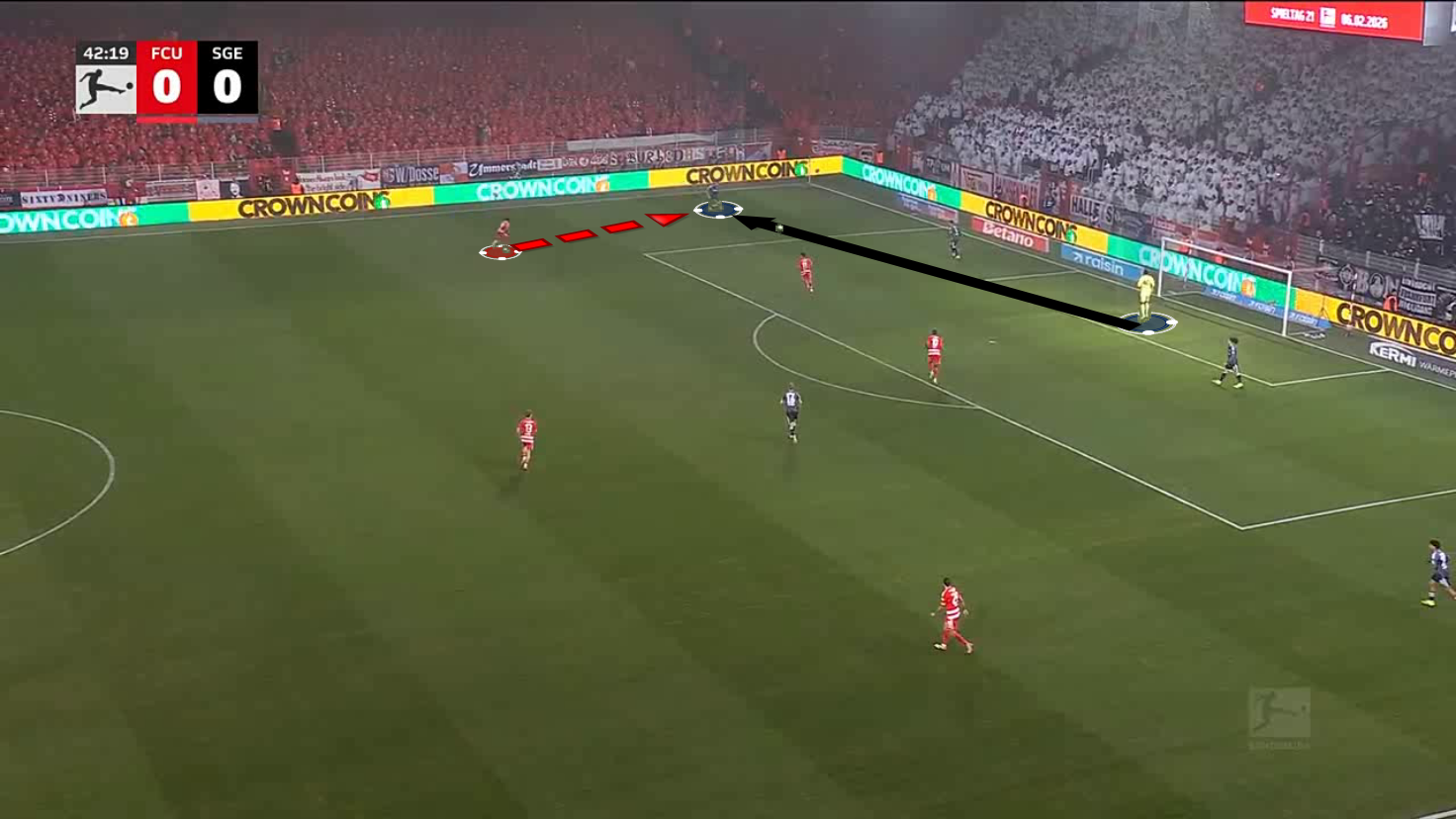
In this variation of the same idea, to have their winger receive alone in the wide area, Frankfurt had right-back Kristensen start lower and receive the first pass from the goalkeeper.
This bypassed the two pressing forwards at the edge of their box and tempted the wide-pressing player into a high position, leaving space behind him.
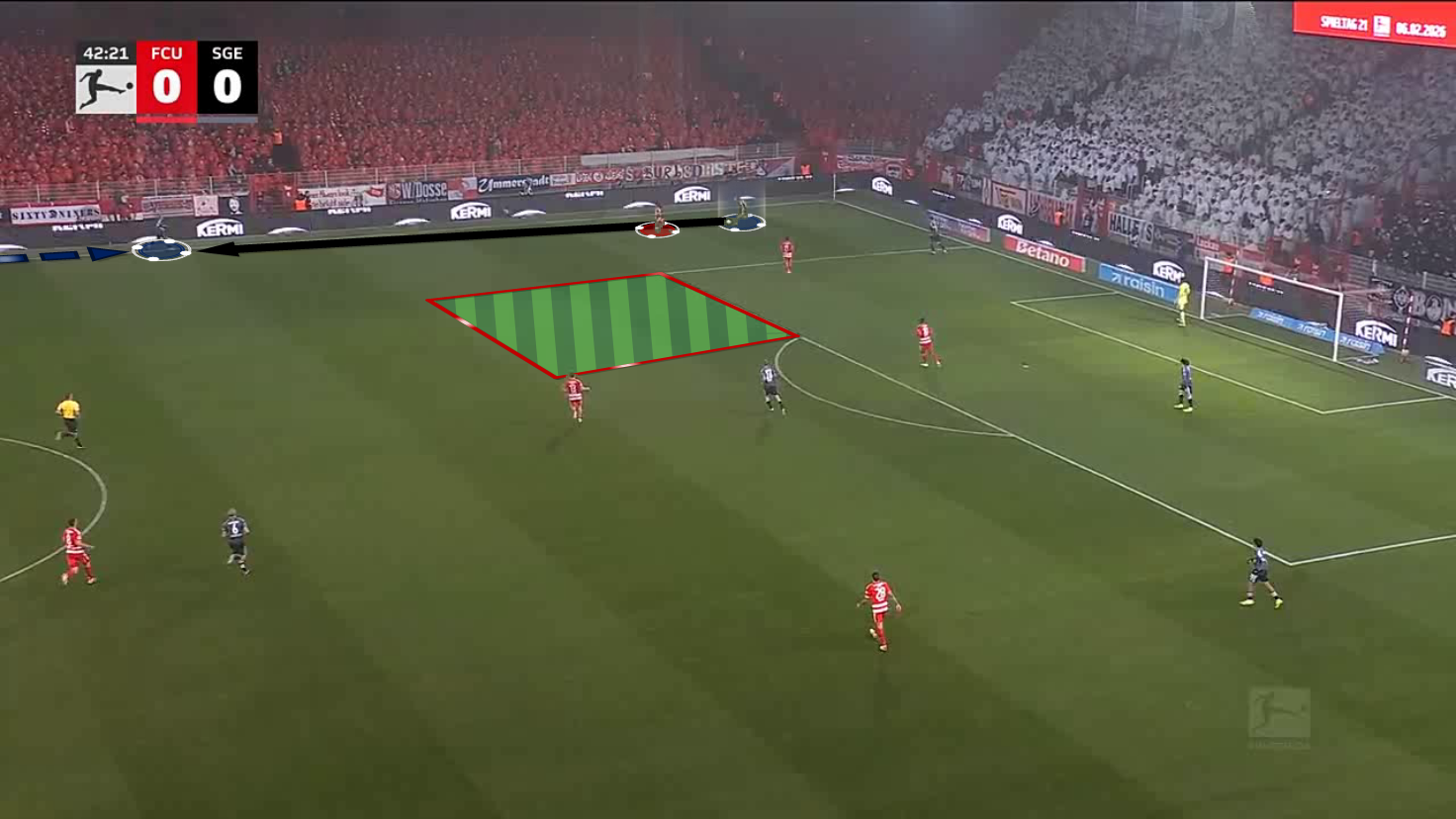
As the full-back received the ball, the winger dropped down quickly to receive.
However, due to the speed at which Union Berlin pressed Kristensen, and the angle of the pressing run, which blocked the outside pass to the winger, Frankfurt were trapped.
With no half-space passing option inside, Kristensen was forced to play backwards to his centre-back, and possession was ultimately lost.
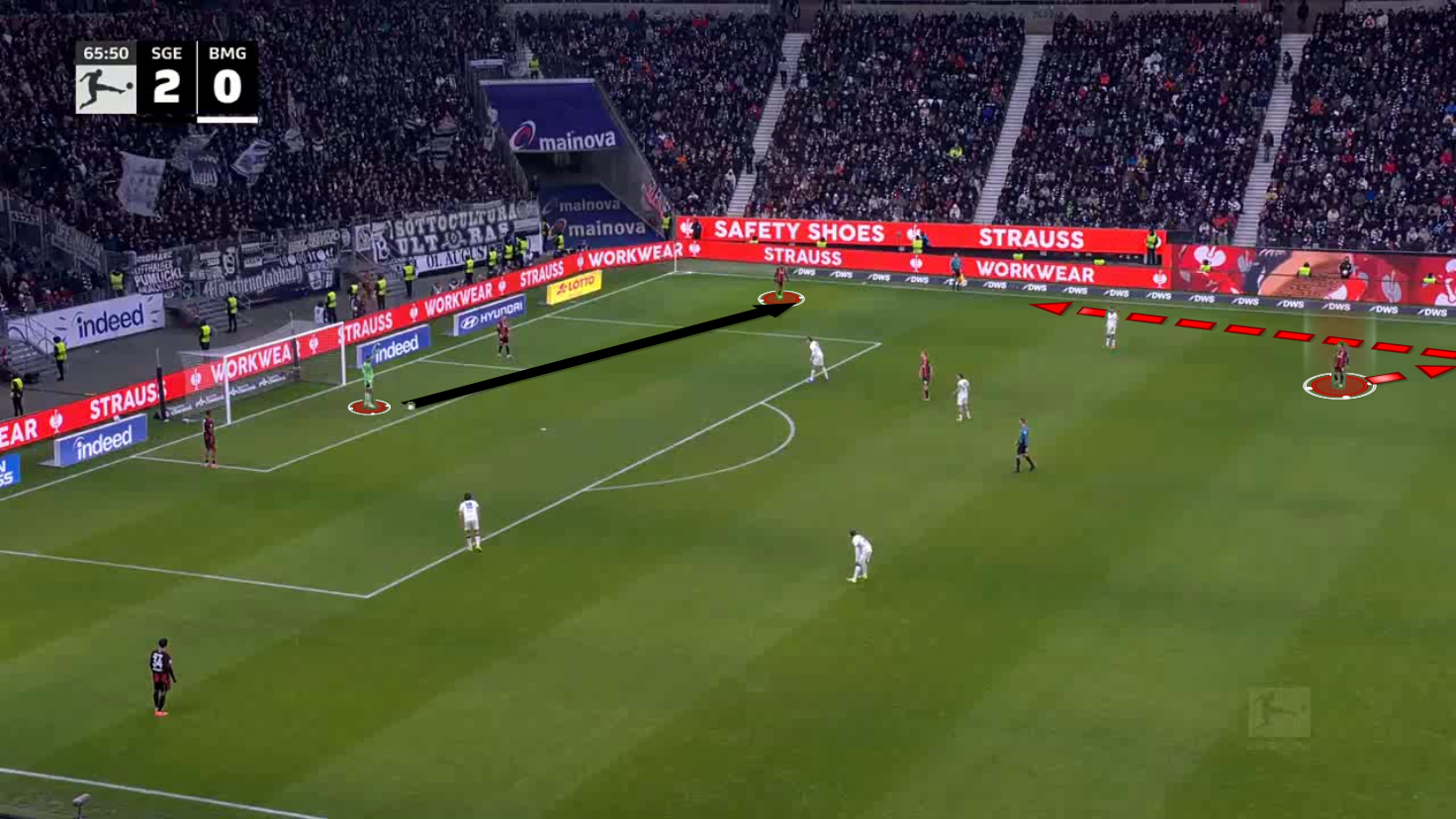
Frankfurt, now playing in their traditional red-and-black home kits, repeated this play against Borussia Monchengladbach, with far greater success.
On this occasion, the ball reached the full-back much more quickly from the goalkeeper.
Support from the wide player, who made a double movement away and then towards the ball, also appeared quicker.
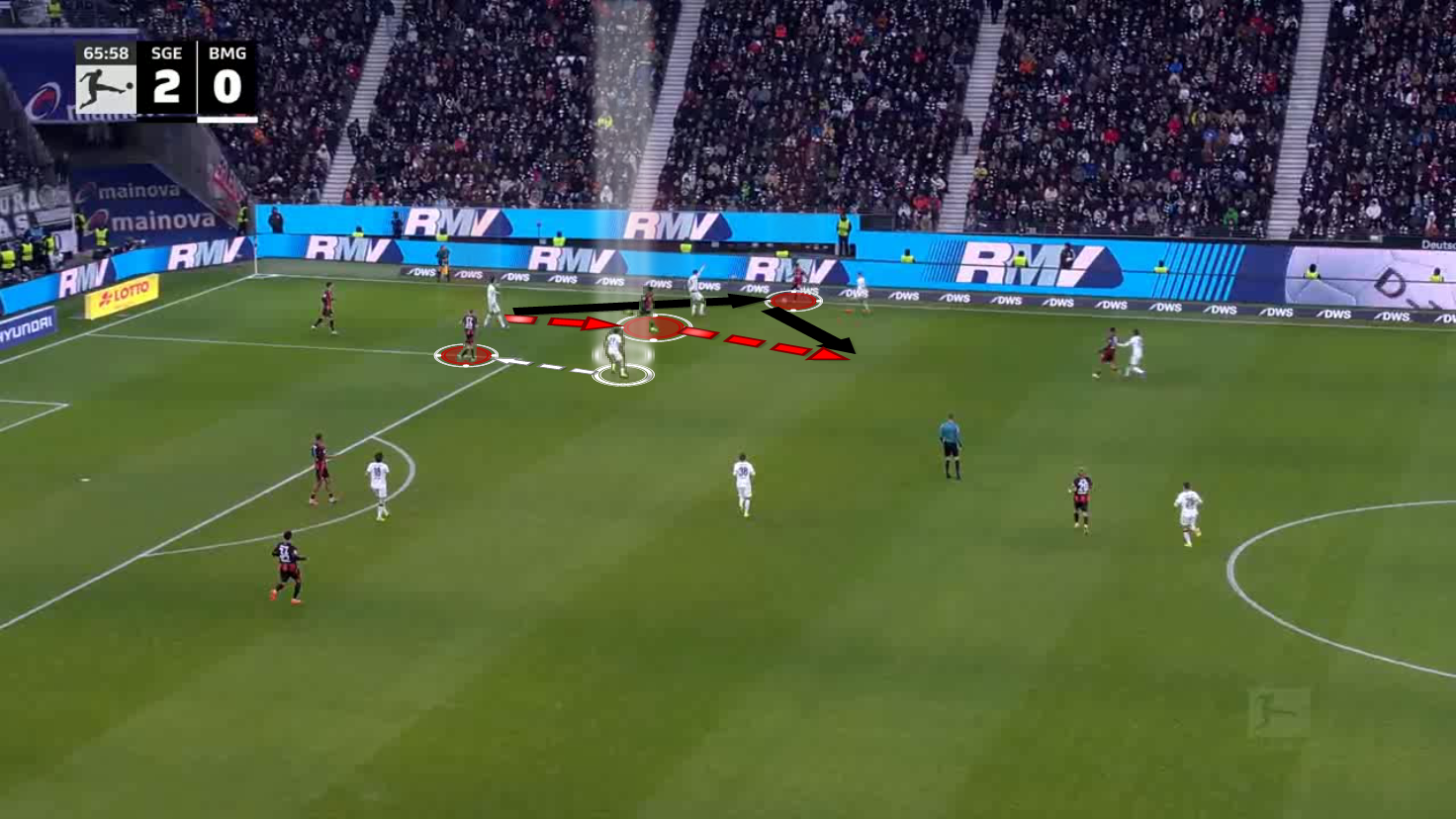
Despite the opposition once again pressing from the outside in to cut off a pass to the winger, Frankfurt's attacking wide player dropped even deeper to allow an angle for a pass.
This allowed the left-back to play a one-two with his wide teammate and burst into open space with the ball.
Also important here is the movement of Frankfurt’s ‘6’ (highlighted).
Not only does his dropping towards the ball help keep his side secure should they lose it, but by becoming an option for the ball, he attracts a pressing player.
This clears the space for his full-back to attack.
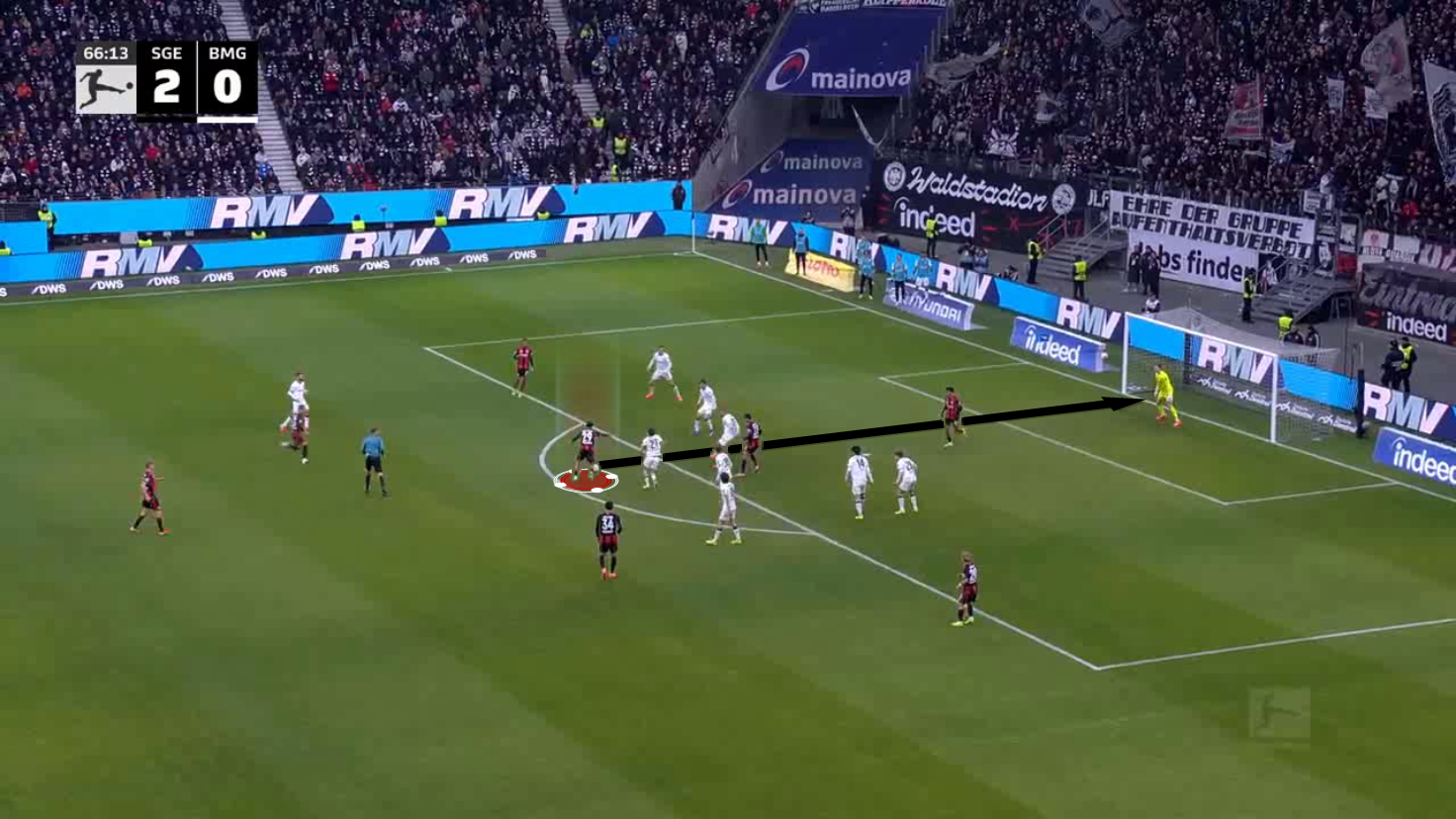
This move ultimately gave Frankfurt a shot from the edge of the opposition's penalty area.
Playing Short To Go Long
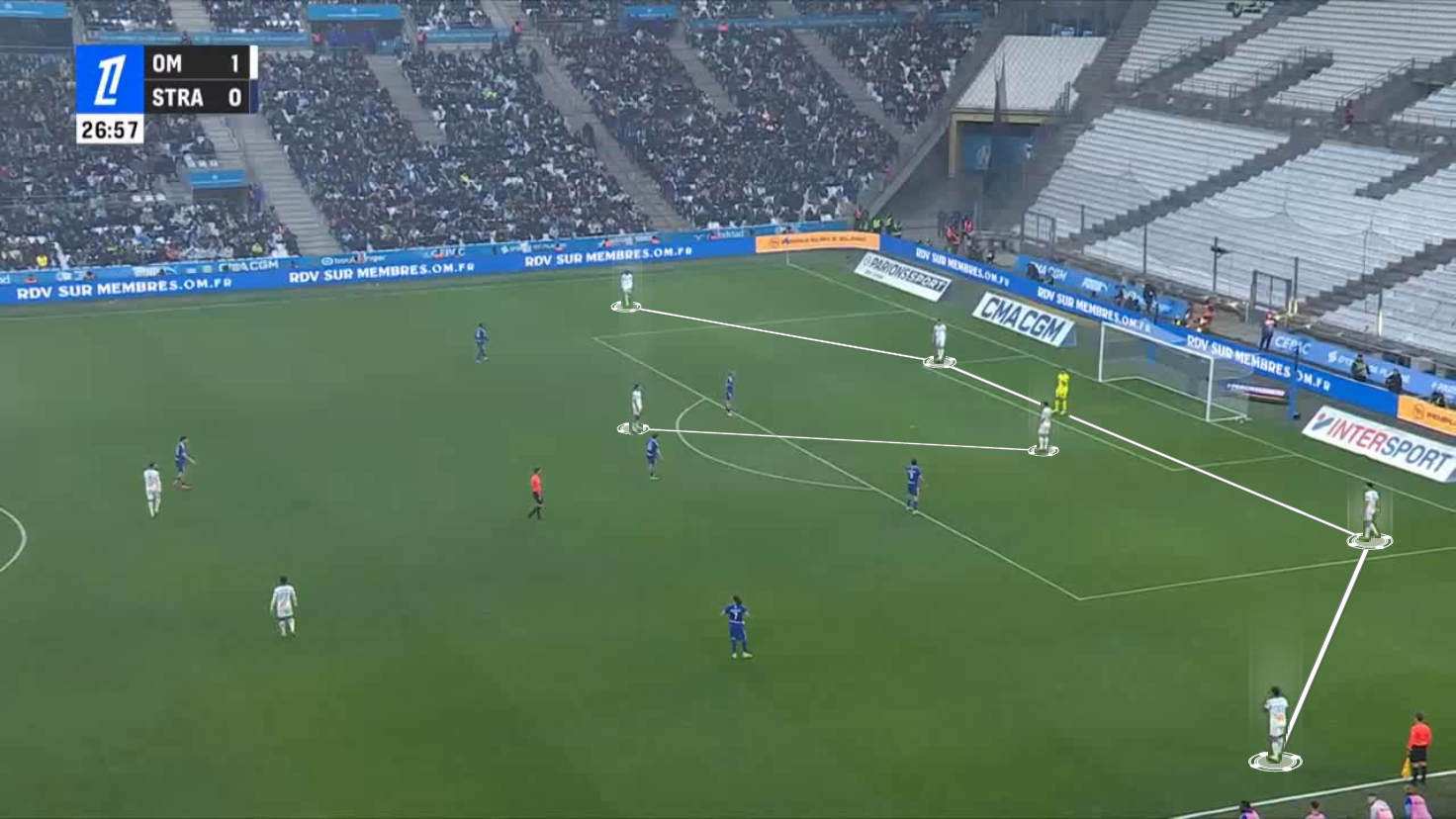
A common theme in teams playing out from the back from goal kicks in the last several seasons is doing so to attract the opposition's press before putting the ball behind them from a low position.
The image above shows an example of this performed by Olympique de Marseille, under former manager Roberto De Zerbi.
Marseille’s set-up is a 4-2-4 with the front four (out of shot) staggered.
Importantly, one of the two midfield players, Pierre-Emile Højbjerg, is situated in close proximity to the goalkeeper, in a central position just outside the six-yard box.
The positioning of this player receiving from his goalkeeper creates several problems for the opposition.
Højbjerg, from this position, can play in behind the opposition's backline, or, as will also be analysed in this section, comfortably play beyond the first line of pressure into his full-backs.
There is also the possibility of the midfielder playing into the pockets of space behind the pressing forwards, and for him to dribble with the ball.
Both of these options are clearly far safer for him to perform than for the goalkeeper from the same area.
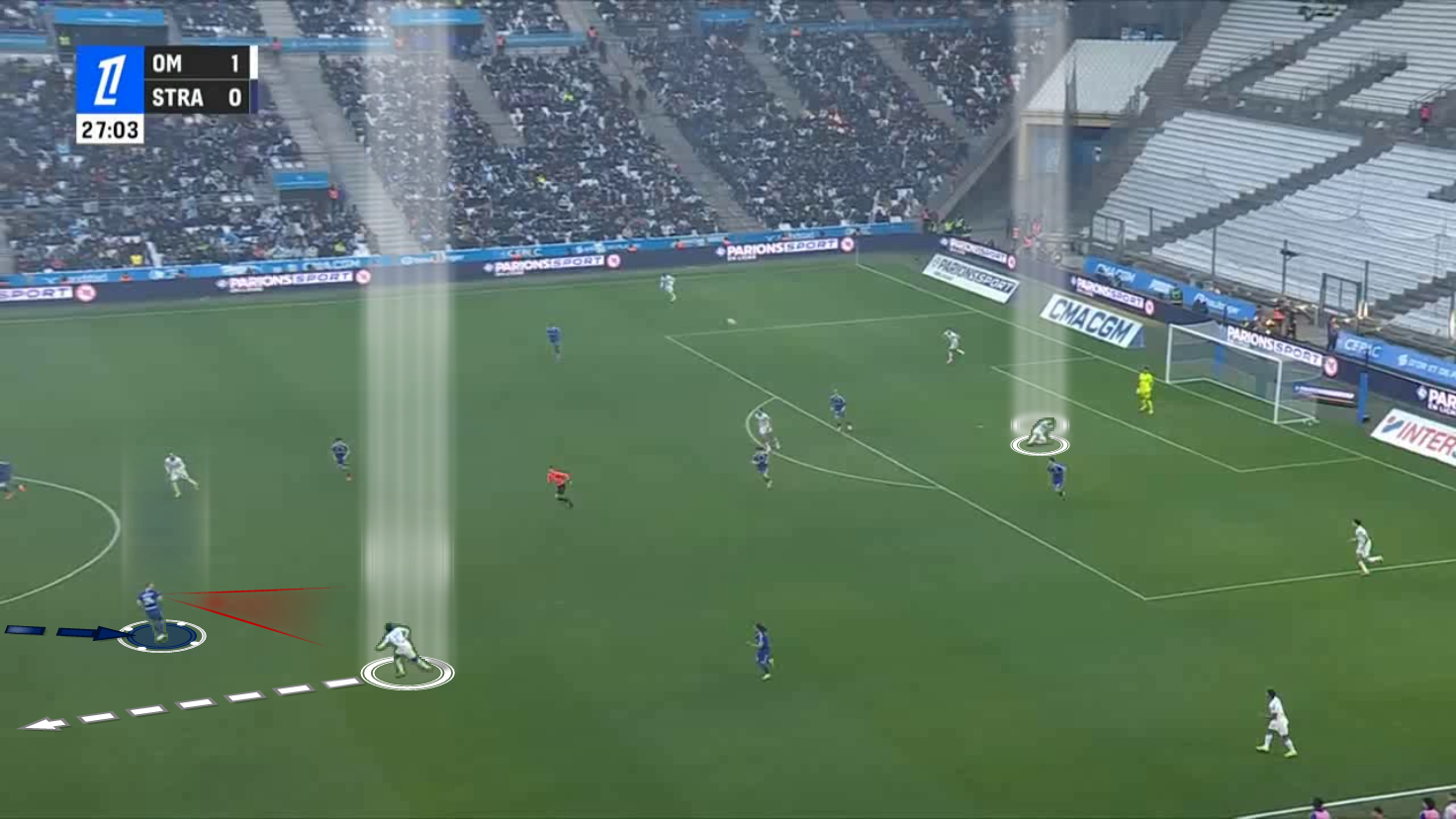
Højbjerg receives the ball from his goalkeeper before kicking it long, in a play that eventually results in Marseille being one-on-one in the wide area with their winger, Pierre-Emerick Aubameyang, gaining possession goal-side of his marker.
This image, taken moments after centre-back Højbjerg has kicked a long diagonal from deep in his own box, highlights the key to creating this situation.
The Strasbourg centre-back (highlighted on the left of the image) initially, when Goalkeeper Gerónimo Rulli had the ball at his feet, remained on the halfway line to give his side an overload on their defensive line.
Had Rulli kicked the ball long in this moment, the centre-back would have been able to cover behind any one of his defensive partners and help keep his side secure.
However, because Rulli played short first, this caused the Strasbourg centre-back to prioritise preventing midfielder Quinten Timber, highlighted, from receiving the ball to his feet.
To do this, the centre-back jumped to the Marseille midfielder as soon as Højbjerg received the short pass.
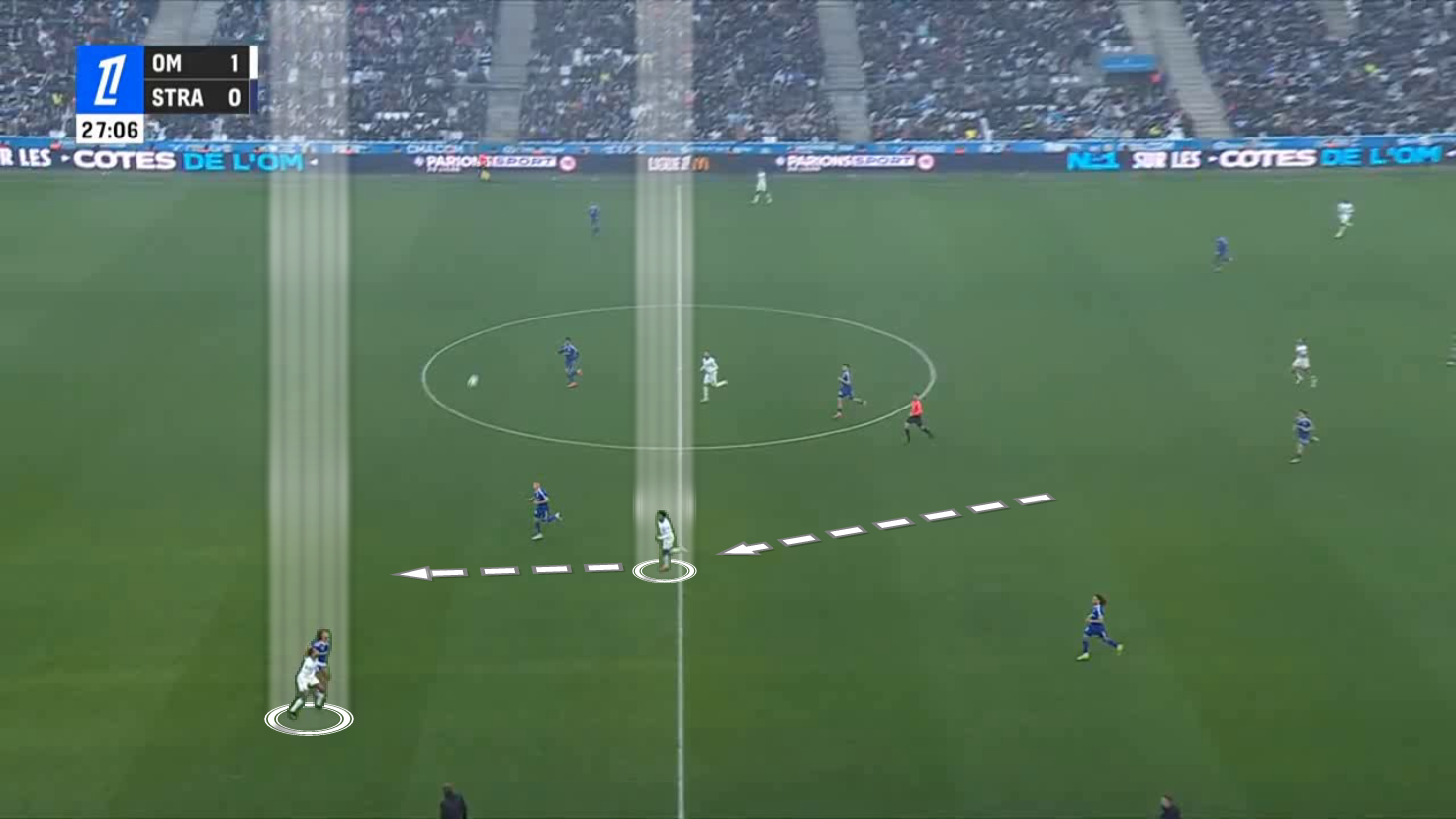
Højbjerg, after receiving the short pass, kicked the ball over the halfway line and into the wide area for his winger, Aubameyang, to compete for.
This was done efficiently by controlling the ball with his left foot to set himself up to play long with his stronger right foot.
Timber, immediately as the ball was kicked, made a run in behind to support Aubameyang.
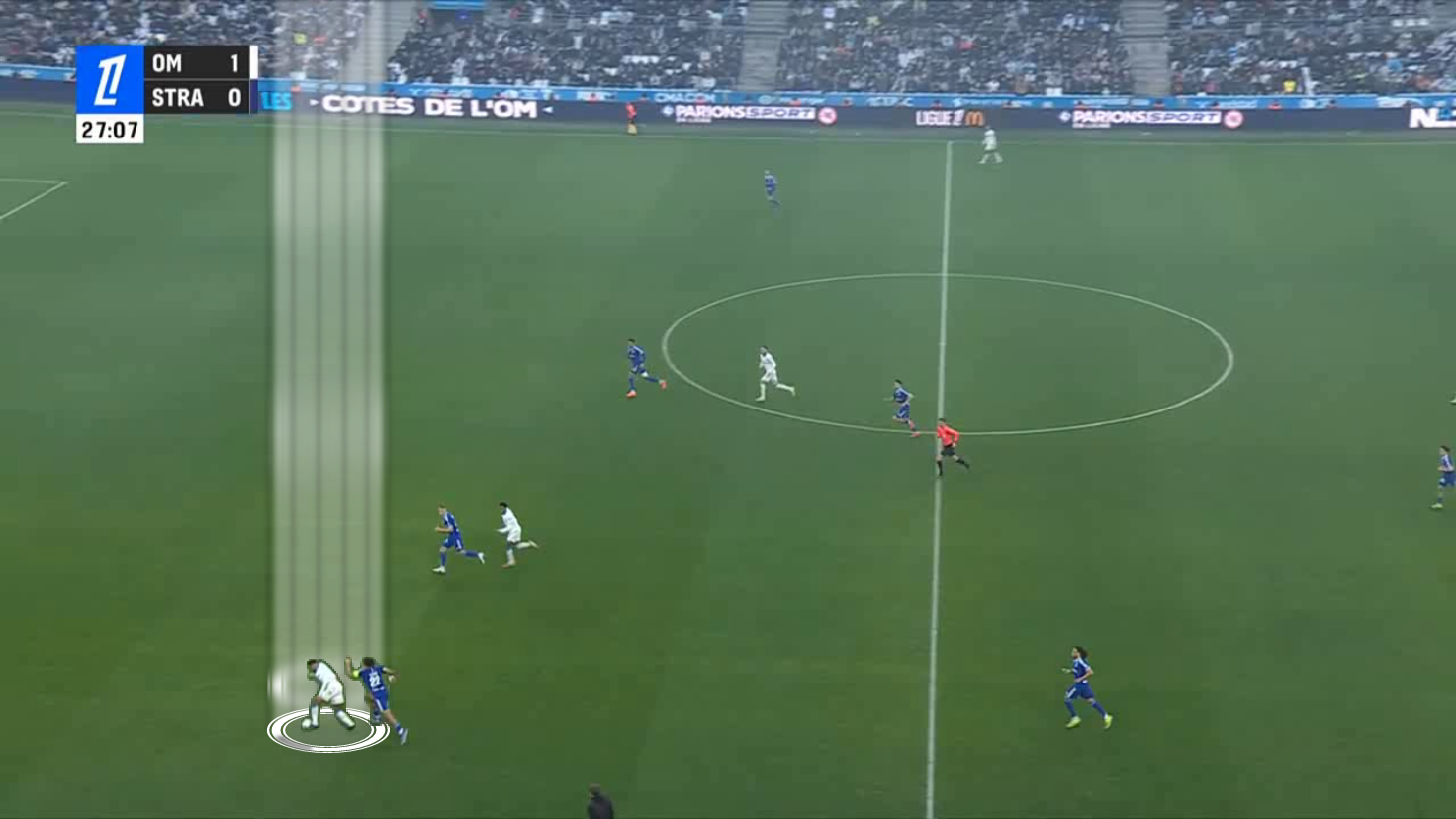
Predictably, Aubameyang won the duel and the former Arsenal and Barcelona man found himself running deep into the opposition's half on the goal side of the recovering defenders.
Playing Short To Go Long: Marseille Modification
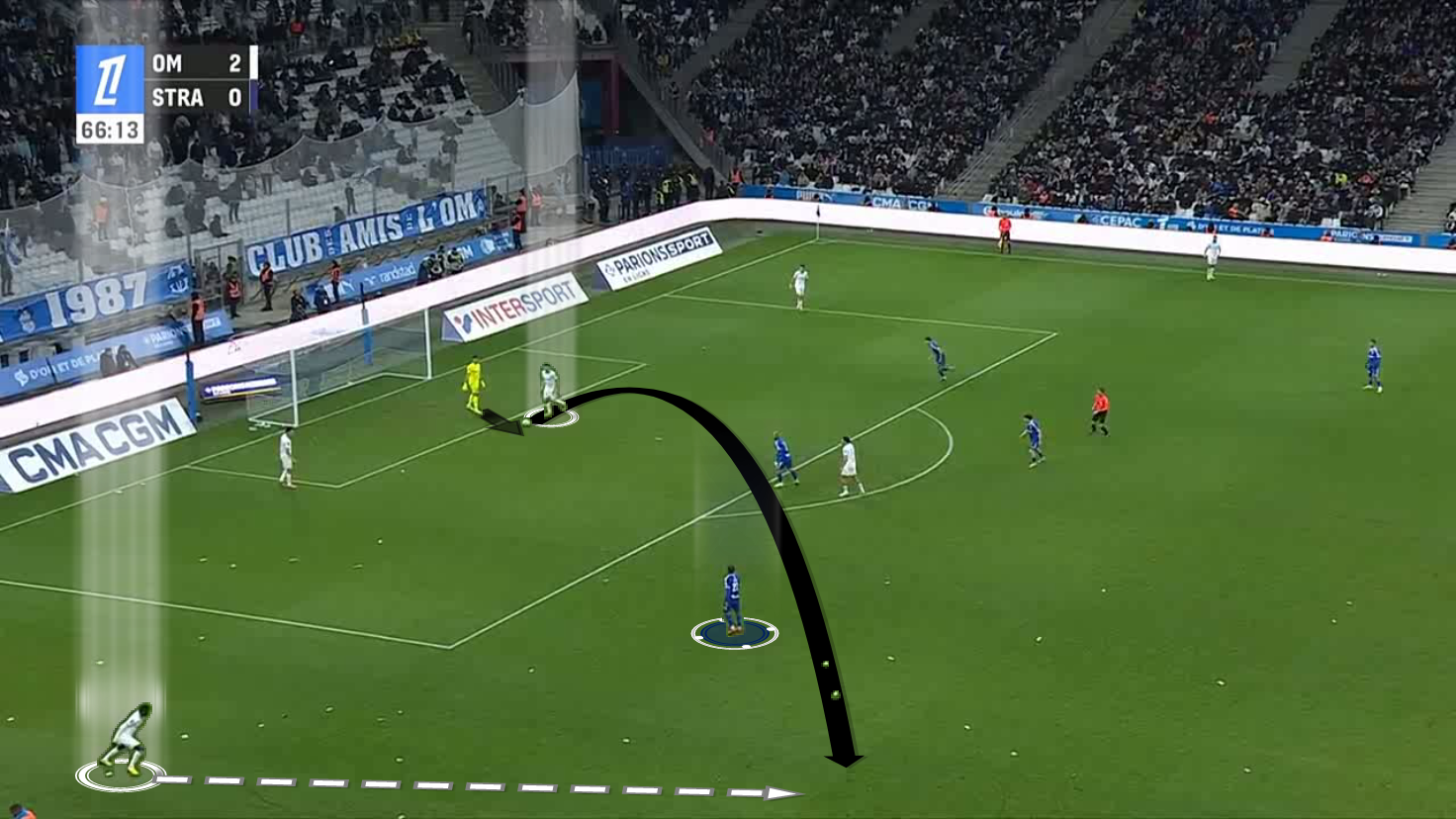
This set-up, with Højbjerg receiving centrally, provides other escape routes for Marseille.
Here, with four opposition players poised to press and the widest player (highlighted) in position to both protect the half-space and press Marseille’s full-back should he receive to feet, Højbjerg clips the ball over him.
Højbjerg receiving the ball locks the opposition pressing players' eyes on the ball, allowing their right-back to sneak in behind the first line of pressure.
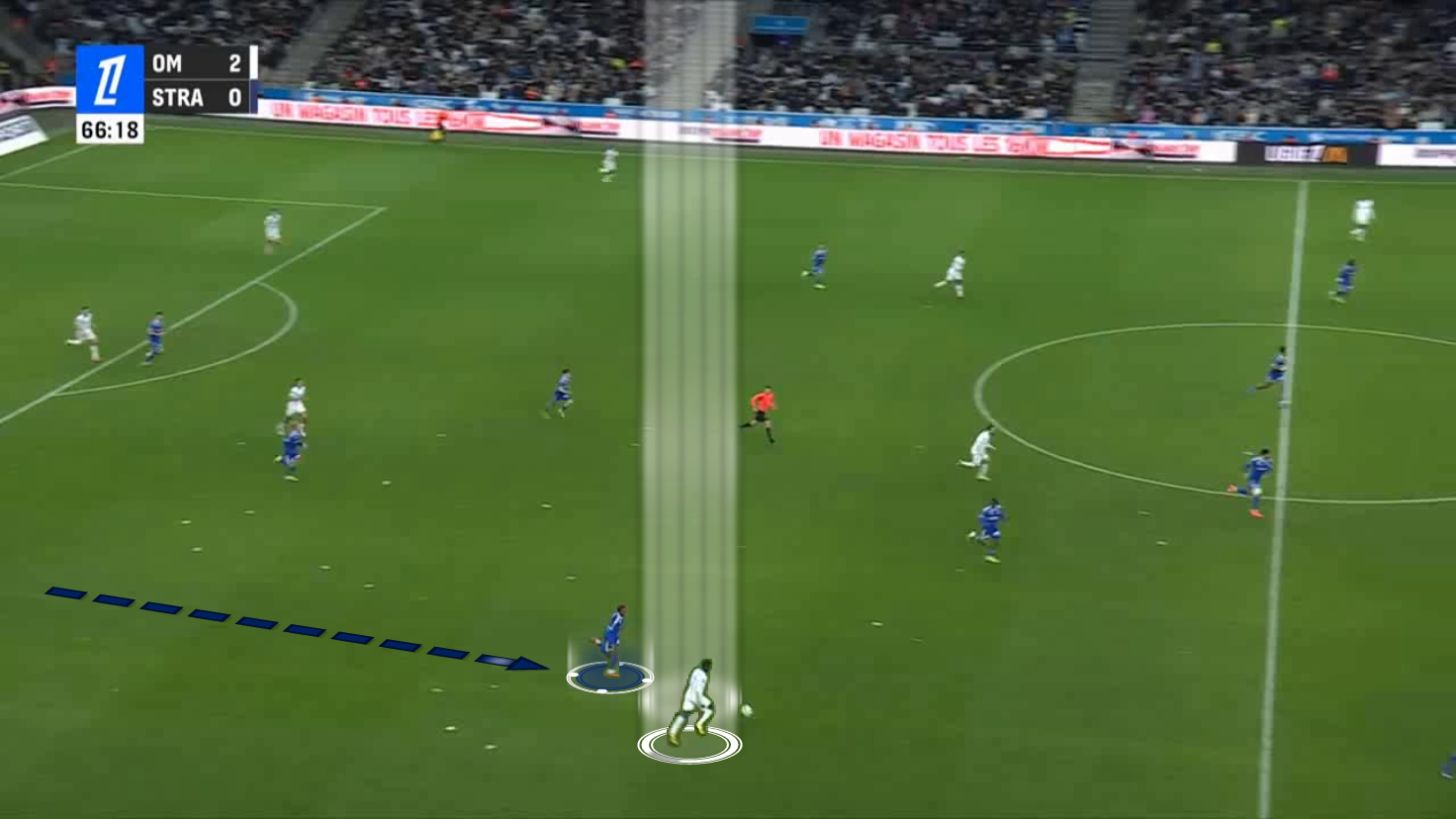
With enough players in high positions to pin the opposition back line, Marseille's full-back can receive alone and stride forward with the ball.
Como Quick Goal Kicks
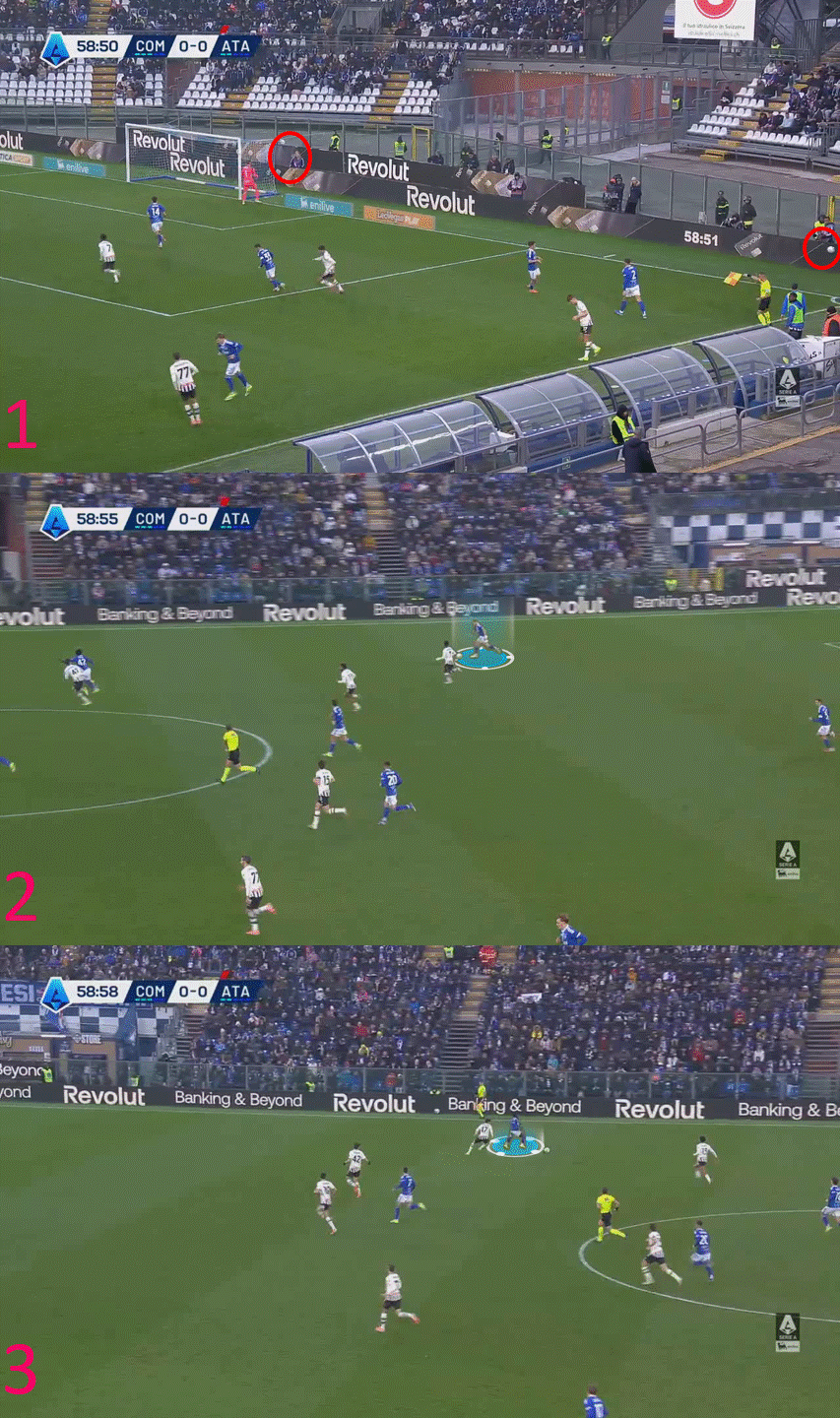
Whilst it is tempting, as coaches and analysts, to devise master plans to break down opposition pressing structures, the simplest ideas are often the best.
This example comes from Cesc Fàbregas’s high-flying Como in a Serie A encounter with Atalanta.
On several occasions in this match, Como 1907 reached the opposition's half by quickly getting the ball into play.
This example illustrates how, by playing immediately, an opposition's pressing setup can be bypassed before it is even set up.
As image 1 shows, Como’s goalkeeper is requesting a new ball as the other one is only just crossing the byline to head out of play.
The new ball is then put in play on the opposite side of the pitch from where the ball has just gone out, allowing Como to get deep into the opposition's half within 8 seconds of the ball going out of play and in two simple passes.
Of course, this tactic has one major limiting factor: it is much easier to implement at home than in away games, where the ball assistants are perhaps less hospitable.
The Build Up Game
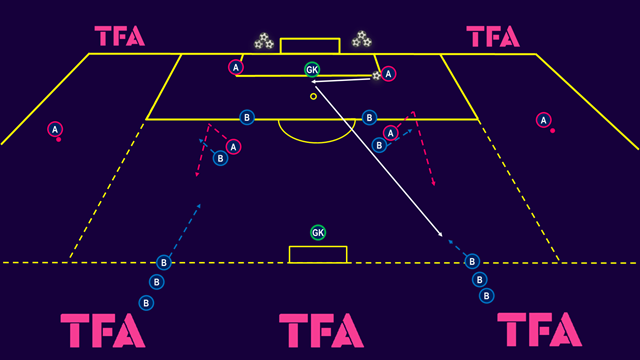
Many of the concepts analysed above can be condensed into this one game-related practice.
The exercise begins with the pink, working team, taking a goal kick and following a pre-determined pattern of play.
This pattern, in which the centre-back passes to the goalkeeper, who then skips a line and plays into a forward's feet, is based on a classic De Zerbi goal-kick pattern.
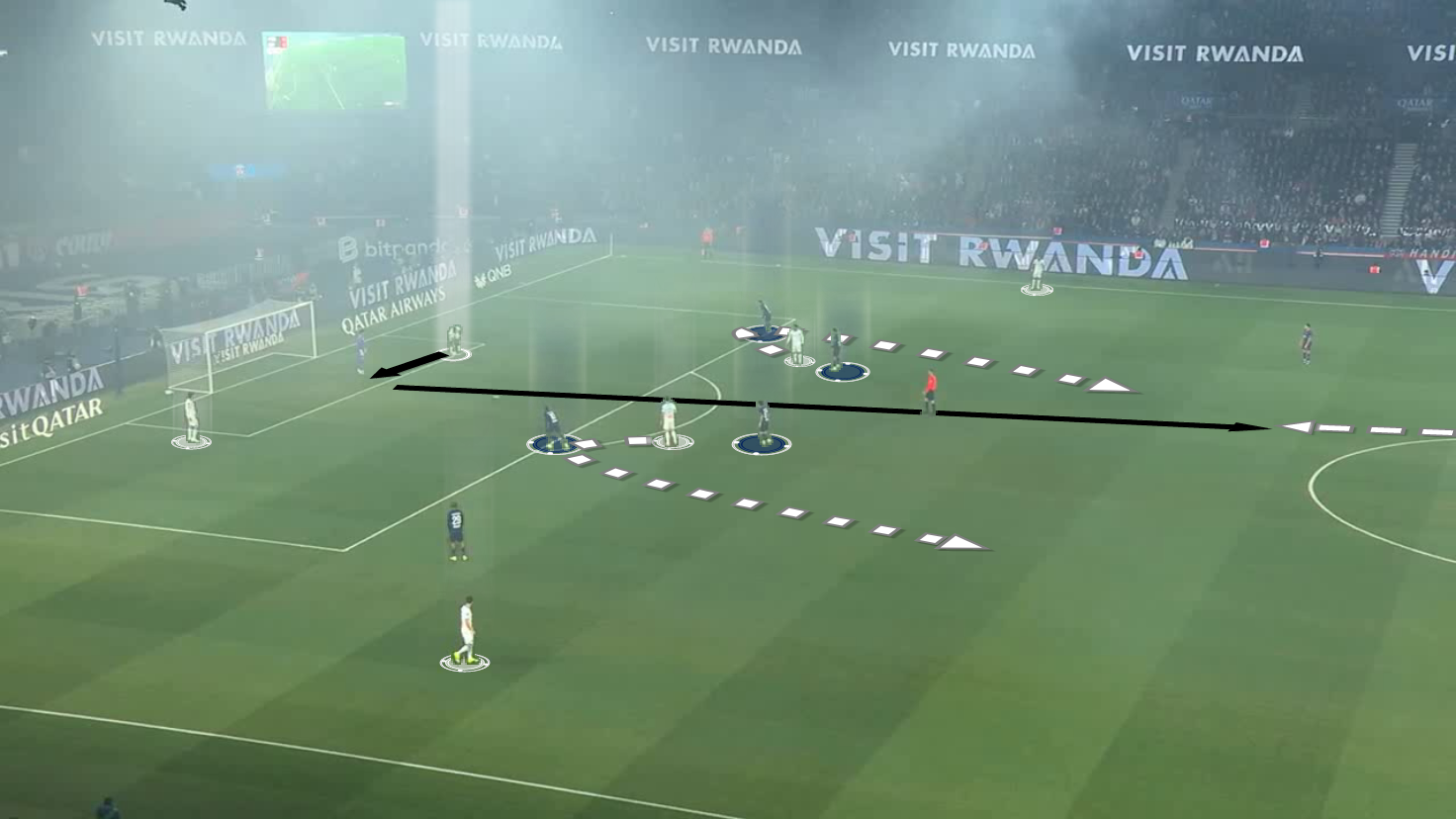
As shown in this goal kick from De Zerbi’s last game in charge of Marseille, the former Brighton head coach likes to use two deep-lying midfielders in his side's build-up play.
The front four stay very high, creating a big gap in the middle of the pitch, which the defensive midfielders will eventually try to receive the ball in.
As the ball is travelling from centre-back to goalkeeper, the defensive midfielders move slightly towards the ball and widen to create a gap between their markers, which their goalkeeper can play through.
As the ball goes through, the midfielders spin and try to connect with one of the forwards who is coming towards the ball to bounce it back to their midfielders.
When this works, and it has done superbly for De Zerbi over several seasons, the midfielders receive facing forward, in a big area of space, and with forward players running in behind.
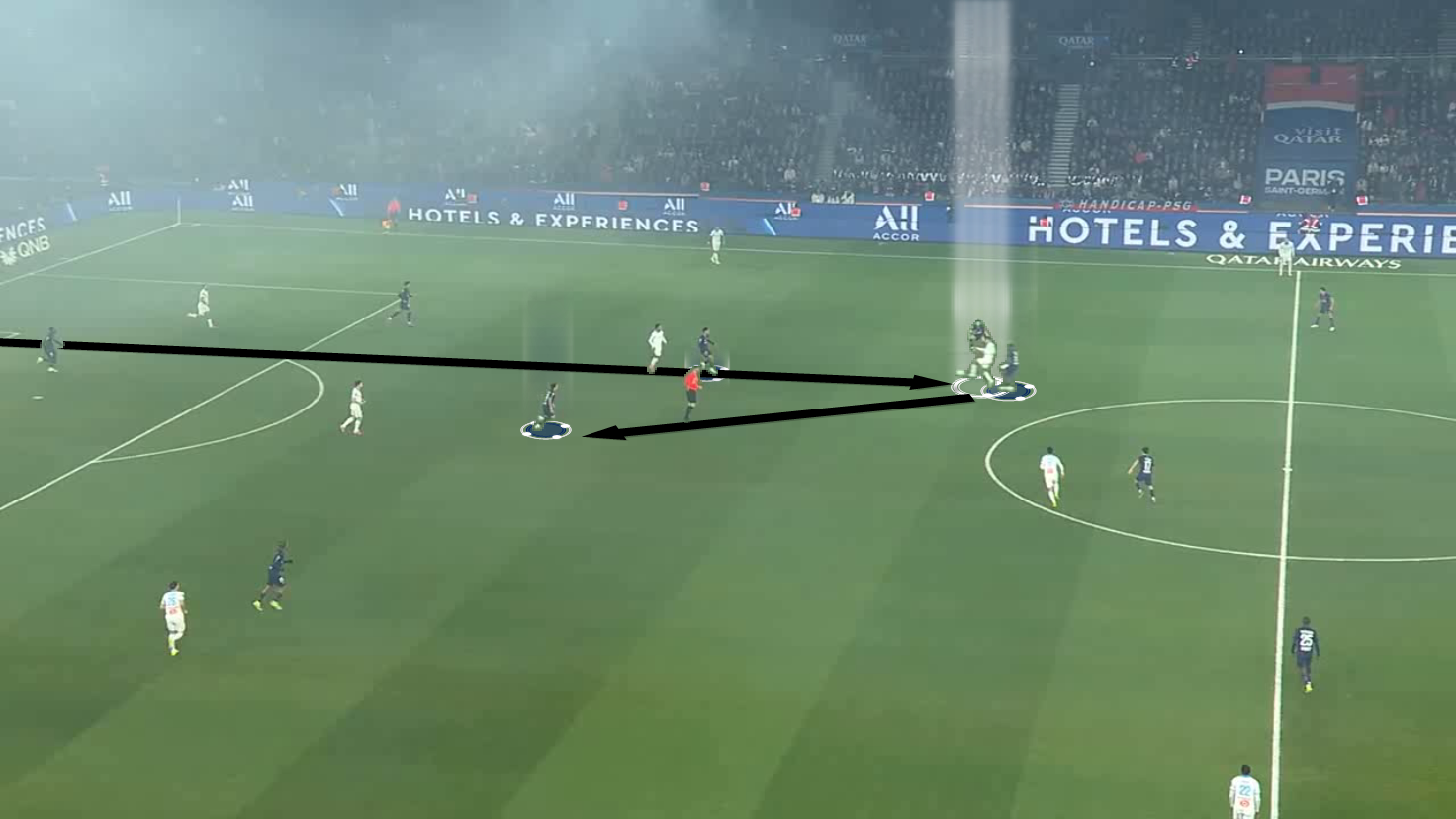
The issue here, though, is that when the opposition reads the play and has the physicality to match the team playing out, it can mean the ball is coming straight back at you.
This is clearly a dangerous situation, although having two defensive midfielders occupying central areas mitigates some of the risk.
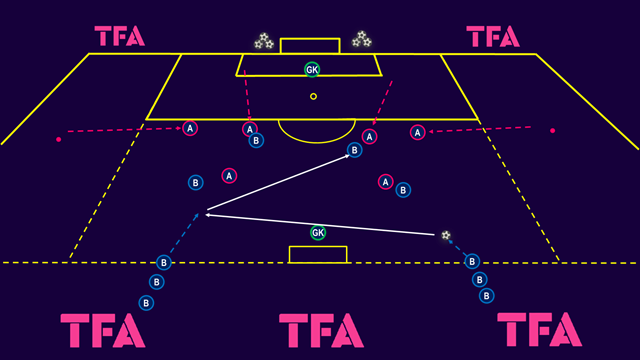
The purpose of this exercise is not only to put players in positions to practice goal-kick patterns, but also to allow teams to respond when the ball is lost.
When the moment arises to break the first line of pressure and play forward, in this example, the goalkeeper deliberately passes the ball to an opposition player positioned on either side of the goal.
Upon the opposition players' (blue) first touch, the game is live, with six attackers going up against a back four and a double pivot across the width of the penalty area.
The now defending team (pink) should aim to make it a six against six quickly by having their full-backs sprint to join their centre-backs.
To make recovering the ball as difficult as possible, coaches should encourage the now-attacking team to play forward as quickly as possible and break straight down the middle of the opposition.