Fantasy Premier League 2026/2027 Chip Strategy: When To Use Your FPL Wildcard, Free Hit, Bench Boost And Triple Captain
Two sets of FPL chips are available in 2026/27, but the first expire at the GW19 deadline. This guide explains when to use the Bench Boost, Wildcard, Free Hit and Triple Captain, including the best early Gameweeks to target.

The start of a new Fantasy Premier League season creates a familiar question: when is the best time to play your chips?
There are two sets of identical chips available to play in the 2026/27 FPL season, the same as last season.
The first half of the campaign gives managers four chips to use before the Gameweek 19 deadline: one Wildcard, one Free Hit, one Bench Boost and one Triple Captain.
The second set becomes available in the second half of the FPL campaign.
The first set cannot be carried beyond the GW19 deadline, so there is a genuine decision to make: maximise points early or preserve flexibility for inevitable problems later down the line?
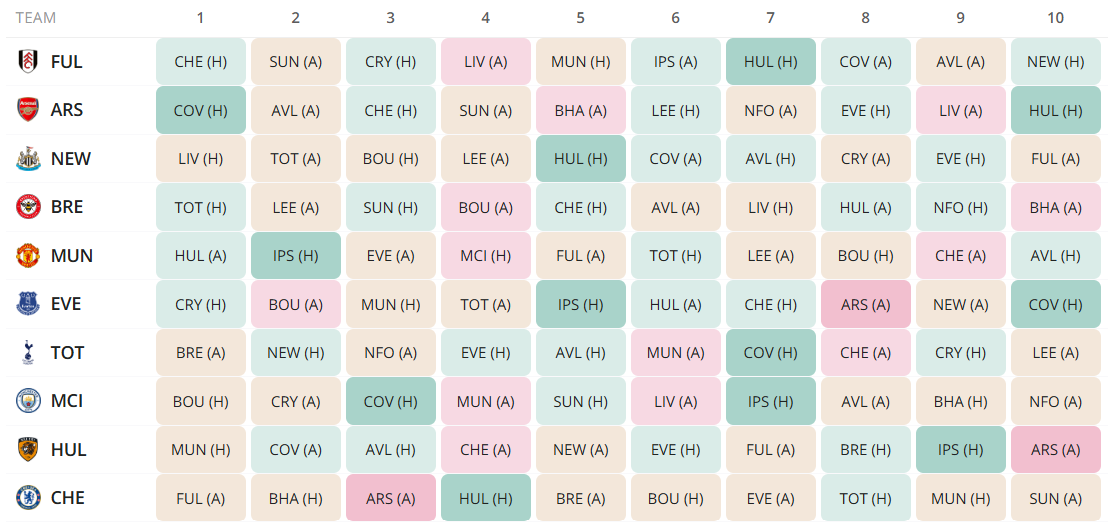
Fig. 1: Fixture ticker (source: FFHub)
The Principle: Use Chips To Solve Problems
A chip should not be played simply because the fixture looks attractive.
It should either create a significant points opportunity or repair a structural weakness in the squad.
That distinction matters particularly in the opening weeks.
We know the fixtures, but we do not yet know which players will be nailed, which new signings (and new managers) will adapt quickly, which clubs will defend or attack well, or how managers will rotate their squads.
Early-season information is valuable, and spending a chip before gathering it can leave us with less flexibility than necessary.
There are four questions I would ask before activating any first-half chip:
- How many players in my squad have a realistic route to a return?
- Is there a genuine fixture swing to target?
- Does the chip improve my expected points enough to justify the use?
- Would waiting give me better information or a stronger opportunity?
Bench Boost: The Case For Using It Early
Traditionally, the Bench Boost has been associated with a double gameweek later in the season, but with two sets of chips available to managers and this season’s player pricings, it has made the Bench Boost chip increasingly difficult to carry, considering you need to find fifteen players who are likely to play and have some potential to return.
The traditional Bench Boost squad often includes a £4.0m goalkeeper who can be called upon when a random favourable home fixture appears.
This season, there is no obvious option at that price.
More money may therefore need to be invested in the GK position simply to optimise the chip.
The goalkeepers I currently like are Antonín Kinský (£4.5m), Bart Verbruggen (£4.5m) and Senne Lammens (£5.0m).
The same issue applies further forward.
There are no particularly attractive £4.5m, or even £5.0m, midfield and forward options, meaning managers may need to diversify their funds to create fifteen genuine playing options.
That is a difficult structure to maintain across multiple gameweeks.
There are nine Premier League teams competing in Europe this season.
Once the European fixtures begin, rotation will become a major consideration.
The more clubs involved across the Champions League, Europa League and Conference League, the harder it becomes to predict minutes for the players we want in our squads.
Even nailed-on starters may be rested, injured, substituted earlier or rotated, making the expected value of a strong bench less certain.
This is why an early Bench Boost chip activation makes sense.
Preseason allows you to construct a squad specifically for GW1 or GW2, selecting players with secure minutes and decent early fixtures rather than hoping your cheaper squad players become useful later down the line.
It also avoids carrying an expensive bench through the opening weeks and frees up funds to invest in your starting 11 thereafter.
The trade-off is that an early Bench Boost requires careful planning.
Wildcard: Gameweek 4 Or Gameweek 6?
If the early Bench Boost is the foundation of the strategy, the Wildcard becomes the mechanism for rebuilding your squad afterwards.
Difficult fixtures for teams likely to be targeted on the early Bench Boost come around in GW3 and GW4, particularly for a team like Manchester United.
Facing two promoted sides in GW1 and GW2, followed by Everton (A) and Manchester City (H).
Chelsea have Arsenal (A) in GW3, followed by Hull City (H) in GW4.
So they become a clear team to target, but could be tentatively avoided in the first three gameweeks while we establish Xabi Alonso’s preferred XI.
Cole Palmer is the obvious case.
At £9.5m, he looks like a bargain if he starts the season in great form, but after leaving FPL managers slightly bruised over the last two campaigns, patience may be justified before bringing him in.
Overall, there aren’t any obvious fixture swings, which suggests managers may be able to build a strong squad for an early Bench Boost and use their free transfers to extend the Wildcard window to GW6, which is after the international break.
After GW5, there is almost an entire month without Premier League football due to a new extended international break.
More internationals mean more opportunities for injuries.
A Wildcard may be the saving grace when PL football returns in GW6.
Free Hit: The Get Out Of Jail Card
An early Bench Boost can also create a reason to use the Free Hit chip.
If the opening squad is built around particular teams or short-term fixtures, an unfavourable clash can leave managers with a problem or two.
GW3 is the popular early option, with managers considering three Manchester City assets for their home fixture against Coventry City.
This is the type of week where the Free Hit chip can create a concentrated, high-upside squad without forcing long-term transfers.
GW9 is also tempting. Liverpool will be hosting Arsenal, while Manchester United visit Chelsea.
These are exactly the kinds of fixtures where many managers may have significant investment, making it difficult to build a balanced team.
![Fulham Vs Manchester United [1-1] Premier League 2026/2027: How Álvaro Arbeloa Tactics Exposed The Red Devils' Problems - Tactical Analysis](https://cdn.mymidnight.blog/77f959f119f4fb2321e9ce801e2f5163/size/w600/2026/09/Fulham-FC-Vs-Man-United-2026_2027---Tactical-Analysis.png)