
![Brazil Vs Norway [1–2] – FIFA World Cup 2026: Why The Seleção Fell Short – Tactical Analysis](https://cdn.mymidnight.blog/77f959f119f4fb2321e9ce801e2f5163/size/w1000/2026/07/Brazil-Vs-Norway-World-Cup-2026.png)
Brazil Vs Norway [1–2] – FIFA World Cup 2026: Why The Seleção Fell Short – Tactical Analysis

Brazil faced off with Norway in the 2026 FIFA World Cup Round of 16; the game ended with Norway's qualification to the quarter-finals and Brazil's elimination following a 1-2 result.
Brazil’s journey in the World Cup ended in a frustrating way as they had hoped to at least reach the quarter-finals, but Carlo Ancelotti and his men were unable to beat the dark horse of the tournament.
The loss was frustrating for Brazil, mainly because they had moments that they could have exploited in a much better way, but failed to do so.
On the other hand, Ståle Solbakken’s players were more eager to win and to exploit any half-chance, as that’s how Erling Haaland was able to score twice.
Norway’s historic journey in this tournament promises to last longer as they are becoming a very powerful and balanced team capable of beating any of the remaining teams.
That said, it will be crucial for them to limit their defensive errors, especially against teams like England, who they face next.
In this World Cup tactical analysis article, we explore why Brazil failed to win and exploit their momentum, while looking at Norway’s playmaking strengths, ability to resist high pressure, and to exploit half-chances in attack.
Brazil Vs Norway Lineups & Formations
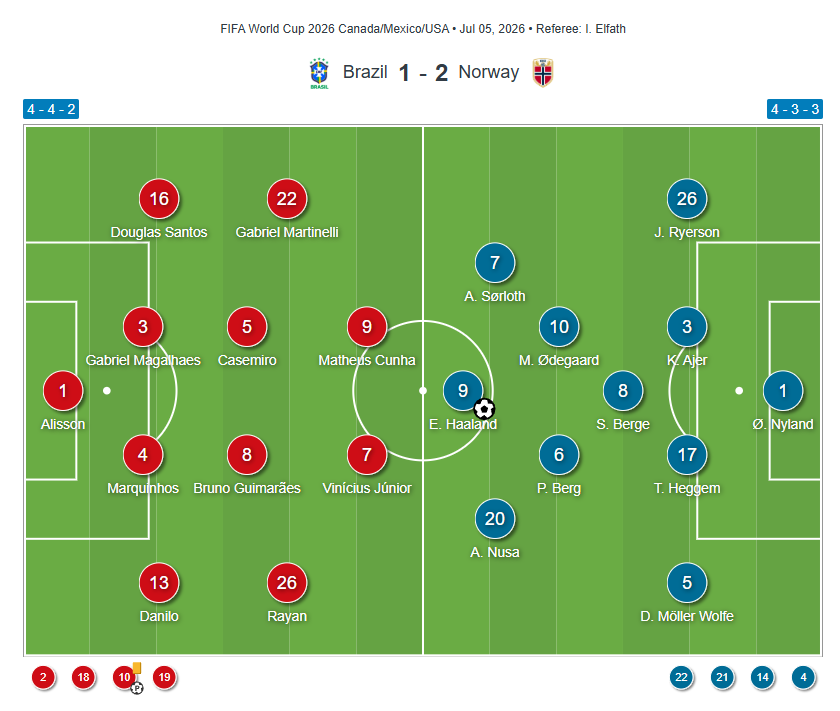
Brazil Lineup Vs Norway
Ancelotti preferred to start the match using a 4-4-2 formation with Alisson Becker as a goalkeeper, Marquinhos and Gabriel Magalhães as centre-backs, Danilo as a right-back, and Douglas Santos as a left-back.
The midfield was made up of Casemiro and Bruno Guimarães as central midfielders, with Gabriel Martinelli as a left winger, Rayan as a right winger, and both Vinícius Júnior and Matheus Cunha as the attacking duo, with Vinícius leaning frequently towards the left wing.
Norway Lineup Vs Brazil
Solbakken used his usual 4-3-3 formation with Ørjan Nyland as a goalkeeper, and a defensive line made up of Torbjørn Heggem and Kristoffer Ajer as centre-backs, Julian Ryerson as a right-back, and David Møller Wolfe as a left-back.
In midfield, Solbakken used Sander Berge as the defensive midfielder, with Martin Ødegaard and Patrick Berg as central midfielders.
And in attack, he relied on Antonio Nusa and Alexander Sørloth on the wings, with Haaland as the main striker.
Norway Counterattacks Vs Brazil High Line
Norway were immediately threatening to Brazil’s defence as they benefited from their high recoveries to launch quick counterattacks as they are used to.
What made these actions less complicated for Norway was Brazil’s sometimes high defensive block, as the South American side wanted to impose their game and play inside Norway’s half.
However, that plan did not work well for Brazil from the start, mainly due to a passing accuracy issue that occurred due to Norway’s intense pressing in key areas, like in this disallowed goal action.
Failing to avoid Norway’s pressure in midfield and in tight areas revealed that Brazil were not well prepared for a team like Norway from a playmaking perspective, as there were no obvious plans to overcome that pressure in midfield.
Furthermore, what made things even more favourable for Norway was the use of a high line.
During the goal action, Brazil players tried to retreat quickly to support the defensive line, but they were not as quick as Norway’s players, who benefited from Sørloth’s quick progression on the right wing.
Norway counterattacked in numbers and did not allow Brazil the chance to reorganise their defence, with Ødegaard providing the through pass to Sørloth, and the latter providing a cut back to the direction of Berg, who finished the action in the best possible way using a powerful and accurate shot.
What is more remarkable in this action was that all of Berg, Ødegaard, and Nusa were all well-positioned to finish the action, and the three of them were completely unmarked inside the box.
![Croatia Vs Spain [1-2] UEFA Nations League 2026/2027: How Slaven Bilić High Pressing Tactics Troubled Spain - Tactical Analysis](https://cdn.mymidnight.blog/77f959f119f4fb2321e9ce801e2f5163/size/w600/2026/10/Croatia-Vs-Spain--1-2--UEFA-Nations-League-20262027---Tactical-Analysis.png)

![Scotland Vs Switzerland [0-3] UEFA Nations League 2026/2027: How Aggressive Pressing Backfired & Murat Yakin Took Advantage - Tactical Analysis](https://cdn.mymidnight.blog/77f959f119f4fb2321e9ce801e2f5163/size/w600/2026/10/Scotland-Vs-Switzerland-20262027---Tactical-Analysis.png)
![Olympique De Marseille Vs PSG [1-2] Ligue 1 2026/2027: How Bruno Génésio Transitions Troubled PSG - Tactical Analysis](https://cdn.mymidnight.blog/77f959f119f4fb2321e9ce801e2f5163/size/w600/2026/09/Marseille-Vs-PSG-2026_2027---Tactical-Analysis.png)
![Fulham Vs Manchester United [1-1] Premier League 2026/2027: How Álvaro Arbeloa Tactics Exposed The Red Devils' Problems - Tactical Analysis](https://cdn.mymidnight.blog/77f959f119f4fb2321e9ce801e2f5163/size/w600/2026/09/Fulham-FC-Vs-Man-United-2026_2027---Tactical-Analysis.png)
![AS Roma Vs Inter Milan [2-2] Serie A 2026/2027: When Undefeated Giallorossi Attack Met Nerazzurri Comeback Resilience - Tactical Analysis](https://cdn.mymidnight.blog/77f959f119f4fb2321e9ce801e2f5163/size/w600/2026/09/AS-Roma-Vs-Inter-Milan-2026_2027---Tactical-Analysis.png)
![Real Sociedad Vs Bournemouth [1-2] Europa League 2026/2027: How Do Marco Rose Pressing Tactics Work? - Tactical Analysis](https://cdn.mymidnight.blog/77f959f119f4fb2321e9ce801e2f5163/size/w600/2026/09/Real-Sociedad-Vs-Bournemouth-20262027---Tactical-Analysis-1.png)
![AC Milan Vs Benfica [0-2] Europa League 2026/2027: How Marco Silva Tactics Exposed Rúben Amorim Defensive Problems - Tactical Analysis](https://cdn.mymidnight.blog/77f959f119f4fb2321e9ce801e2f5163/size/w600/2026/09/AC-Milan-Vs-Benfica-20262027---Tactical-Analysis.png)