
![France Vs Morocco [2–0] – FIFA World Cup 2026: How Didier Deschamps Tactics Neutralised The Atlas Lions – Tactical Analysis](https://cdn.mymidnight.blog/77f959f119f4fb2321e9ce801e2f5163/size/w1000/2026/07/France-Vs-Morocco-World-Cup-2026-1.png)
France Vs Morocco [2–0] – FIFA World Cup 2026: How Didier Deschamps Tactics Neutralised The Atlas Lions – Tactical Analysis
France met Morocco in the quarter-finals of the 2026 FIFA World Cup, and the match ended with a crucial 2-0 win for Les Bleus. France confirmed once again that they are going to be very tough to beat in this tournament, as they were in the previous World Cup.

France Vs Morocco World Cup 2026 Match Overview
France met Morocco in the quarter-finals of the 2026 FIFA World Cup, and the match ended with a crucial 2-0 win for Les Bleus.
France confirmed once again that they are going to be very tough to beat in this tournament, as they were in the previous World Cup.
After finishing the group stage as the leaders of their group with wins against Senegal, Norway, and Iraq, France continued their winning streak by eliminating Sweden in the Round of 32 and Paraguay in the Round of 16.
Following this win against Morocco, Didier Deschamps’ side faces Spain in another big semi-final match in Dallas, with the winner to play against one of Norway, England, Switzerland, or Argentina in the final.
On the other side, Mohamed Ouahbi’s men failed to continue their World Cup journey after falling to one of the giants.
This loss does not cancel the big achievement of Moroccan football as they have succeeded in reaching the quarter-finals of the World Cup for the second consecutive time, following their success in 2022.
Morocco started the tournament in an impressive way by putting on a convincing performance against Brazil and finishing the match with a draw.
Morocco were then able to beat both Scotland and Haiti in the group stage before eliminating the Netherlands on penalties and beating one of the hosts, Canada, with a very convincing 3-0 performance.
In this World Cup tactical analysis, we explore France’s attacking strengths and intelligent game plan, which allowed them to prevent Morocco from using their key solutions.
France Vs Morocco Lineups & Formations
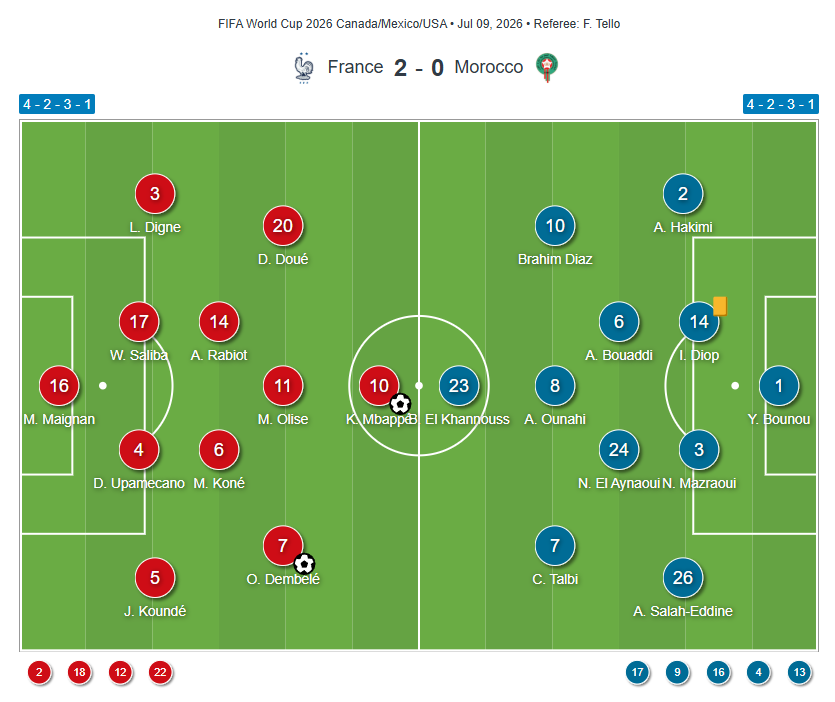
France Lineup Vs Morocco
Deschamps started the match using the 4-2-3-1 formation with Mike Maignan as a goalkeeper, and a defensive line made up of Dayot Upamecano and William Saliba as centre-backs, Jules Koundé as a right-back, and Lucas Digne as a left-back.
The midfield was made up of Manu Koné and Adrien Rabiot as central midfielders, Michael Olise as an advanced playmaker, Ousmane Dembélé as a right winger, Désiré Doué as a left winger, and Kylian Mbappé as the main striker.
Morocco Lineup Vs France
Ouahbi started the match with the 4-2-3-1 formation as well, with Yassine Bounou as a goalkeeper, Achraf Hakimi as a right-back, Noussair Mazraoui and Issa Diop
as centre-backs, and Anass Salah-Eddine as a left-back.
The midfield was composed of Ayyoub Bouaddi and Neil El Aynaoui as central midfielders, Azzedine Ounahi as the advanced playmaker, and both Brahim Díaz and Chemsidine Talbi playing on the wings.
The main striker was Bilal El Khannouss.
France Quick Attacking Solutions & Quality In Tight Spaces
Morocco tried to start the match with intense high pressing as they did against Brazil, in particular, and although they were successful in doing so in the first minutes, the French players' quality and experience in dealing with such high pressing situations made Morocco’s efforts inside France’s half look useless on many occasions.
France were quickly able to start imposing their game and start playing inside Morocco’s half more often, a situation that allows them to alternate their attacks and use their numerous attacking solutions/players for creating dangerous actions.
In particular, this was done through individual penetrations from Olise, Dembelé, Doué, and Mbappé.
All of them attempted turns and unpredictable accelerations to surprise Morocco’s defensive organisation and oblige them to concede some space.
France’s attacking solutions were obviously too varied for Morocco to stop or prevent, and that’s what led to France reaching Morocco’s goal a lot of times both in the first and the second half.
France were ready and aware of Morocco’s intent to leave no space for France’s attacking players and apply double marking on the ball holder inside their own third in order to limit the threats.
To counter that defensive approach, France looked ready to shoot on goal from any position whenever they found the slightest possible shooting trajectory, even if that required curving the ball to avoid hitting a Moroccan defender.
This was repeated on more than one occasion, and it helped France make Morocco’s marking efforts worthless.
One of these actions saw Doué cut inside while dribbling past his direct marker and provide a pass to Mbappé, who was moving well to escape from marking and ask for the ball.
Mbappé was completely aware of the lack of time and space in that area and immediately controlled the ball and coordinated his body to aim for a curved shot that Diop was not able to block or deflect simply because Mbappé knew how to curve it away from Diop.
Moreover, at the moment of controlling the ball and aiming for the shot, Mbappé got surrounded by three Moroccan players.
So, if he added one single touch or spent one more second thinking about his next action, the ball would have been intercepted from him.
This quality in the execution of shots and in coordinating the body in a quick way during such half-chances made the difference for France in the long run.
![Croatia Vs Spain [1-2] UEFA Nations League 2026/2027: How Slaven Bilić High Pressing Tactics Troubled Spain - Tactical Analysis](https://cdn.mymidnight.blog/77f959f119f4fb2321e9ce801e2f5163/size/w600/2026/10/Croatia-Vs-Spain--1-2--UEFA-Nations-League-20262027---Tactical-Analysis.png)
![Scotland Vs Switzerland [0-3] UEFA Nations League 2026/2027: How Aggressive Pressing Backfired & Murat Yakin Took Advantage - Tactical Analysis](https://cdn.mymidnight.blog/77f959f119f4fb2321e9ce801e2f5163/size/w600/2026/10/Scotland-Vs-Switzerland-20262027---Tactical-Analysis.png)
![Olympique De Marseille Vs PSG [1-2] Ligue 1 2026/2027: How Bruno Génésio Transitions Troubled PSG - Tactical Analysis](https://cdn.mymidnight.blog/77f959f119f4fb2321e9ce801e2f5163/size/w600/2026/09/Marseille-Vs-PSG-2026_2027---Tactical-Analysis.png)
![Fulham Vs Manchester United [1-1] Premier League 2026/2027: How Álvaro Arbeloa Tactics Exposed The Red Devils' Problems - Tactical Analysis](https://cdn.mymidnight.blog/77f959f119f4fb2321e9ce801e2f5163/size/w600/2026/09/Fulham-FC-Vs-Man-United-2026_2027---Tactical-Analysis.png)
![AS Roma Vs Inter Milan [2-2] Serie A 2026/2027: When Undefeated Giallorossi Attack Met Nerazzurri Comeback Resilience - Tactical Analysis](https://cdn.mymidnight.blog/77f959f119f4fb2321e9ce801e2f5163/size/w600/2026/09/AS-Roma-Vs-Inter-Milan-2026_2027---Tactical-Analysis.png)
![Real Sociedad Vs Bournemouth [1-2] Europa League 2026/2027: How Do Marco Rose Pressing Tactics Work? - Tactical Analysis](https://cdn.mymidnight.blog/77f959f119f4fb2321e9ce801e2f5163/size/w600/2026/09/Real-Sociedad-Vs-Bournemouth-20262027---Tactical-Analysis-1.png)
![AC Milan Vs Benfica [0-2] Europa League 2026/2027: How Marco Silva Tactics Exposed Rúben Amorim Defensive Problems - Tactical Analysis](https://cdn.mymidnight.blog/77f959f119f4fb2321e9ce801e2f5163/size/w600/2026/09/AC-Milan-Vs-Benfica-20262027---Tactical-Analysis.png)