
![Argentina Vs Egypt [3–2] – FIFA World Cup 2026: How The Pharaohs Exposed The World Champions – Tactical Analysis](https://cdn.mymidnight.blog/77f959f119f4fb2321e9ce801e2f5163/size/w1000/2026/07/Argentina-Vs-Egypt-World--Cup-2026-1.png)
Argentina Vs Egypt [3–2] – FIFA World Cup 2026: How The Pharaohs Exposed The World Champions – Tactical Analysis
Argentina faced Egypt at the Atlanta Stadium in the 2026 FIFA World Cup Round of 16, and the result was Argentina's qualification to the quarter-finals following a very entertaining 3-2 match.

Argentina Vs Egypt World Cup 2026 Match Overview
Argentina faced Egypt at the Atlanta Stadium in the 2026 FIFA World Cup Round of 16, and the result was Argentina's qualification to the quarter-finals following a very entertaining 3-2 match.
The match witnessed a stellar performance from Egypt, who created a lot of problems for Argentina, limiting their attacking threats for 80 minutes before losing their defensive balance and concentration to concede three goals late on.
At the same time, Egypt remained dangerous going forward throughout the match and could have won if they had exploited their final counterattacking action more decisively.
Hossam Hassan’s men were therefore very close to securing qualification, as they were also leading by two goals at some point.
Argentina's performances against Cape Verde and now Egypt can only confirm that the team is suffering from several issues, notably some remarkable defensive weaknesses, whether in aerial duels or in terms of individual man-marking.
These issues need to be fixed ahead of the Switzerland match as they risk getting knocked out following two warnings from Cape Verde and Egypt.
In this World Cup tactical analysis, we look at Egypt’s exceptional attacking performance and overall match plan to explore how they succeeded in disturbing Argentina both in the attacking and defensive phases.
Argentina Vs Egypt Lineups & Formations
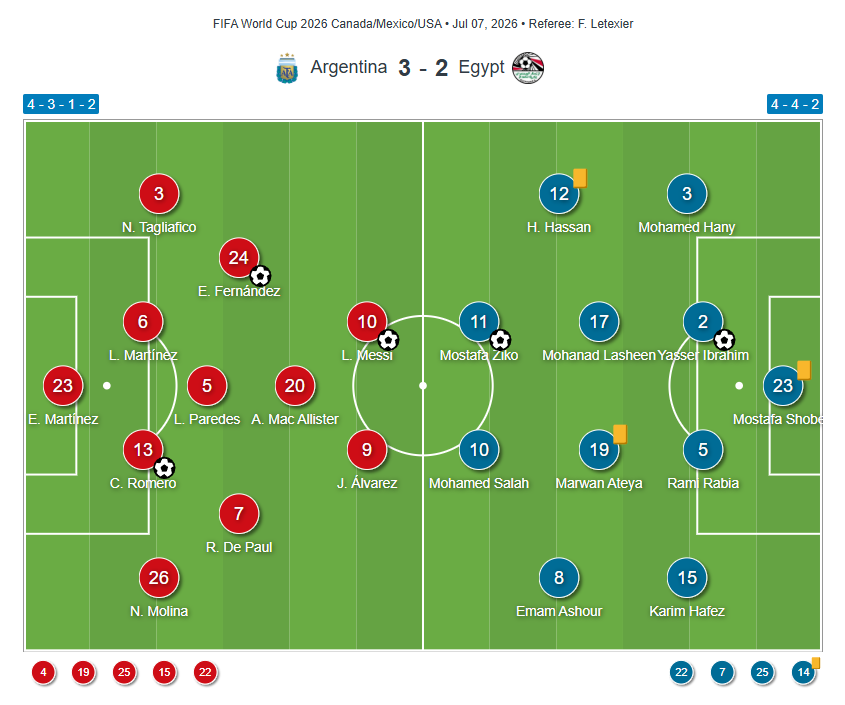
Argentina Lineup Vs Egypt
Lionel Scaloni preferred to start the match using the 4-3-1-2 formation with Emiliano Martínez as a goalkeeper, and a defensive line made up of Cristian Romero and Lisandro Martínez as centre-backs, Nahuel Molina as a right-back, and Nicolás Tagliafico as a left-back.
The midfield was composed of Leandro Paredes as a defensive midfielder, with Enzo Fernández and Rodrigo De Paul as central midfielders, Alexis Mac Allister as an advanced playmaker, with both Lionel Messi and Julián Alvarez forming the attacking duo.
Egypt Lineup Vs Argentina
On the other hand, Hassan chose to start with the 4-4-2 formation, relying on Mostafa Shobeir as the goalkeeper, and a defensive line made up of Yasser Ibrahim and Ramy Rabia as centre-backs, Mohamed Hany as a right-back, and Karim Hafez as a left-back.
In midfield, Hassan used Mohanad Lasheen and Marwan Attia as central midfielders, with Emam Ashour and Haissem Hassan as wingers.
Egypt's attacking duo was Mohamed Salah and Mostafa Ziko.
Egypt Wing-Play & Exploitation Of Argentina Aerial Weaknesses
Egypt started the match in a very confident and balanced way, using a mid-block to avoid getting dominated in their own half and in order to succeed in keeping Argentina back.
This was successful for Egypt on multiple occasions and helped them win back the ball and be able to launch quick attacking transitions, which was one of their strengths in this match in particular.
In possession, Egypt were able to avoid Argentina’s high press thanks to the excellent build-up from the back abilities of their midfielders Attia and Lasheen, as well as the valuable retreating of players like Ashour, Salah, and Ziko to help in that build-up phase and ensure that Egypt find passing solutions.
Moreover, the dribbling skills and ball protection used by these players to resist Argentina’s high press allowed Egypt to get away from many complicated situations and turn them into dangerous attacks instead of conceding attacks.
More importantly, Egypt played on Argentina’s errors, especially in the air, as they were aware of the defensive line’s issues in this regard, particularly Lisandro Martínez.
Egypt exploited their strengths in terms of crossing and ability to escape from marking inside the box as they did against Australia, confirming once again that they can create issues for any defence using their accurate and unexpected crosses, plus the excellent movement inside the box.
The idea was mainly to attack the penalty area with as many players as possible so that Argentina’s players get confused in terms of marking and leave space behind them for one Egyptian player who would move without the ball at the right time, when the ball is being crossed.
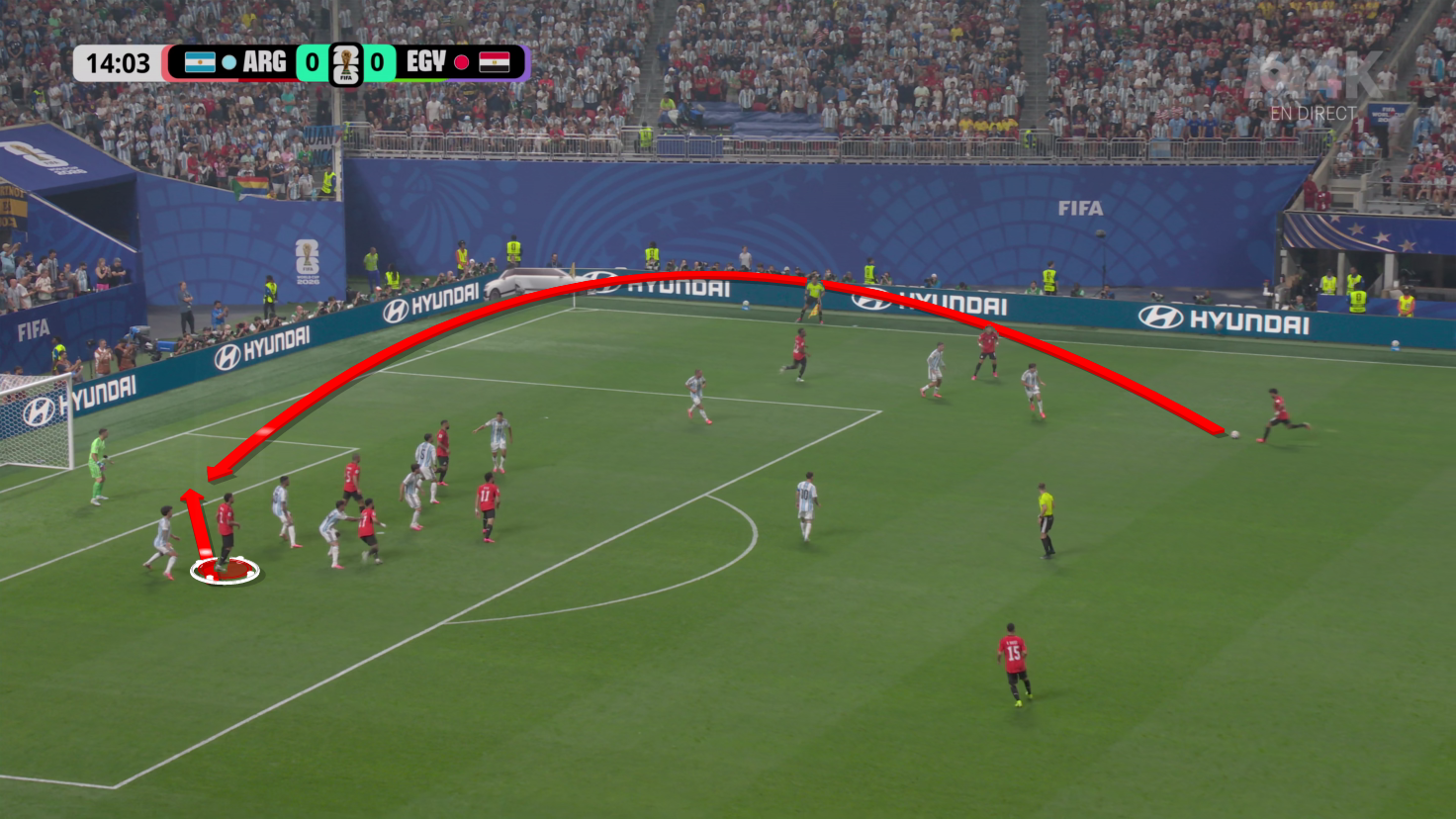
Ibrahim applied this plan perfectly, as he was marked by Martínez but moved at the right time to get to the ball first while leaving Martínez behind him.
Being taller than Martínez and having a higher jump allowed Ibrahim to get to the ball and direct his header towards the bottom-right corner.
It is important to note that the action was born thanks to Ashour’s impressive work against two Argentine players on the right wing, as he pretended to cross more than once and fixed his direct opponents before passing the ball back to Attia, whose first-time cross was creative and dangerous enough to surprise Argentina’s defensive line.
Martínez was not expecting the cross to arrive from Attia, especially first-time, and that made him lose time against Ibrahim, who obviously read his teammate's plan better.
Egypt confirmed once again that they are unstoppable in terms of exploiting crosses and winning in offensive aerial duels, first against Australia and now against Argentina too.
Egypt Post-First Goal Approach
Following their first goal, Egypt got even more confident in their ability to keep disturbing Argentina by pressing high whenever possible, retreating to defend when needed, and exploiting any counterattacking possibility.
This was Egypt’s plan to secure their advantage and try doubling it without risking too much or leaving too much space behind their defensive line.
It is also true that Egypt risked a lot when they retreated, as Argentina’s attacks were very dangerous, but in the end, Shobeir was decisive most of the time.
Despite that, Egypt’s counterattacks represented a continuous threat to Argentina’s defensive line.
Egypt’s excellent attacking transitions following mid and high recoveries obliged Argentina to keep conceding risky counterattacks, as they had to keep playing with a high defensive line in order to score.
This scenario was very suitable for Egypt, whose players are better-suited for playing in spaces, exchanging passes quickly and moving well without the ball to surprise Argentina’s retreating players.
In particular, the attacking depth provided by Salah as the first player attacking Argentina’s defence during counter-attacks was disturbing to Argentina and could have led to goals if Salah dealt better with some of those situations.
This counterattacking example illustrates one of the times when Salah moved well to try winning the duel against Martínez following a long-pass clearance from Rabiaa.
Martínez misjudged the trajectory of the pass and made a completely wrong clearance attempt, leaving Salah with the ball in a dangerous situation.
However, Salah failed to touch the ball at the right time too and missed the opportunity of providing an assist to Ziko, who was coming from behind and proposing a perfect passing solution.
Although Romero was reactive enough to cover for Martínez and intercept the ball, Martínez made another crucial error that could have led to conceding another goal.
![Croatia Vs Spain [1-2] UEFA Nations League 2026/2027: How Slaven Bilić High Pressing Tactics Troubled Spain - Tactical Analysis](https://cdn.mymidnight.blog/77f959f119f4fb2321e9ce801e2f5163/size/w600/2026/10/Croatia-Vs-Spain--1-2--UEFA-Nations-League-20262027---Tactical-Analysis.png)

![Scotland Vs Switzerland [0-3] UEFA Nations League 2026/2027: How Aggressive Pressing Backfired & Murat Yakin Took Advantage - Tactical Analysis](https://cdn.mymidnight.blog/77f959f119f4fb2321e9ce801e2f5163/size/w600/2026/10/Scotland-Vs-Switzerland-20262027---Tactical-Analysis.png)
![Olympique De Marseille Vs PSG [1-2] Ligue 1 2026/2027: How Bruno Génésio Transitions Troubled PSG - Tactical Analysis](https://cdn.mymidnight.blog/77f959f119f4fb2321e9ce801e2f5163/size/w600/2026/09/Marseille-Vs-PSG-2026_2027---Tactical-Analysis.png)
![Fulham Vs Manchester United [1-1] Premier League 2026/2027: How Álvaro Arbeloa Tactics Exposed The Red Devils' Problems - Tactical Analysis](https://cdn.mymidnight.blog/77f959f119f4fb2321e9ce801e2f5163/size/w600/2026/09/Fulham-FC-Vs-Man-United-2026_2027---Tactical-Analysis.png)
![AS Roma Vs Inter Milan [2-2] Serie A 2026/2027: When Undefeated Giallorossi Attack Met Nerazzurri Comeback Resilience - Tactical Analysis](https://cdn.mymidnight.blog/77f959f119f4fb2321e9ce801e2f5163/size/w600/2026/09/AS-Roma-Vs-Inter-Milan-2026_2027---Tactical-Analysis.png)
![Real Sociedad Vs Bournemouth [1-2] Europa League 2026/2027: How Do Marco Rose Pressing Tactics Work? - Tactical Analysis](https://cdn.mymidnight.blog/77f959f119f4fb2321e9ce801e2f5163/size/w600/2026/09/Real-Sociedad-Vs-Bournemouth-20262027---Tactical-Analysis-1.png)
![AC Milan Vs Benfica [0-2] Europa League 2026/2027: How Marco Silva Tactics Exposed Rúben Amorim Defensive Problems - Tactical Analysis](https://cdn.mymidnight.blog/77f959f119f4fb2321e9ce801e2f5163/size/w600/2026/09/AC-Milan-Vs-Benfica-20262027---Tactical-Analysis.png)