
![Australia Vs Egypt [1–1 (Penalties: 2–4)] – FIFA World Cup 2026: Egypt Attacking Variety Sets Up Argentina Showdown – Tactical Analysis](https://cdn.mymidnight.blog/77f959f119f4fb2321e9ce801e2f5163/size/w1000/2026/07/Australia-Vs-Egypt-World--Cup-2026.png)
Australia Vs Egypt [1–1 (Penalties: 2–4)] – FIFA World Cup 2026: Egypt Attacking Variety Sets Up Argentina Showdown – Tactical Analysis

Australia met Egypt in the 2026 FIFA World Cup Round of 32 at Dallas Stadium.
The match ended in a 1-1 draw, with Egypt ultimately going through on penalties.
Egypt's historic qualification to the Round of 16 comes after their first-ever win in a World Cup, which came when they beat New Zealand.
Therefore, this has already become an unforgettable World Cup edition for the Egyptians, who won a World Cup match for the first time, qualified from the group stage for the first time since 1934, and will be hoping to break another record when they meet Argentina in the Round of 16.
Facing a world-class team like Argentina is not going to be a walk in the park.
At the same time, Egypt will not be an easy opponent for Argentina either.
Following Cape Verde’s impressive performance against Argentina, Egypt’s potential to disturb and challenge Argentina for qualification is being further confirmed.
In this World Cup tactical analysis, we examine Egypt’s attacking performance against Australia and the variations used to disturb Tony Popovic’s side, while considering the weaknesses and errors that they should fix ahead of facing Argentina, as well as Argentina’s defensive weaknesses.
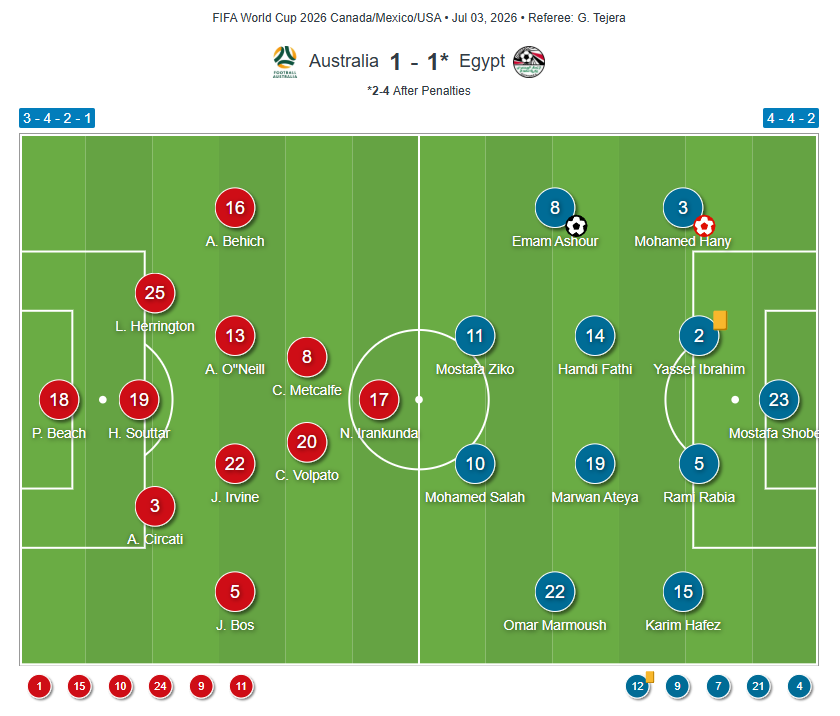
Australia Vs Egypt Lineups & Formations
Australia Lineup Vs Egypt
Popovic used a 3-4-2-1 formation to face Egypt, with Patrick Beach as the goalkeeper, and a defensive trio of Alessandro Circati, Harry Souttar, and Lucas Herrington.
The midfield line involved both Aiden O'Neill and Jackson Irvine as central midfielders, Jordan Bos and Aziz Behich as wing-backs, with Connor Metcalfe and Cristian Volpato as wide playmakers behind the striker, Nestory Irankunda.
Egypt Lineup Vs Australia
On the other side, Hassan relied on a 4-4-2 formation with Mostafa Shobeir as the goalkeeper, and a defensive line made up of Yasser Ibrahim and Rami Rabia as centre-backs, Mohamed Hany as a right-back, and Karim Hafez as a left-back.
In midfield, Hassan used Hamdy Fathy and Marwan Attia as central midfielders, with Emam Ashour and Omar Marmoush as wingers.
Egypt's attacking duo was Mohamed Salah and Mostafa Ziko.
Egypt Exploitation Of Australia Marking Errors
Egypt succeeded in absorbing Australia’s first attempts, as they risked conceding a goal in the first minutes due to defensive positioning issues and marking errors that were recovered afterwards.
At the same time, Egypt tried to advance progressively and start playing inside Australia’s final third more often, with the main idea being to create numerical superiority on the wings and try to penetrate from the right or the left.
Furthermore, what helped Egypt score an early goal was their diversity of attacks from the beginning, as they tried shooting from distance, short passes, penetration attempts from the wings, and crosses, too.
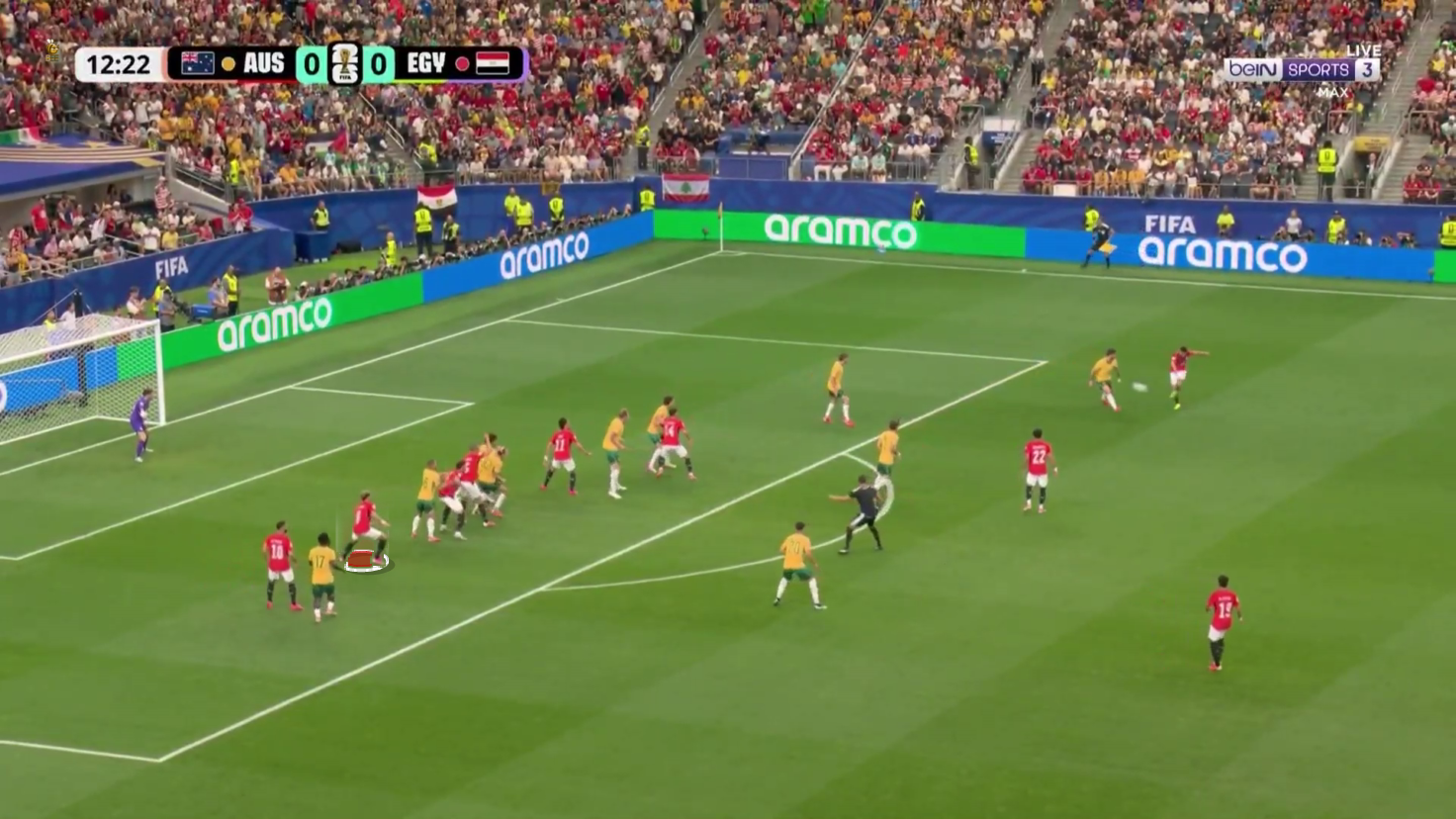
Knowing that Australia are powerful in aerial duels, it was very intelligent from Egypt to spot an Australian marking issue during an attack, and play on that positioning error to serve Ashour at the perfect timing and spot.
In fact, Australia’s marking error was obvious and confirmed the team’s lack of organisation and communication during such occasions.
As the following picture shows, Ashour was left unmarked even before the crossing attempt, which confirms that Hafez’s assist was intended and not just another cross towards the box.
Egypt Attacking Solutions Vs Australia Compact Defensive Approach
Australia adopted a very defensive yet dangerous playing style based on defending with close lines and with intensity, with the hope of launching quick counterattacks as soon as they intercept the ball.
Egypt looked ready and unsurprised by this approach, as they were patient in their playmaking process and waited until they got an adequate opportunity to advance.
This patience and calmness in the build-up, as well as the intelligence in exploiting the gaps within Australia's compact 3-4-2-1 plan, confused Popovic's side even further and made them unable to predict when Egypt would attack with full intensity or when they would advance more slowly.
Also, the quick changes of rhythm whenever they find a penetration or a line-breaking pass possibility made Australia’s defensive efforts look ineffective.
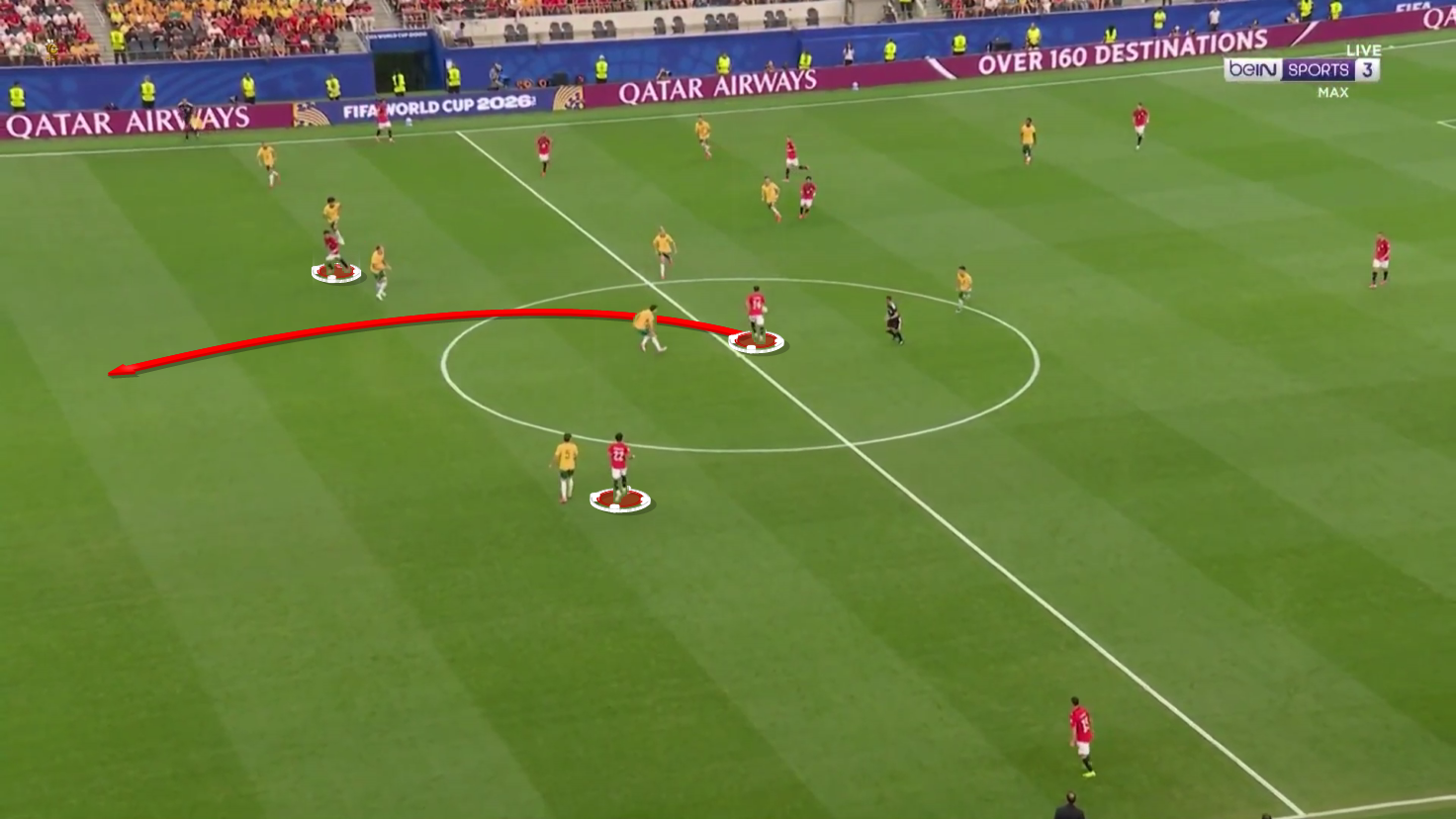
One of the occasions that highlight this type of quick changes of rhythm and surprising key passes between the lines started with Hany’s vertical pass to Fathy, who was surrounded by two players.
Fathy was creative enough to provide a first-time through pass to the direction of Ziko’s forward run at the back of Australia’s defensive line.
This eventually created an extremely dangerous goalscoring situation for Ziko as he was also accompanied by Marmoush in front of Australia’s goal.
It is true that Ziko was in an offside position at the start of the action, yet the action highlights Egypt’s plethora of attacking solutions to beat Australia’s defensive lines and find ways to reach the goal.
This time, it was done thanks to the creativity and intelligent passing of Fathy, as he eliminated two direct markers and a whole defensive line with that first-time vertical pass.
Egypt Progressive Attacking Football & Prepared Combinations
Egypt made sure to remain patient with the ball as time progressed.
They knew that this would tire Australia even further and add to their frustration, therefore forcing them into mistakes.
At the same time, Egypt made sure to play some prepared combinations from time to time in order to gain time over Australia’s players.
These combinations involved many of the midfield and attacking players.
With quick passes and well-timed movements without the ball, to make the combinations successful.
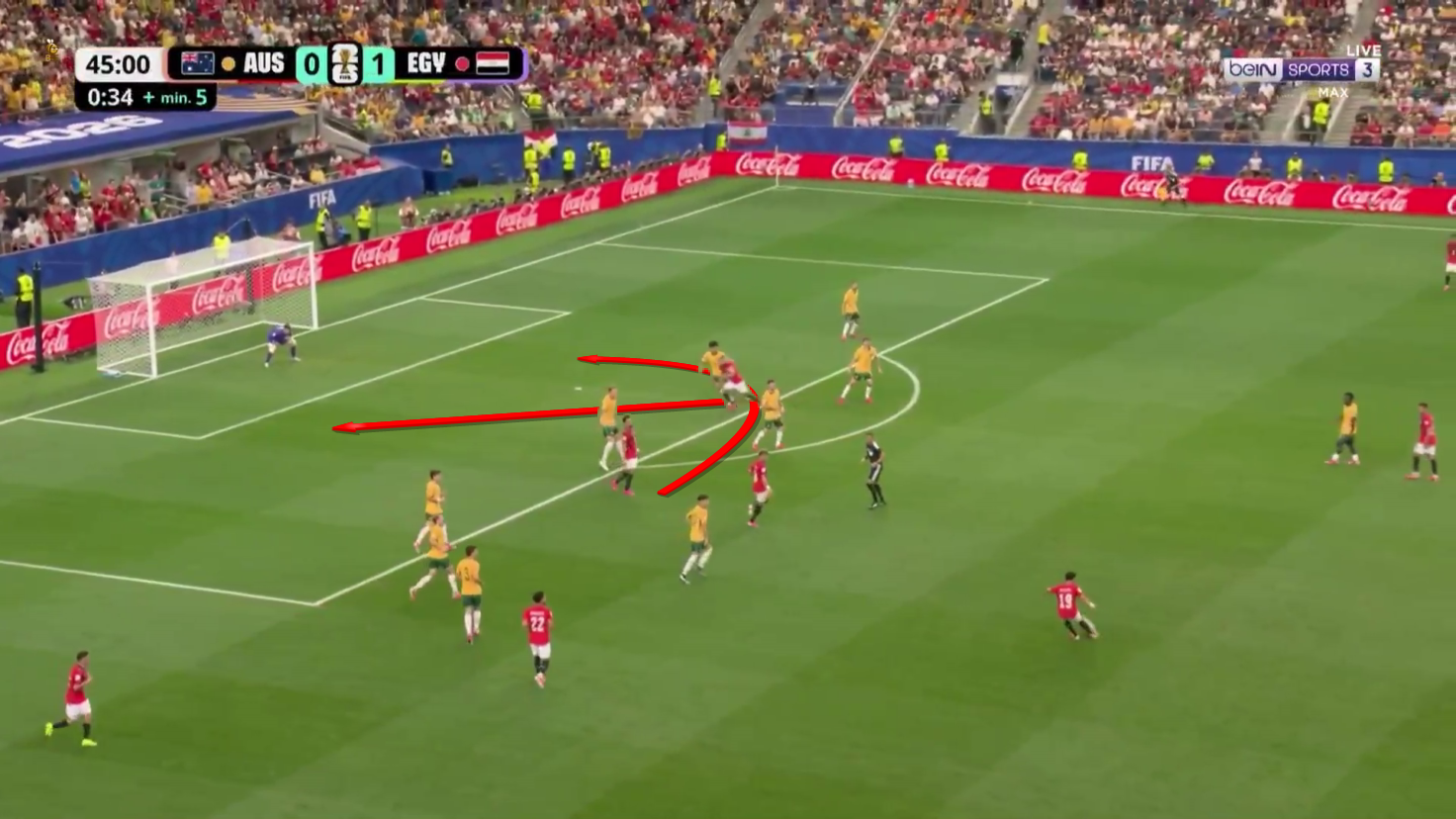
In one of the many combinations attempted by Egypt, the ball was circulating between the players on the left wing.
As it reached Attia in midfield, Salah made the diagonal movement without the ball to get to Attia’s cross, which broke Australia’s defensive line (in the same way Fathy’s vertical pass broke that Australian line).
Even though Herrington noticed Salah’s movement and followed him, Salah was still able to use a backward header that was not accurate enough to reach Ziko, who was moving behind Salah, hoping to receive a potential assist.
These movements without the ball were recurrent from all of Salah, Ziko, Marmoush, and Ashour, as these attacking players were dynamic enough and had good chemistry between them and the midfield players, as that’s what made these combinations relatively successful.
Working on such combinations and adding more precision to them, especially in terms of finishing and final passes, would eventually help Egypt create another surprise against Argentina, given that the talent, the understanding, and the skills are all there.

![Scotland Vs Switzerland [0-3] UEFA Nations League 2026/2027: How Aggressive Pressing Backfired & Murat Yakin Took Advantage - Tactical Analysis](https://cdn.mymidnight.blog/77f959f119f4fb2321e9ce801e2f5163/size/w600/2026/10/Scotland-Vs-Switzerland-20262027---Tactical-Analysis.png)
![Olympique De Marseille Vs PSG [1-2] Ligue 1 2026/2027: How Bruno Génésio Transitions Troubled PSG - Tactical Analysis](https://cdn.mymidnight.blog/77f959f119f4fb2321e9ce801e2f5163/size/w600/2026/09/Marseille-Vs-PSG-2026_2027---Tactical-Analysis.png)
![Fulham Vs Manchester United [1-1] Premier League 2026/2027: How Álvaro Arbeloa Tactics Exposed The Red Devils' Problems - Tactical Analysis](https://cdn.mymidnight.blog/77f959f119f4fb2321e9ce801e2f5163/size/w600/2026/09/Fulham-FC-Vs-Man-United-2026_2027---Tactical-Analysis.png)
![AS Roma Vs Inter Milan [2-2] Serie A 2026/2027: When Undefeated Giallorossi Attack Met Nerazzurri Comeback Resilience - Tactical Analysis](https://cdn.mymidnight.blog/77f959f119f4fb2321e9ce801e2f5163/size/w600/2026/09/AS-Roma-Vs-Inter-Milan-2026_2027---Tactical-Analysis.png)
![Real Sociedad Vs Bournemouth [1-2] Europa League 2026/2027: How Do Marco Rose Pressing Tactics Work? - Tactical Analysis](https://cdn.mymidnight.blog/77f959f119f4fb2321e9ce801e2f5163/size/w600/2026/09/Real-Sociedad-Vs-Bournemouth-20262027---Tactical-Analysis-1.png)
![AC Milan Vs Benfica [0-2] Europa League 2026/2027: How Marco Silva Tactics Exposed Rúben Amorim Defensive Problems - Tactical Analysis](https://cdn.mymidnight.blog/77f959f119f4fb2321e9ce801e2f5163/size/w600/2026/09/AC-Milan-Vs-Benfica-20262027---Tactical-Analysis.png)
![Sunderland Vs AZ Alkmaar [1-0] Europa League 2026/2027: Why The Black Cats Make Better Underdogs - Tactical Analysis](https://cdn.mymidnight.blog/77f959f119f4fb2321e9ce801e2f5163/size/w600/2026/09/Sunderland-Vs-AZ-Alkmaar-20262027---Tactical-Analysis.png)