
![Real Sociedad Vs Bournemouth [1-2] Europa League 2026/2027: How Do Marco Rose Pressing Tactics Work? - Tactical Analysis](https://cdn.mymidnight.blog/77f959f119f4fb2321e9ce801e2f5163/size/w1000/2026/09/Real-Sociedad-Vs-Bournemouth-20262027---Tactical-Analysis-1.png)
Real Sociedad Vs Bournemouth [1-2] Europa League 2026/2027: How Do Marco Rose Pressing Tactics Work? - Tactical Analysis

AFC Bournemouth marked a new milestone in their era of unprecedented success on Thursday, as the Cherries played in European competition for the very first time.
To add the cherry on the cake, Marco Rose led the south coast club to a 2-1 victory away to Basque side Real Sociedad at the Anoeta, with early goals from Justin Kluivert and Rayan ensuring they’d be bringing three UEFA Europa League points back from their excursion.
The speed and intensity of Bournemouth’s play in and out of possession, particularly early on in the game, played a crucial role in their win.
By the end of the match, Bournemouth averaged far less possession (40.8%) than the hosts (59.2%), took fewer shots (10) than Txuri-urdin (16), and finished with significantly lower xG (0.7) than the Basque side (1.91).
On the surface, this data looks concerning for Bournemouth.
However, the game state had a major impact here.
Bournemouth were clearly the better side throughout the first half, during which they generated 0.6 of their 0.7 xG and limited the home side to just 0.12 xG.
They were incredibly efficient in terms of their chance creation and their finishing, and that efficiency was driven by the Cherries’ effective out-of-possession tactics.
Early on, Bournemouth consistently made the home side’s possession phases uncomfortable through intense, organised pressing.
They turned the resulting regains into some decent goalscoring opportunities, two of which they converted ruthlessly.
They survived Real Sociedad’s subsequent second-half rally to take three points from their European debut.
This Real Sociedad vs Bournemouth tactical analysis examines how and why Marco Rose’s pressing tactics proved so effective.
Real Sociedad Vs Bournemouth Lineups & Formations
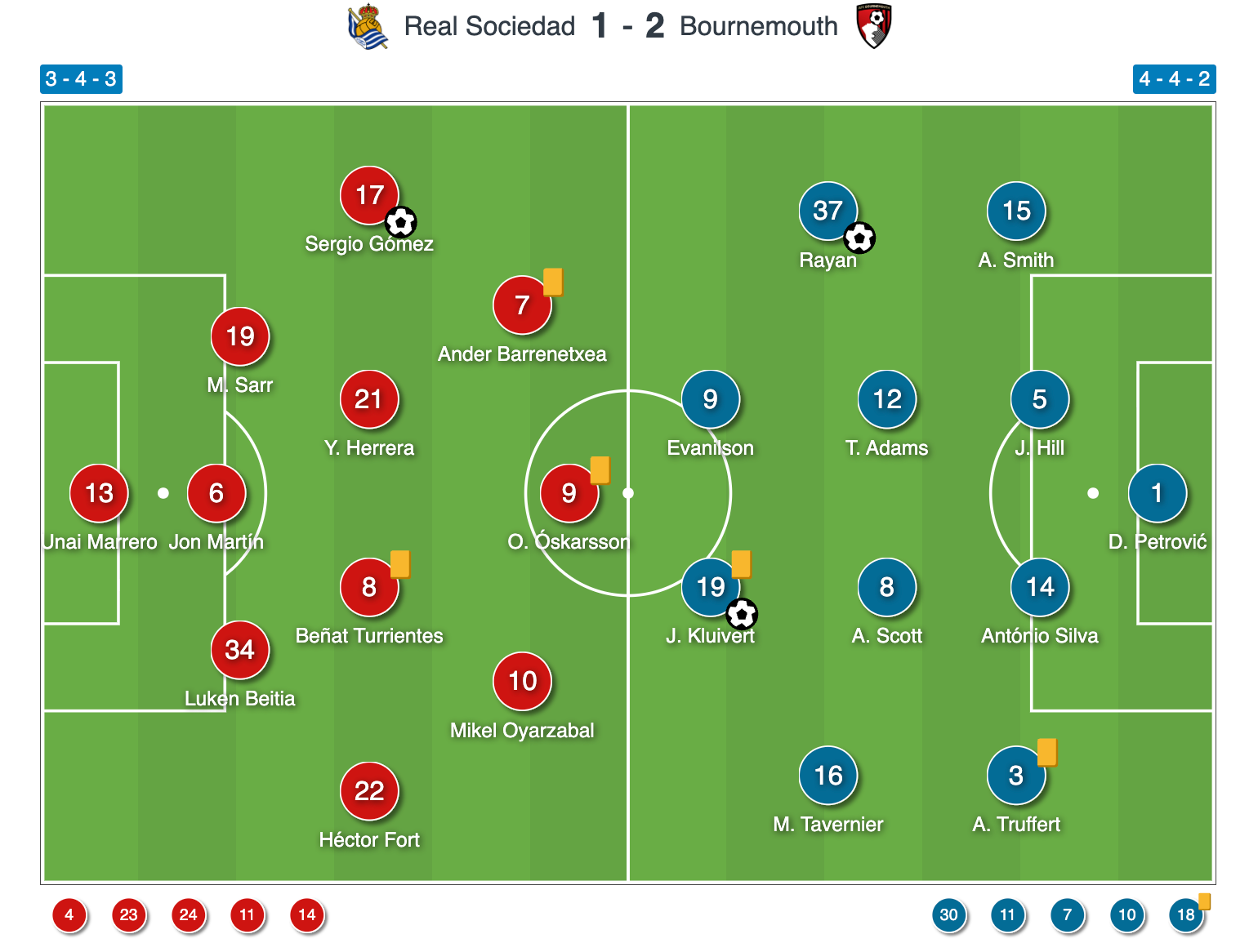
Real Sociedad Lineup Vs Bournemouth
Pellegrino Matarazzo set his side up in a 3-4-3 shape with Unai Marrero in goal behind a back three of Luken Beitia, Jon Martín and Mamadou Sarr, from right to left.
Héctor Fort and Sergio Gómez played as the right and left wing-backs, respectively, with Beñat Turrientes and Yangel Herrera in central midfield behind a front three of right-winger Mikel Oyarzabal, left-winger Ander Barrenetxea, and centre-forward Orri Óskarsson.
Matarazzo made five substitutions during the match, the first of which came at half-time as Fort made way for Gonçalo Guedes.
In the 58th minute, Jon Gorrotxategi came on for Beñat Turrientes, before Luka Sučić was introduced for Oyarzabal in the 73rd minute.
Real Sociedad’s final two changes came in the 84th minute, as Takefusa Kubo and Arsen Zakharyan replaced Ander Barrenetxea and Yangel Herrera.
Bournemouth Lineup Vs Real Sociedad
Meanwhile, the visitors set up in a 4-2-2-2 shape, with Đorđe Petrović in goal behind a back four of Adam Smith, James Hill, António Silva and Adrien Truffert, from right to left.
Tyler Adams and Alex Scott started in central midfield, with Rayan and Marcus Tavernier occupying the attacking midfield positions behind Evanilson and Justin Kluivert up top.
Marco Rose also made five substitutions during the match, with the first two coming shortly after Real Sociedad scored in the 58th minute, with Bafodé Diakité and Ryan Christie coming on for Adam Smith and Tyler Adams just after the hour mark.
Another double change followed in the 71st minute, as Ben Gannon-Doak and Álvaro Rodríguez replaced Rayan and Evanilson.
Lastly, in the 83rd minute, David Brooks came on for Justin Kluivert.
Horizontal Compactness As A Pressing Tool In The Mid Block
Bournemouth’s press was a weapon they intensified early on to help establish a two-goal lead.
Its intensity reduced as the game-state changed.
Bournemouth PPDA Timeline Vs Real Sociedad
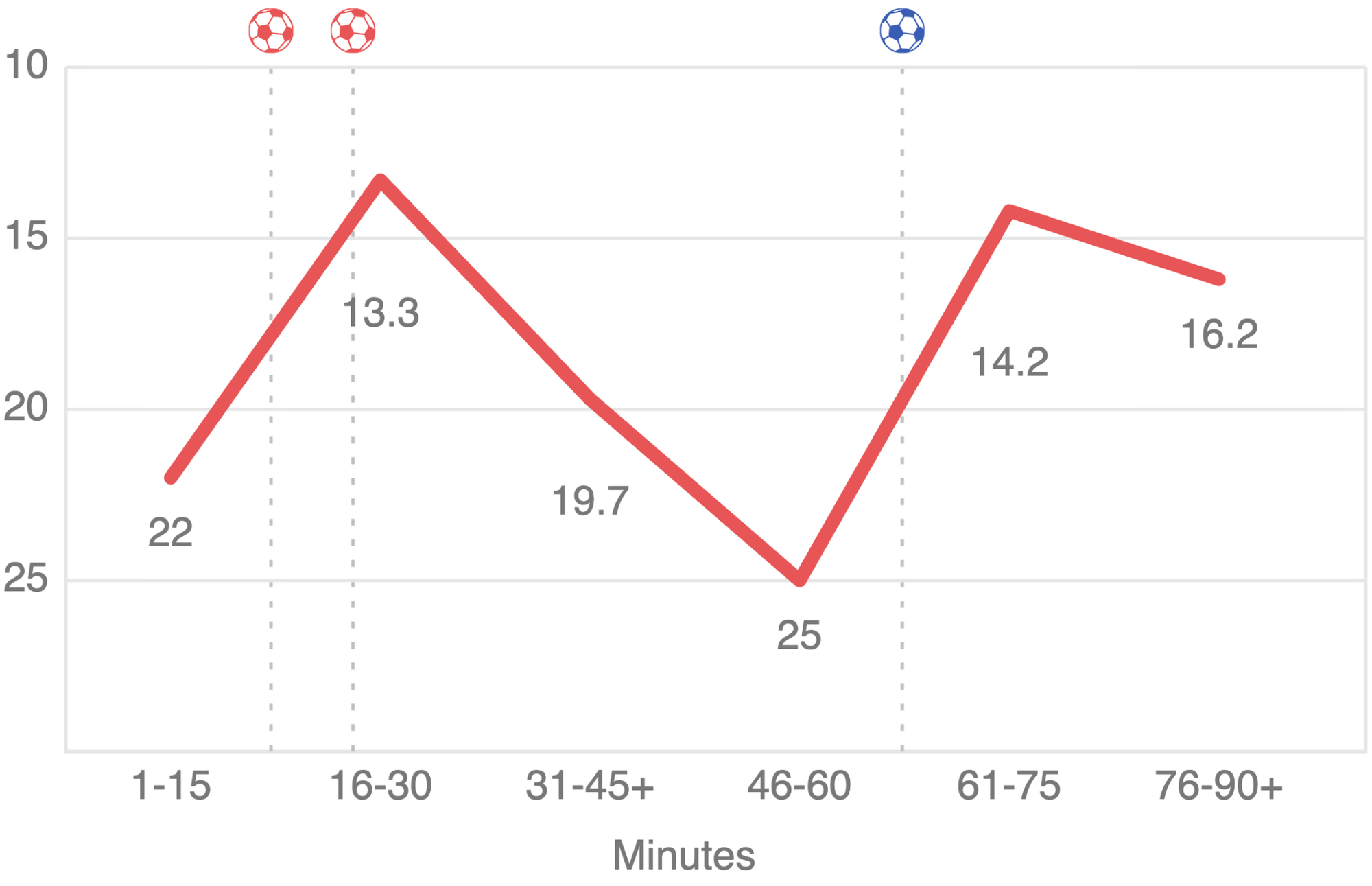
Figure 2 shows how Bournemouth’s pressing intensity developed through the match.
Their PPDA peaked at 13.3 in the second 15-minute period before tapering off over the next 30 minutes as Bournemouth began to sink in and accept more possession against them.
Things picked back up again, without reaching the same heights, in the final 30 minutes following Real Sociedad’s goal and as the hosts played more and more aggressively in search of an equaliser.
The Cherries’ out-of-possession success was built on control of central space.
They used an extremely narrow 4-2-2-2 shape which kept Real Sociedad’s midfielders tightly marked and kept Bournemouth bodies relatively close by to allow the Cherries to press selectively and counterpress aggressively on turnovers.
Marco Rose’s side relied on a predominantly ball-oriented press, backed by a narrow, space-oriented defensive structure as they were constantly guided by the principle of protecting the central space first.
In other words, Bournemouth pressed the ball but defended the space around it.
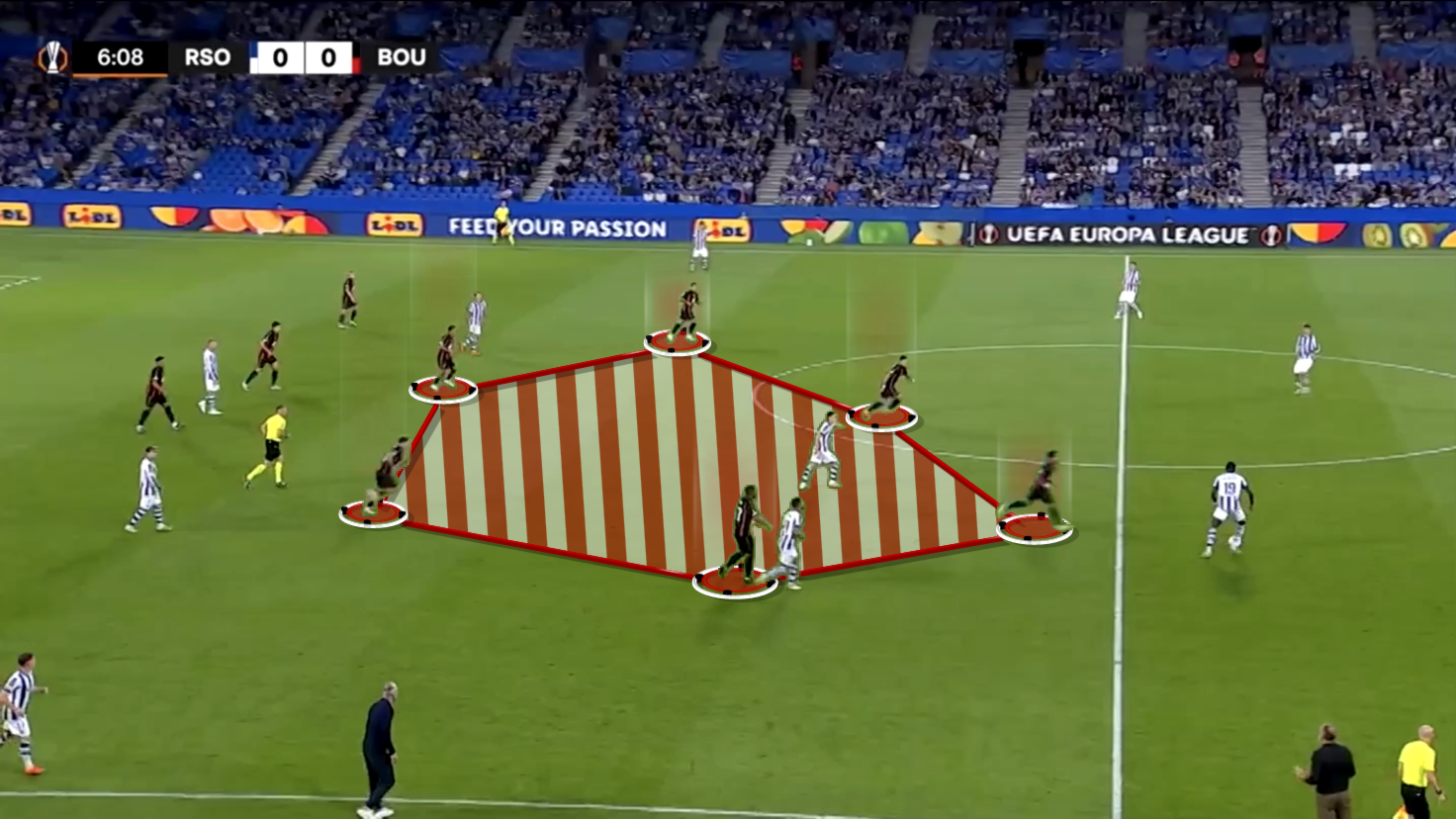
Figure 3 highlights just how narrow Bournemouth shaped up without the ball.
They essentially looked to congest the central corridor and deny all progression through those valuable central areas.
The trade-offs are that this naturally invites circulation around the block, via the wings, while a ball-oriented press always opens the door to the team in possession finding players in space via long switches of play.
Real Sociedad had to use these natural structural weaknesses in Bournemouth’s system to their benefit and, ultimately, they failed to do so in the first half when Bournemouth’s press was at its most aggressive.
The aggressive and intense press created panic and forced errors, whereas the team in possession has to be prepared for intense pressure like this and try to remain calm, continue circulating the ball to move and stretch the pressing structure, and combine intelligent off-the-ball movement with technical quality to find players in space away from the immediate pressure.
Extreme horizontal compactness was the defining feature of Marco Rose’s pressing here.
Going back to Figure 3, the distances and spacing between the Bournemouth bodies in the mid block here are short, while the defending players are, crucially, not trying to press every opponent individually here but rather they’re protecting the central space first while orienting the direction of the press towards the ball.
In the clip below, then, we see an example of how Bournemouth’s narrow defensive structure constantly kept players near the opposing ball carrier to place them under immediate pressure, while facilitating fluid counterattacking play with reduced distances between players when the ball was turned over.
![AC Milan Vs Benfica [0-2] Europa League 2026/2027: How Marco Silva Tactics Exposed Rúben Amorim Defensive Problems - Tactical Analysis](https://cdn.mymidnight.blog/77f959f119f4fb2321e9ce801e2f5163/size/w600/2026/09/AC-Milan-Vs-Benfica-20262027---Tactical-Analysis.png)
![Sunderland Vs AZ Alkmaar [1-0] Europa League 2026/2027: Why The Black Cats Make Better Underdogs - Tactical Analysis](https://cdn.mymidnight.blog/77f959f119f4fb2321e9ce801e2f5163/size/w600/2026/09/Sunderland-Vs-AZ-Alkmaar-20262027---Tactical-Analysis.png)
![Leeds United Vs Newcastle United [4-1] Premier League 2026/2027: Why Did Daniel Farke Tactics Dominate The Magpies? - Tactical Analysis](https://cdn.mymidnight.blog/77f959f119f4fb2321e9ce801e2f5163/size/w600/2026/09/Leeds-United-Vs-Newcastle-2026_2027---Tactical-Analysis.png)
![Real Sociedad Vs Atlético Madrid [0-3] La Liga 2026/2027: How Diego Simeone Tactical Precision Rescued A Late Victory - Tactical Analysis](https://cdn.mymidnight.blog/77f959f119f4fb2321e9ce801e2f5163/size/w600/2026/09/Real-Sociedad-Vs-Atl--tico-Madrid-20262027---Tactical-Analysis-1.png)
![Manchester United Vs Manchester City [0-1] Premier League 2026/2027: How Enzo Maresca Tactics Secured Victory With 10 Men - Tactical Analysis](https://cdn.mymidnight.blog/77f959f119f4fb2321e9ce801e2f5163/size/w600/2026/09/Manchester-United-Vs-Manchester-City--20262027---Tactical-Analysis.png)
![Tottenham Hotspur Vs Everton [0-0] Premier League 2026/2027: Why Can't Spurs Score? - Tactical Analysis](https://cdn.mymidnight.blog/77f959f119f4fb2321e9ce801e2f5163/size/w600/2026/09/Tottenham---Vs-Everton-20262027---Tactical-Analysis.png)
![West Ham United Vs Wrexham [6-0] EFL Championship 2026/2027: The Cost Of Passive Defending Against Smart Movement - Tactical Analysis](https://cdn.mymidnight.blog/77f959f119f4fb2321e9ce801e2f5163/size/w600/2026/09/West-Ham-United-Vs-Wrexham-2026_2027---Tactical-Analysis.png)
![Fenerbahçe Vs AS Roma [1-1] Champions League 2026/2027: How İsmail Kartal's Compact Defence Limited Gian Piero Gasperini's Attack - Tactical Analysis](https://cdn.mymidnight.blog/77f959f119f4fb2321e9ce801e2f5163/size/w600/2026/09/Fenerbah--e-Vs-Roma-20262027---Tactical-Analysis.png)