
Why Are Midfielders Like Arsenal's Bruno Guimarães & Barcelona's Frenkie De Jong Essential In Modern Football? – Data Analysis
This data analysis examines how modern football has reshaped the midfielder profile, focusing on press resistance, vertical progression and versatility through Bruno Guimarães, Frenkie de Jong and other elite examples.

As explored throughout our previous two data analysis pieces in this Tactical Football Analysis series, the modern game has developed through a continuous cycle in which dominant styles create new problems, prompting opponents to develop solutions of their own.
Part One of this series examined whether football has really changed, while Part Two traced when the most significant tactical shifts took place and how positional play, pressing, and build-up structures evolved in response.
But tactical changes don't affect every style or player profile equally.
As new approaches emerge and established ideas are countered, some styles gain an advantage while others gradually lose their influence.
In Part Three, the final part of our current data analysis series, we examine which styles of play and types of players have benefited most from football’s evolution, and which have been left behind.
Which Midfielders Learned To Survive The Press?
As pressing has become one of the defining features of modern football, the value of midfielders capable of remaining effective under pressure has risen sharply.
The modern midfielder is increasingly required not only to receive the ball, but to receive it when opponents are actively trying to take it away.
This has elevated the importance of press resistance, a player’s ability to retain possession and continue progressing play when subjected to pressure.
To assess which midfielders are best equipped to operate under pressure, we developed our own Press Resistance Index (PRI), combining multiple metrics to evaluate press resistance through a single measure.
The aim is to combine the key indicators of a midfielder’s ability to receive, retain and progress possession when actively pressed into a single measure.
The index is built around Pressured Pass Completion % (PPC) as its primary component, supported by Turnovers + Dispossessions per 90 as an indicator of how frequently possession is lost under pressure.
The two measures must be considered together; a midfielder who frequently attempts to receive and play through pressure may naturally record more possession losses than a player who rarely takes those risks.
Therefore, the KPI rewards high-pressure pass completion while accounting for the volume of Turnovers and Dispossessions, with possession losses assessed in the context of how frequently a player attempts to operate under pressure.
This approach allows us to move beyond asking which player records the best individual number and instead identify which midfielders consistently combine efficiency with the willingness to operate under pressure.
The resulting Press Resistance Index provides a more balanced framework for comparing players and identifying the profiles that have adapted best to the demands of the modern pressing game.
Our 2020/2021 sample of central midfielders in Europe's top-five leagues, selected because it falls within a period of increasingly intense pressing and limited to players with more than 1,000 minutes, highlights a clear group of players who had adapted particularly well to the growing demands of playing under pressure.
The Balance Between Passing Efficiency & Possession Losses Under Pressure
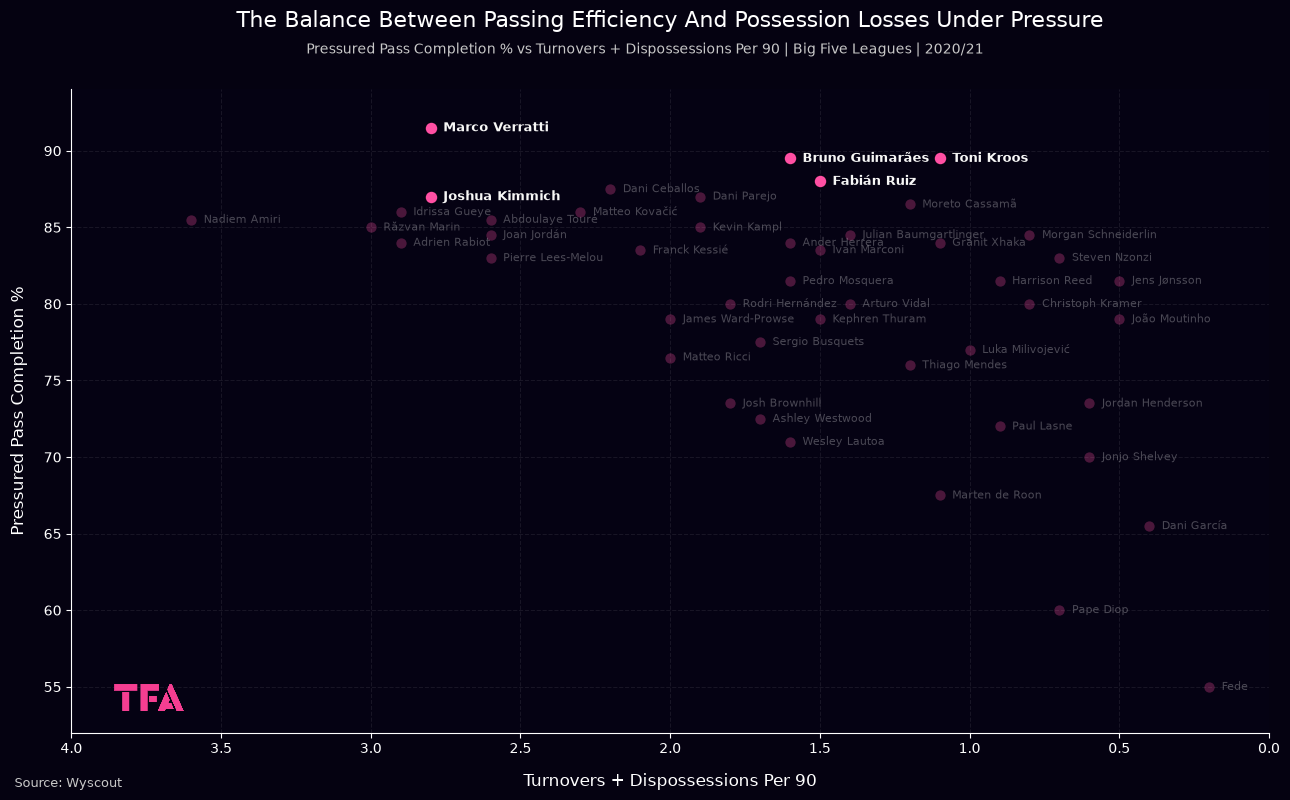
At the top of the 2020/2021 sample sits Marco Verratti, completing 91.5% of his passes under pressure, the highest figure in the sample.
His 2.8 Turnovers + Dispossessions per 90 may initially appear high, but the context is important, as Verratti was consistently willing to receive the ball in congested areas and attempt to play through pressure.
His ability to retain possession was also supported by his effectiveness when carrying the ball, with 86% of his attempted take-ons completed, the highest success rate among central midfielders in the top-five leagues attempting at least 2.0 dribbles per 90.
Marco Verratti Carries & Take-Ons At Paris Saint-Germain 2020/2021
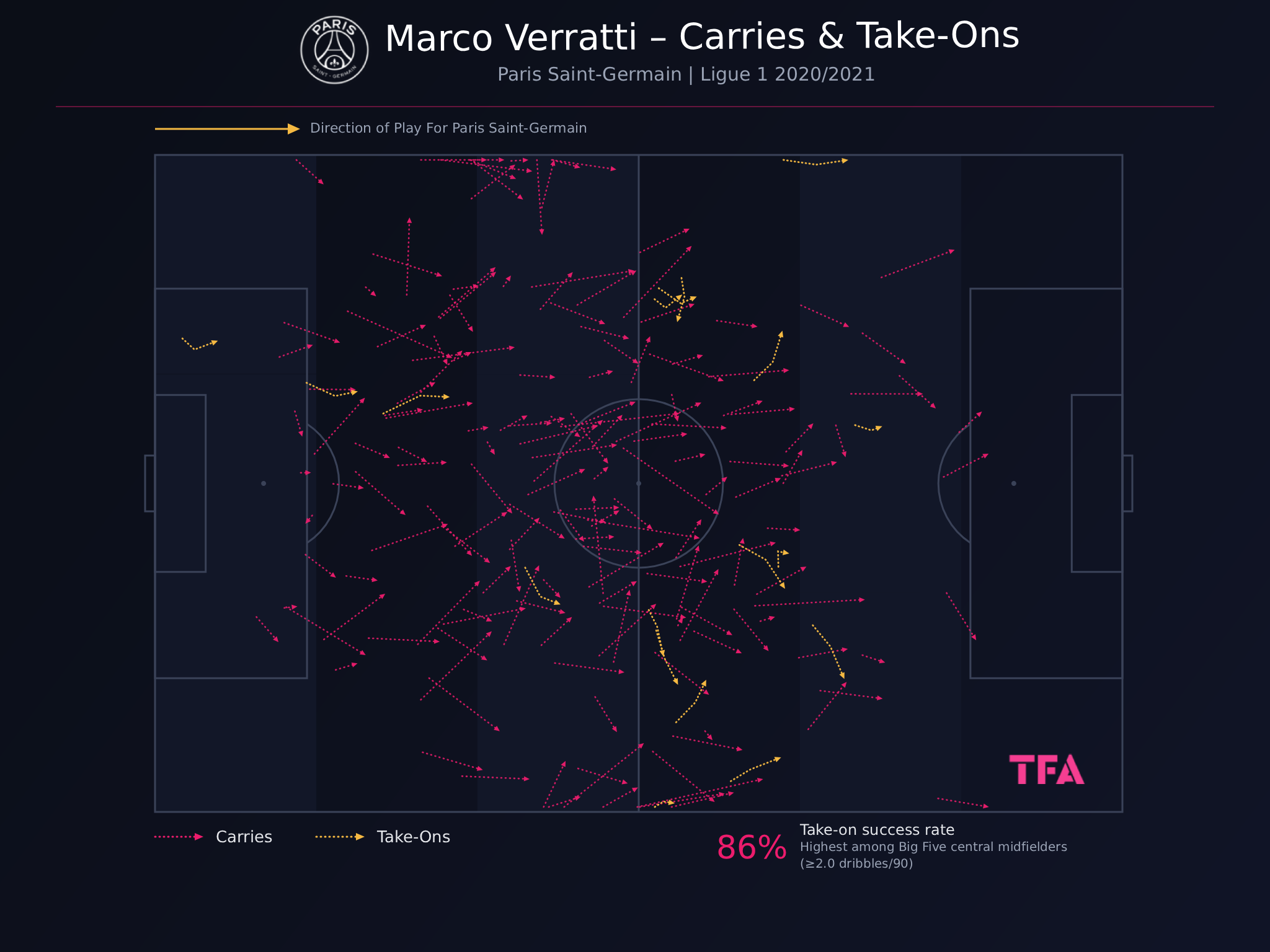
This combination of passing security and dribbling ability made him particularly effective at escaping pressure, whether by finding a teammate or carrying the ball away from it.
His 91.5% pressured-pass completion rate, alongside his ability to beat opponents in possession, shows why his relatively high rate of possession losses should not be viewed in isolation.
New Arsenal signing Bruno Guimarães and Toni Kroos follow on 89.5%, but arrive at that figure through different profiles.
Guimarães combined press resistance with physicality, scanning and ball-carrying, regularly dropping into deeper positions to provide an outlet during Olympique Lyonnais' build-up.
His 1.6 Turnovers + Dispossessions per 90 was considerably lower than Verratti's, despite operating in similarly demanding midfield areas.
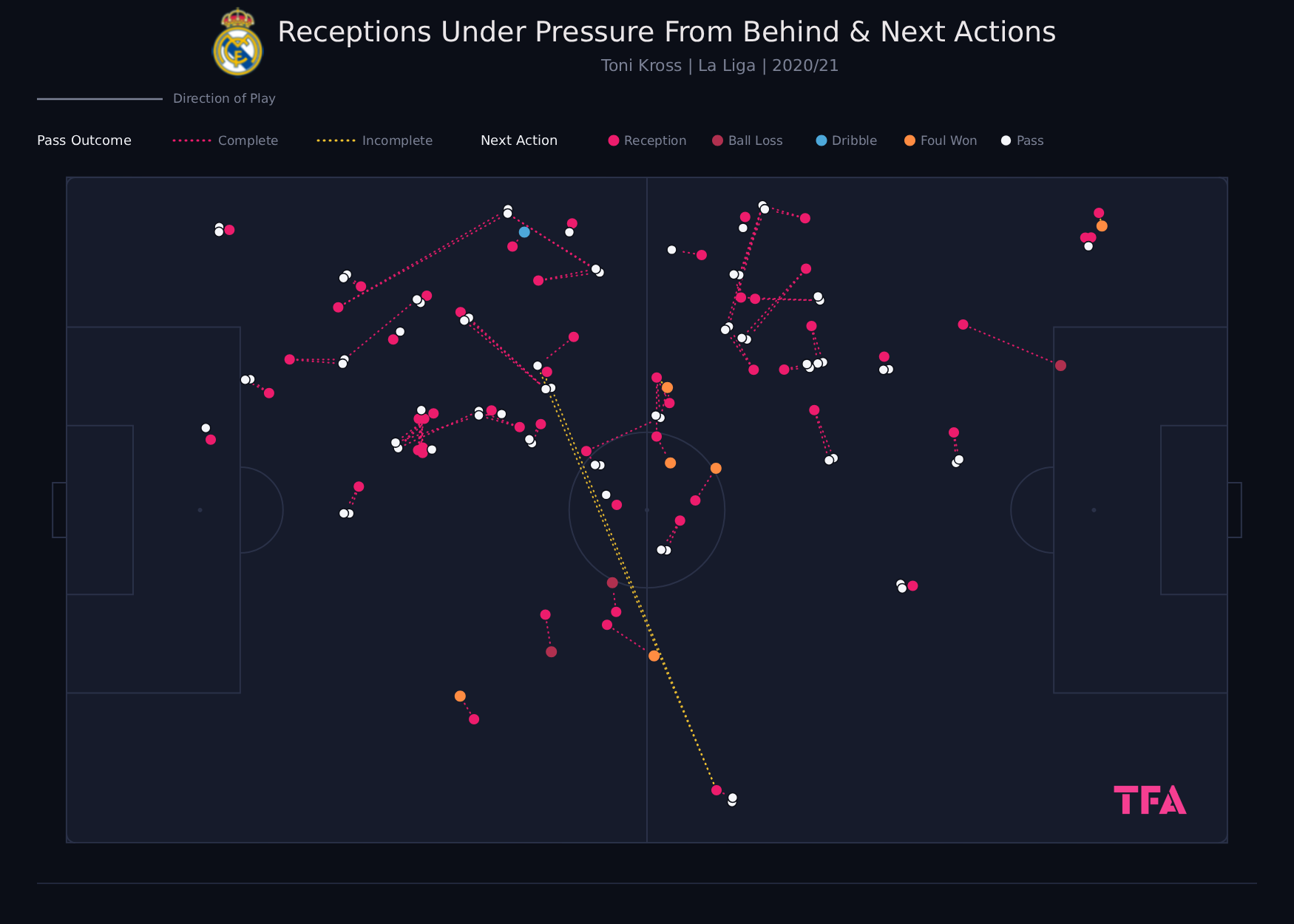
Kroos, meanwhile, recorded the same 89.5% completion rate with just 1.1 Turnovers + Dispossessions per 90, underlining the security provided by his scanning, first touch and passing range.
His ability to recognise pressure before receiving the ball became a defining feature of his game at Real Madrid.
Toni Kroos Receptions Under Pressure From Behind & Next Actions At Real Madrid 2020/2021
Fabián Ruiz (88%) and Joshua Kimmich (87%) complete the leading group.
Ruiz's combination of ball protection, first touch and changes of direction allowed him to receive behind pressure and progress Napoli's build-up.
Kimmich's 2.8 Turnovers + Dispossessions per 90 came alongside a high-pressure pass completion rate and a willingness to become an additional build-up player.
TFA's analysis has previously highlighted another key part of his press resistance: his ability to use his first touch to escape pressure and immediately create the next passing option.
In a 2020 scout report, Carl Elsik showed how Kimmich's awareness of opponents, teammates and available space allows him to make these decisions in extremely tight areas.
Kimmich can use his first touch to redirect possession away from pressure, eliminate multiple opponents and then reposition himself to receive the ball again.
This ability to turn the first touch into both an escape mechanism and a means of progressing the next action helps explain why Kimmich could continue to function as an additional build-up player despite operating in increasingly aggressive pressing environments.
The Shift Towards Verticality & Transition Football
As pressing became more aggressive and increasingly sophisticated, teams began looking for ways not only to resist pressure but to exploit the spaces created by it.
This contributed to a shift towards more vertical progression and transition-oriented football, with teams increasingly looking to move the ball forward quickly.
High pressing often requires defenders and midfielders to step higher up the pitch, creating space behind the first line of pressure and, in some cases, leaving large distances for opponents to attack when possession is regained.
This made progressive running, forward passing and ball-carrying increasingly valuable, particularly during transitions when defensive structures were temporarily disorganised.
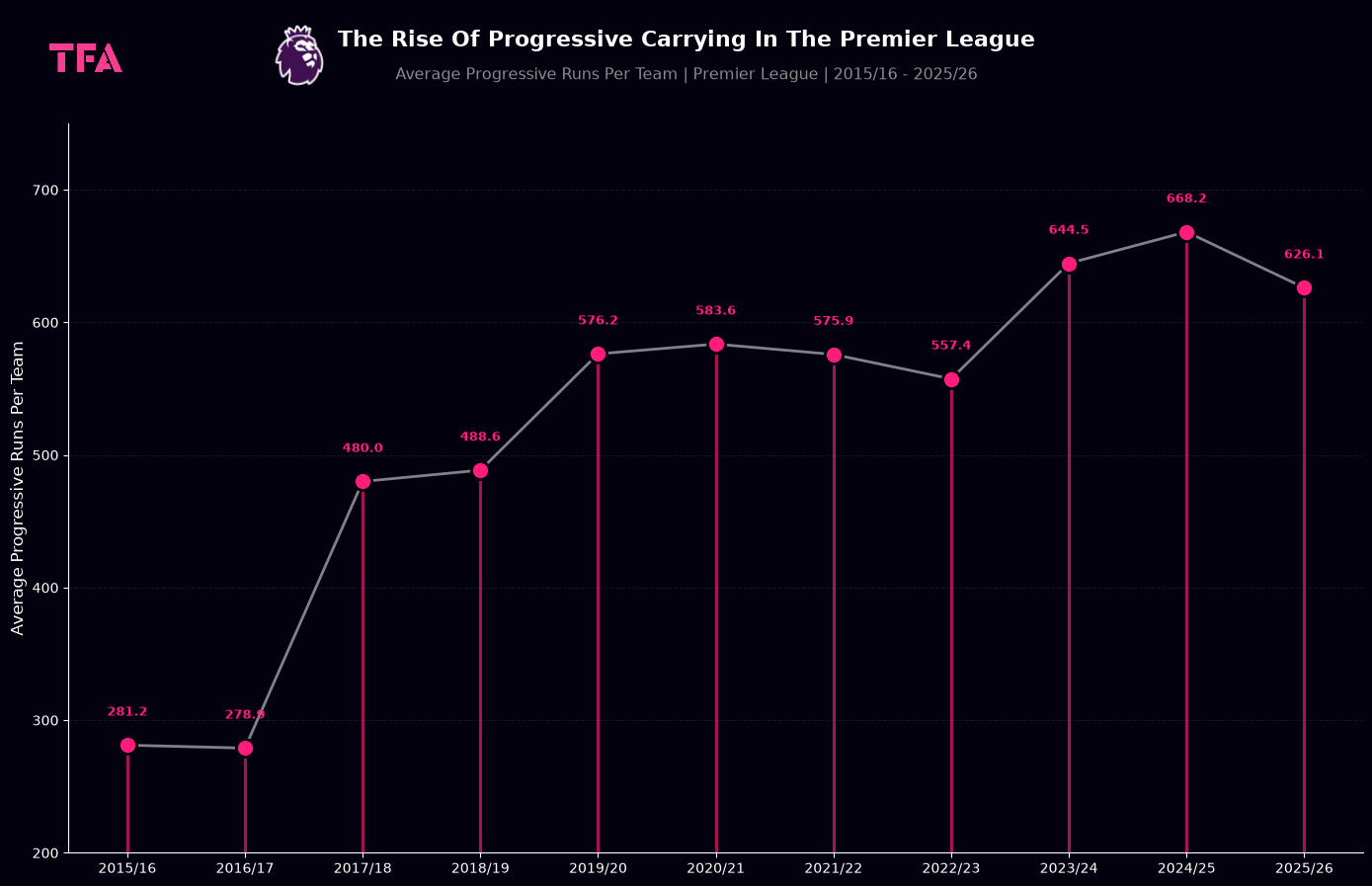
As highlighted in our first report in this series, the growth of these approaches coincided with an increase in progressive runs, while the ability to carry the ball through open space became an increasingly important method of advancing attacks.
The Rise Of Progressive Carrying In The Premier League From 2015/2016-2025/2026