Massimiliano Allegri Tactics At Napoli 2026/2027: How Will He Shape Gli Azzurri? – Tactical Analysis
Explore how Massimiliano Allegri could shape Napoli through his preferred formation, midfield balance, attacking combinations and defensive discipline, and why the squad may suit his methods.

Who Is Massimiliano Allegri?
Following a season that's ultimately one to forget for Massimiliano Allegri back at AC Milan, the 58-year-old is now about to start a new Serie A season in the south of Italy with Napoli.
Gli Azzurri announced earlier this summer that Allegri will take charge of the team in 2026/2027 following the departure of Antonio Conte.
The main objective for the new season will be to continue battling for the top spots and obviously for the title, while trying to perform better and achieve better results in the UEFA Champions League.
Last season, Napoli finished the season with a second-place finish in Serie A, but were disappointing in the UEFA Champions League as they got eliminated from the League Phase and were unable to qualify for the knockout phase.
This failure on a European level was surprising mainly because the team showed more potential compared to what was achieved.
Allegri’s mission will therefore consist of keeping Napoli very competitive on a Serie A level, while having to do much better in the UEFA Champions League.
And of course, reaching the best possible result in the Coppa Italia will be a bonus for the end of the season.
In this Napoli tactical analysis, we explore the expected formation that Allegri will be using at Napoli while assessing his principles and players he is going to rely on to better apply his ideas.
The analysis will also look at Allegri's attacking ideas and potential defensive fixes.
Massimiliano Allegri Potential Lineup & Formation At Napoli 2026/2027
Just like 13 years ago at Juventus, Allegri inherits a team that was built by Conte.
But this time, the situation and the players are completely different, as is the club.
Conte’s Napoli used to play according to the 3-4-2-1 formation, especially during the second half of the season, when things did not go well for Conte using the 4-3-3 formation during the first part of the campaign.
The change of formation helped Napoli play better football and get more positive results, as the players within the team were better-suited to play using a back-three system.
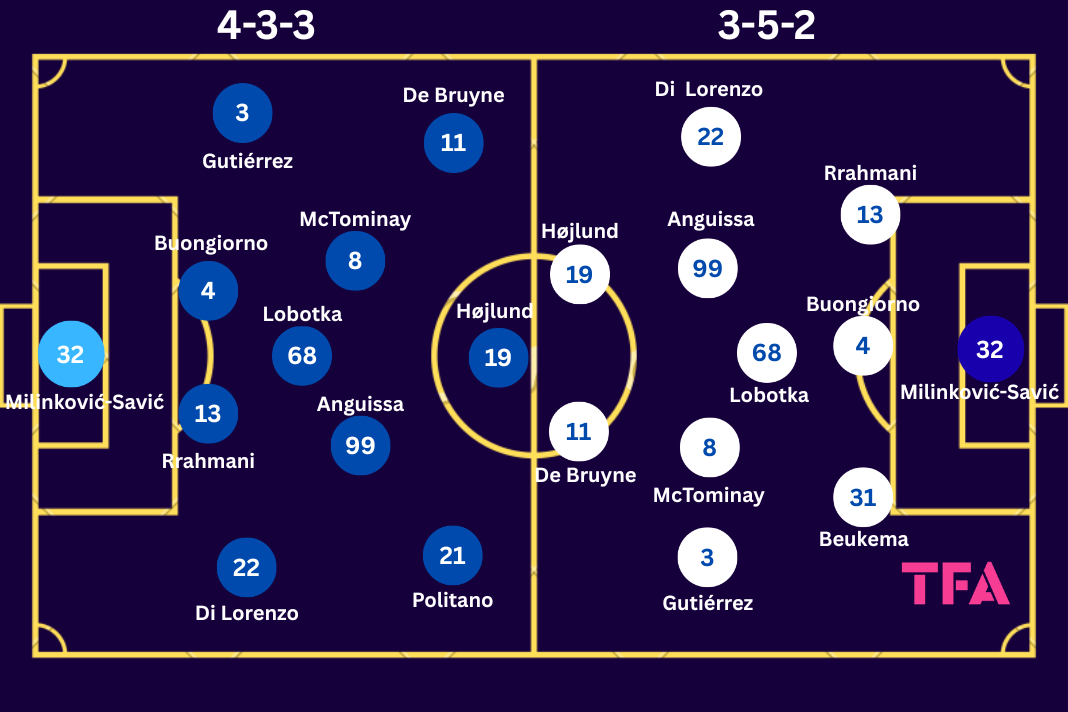
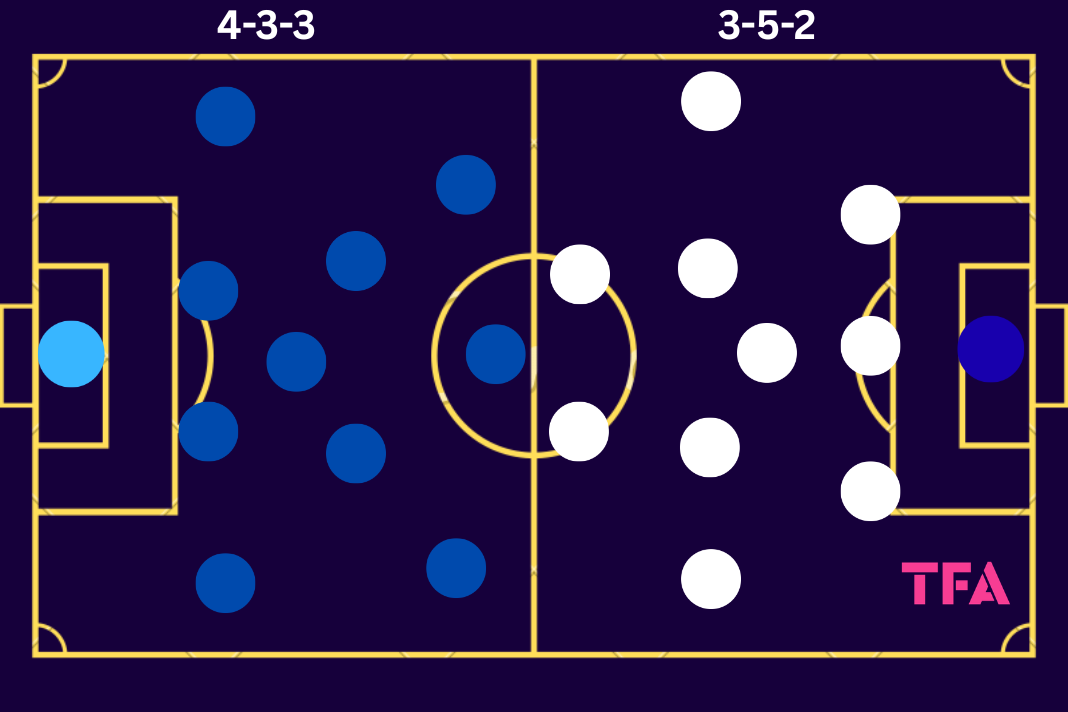
Allegri is expected to either restart with the 4-3-3 formation, which guarantees more balance and defensive compactness based on Allegri’s tactics, or switch to the 3-5-2 formation (or one of its variations), which he's preferred recently.
Allegri used that 3-5-2 formation with Milan for most of the season.
At Milan, he was inclined towards making that formation change in order to better exploit the traits of his players.
But at Napoli, the players are already used to playing both according to the 4-3-3 formation as well as according to the back-three formations.
This will help Allegri to win precious time in coaching specific tactical plans instead of trying to adapt the players to their required roles and movements within those two formations.
In fact, Allegri will more likely be working with the team more extensively on the defensive aspect and organisation in order to concede fewer goals than last season.
In attack, Allegri is known for being a head coach who relies on the creativity and the chemistry between the attacking players to get the job done.
In other words, he will try to push the attacking trio or duo and the midfielders to work a lot together and create combinations and well-timed movements without the ball so that they will make use of these attempted combinations during the games.
This also means that Allegri does not prepare specific, well-defined combinations in attack and is not obsessed with specific attacking movements/combinations.
He tries to put his players in the best possible situations and pushes them to move in the right way in order to create suitable situations for them inside the final third.
In midfield, his preferences are centred around the reliance on one defensive midfielder plus two central midfielders to ensure more balance within his formation and guarantee more regular defensive support.
This is another reason why he prefers to use the 4-3-3 formation or the 3-5-2 formation in particular.
Massimiliano Allegri Lineup Preferences At Napoli
Allegri is known for preferring technical players in attack and ones with proven and confirmed defensive traits in deeper positions.
His style of football does not require complex tactics but involves a lot of realism in both phases.
Regarding his player preferences, Allegri will more likely have the same squad that finished last season at his disposal, knowing that Napoli made some significant signings last season and are not expected to spend a lot more money during this transfer window.
For the goalkeeper position, Allegri will be relying on Vanja Milinković-Savić as the first-choice goalkeeper, with Alex Meret as a second option that has enough quality to compete seriously with Milinković-Savić for the starting position.
Should Allegri opt for a 4-3-3 formation, his defensive line will be made up of Giovanni Di Lorenzo as a right-back, with Leonardo Spinazzola as a second-choice right-back and one of the first-choice left-backs.
In fact, Spinazzola is expected to compete with Mathías Olivera and Miguel Gutiérrez for the left-back role.
For the centre-backs, Allegri will more likely prefer both Alessandro Buongiorno and Amir Rrahmani as the starting defensive duo, with Sam Beukema as the only centre-back alternative for now, following the expiry of Juan Jesus’ contract.
This means that a backup centre-back signing might be much needed for Allegri’s team, especially because the team will be playing in the UEFA Champions League this season.
In case of opting for a 3-5-2 formation, the defensive line would be made up of Alessandro Buongiorno, Amir Rrahmani, and Sam Beukema, with Di Lorenzo and one of Spinazzola, Olivera, or Gutiérrez playing as wing-backs.
In midfield, Allegri will be using Stanislav Lobotka as the defensive midfielder, just like he used Luka Modrić successfully in that role at Milan last season.
The alternative for this role will be Billy Gilmour.
For the two central midfielders, Allegri is expected to benefit from the qualities of Scott McTominay in almost the same way he used Adrien Rabiot at Milan, given that both players have similar traits and physical abilities.
Given that Allegri wants to have a powerful and very balanced midfield, it is less likely that he will deploy Kevin De Bruyne at the same time as McTominay.
Instead, he would be more inclined to rely on an all-round midfielder who guarantees more defensive support, like Frank Anguissa.
In fact, Napoli’s midfield is expected to be much more powerful in this way as it combines the physical strength of both Anguissa and McTominay with the creativity, the shooting and passing skills needed to support the attacking line in the best possible way.
This means that De Bruyne will have limited playing time both in the 4-3-3 and in the 3-5-2 formations, as Allegri’s philosophy will make it complicated for him to get the needed space to play consistently.
The only solution for him to get playing time and be used in his best possible position is to sacrifice both wingers and use him as an advanced playmaker behind two strikers, a solution that Allegri might resort to on some occasions, but not on a regular basis, since he has a lot of reliable options on the wings.
For the right-wing position, Allegri will be preferring Matteo Politano over David Neres simply because Politano is a reliable winger in attack, but one who sacrifices a lot in the defensive phase and can be extremely useful in double marking and in the pressing phase.
Using Politano on the right wing would also pave the way for Allegri to make a riskier choice on the left wing by using De Bruyne more often as the starting choice in that role on paper, while instructing him to play closer to or behind the striker during games.
Allegri might be inclined to this idea simply because he knows that De Bruyne guarantees remarkable quality in terms of passing and finishing, and can be very useful when playing near the striker.
What would facilitate such a choice is the use of a more defensive winger like Politano on the other wing, in order to make up for De Bruyne’s limited defensive input.
That said, Alisson Santos would be the Plan B traditional left-winger and could come to own that position as the season goes on.
For the striker role, Rasmus Højlund has the advantage of remaining the first-choice striker, with Giovane as the alternative.
In case of using the 3-5-2 formation, Allegri will be using an attacking duo made up of Højlund and De Bruyne as a second striker.