
![Arsenal Vs Manchester City [3-0] FA Community Shield 2026: How Did Mikel Arteta Tactics Beat Enzo Maresca Pressing Structure? – Tactical Analysis](https://cdn.mymidnight.blog/77f959f119f4fb2321e9ce801e2f5163/size/w1000/2026/08/Arsenal-Vs-Manchester-City-FA-Community-Shield.png)
Arsenal Vs Manchester City [3-0] FA Community Shield 2026: How Did Mikel Arteta Tactics Beat Enzo Maresca Pressing Structure? – Tactical Analysis
Arsenal beat Manchester City 3-0 to win the Community Shield. This tactical analysis examines Mikel Arteta’s build-up, pressing and attacking transitions, while assessing the problems Enzo Maresca’s City faced in their first competitive test of the season.

Arsenal won the FA Community Shield after defeating Manchester City 3-0 at the Principality Stadium.
The match was always going to be significant, with two Premier League title contenders facing each other in the ceremonial season curtain-raiser, but several additional storylines made this particular encounter even more intriguing.
The biggest one concerned Manchester City, as this was their first game of a new era under head coach Enzo Maresca, who takes charge following Pep Guardiola’s departure.
However, the start of this new era did not go in the Italian’s favour.
The defeat gave Maresca the joint-record for the heaviest defeat suffered by a Manchester City manager in his first game; he shares that honour with Harry Newbould from 1906.
On the other side, Arsenal enjoyed a convincing victory and lifted the trophy in style.
Their 3-0 win over Manchester City was the biggest margin of victory in a Community Shield since 2014, when the Gunners defeated City by the same scoreline.
Arsenal started the game with a clear intention to return to North London with the trophy.
Riccardo Calafiori’s goal after just 23 seconds helped them take control from the beginning.
It was the first opening-minute goal in the Community Shield since Bobby Owen scored for Manchester City against West Bromwich Albion in 1968.
From there, Mikel Arteta's side managed the game effectively before adding two more goals to secure a convincing victory.
However, beyond the scoreline and the trophy, the game provided several interesting tactical themes.
Arsenal were able to create problems for City in different phases, while their defensive organisation limited City’s ability to turn possession into consistent danger.
At the other end, Arsenal found ways to exploit space and create decisive situations.
This Arsenal vs Manchester City tactical analysis examines how both sides approached the game and determines why Arsenal managed to achieve such a convincing victory.
Arsenal Vs Manchester City Lineups & Formations
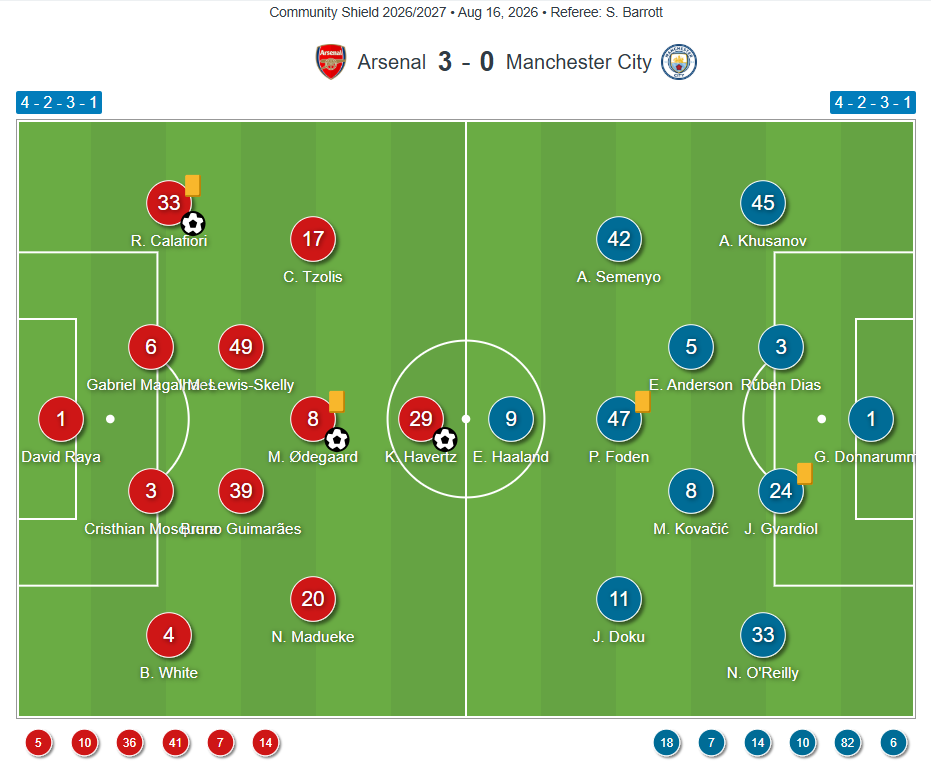
Arsenal Lineup Vs Manchester City
Arsenal lined up with a 4-2-3-1 formation.
David Raya started in goal.
Arsenal’s back four were Cristhian Mosquera and Gabriel Magalhães as right and left centre-backs, with Ben White and Riccardo Calafiori as the right and left full-backs, respectively.
Myles Lewis-Skelly and Bruno Guimarães started in central midfield, with Martin Ødegaard playing as the No. 10.
Noni Madueke was Arsenal’s right winger with Christos Tzolis on the left, and Kai Havertz up front.
Arteta made six substitutions in the match.
Declan Rice (46′) came on for Bruno Guimarães; Piero Hincapié and Bukayo Saka (60′) were introduced for Riccardo Calafiori and Noni Madueke; Viktor Gyökeres and Martín Zubimendi (75′) came on for Kai Havertz and Myles Lewis-Skelly; Eberechi Eze (84′) replaced Martin Ødegaard.
Manchester City Lineup Vs Arsenal
Manchester City lined up with a 4-2-3-1 formation too.
Gianluigi Donnarumma started in goal.
Rúben Dias was at right centre-back while Joško Gvardiol operated as the left centre-back, flanked by Abdukodir Khusanov on the right and Nico O’Reilly on the left as full-backs.
Elliot Anderson and Mateo Kovačić started as the two No. 6s, with Phil Foden playing as a No. 10.
Antoine Semenyo and Jérémy Doku started as the right and left wingers, with Erling Haaland as the striker.
Maresca also made six substitutions in the match.
Jack Grealish (46′) came on for Jérémy Doku; Omar Marmoush (53′) was introduced for Erling Haaland; Marc Guéhi (54′) replaced Nico O’Reilly; Rico Lewis (60′) came on for Elliot Anderson; Rayan Cherki (60′) took over from Phil Foden; Nico González (60′) came on for Mateo Kovačić.
Arsenal Build-Up Tactics Vs Manchester City
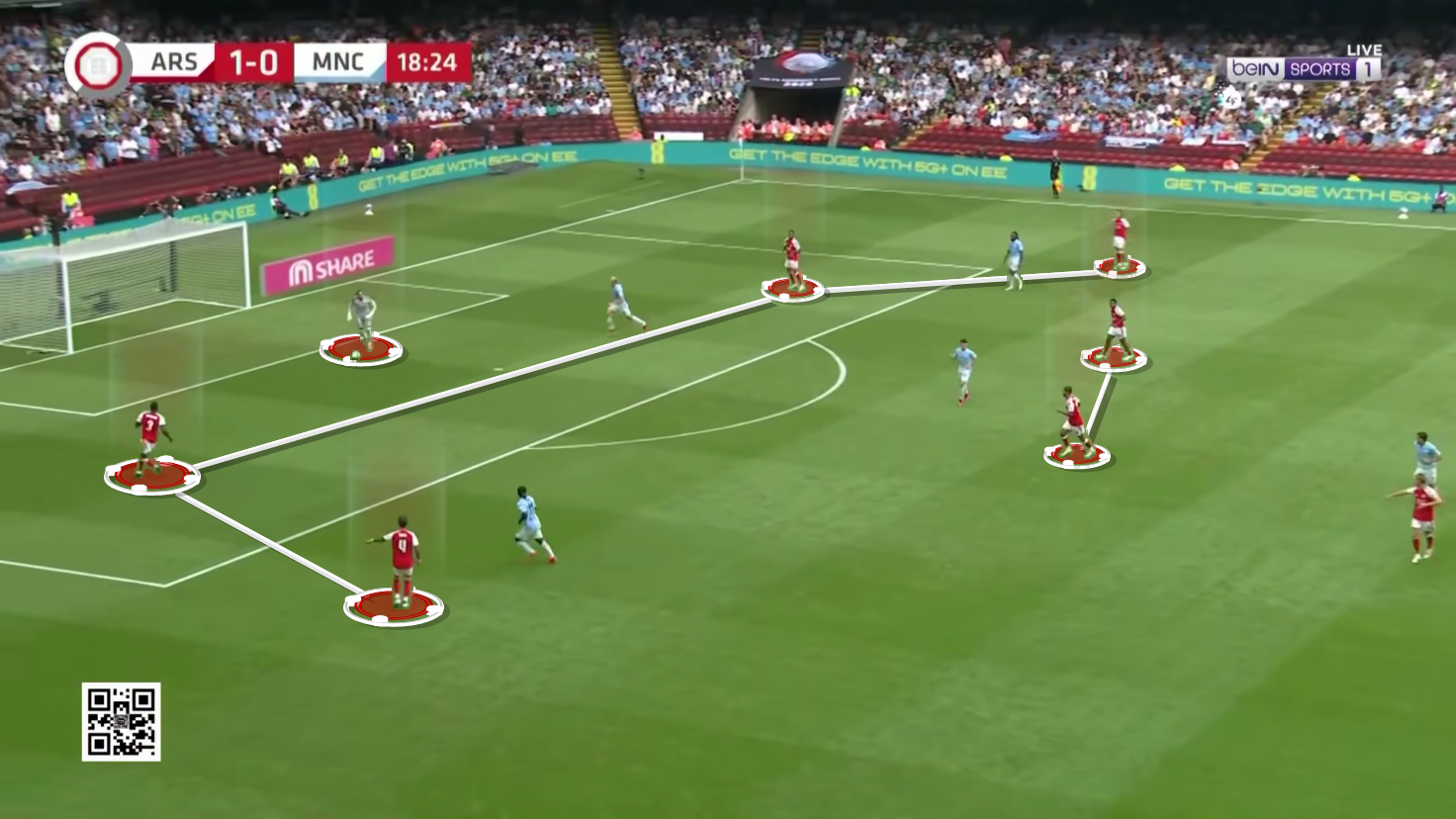
Arsenal’s build-up shape is mainly a 4-2 structure, with Riccardo Calafiori, Gabriel Magalhães, Cristhian Mosquera, and Ben White forming the back four, with goalkeeper Raya behind them and Myles Lewis-Skelly and Bruno Guimarães operating as the two midfielders ahead of the defence.
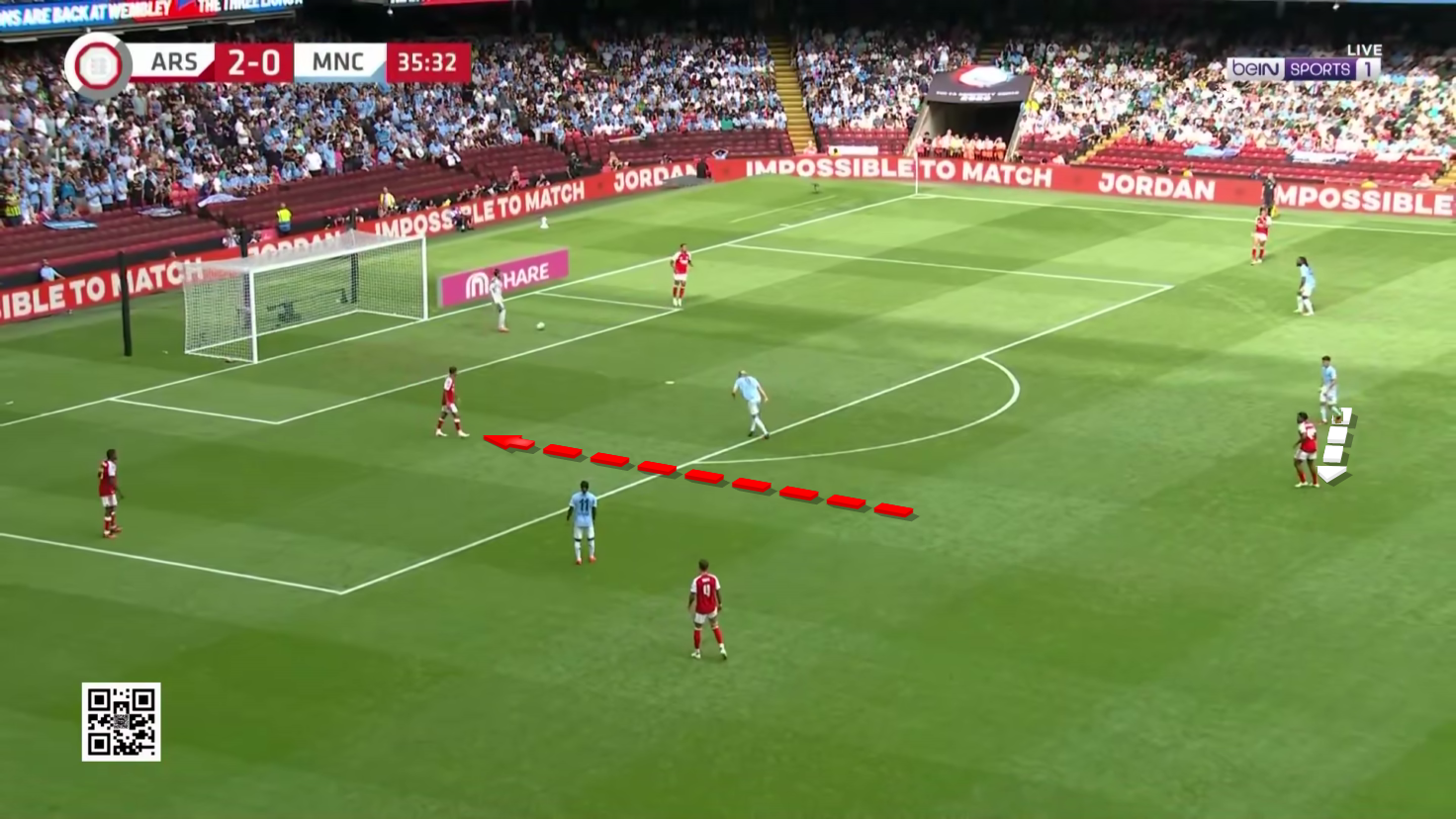
From goal kicks, Arsenal make a small adjustment to their shape to manipulate Manchester City’s high-pressing structure.
Bruno Guimarães drops deep into the box, while Myles Lewis-Skelly moves into a more central position.
As a result, Phil Foden follows Lewis-Skelly and is pulled away from his previous position.
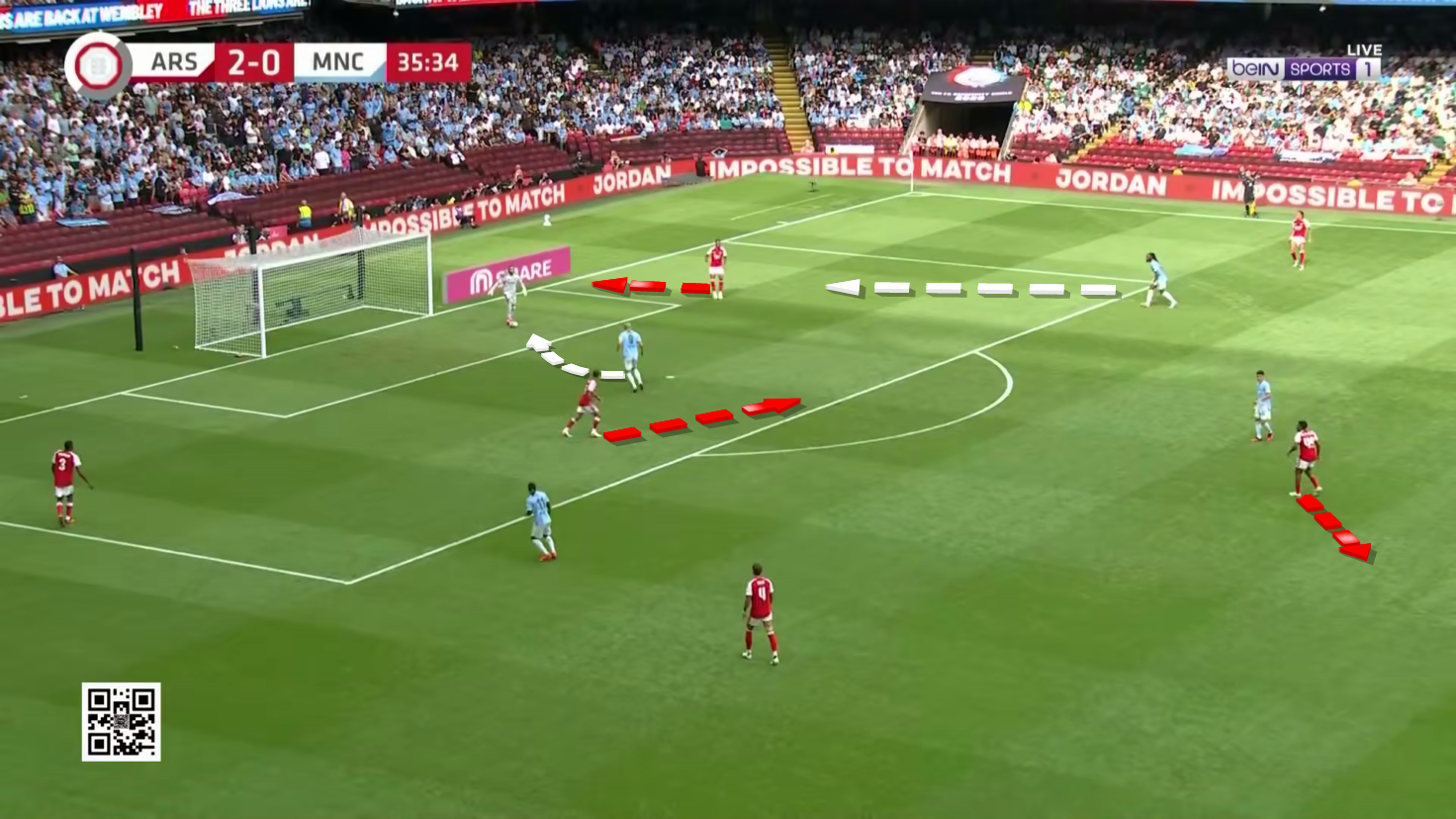
Gabriel Magalhães passes the ball to Raya, with the goalkeeper inviting Erling Haaland to press him.
At the same time, Gabriel drops slightly deeper to attract Antoine Semenyo’s pressure.
Combined with Lewis-Skelly’s movement, this creates space for Bruno Guimarães to move into and receive.
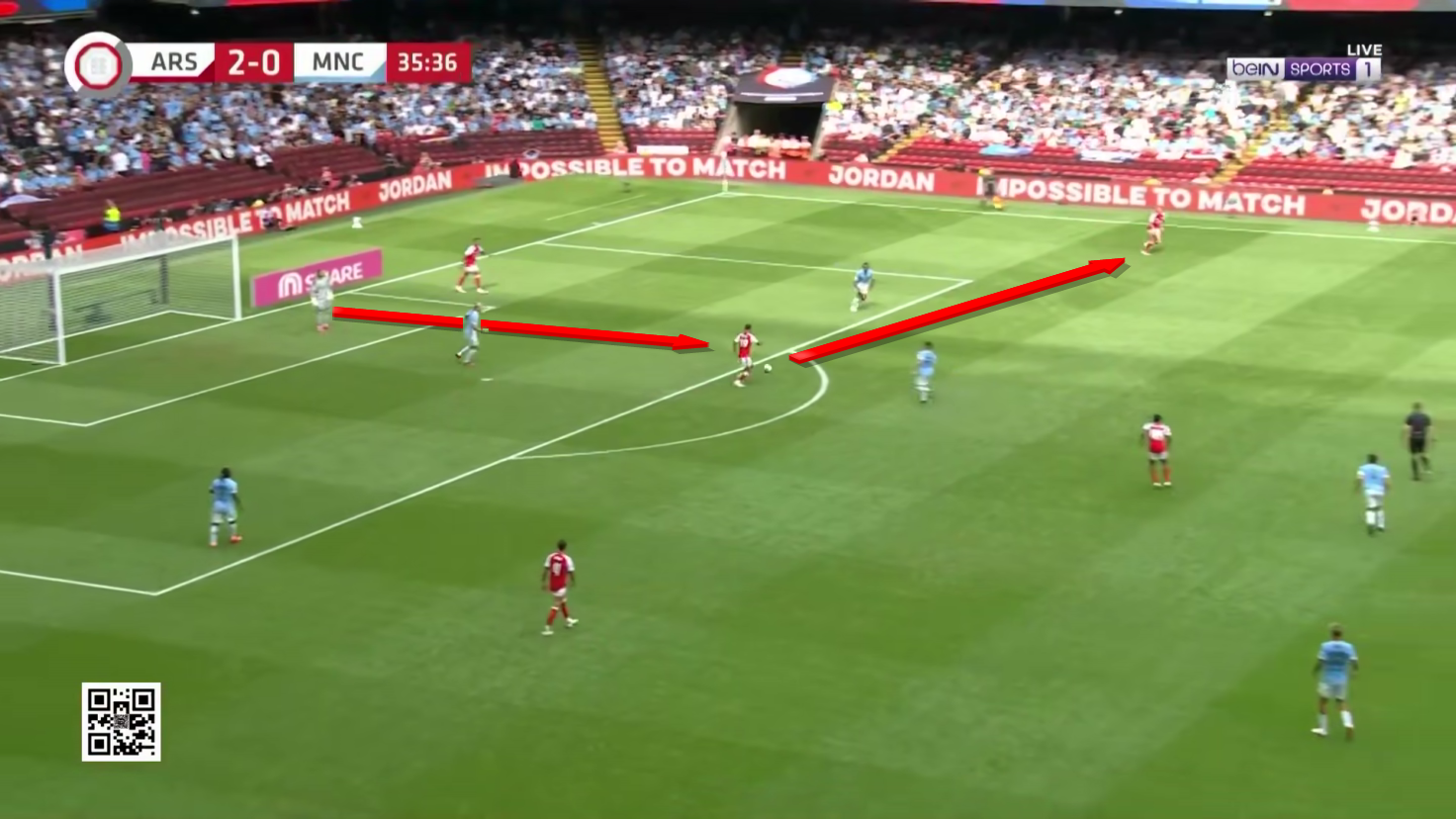
The passing lane is now open, allowing Raya to find Bruno with a pass.
Bruno then tries to find Riccardo Calafiori from behind Semenyo, who has pushed forward to press Gabriel.
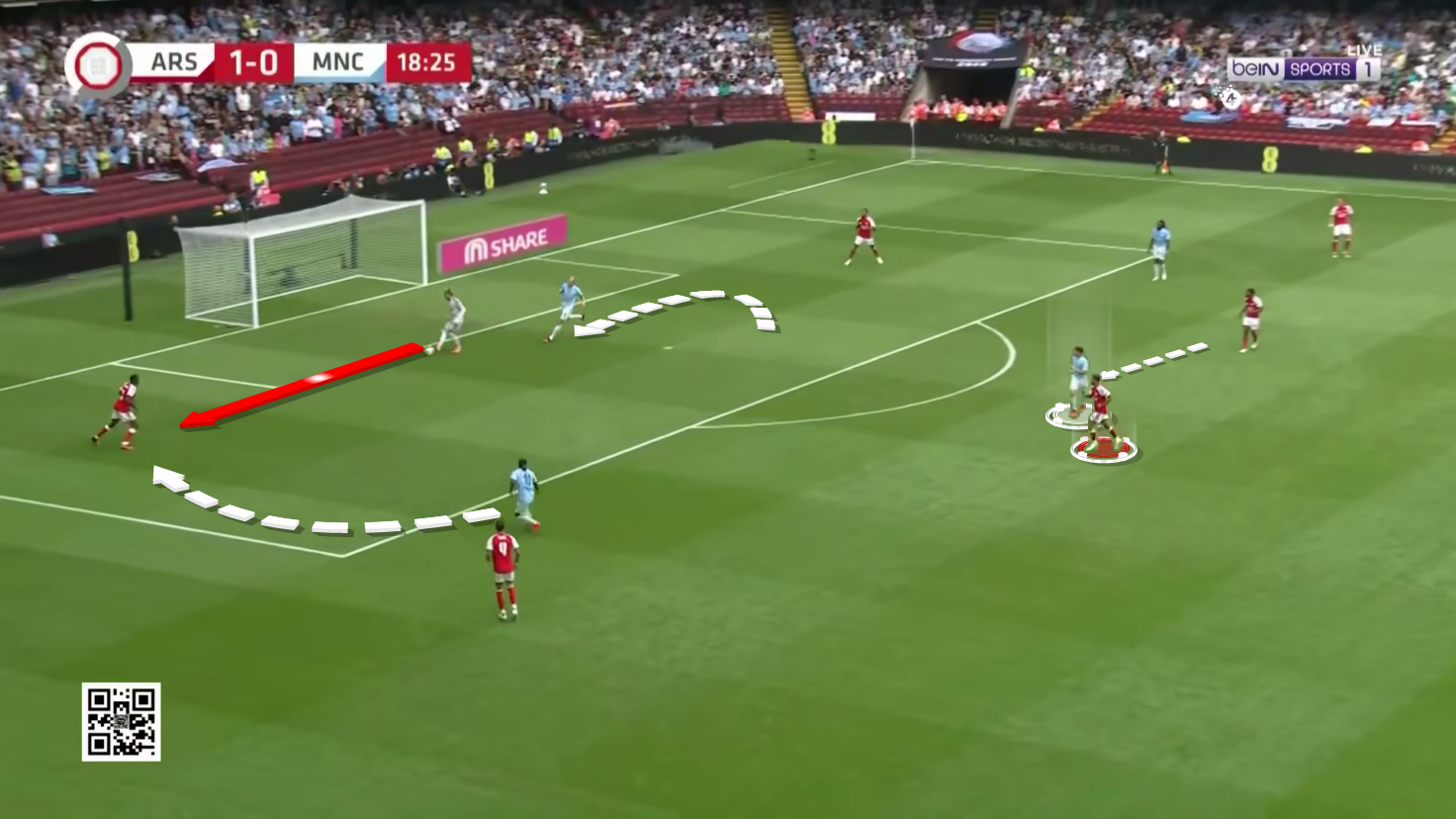
In open play, Arsenal rely on their two No. 6s operating at the same height.
Here, Bruno Guimarães starts alongside Myles Lewis-Skelly, with both positioned on the same line.
As a result, Phil Foden is responsible for marking both midfielders, adjusting his position according to the direction of the ball.
With the ball moving towards Arsenal’s right side, he moves closer to Bruno.
Meanwhile, Haaland uses a curved run to press Raya and direct the pressure towards Arsenal’s right side, allowing Cristhian Mosquera to receive the goalkeeper’s pass.
Doku waits until the ball reaches Mosquera before pressing him, while also curving his run to close the passing lane towards Arsenal’s right-back, Ben White.
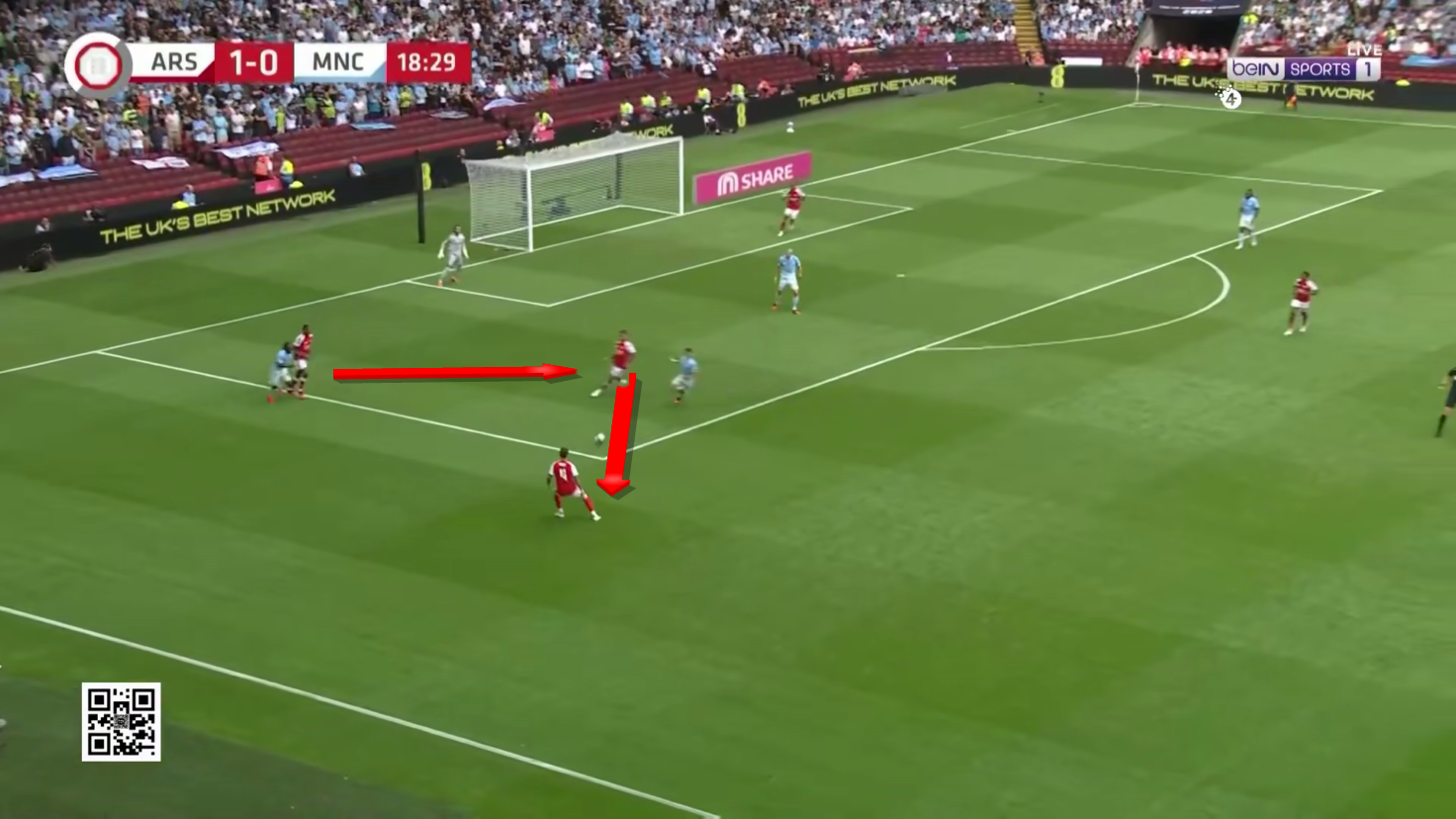
Bruno Guimarães recognises the situation and moves closer to Mosquera, exploiting the passing lane opened by Haaland and Doku’s pressing runs.
With Foden positioned between Bruno and Lewis-Skelly, Bruno uses the situation to make a wall pass, allowing Mosquera to find Ben White, who is now free.
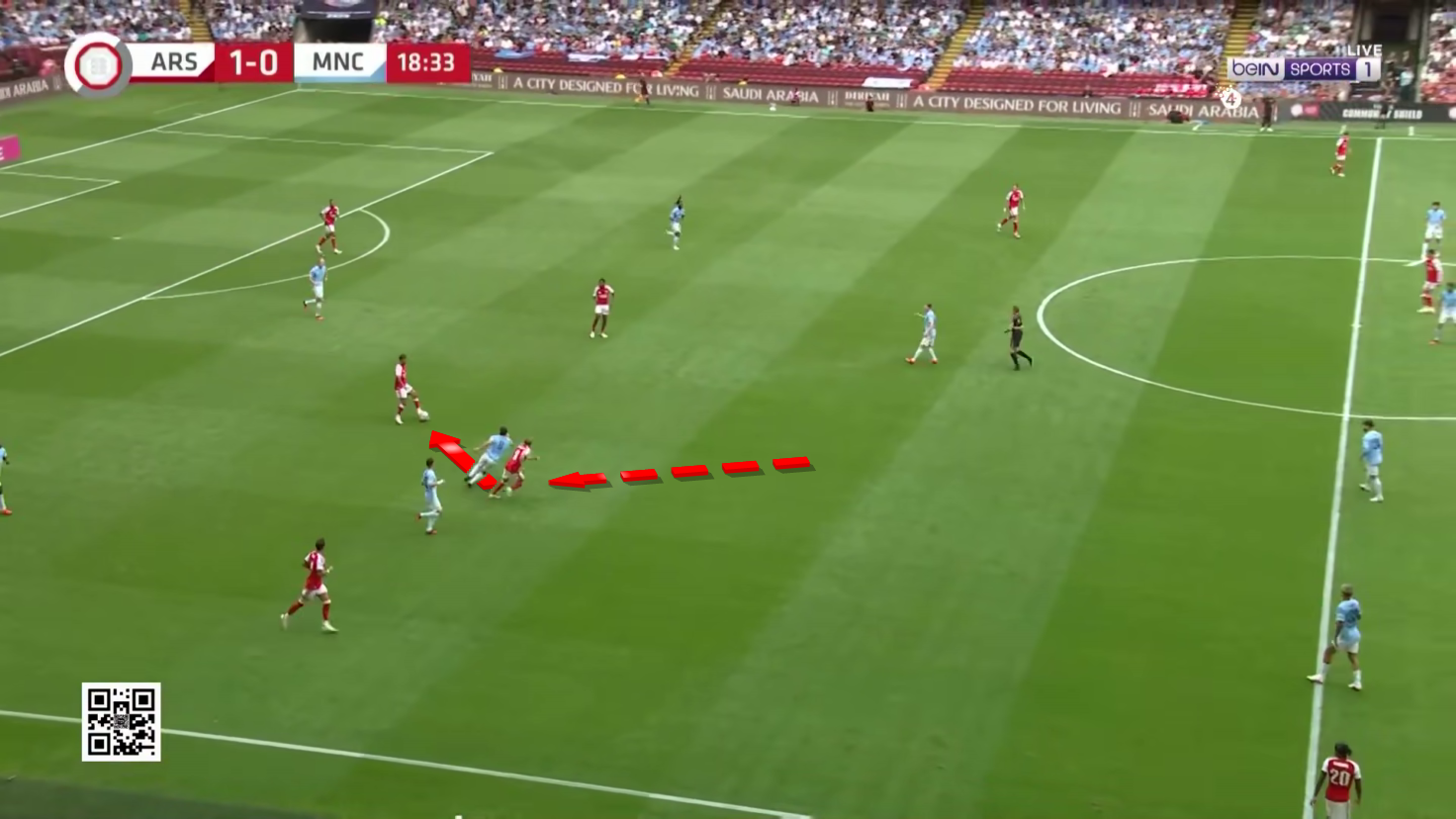
Martin Ødegaard drops to support Ben White and offer another passing option.
He then uses a wall pass to return the ball to Bruno Guimarães, who is now free and receives facing forward.
This allows Arsenal to escape Manchester City’s high press.
How Did Arsenal Break Down Manchester City’s Adjusted High Press?
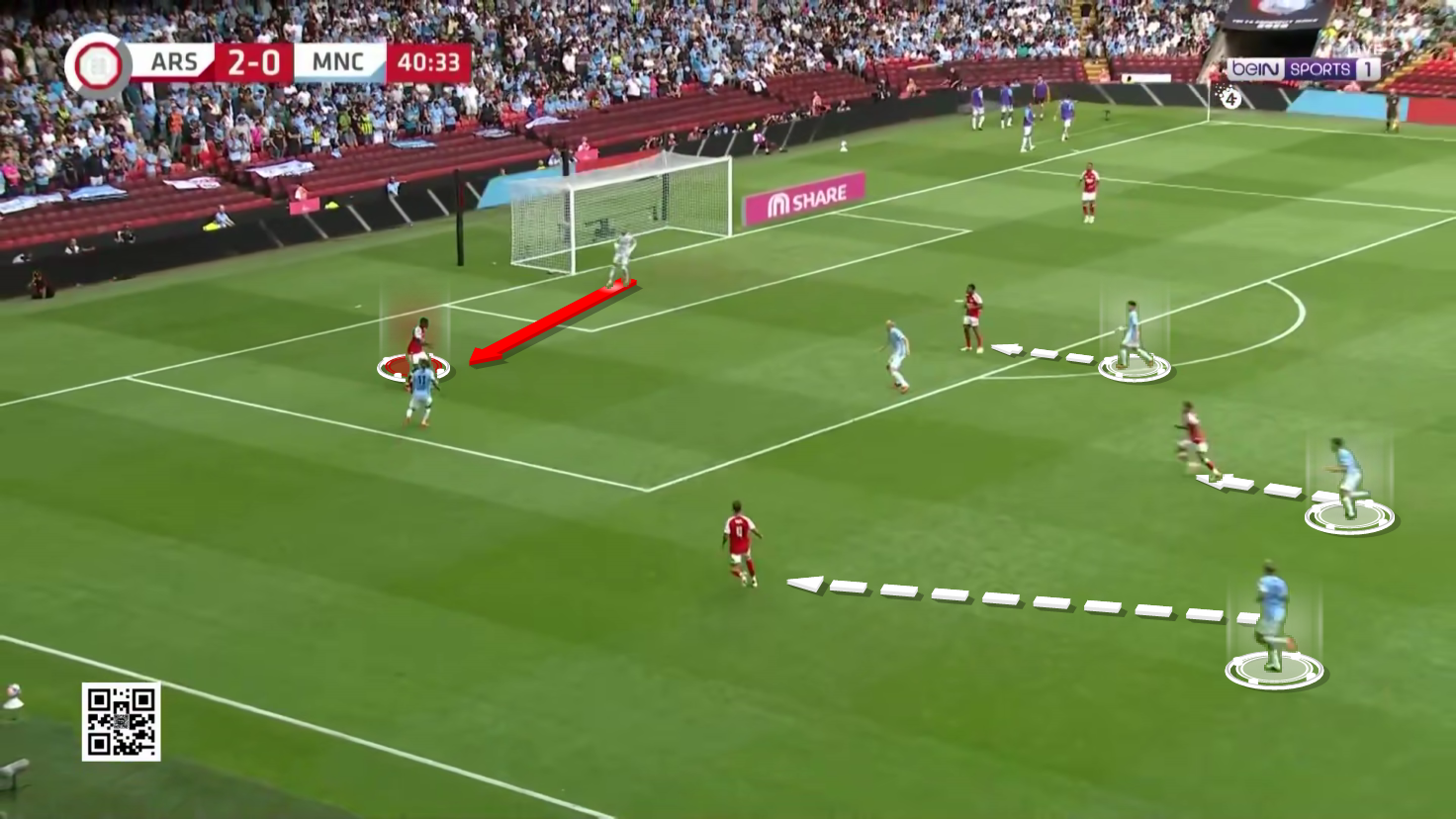
Manchester City tried to find a solution to their defensive high-pressing structure.
Doku maintains his role, curving his run to shadow Ben White while pressing Mosquera after he receives Raya’s pass.
However, Foden now focuses only on Lewis-Skelly, while Mateo Kovačić jumps forward to pick up Bruno Guimarães.
At the same time, left-back Nico O’Reilly pushes forward to mark Ben White.
In this way, Manchester City try to shut down Arsenal’s initial structure and prevent Bruno from receiving the first wall pass.
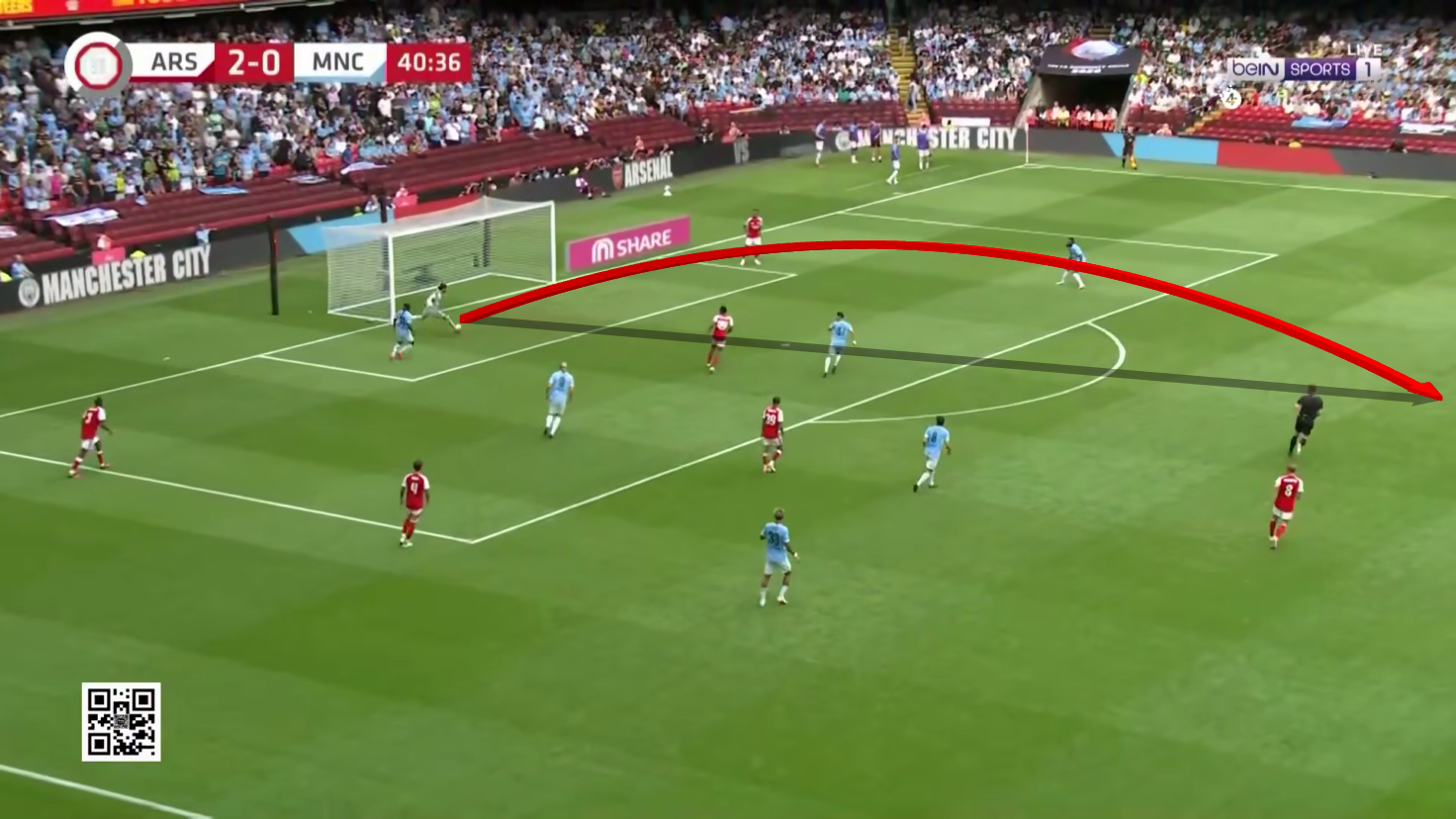
Under significant pressure and with no available passing options, Cristhian Mosquera plays the ball back to David Raya, who is forced to go long.
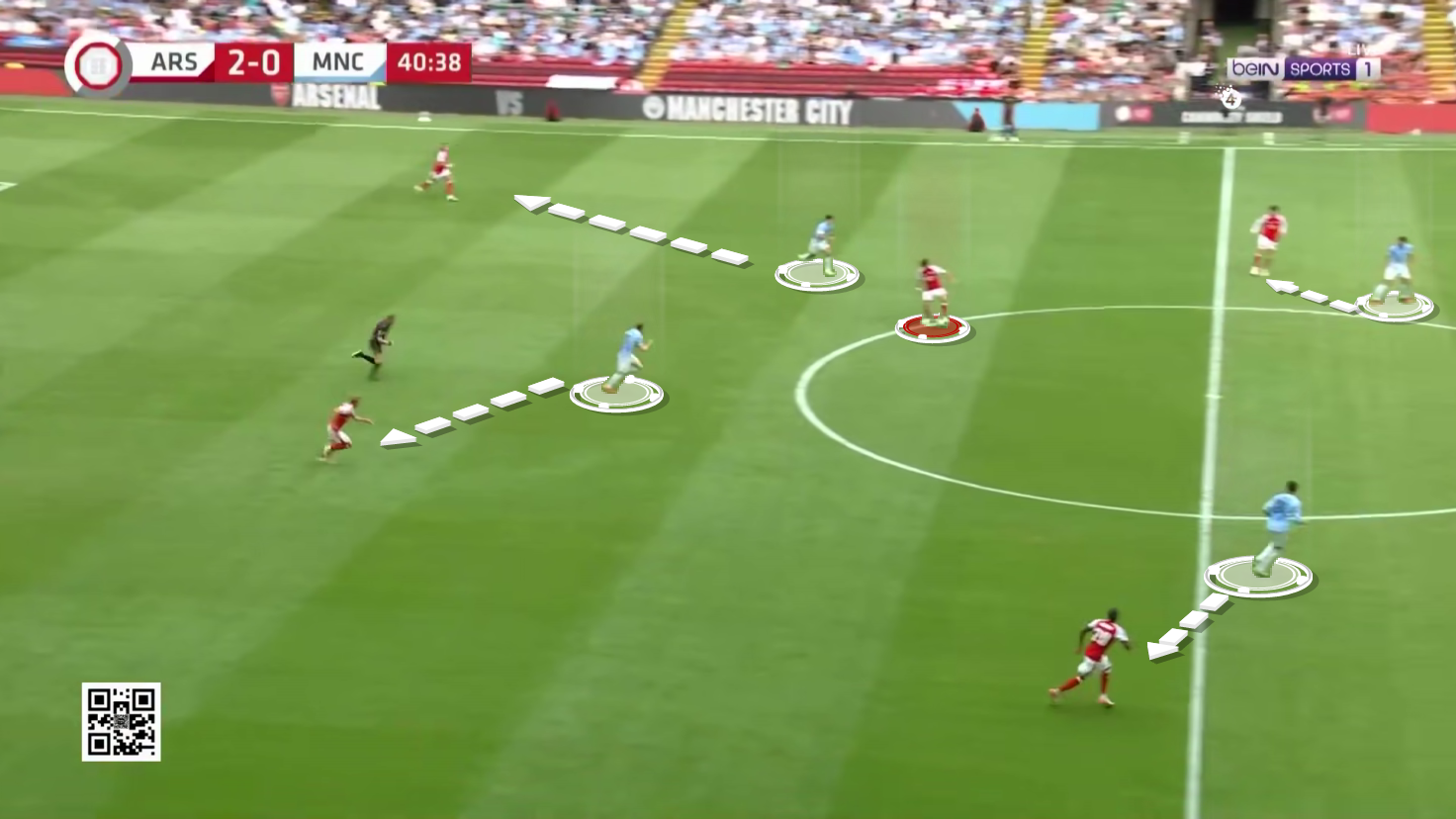
At first glance, it might appear that Raya simply clears the ball away from his own box to avoid losing possession in a dangerous area.
However, the destination of the ball tells a different story.
Raya picks out a good long pass towards left winger Christos Tzolis, who has moved centrally to attack the free space created by Abdukodir Khusanov and Elliot Anderson pushing forward to mark Riccardo Calafiori and Martin Ødegaard.
At the same time, Manchester City’s two centre-backs, Joško Gvardiol and Rúben Dias, are occupied by Noni Madueke and Kai Havertz.
This allows Arsenal to find the free player within Manchester City’s adjusted high-pressing structure.
How Did Arsenal Use Attacking Transitions as a Dangerous Weapon Against Man City?
One of Arsenal’s strongest weapons against Manchester City was their ability to create dangerous attacking transitions that quickly put the Cityzens’ goal under threat.
Their approach was to find the free winger in a wide position, allowing him to carry the ball forward and attack the Manchester City full-back 1v1, supported by an underlapping run from the full-back, as Ben White produces here.

![Scotland Vs Switzerland [0-3] UEFA Nations League 2026/2027: How Aggressive Pressing Backfired & Murat Yakin Took Advantage - Tactical Analysis](https://cdn.mymidnight.blog/77f959f119f4fb2321e9ce801e2f5163/size/w600/2026/10/Scotland-Vs-Switzerland-20262027---Tactical-Analysis.png)
![Olympique De Marseille Vs PSG [1-2] Ligue 1 2026/2027: How Bruno Génésio Transitions Troubled PSG - Tactical Analysis](https://cdn.mymidnight.blog/77f959f119f4fb2321e9ce801e2f5163/size/w600/2026/09/Marseille-Vs-PSG-2026_2027---Tactical-Analysis.png)
![Fulham Vs Manchester United [1-1] Premier League 2026/2027: How Álvaro Arbeloa Tactics Exposed The Red Devils' Problems - Tactical Analysis](https://cdn.mymidnight.blog/77f959f119f4fb2321e9ce801e2f5163/size/w600/2026/09/Fulham-FC-Vs-Man-United-2026_2027---Tactical-Analysis.png)
![AS Roma Vs Inter Milan [2-2] Serie A 2026/2027: When Undefeated Giallorossi Attack Met Nerazzurri Comeback Resilience - Tactical Analysis](https://cdn.mymidnight.blog/77f959f119f4fb2321e9ce801e2f5163/size/w600/2026/09/AS-Roma-Vs-Inter-Milan-2026_2027---Tactical-Analysis.png)
![Real Sociedad Vs Bournemouth [1-2] Europa League 2026/2027: How Do Marco Rose Pressing Tactics Work? - Tactical Analysis](https://cdn.mymidnight.blog/77f959f119f4fb2321e9ce801e2f5163/size/w600/2026/09/Real-Sociedad-Vs-Bournemouth-20262027---Tactical-Analysis-1.png)
![AC Milan Vs Benfica [0-2] Europa League 2026/2027: How Marco Silva Tactics Exposed Rúben Amorim Defensive Problems - Tactical Analysis](https://cdn.mymidnight.blog/77f959f119f4fb2321e9ce801e2f5163/size/w600/2026/09/AC-Milan-Vs-Benfica-20262027---Tactical-Analysis.png)
![Sunderland Vs AZ Alkmaar [1-0] Europa League 2026/2027: Why The Black Cats Make Better Underdogs - Tactical Analysis](https://cdn.mymidnight.blog/77f959f119f4fb2321e9ce801e2f5163/size/w600/2026/09/Sunderland-Vs-AZ-Alkmaar-20262027---Tactical-Analysis.png)