How Did Maurizio Sarri's Napoli, Pep Guardiola's Manchester City, Jürgen Klopp's Liverpool & Mikel Arteta's Arsenal Shape Modern Football? - Data Analysis
From Sarri’s Napoli to Guardiola’s Manchester City, Part Two of our evolution series traces how positional play, pressing and evolving build-up structures reshaped modern football between 2016 and 2026.

Football rarely changes overnight.
Tactical evolution is generally the result of gradual adjustments, with new ideas emerging and spreading across different leagues before eventually becoming part of the game's tactical landscape.
Our most recent data analysis at Tactical Football Analysis showed that modern football has undeniably changed.
The next question, then, is arguably even more important: when did these changes become visible, and what drove them?
In this data analysis, we will trace the timeline behind football's tactical evolution, identifying the seasons in which key shifts began to accelerate and examining the tactical, statistical, and strategic factors that shaped them.
By comparing different eras, competitions, and influential teams, we aim to explain not only what changed but also why modern football developed in the direction it has today.
2016-2018: The Era Of Positional Control
The opening years of our timeline represent the peak of positional play as one of football’s dominant tactical ideas.
Coaches increasingly used it to control space, manipulate defensive structures and create passing options between the lines.
Two teams provide particularly strong examples of this approach: Maurizio Sarri’s Napoli in Serie A and Pep Guardiola’s Manchester City in the Premier League.
Both sides were built around positional occupation, short combinations and constant movement, but expressed these principles in slightly different ways.
Napoli’s ability to find players between defensive lines provides a clear statistical example of this philosophy, while City demonstrated how positional control could be translated into overwhelming territorial and possession dominance.
Maurizio Sarri Tactics At Napoli: Finding Space Between The Lines
Maurizio Sarri’s Napoli were arguably one of the clearest expressions of positional play during this period.
Their 4-3-3 was based on maintaining positional relationships across the pitch, with the centre-backs spreading during build-up, the full-backs advancing, and the midfield providing passing angles underneath and between opposition lines.
Napoli repeatedly moved the ball until a gap appeared, allowing players such as Jorginho, Marek Hamšík, Lorenzo Insigne and Dries Mertens to combine in advanced areas.
The data further highlights how heavily Napoli relied on positional attacks, averaging 38.44 per match in 2017/2018 compared with just 2.56 counterattacks.
Our passing data reinforces this picture: Napoli recorded 595 through passes in 2015/2016, compared with a Serie A average of 340, giving them almost 75% more than the league average.
Two seasons later, they remained comfortably ahead, producing 543 through passes against a league average of 310.
Napoli Led Serie A In Through Passes Between The Lines 2015/2016 & 2017/2018
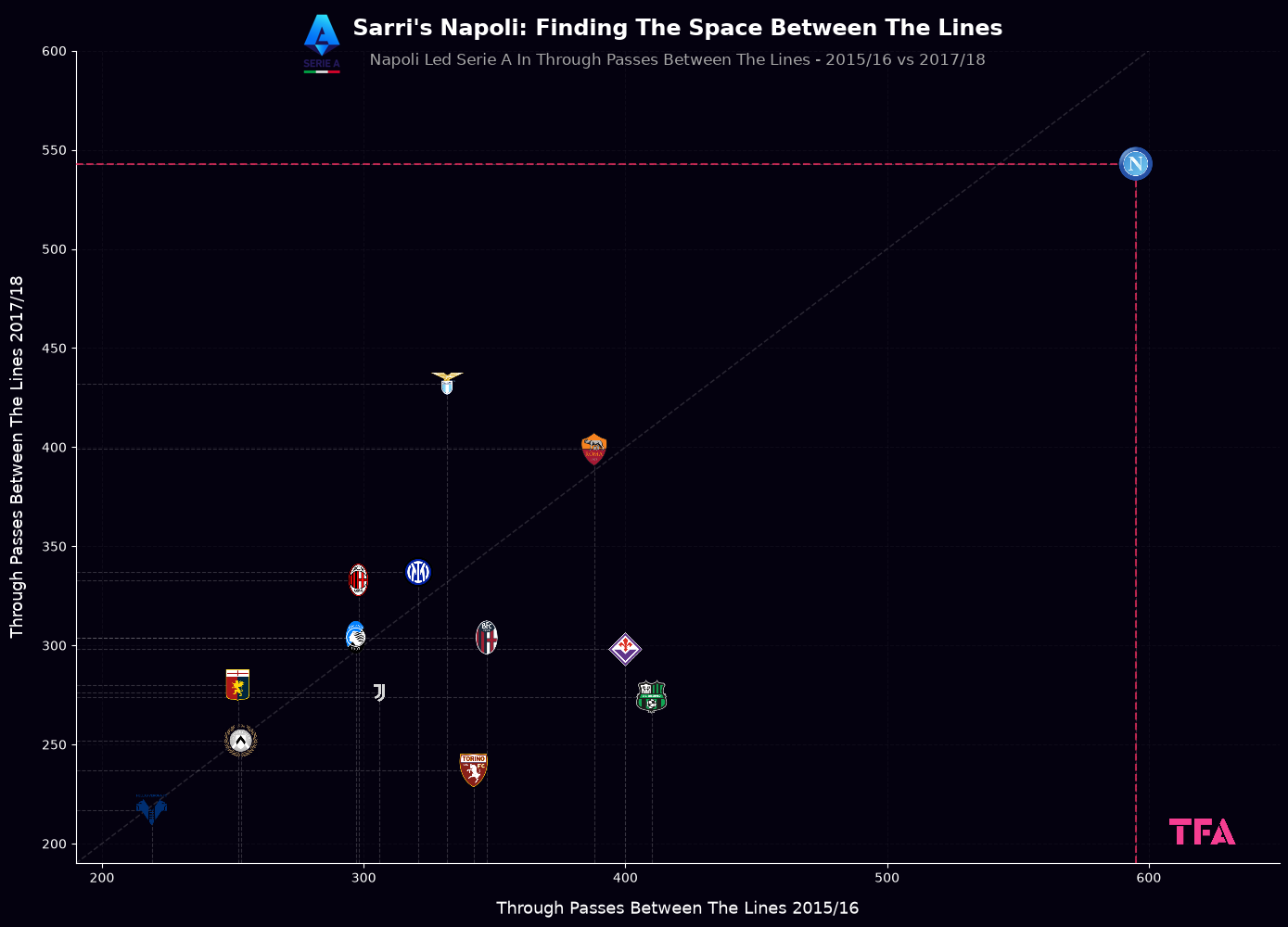
Napoli were the league’s leading side in both seasons, suggesting that their positional structure wasn't simply about circulating possession, but about repeatedly finding routes through or behind defensive lines.
This ability to connect players between the lines became one of the clearest statistical fingerprints of Sarri’s football.
Pep Guardiola Tactics At Manchester City: Possession As A Form Of Control
If Sarri’s Napoli demonstrated how positional play could create passing routes through defensive lines, Pep Guardiola’s Manchester City showed how the same principles could be scaled into a system capable of controlling entire matches.
Guardiola arrived at City in 2016, but it was during the 2017/2018 campaign that his ideas reached their first full expression in England.
City combined extreme possession, positional discipline and constant occupation of the width and half-spaces, creating a structure in which the ball could be circulated until an opening appeared.
The result was a side that finished the 2017/2018 Premier League season with 100 points, while averaging around 72% possession.
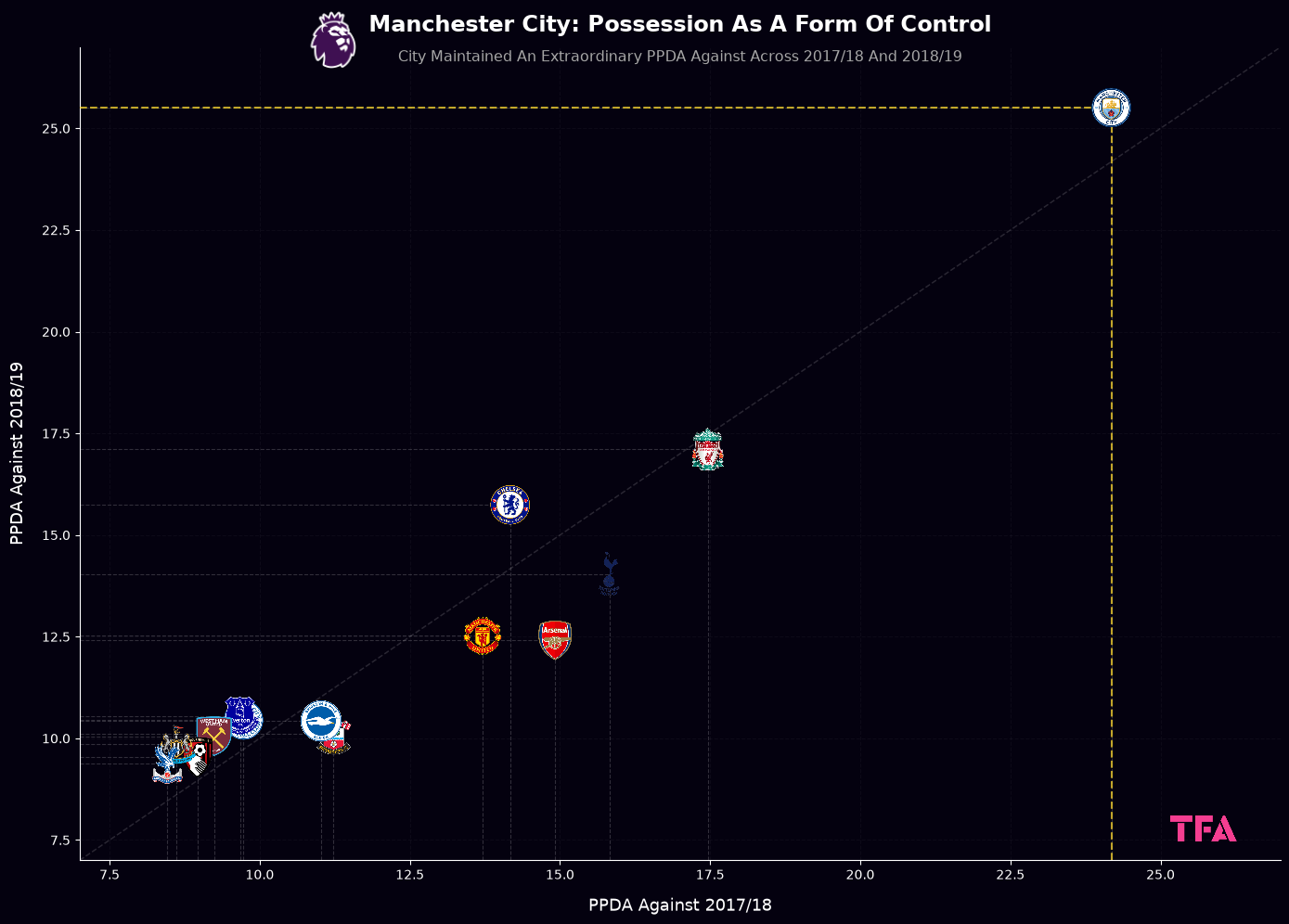
Our PPDA Against data provides another way of illustrating this control.
Unlike conventional PPDA, which measures how many passes a team allows its opponent before making a defensive action, PPDA Against looks at the same interaction from the other side: how many passes a team is able to complete before the opposition makes a defensive intervention.
A higher figure, therefore, indicates that the team in possession was able to circulate the ball for longer before being disrupted.
Man City Maintained An Extraordinary PPDA Against Across 2017/2018 & 2018/2019