Olivier Pantaloni Tactics At Lorient 2025/2026: The Structure Behind Lorient’s Successful Ligue 1 Return – Tactical Analysis

Who Is Olivier Pantaloni?
In June 2024, Olivier Pantaloni began a new chapter when he was appointed head coach of Lorient, following the club’s relegation from Ligue 1.
His impact was immediate.
During the 2024/2025 season, he guided Lorient to the Ligue 2 title, securing promotion back to Ligue 1.
He was also awarded Ligue 2 Manager of the Year, further confirming his reputation as one of the most effective promotion specialists in French football.
During the 2025/2026 season, FC Lorient have experienced a relatively balanced campaign in domestic competitions.
In Coupe de France, Lorient reached the quarter-finals, demonstrating a competitive run in the national cup.
In the league, Lorient have shown mixed but generally stable results.
At the time of writing, the team occupies ninth place in the Ligue 1 standings with 41 points.
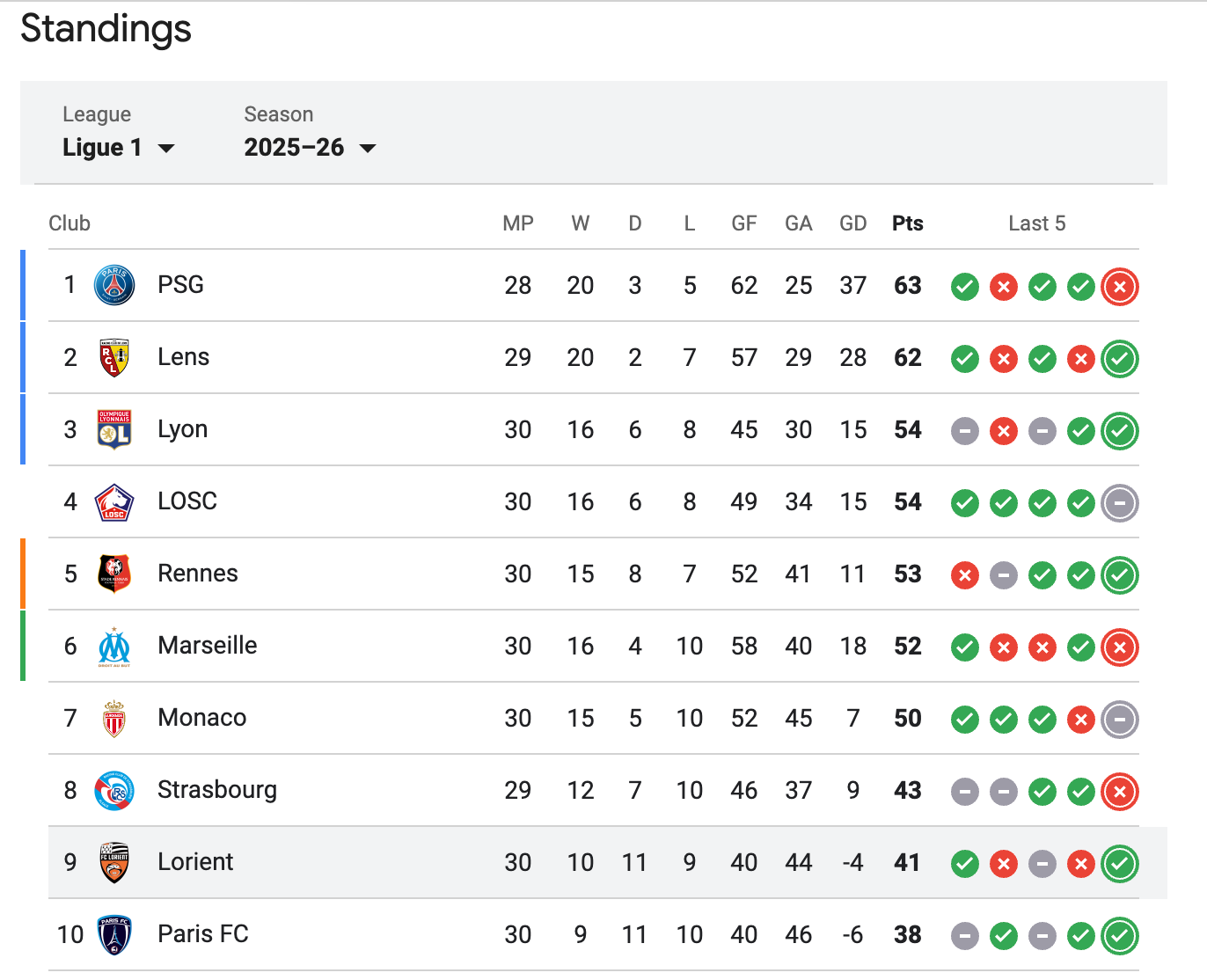
From an attacking perspective, Lorient have scored 37 goals, indicating a reasonable offensive output for a mid-table side.
However, the team has faced more difficulties defensively, and their record suggests that while they have been capable of competing and scoring goals, maintaining defensive solidity has remained a challenge.
Overall, Lorient’s mid-table position reflects a solid adaptation to Ligue 1, combining competitive performances with areas that still require improvement, particularly in defensive consistency.
This Olivier Pantaloni head coach analysis and Lorient tactical analysis examines Pantaloni's tactics with Lorient in 2025/2026, focusing on how he's got the team competing at a decent level in Ligue 1 just after promotion and where the team stands to improve to cement their top-flight status in the coming seasons.
According to Transfermarkt, Lorient have one of the lowest squad market values in Ligue 1.
The team currently ranks fifth-lowest in total market value, at approximately €71.05m, making the team’s competitive performances even more notable.
Lorient Formations & Key Players 2025/2026
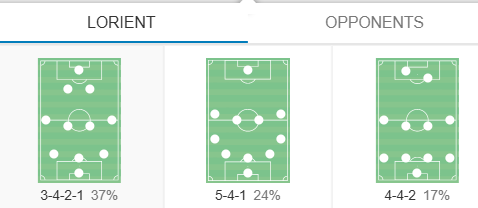
Pantaloni has mainly used a back-three structure.
The most frequently used formation has been 3-4-2-1, followed by 5-4-1.
In the 3-4-2-1, the wingers operate in more advanced, central positions, supporting the attack and linking with the striker and the wing-backs to provide width.
The 5-4-1 tends to appear when the team adopts a more defensive structure, with the wing-backs dropping deeper to form a back five and the wingers contributing more to defensive stability, joining the midfield line.
At this stage of the season, the player with the most appearances for Lorient is the French wing-back Théo Le Bris.
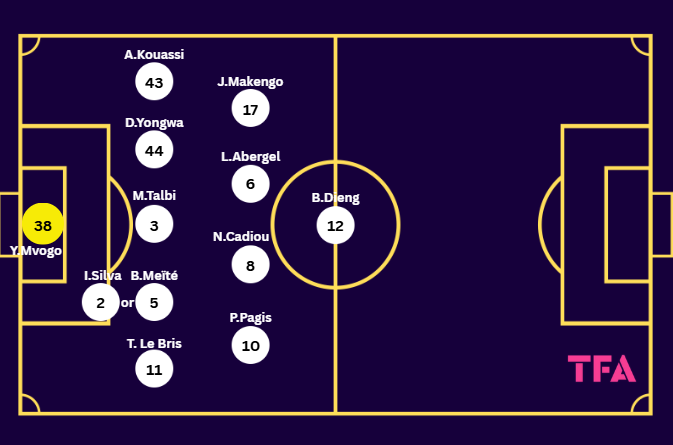
In terms of minutes played, the Tunisian centre-back Montassar Talbi leads the squad; he is followed by the French midfielder Laurent Abergel and the Burkinabé defender Kan-Guy Kouassi, both of whom are of great importance to the team’s structure.
An interesting pattern emerges when comparing the current season with the previous one.
The five players who accumulated the most minutes last season are all among the top-12 players with the most minutes in the current league campaign.
Lorient Attacking Tactics 2025/2026
Build-Up Play
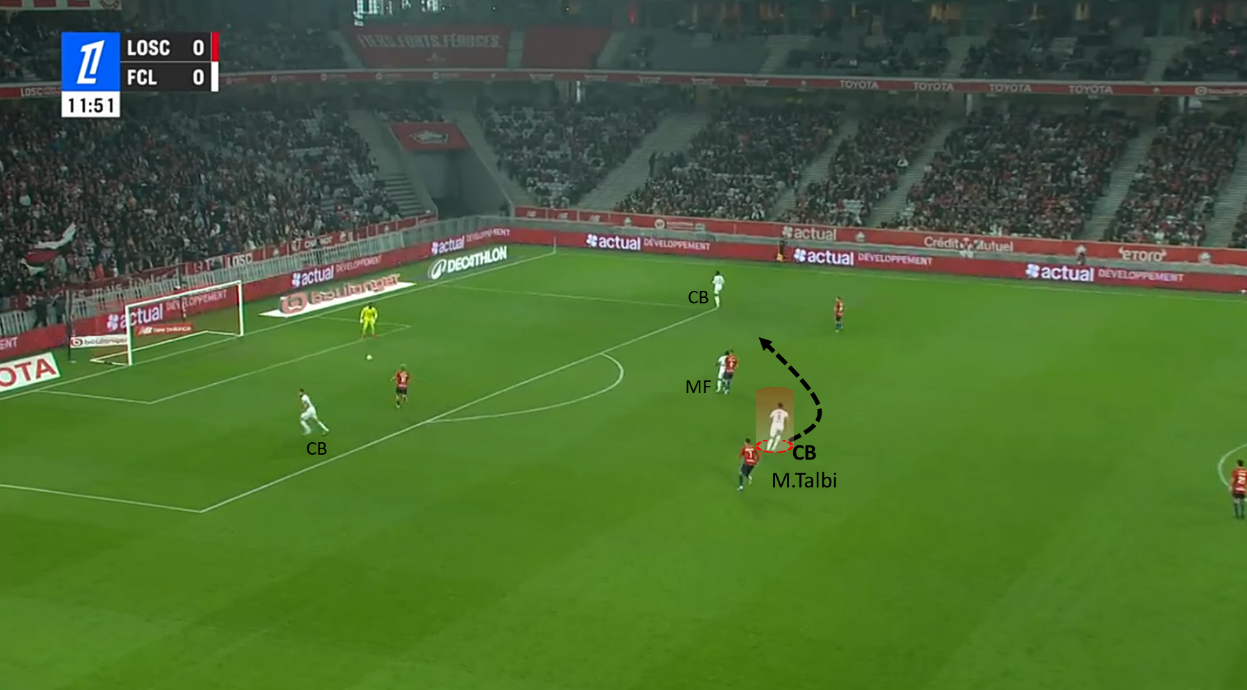
During the build-up phase, Talbi, who usually plays as the central centre-back, often steps forward into a higher position on the pitch and temporarily operates as a midfielder.
This movement helps the team create an additional player in the central area during the first phase of build-up.
When the ball progresses further up the field, Talbi typically drops back into the defensive line to restore the original structure.
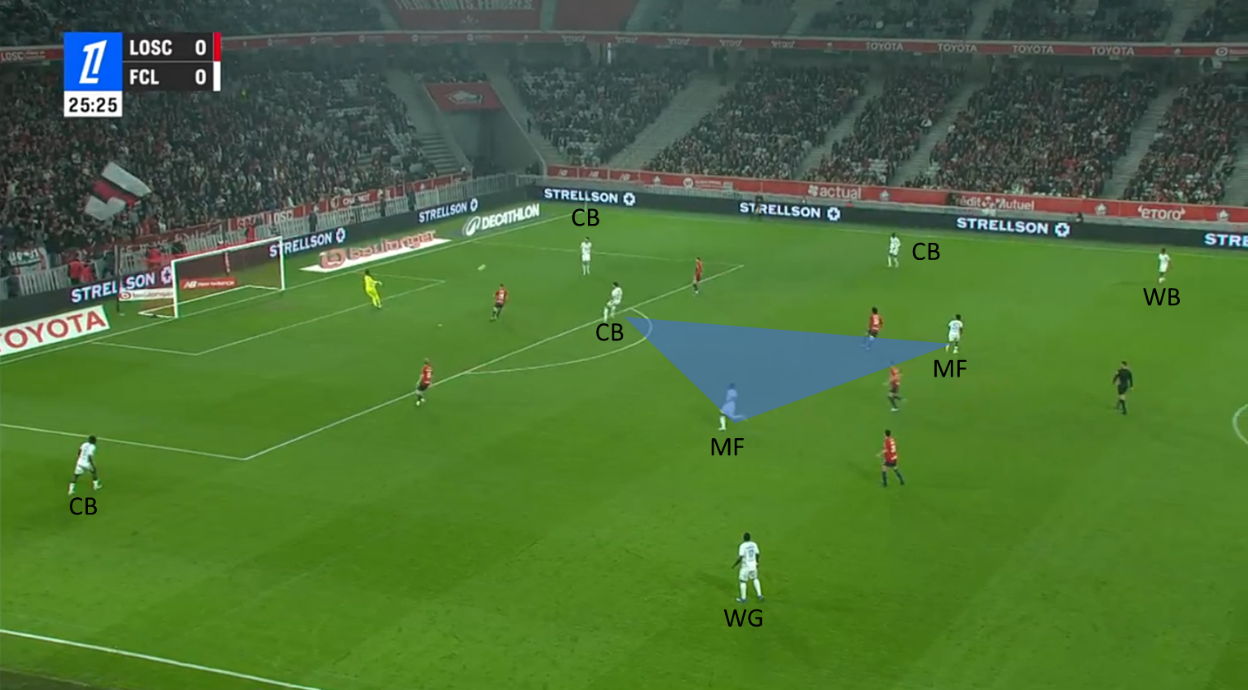
In some situations, he positions himself at the base of an inverted triangle, with the two midfielders positioned higher ahead of him, facilitating ball circulation and progression through the central corridor.
In other moments, he forms the base of a triangle alongside another midfielder, initially positioning himself slightly to the right before moving towards the left side to receive the ball and support the next passing option.
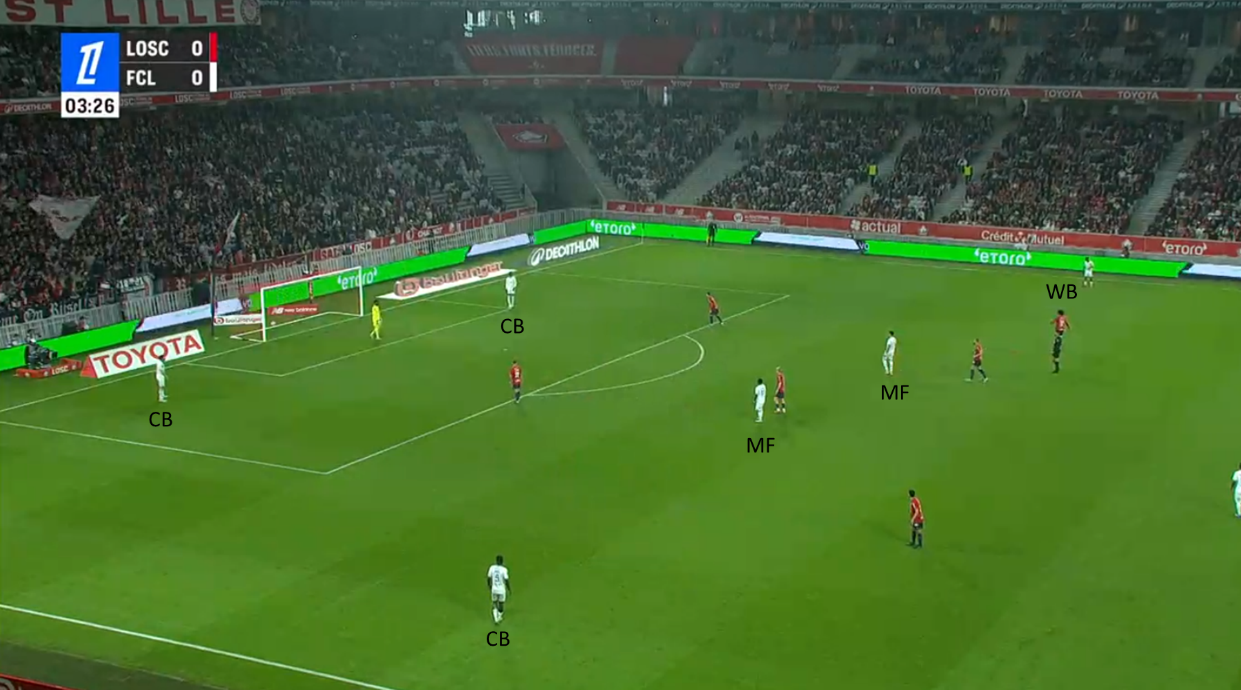
Lorient also uses asymmetrical build-up structures.
In these situations, the right centre-back advances into a full-back-like position, while the opposite wing-back drops deeper to support the defensive line.
This adjustment allows the team to involve up to six players in the first phase of build-up, creating more passing options and improving their ability to progress the ball under pressure.
Chance Creation
In the attacking phase, Lorient showed a rather direct approach, with a clear intention to progress the ball quickly towards wide areas.
The team frequently looked to find their wing-backs and wingers early, especially in advanced positions, often targeting spaces behind or around the opponent’s defensive line.
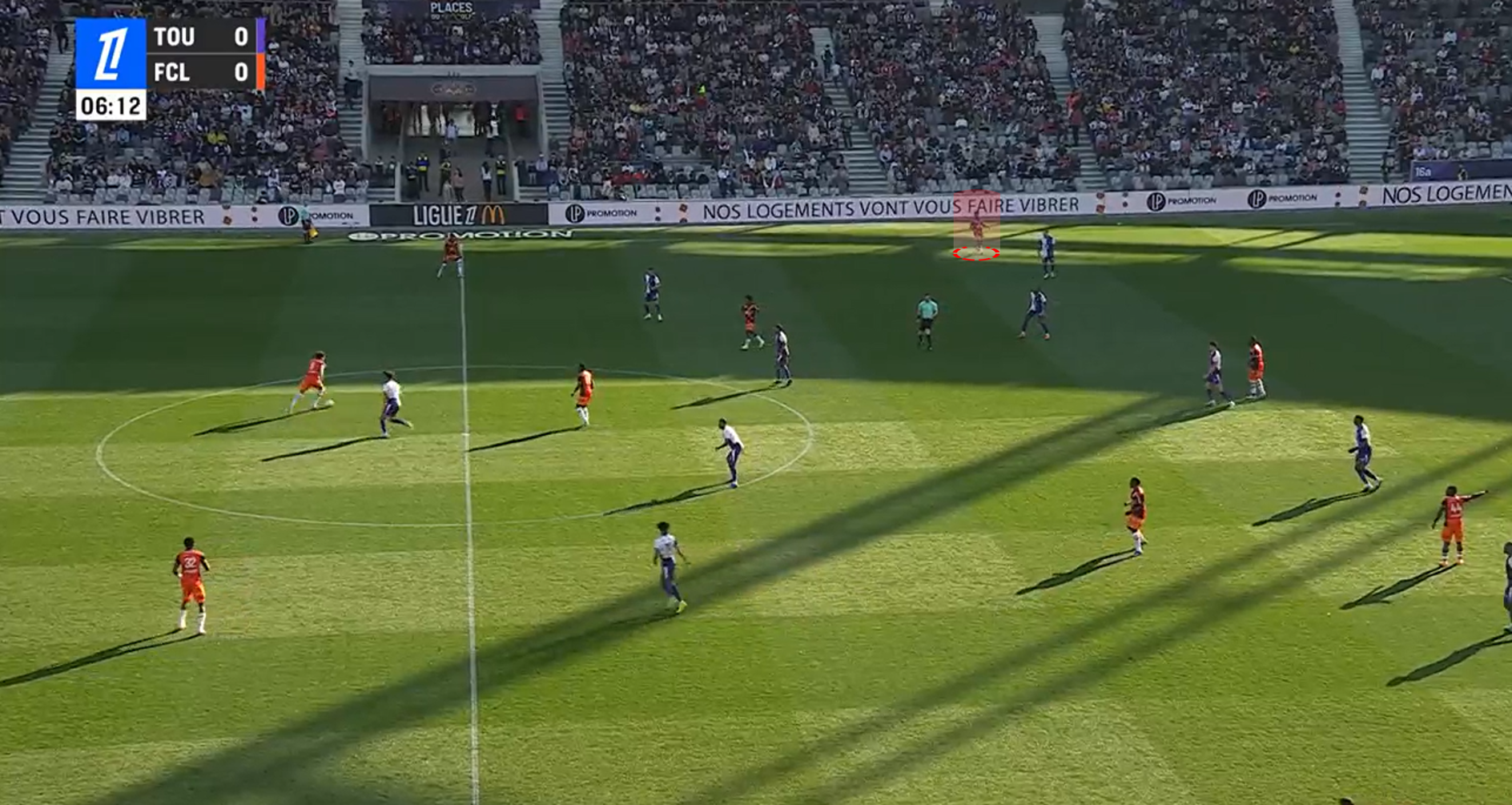
Once the ball reached the flanks, the main objective was to deliver crosses into the box, using the striker Bamba Dieng as the primary reference point.
Lorient aimed to create situations where wide players could receive facing forward.
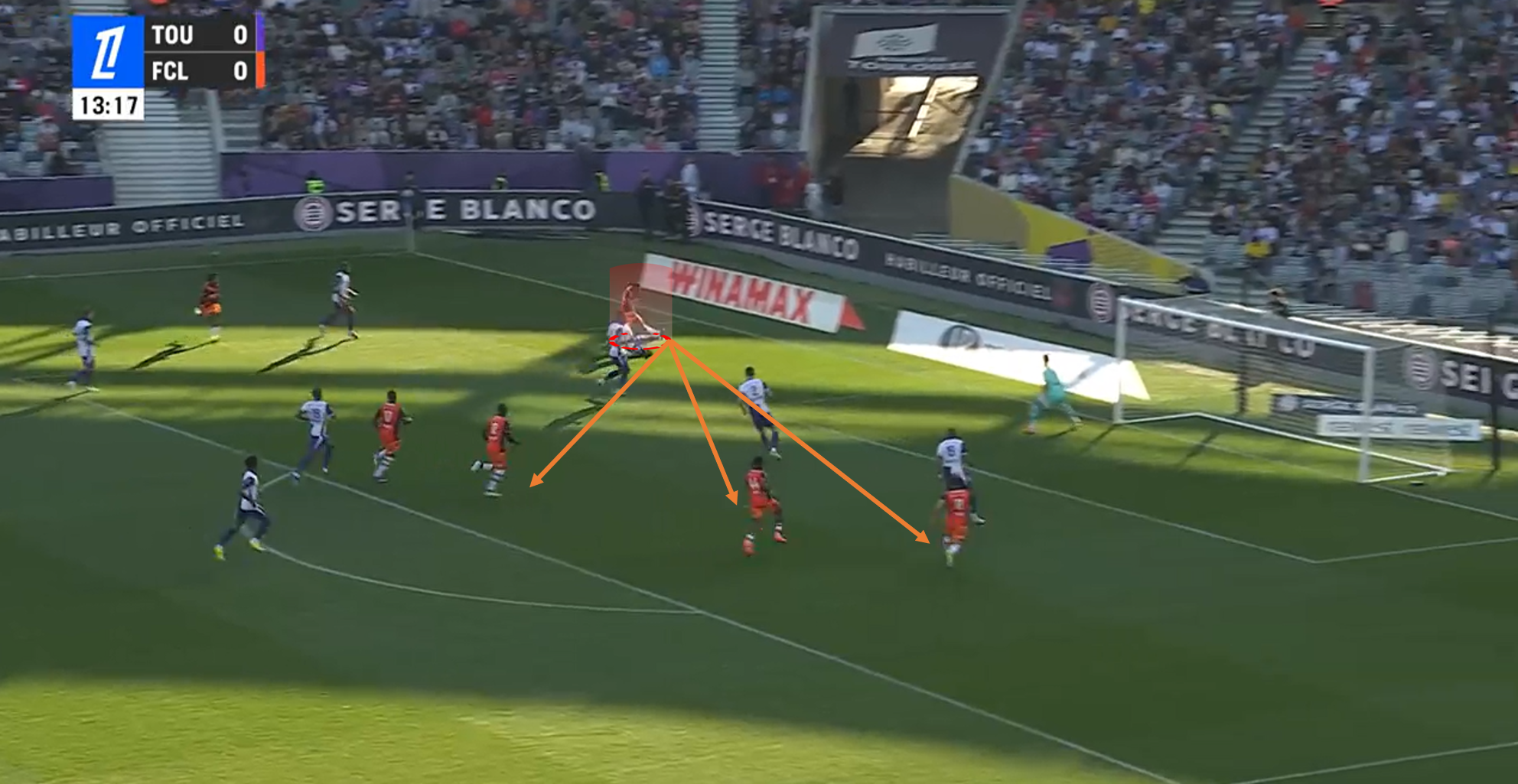
In the final third, their attacking patterns remained relatively simple but consistent.
They relied heavily on crosses into the penalty area, targeting attacking players positioned between defenders, as well as cut-backs from wide or byline positions to find teammates arriving late in the box.
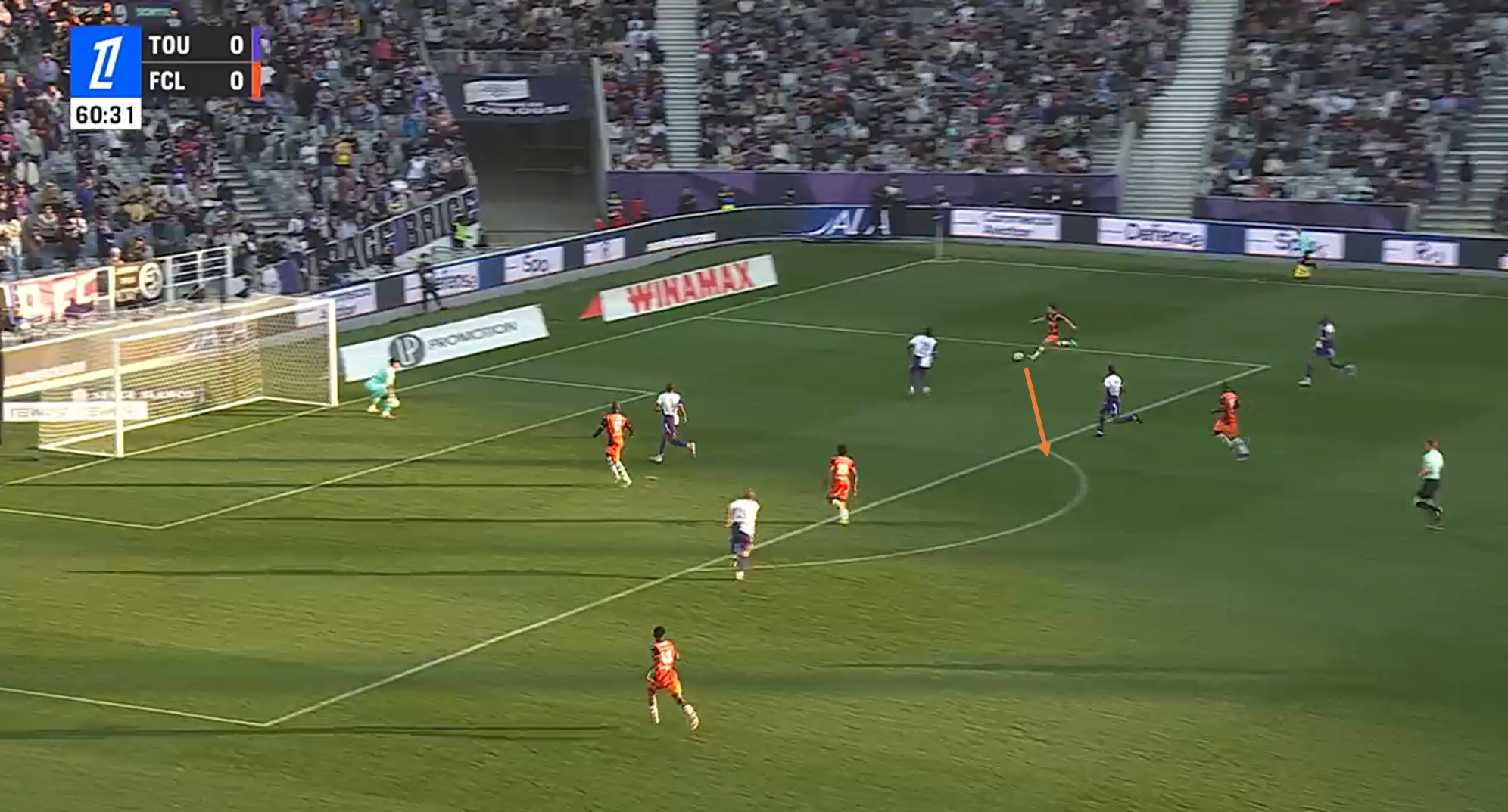
However, the limited variation in their attacking play often made their approach predictable, reducing their ability to create clear goalscoring opportunities.
Lorient Defending Tactics 2025/2026
Mid-Block Tactics
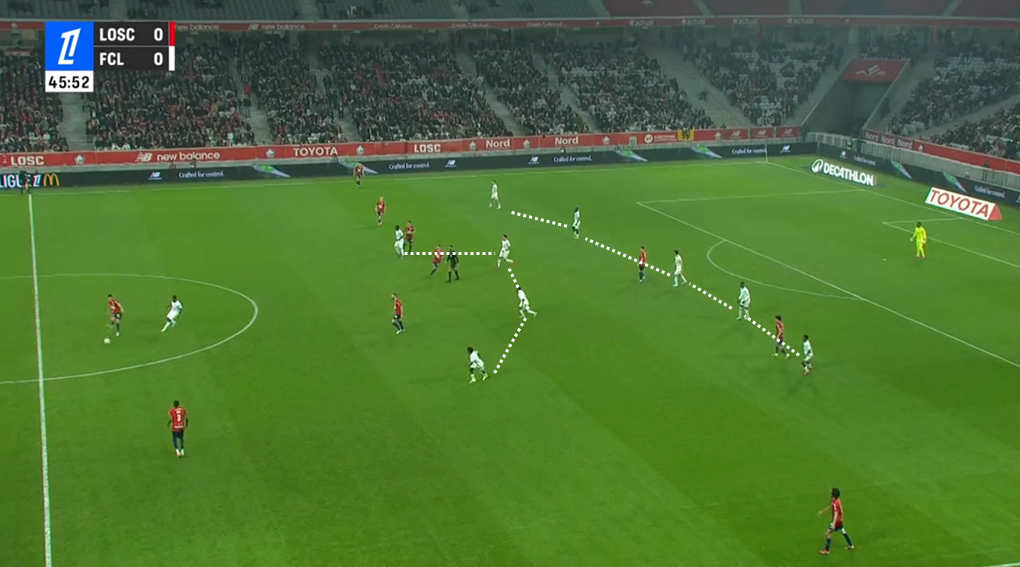
In the defensive phase, particularly in the mid-block, Lorient usually places all players behind the ball, maintaining a compact structure and prioritising defensive stability.
When the opponent has possession in their own half, Lorient typically organises in a 3-4-3 structure.
In this phase, the wing-backs position themselves on the same line as the central midfielders, forming a line of four across midfield.
The wingers remain in the first line of pressure alongside the striker, creating the front three responsible for initiating the press and guiding the opponent’s build-up.
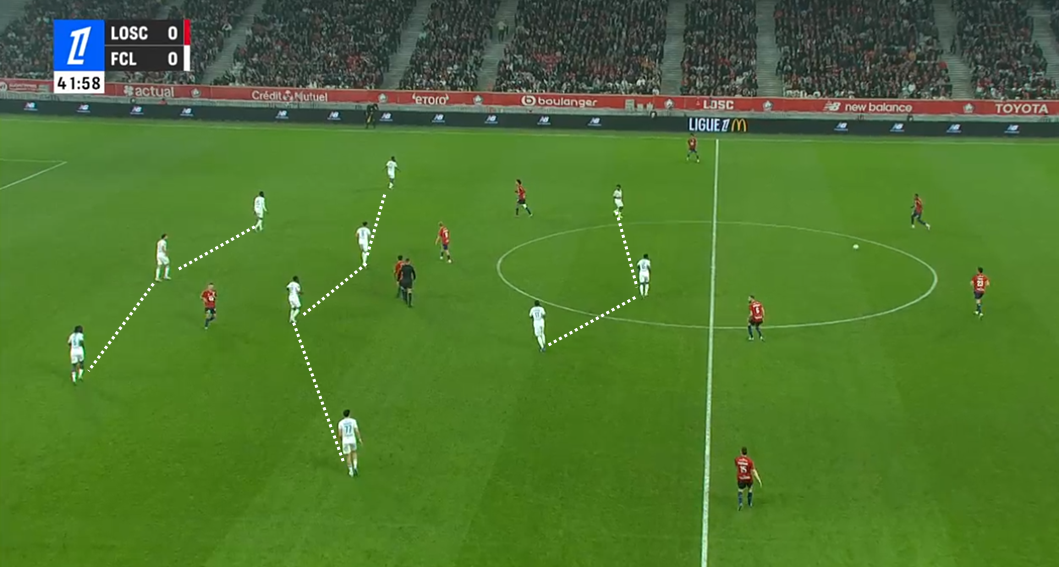
As the opponent progresses into Lorient’s defensive half, the team adjusts its structure and becomes more compact.
In this situation, Lorient shift into a 5-4-1 defensive block.
The wing-backs drop deeper to join the three centre-backs in a back five, while the wingers fall back into the midfield, creating a four-player midfield.
This leaves the striker alone in the first line, mainly responsible for screening central passes and providing the first point of pressure.