
Raffaele Palladino Tactics At Bologna 2026/2027: How Could The Italian Coach Revive I Rossoblù? – Tactical Analysis
Raffaele Palladino has taken charge of Bologna after spells with Fiorentina and Atalanta. This tactical analysis examines his back-three structures, positional rotations, pressing, wide overloads and the adaptations that could shape his new side.

Bologna FC 1909 replaced Domenico Tedesco with Italian coach Raffaele Palladino before the start of the international break.
The appointment comes as a bit of a shock after Tedesco himself was a new appointment, since former manager Vincenzo Italiano had only left Bologna to join Turkish giants Beşiktaş in the summer.
However, a poor run of games, which saw Bologna collect one draw and three losses in four games, meant the ownership was convinced by Tedesco.
Palladino joins Bologna after leaving Atalanta BC at the end of the season, where he had joined as a caretaker to replace Ivan Jurić.
In this Raffaele Palladino tactical analysis, we examine Palladino’s style of play at Fiorentina, both in and out of possessio,n before learning the tactical adjustments he made at Atalanta, which could indicate what we can expect from him at Bologna in the long run.
Rafaelle Palladino Past Formations & Lineups
Palladino’s base structure has always started with a three at the back.
At Fiorentina, he played a 3-5-2 with Moise Kean, one of his most favoured players, while he was supported in attack by Albert Gudmundsson.
Luca Ranieri was his first-choice centre-back while former Manchester United goalkeeper David de Gea was revived under Palladino.
Rolando Mandragora, Yacine Adli, Dodô and Pietro Comuzzo were other players who regularly turned up under Palladino.
At Atalanta, he switched to a 3-4-2-1 given the squad composition of La Dea.
Belgian attacker Charles De Ketelaere and Nikola Krstović were the players who were his most trusted players.
While Ademola Lookman was a key player for Atalanta, he was sold to Atlético Madrid in January, meaning players like Lazar Samardžić started getting more chances.
Atalanta stalwart Marten De Roon was a key figure for Palladino, while Marco Carnesecchi, Giorgio Scalvini and Brazilian midfielder Éderson were also vital parts of the squad.
Rafaelle Palladino In Possession Tactics
When Fiorentina had the ball, they used a 3-2-5 shape with a patient approach in build-up while progressing the ball.
When building out from the back, the centre-backs would split up, which then allowed the wing-backs to occupy higher up spaces while two members from the midfield three would drop down to create a 3+2 build-up shape.
Fiorentina had a variation where the central player of the back would invert into the double pivot, freeing one midfielder to push up and drag an opposition player with him.
This allowed Fiorentina to create dynamic structures and keep the opposition guessing.
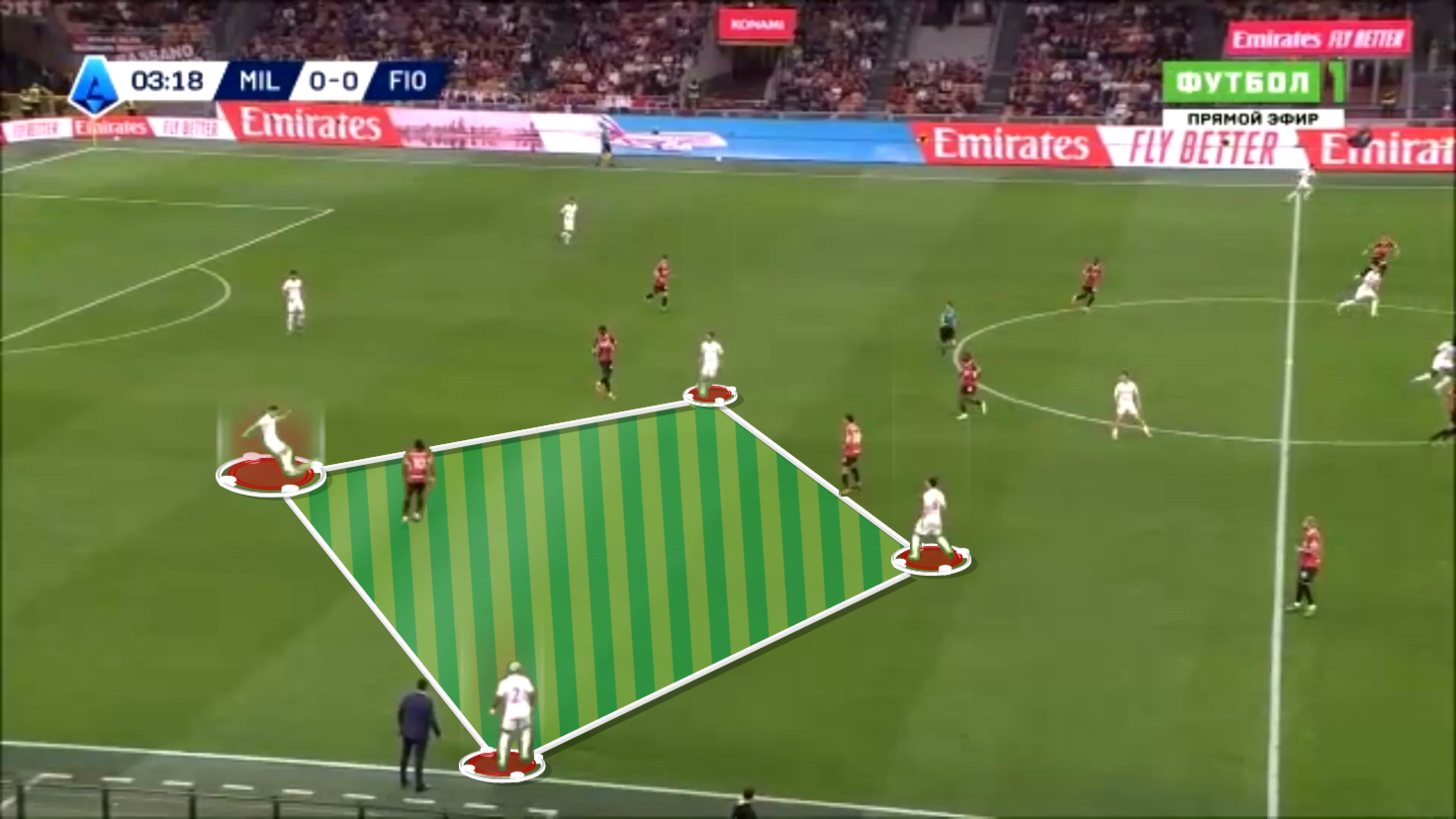
With the structure created through the rotations, Fiorentina would form passing diamonds on their flank (as seen in Figure 1) with the corresponding centre back, wing-back, central midfielder and Gudmundsson getting into positions.
It gives the player on the ball multiple options when deciding who to pass, while it also allowed Fiorentina to suck the opposition's press towards one flank.
Fiorentina would use the pivot in the three-man midfield to switch the play from one flank to another, where the opposition wing-back would be waiting for the ball.
This is possible only because Palladino instructs his wingers to maintain width by hugging the touchline.
The idea behind this concept is to stretch the opposition horizontally.
This act can create gaps in the half spaces, which can be exploited by the midfielders and/or the forwards.
At Fiorentina, where Palladino had athree-mann midfield, he was able to create numerical superiority in midfield.
To progress the ball from the middle third areas, this numerical superiority helped in creating various third-man combinations.
These combinations helped in drawing out opposition players and creating space between the lines of the opposition.
Meanwhile, the striker plays a very important role, whereby he is tasked with stretching the opposition defensively vertically and creating space.
Against teams that play high, the striker makes runs behind the defence while anticipating through balls.
At the same time, he also looks to pin the centre-backs in the last line of defence, looking to create gaps between the second and third line of defence for Gudmundsson to operate.
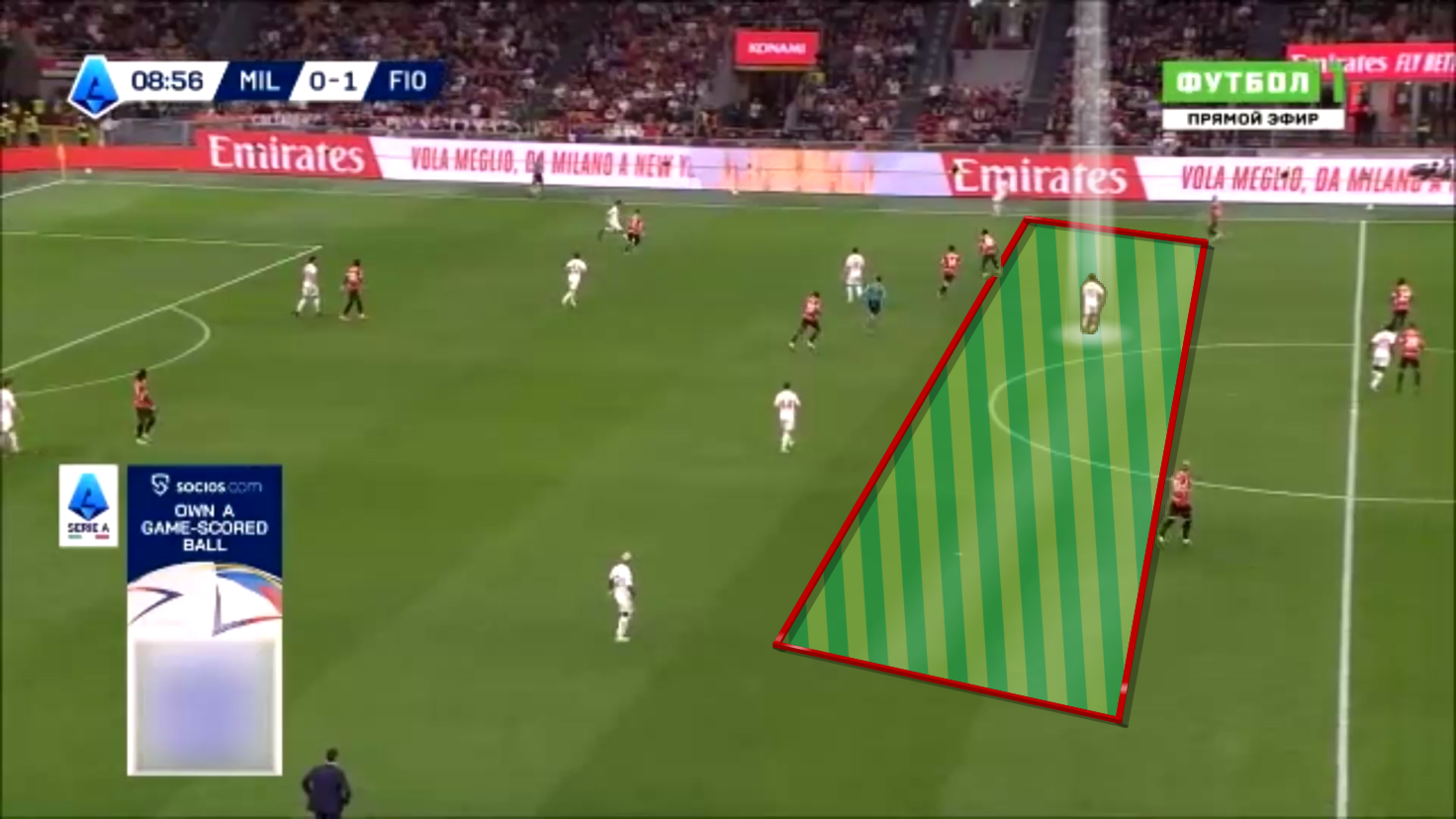
Fiorentina look to bait the opposition press by calmly rotating possession between the centre-backs and midfielders while the striker, usually Kean, and the wing-backs would hold their position.
This would create space between the second and third lines of defence as seen in Figure 2.
Like a typical positional play side, Fiorentina players would rotate positions frequently by occupying different zones while making sure all zones are occupied.
This would help to break the man-marking pressing scheme of the opposition and create different passing angles, and also help in midfield runs.
It aided players like Adli, who played as a mezzala.
Play would progress on the opposite side of the pitch while Adli would make his run just in time to receive their through ball, with his run not being tracked by opposition defenders.
Fiorentina also use the goalkeeper to start quick counterattacks.
Although De Gea is not a ball-playing goalkeeper, Palladino would have him play long balls into the opposition's last line of defence to catch the opponent off guard.
This was seen particularly in the game against AC Milan, where De Gea's goal kick was played directly into the last line of defence, and Fikayo Tomori's mistake ensured a goal for Gudmundsson.
Rafaelle Palladino Out Of Possession Tactics
When Fiorentina are without the ball, they use a 3-4-1-2 pressing structure, aiming to regain the ball as high up as possible.
The 3-4-1-2 (as seen in Figure 3) structure allows Fiorentina to press aggressively and close down the various passing lanes for the opponents.

![Scotland Vs Switzerland [0-3] UEFA Nations League 2026/2027: How Aggressive Pressing Backfired & Murat Yakin Took Advantage - Tactical Analysis](https://cdn.mymidnight.blog/77f959f119f4fb2321e9ce801e2f5163/size/w600/2026/10/Scotland-Vs-Switzerland-20262027---Tactical-Analysis.png)