

From a developmental standpoint, Unai Simón has reached his professional peak.
While his pure shot-stopping metrics may fluctuate depending on the defensive solidity of the block in front of him, his game understanding and involvement in the build-up phase align perfectly with the demands of contemporary football.
Heading into June 2026, Unai Simón remains the vanguard of the Spanish goal: a resilient, proactive leader who defines the modern interpretation of the position through technical security and superior tactical reading.
In this Unai Simón scout report and player analysis, we will examine why Simón is the archetype of the “playmaking goalkeeper” under Ernesto Valverde’s system at Athletic Club and how his ability to read spatial dynamics allows him to manipulate opposition pressing structures.
Unai Simón Build-Up Intelligence & First Phase Progression
Unai Simón’s greatest asset in the modern game is his proactive scanning and his ability to manipulate the opposition’s defensive block during the first phase of possession.
In the current tactical climate, a goalkeeper is no longer a peripheral figure in possession; they are the primary initiator of verticality.
In Ernesto Valverde’s system, Unai Simón acts as the 11th outfielder, creating numerical superiorities that allow the centre-backs to split wide and the full-backs to push into the middle third.
His decision-making is not merely reactive; it is predatory.
He deliberately invites pressure from the opposition’s first line to create ‘gravity’, drawing attackers toward him and thereby vacating space in the midfield.
This requires a high level of technical composure and the ability to wait for the exact moment a pressing trigger is activated before releasing the ball.
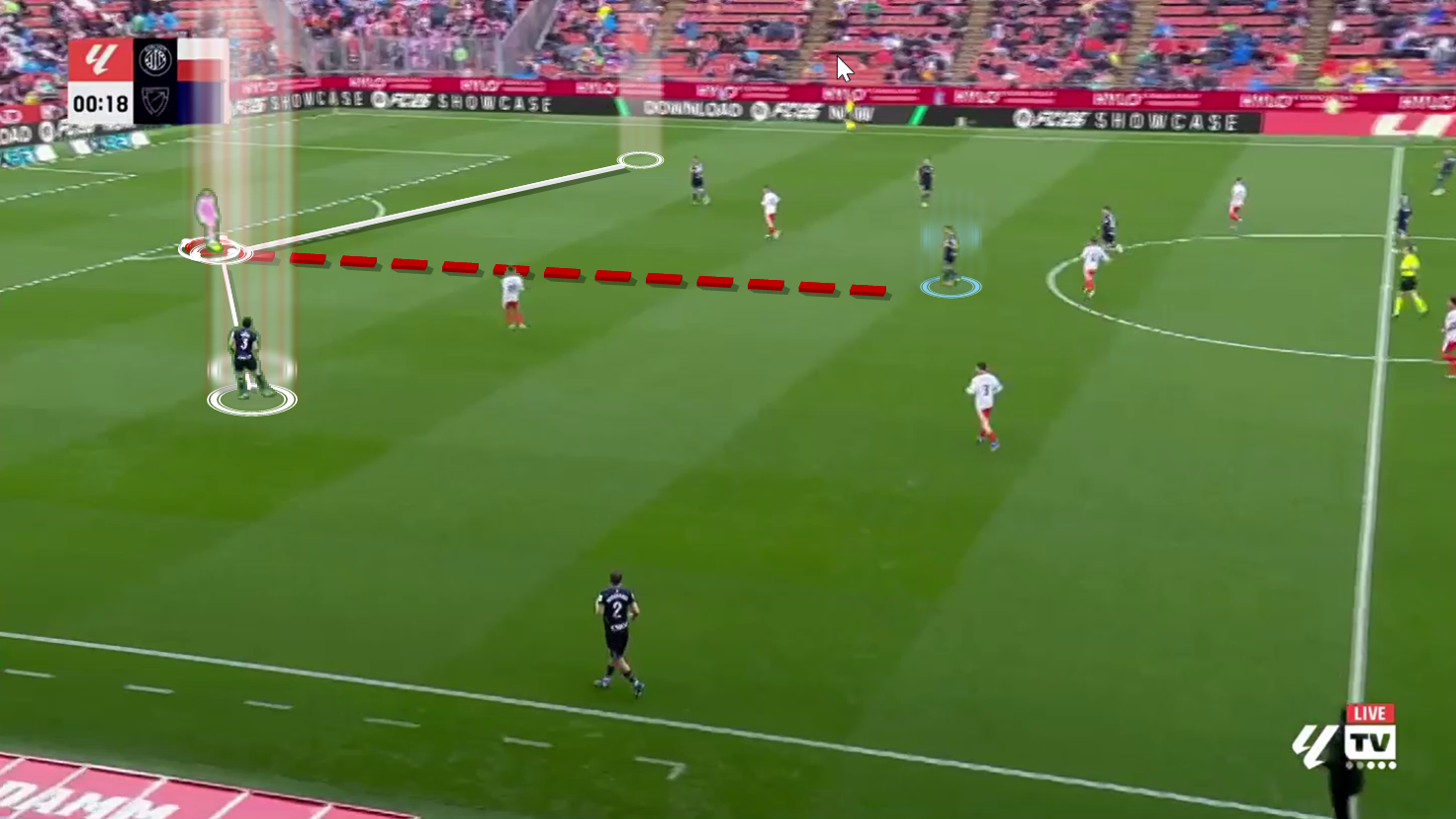
Unai Simón identifies the central free man as the opposition fails to compress the central lane, allowing for immediate vertical progression through the ‘six’ space.
In the opening stages of the match against Girona, Unai Simón demonstrates this elite decision-making.
As the opposition’s first line of pressure remains wide and fails to protect the central corridor, he identifies the interior ‘free man’ positioned behind the midfield line.
This intent to play through the middle is a hallmark of his game.
By bypassing the initial press with a crisp, vertical pass, he catches the opponent’s transition block disorganised, allowing his team to attack the back four with numerical equality.
Structural Adaptation & Scanning Efficiency
Modern build-up is a game of chess, and Unai Simón’s true value lies in his ability to recognise when a primary passing lane has been neutralised.
An elite goalkeeper must possess the tactical flexibility to abandon a plan when the opposition adjusts their defensive shape.
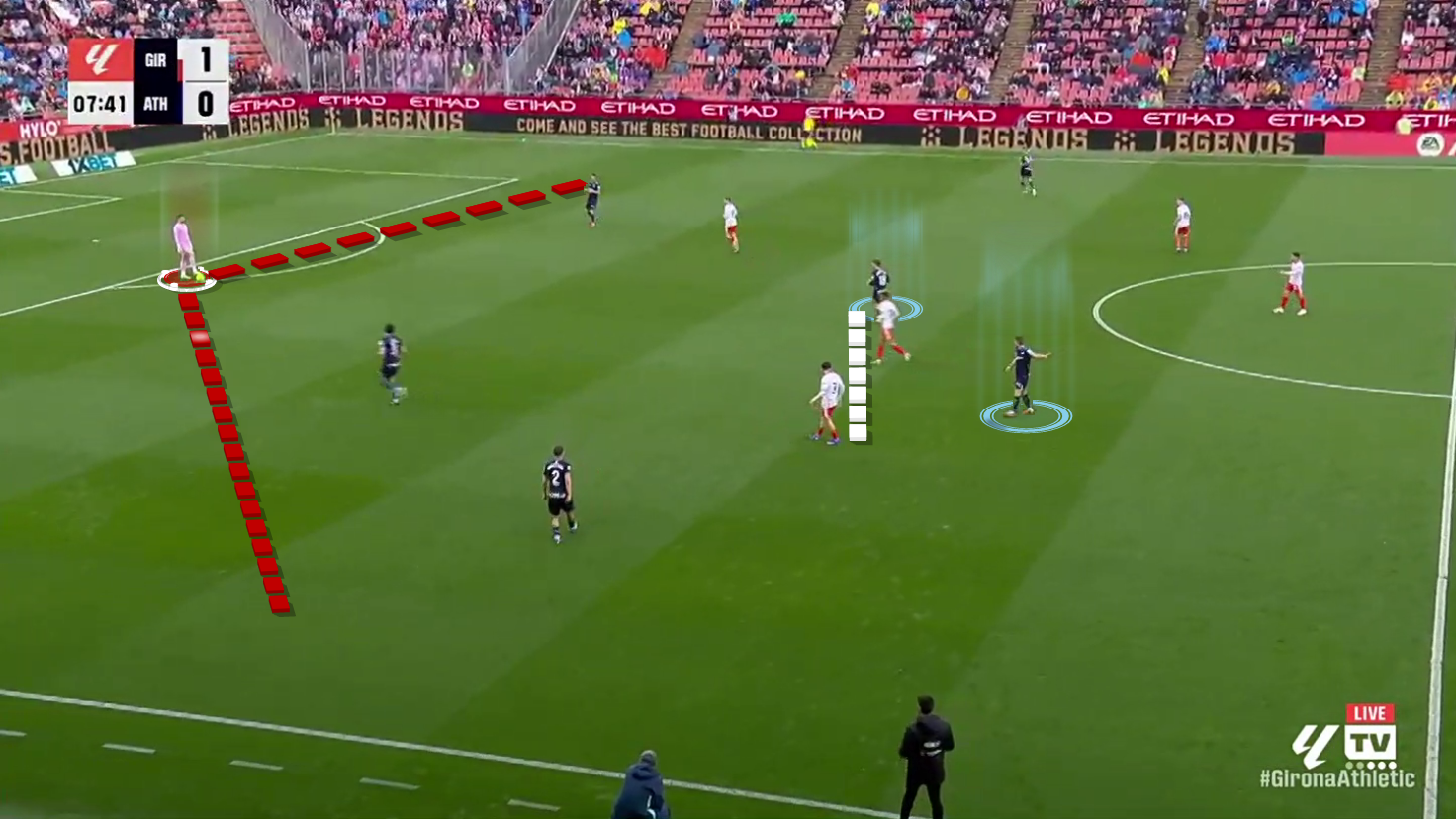
As the opposition adjusts to block the central channel (red dashed lines), Unai Simón recognises the horizontal compactness and shifts the build-up focus to the vacated right flank.
As seen later in the same match, the opposition adjusted their structure, increasing their horizontal compactness to deny the central pass.
Rather than forcing a high-risk delivery into a congested area, a common mistake for less experienced keepers, Unai Simón showcased significant maturity.
By recognising the ‘wall’ created in the middle, he efficiently shifted the point of attack to the right flank.
This lateral shift exploited the space created by the opposition’s inward movement, demonstrating his holistic view of the pitch and his ability to ‘out-think’ the press.
Elite Shot-Stopping Mechanics: Analysis Of The PSG Performance
While his distribution often takes the spotlight, Unai Simón’s fundamental duty remains shot-stopping, and his performance against Paris Saint-Germain serves as a definitive case study in elite goalkeeping mechanics.
In high-stakes environments, the margin for error is nonexistent, and Unai Simón’s technical execution under pressure is what separates him from his peers.
Firstly, his 1v1 ‘block’ technique is exemplary.
He maintains a high centre of gravity and keeps his feet active, refusing to commit to a dive until the striker makes a definitive move.
By staying vertical for as long as possible, he maximises his surface area and reduces the available shooting angles.
This patience in the duel is a psychological weapon that often leads to mistakes or rushed finishes.
Secondly, his handling and parrying show great tactical intent.
When faced with powerful shots from distance, Unai Simón does not simply parry the ball back into the ‘danger zone’ (the central area of the box).
Instead, he uses his palms to deflect the ball into ‘dead zones’ wide of the goal, preventing immediate second-chance opportunities for poaching attackers.
Finally, his pure reflex capacity is a testament to his explosive lower-body power.
His ability to adjust his body mid-air or react to deflections is underpinned by a perfect ‘set position’: feet shoulder-width apart, weight on the balls of the feet, and hands in a neutral, ready position.
This technical foundation allows for near-instantaneous lateral movement
We can observe Unai Simón’s elite mechanics during a high-stakes transition against PSG.
As the attacker enters the penalty area, Unai Simón maintains a strong set position, balanced, with a low centre of gravity and hands in a neutral stance.
The tactical annotations highlight the angle reduction achieved by his positioning; by staying vertical and narrowing the distance between himself and the ball-carrier, he effectively shrinks the ‘green zone’ (the available scoring area) shown in the shaded triangle.
His patience is key here; he does not commit to a dive early, which forces the attacker into a lower-probability finish.
His reaction speed and lower-body power allow him to cover the remaining frame in milliseconds, a crucial attribute for a goalkeeper operating behind a high defensive line.
The Sweeper-Keeper Role & High-Line Management
The modern game requires goalkeepers to defend large spaces behind a high defensive line.
Unai Simón’s average starting position is consistently aggressive, often situated near the edge of his penalty area when his team is in the attacking half.
This sweeping role is vital for neutralising direct balls and long clearances from the opposition.
His anticipation is his greatest ally in these scenarios.
He does not wait for the ball to be played; he scans the opposition’s ball carriers’ body language to predict the trajectory of the long pass.
By intercepting these balls early, he prevents footraces between his centre-backs and fast opposition strikers, effectively killing transitions before they become dangerous.
This proactive defending requires immense concentration and the courage to step out of the safety of the six-yard box.
Psychological Resilience & Proactive Leadership
Beyond the physical and tactical, the psychological dimension of Unai Simón’s game is what makes him a peak performer.
The role of the Spanish goalkeeper is one of intense scrutiny.
Having faced high-profile setbacks early in his career, his ability to return to the highest level without compromising his risky, proactive style is a masterclass in mental fortitude.
He possesses a short memory, a trait shared by all elite goalkeepers.
If a pass is misplaced or a goal is conceded, his behaviour in the next phase of play remains unchanged.
He continues to demand the ball, play high-value vertical passes, and command his area with vocal authority.
This leadership is infectious, providing his teammates with the confidence to maintain their tactical structure even in high-pressure moments.
Comparative Analysis: Club Vs International Demands
It is essential to note how Unai Simón adapts his game between the Athletic Club model and the Spanish National Team.
Under Luis de la Fuente, the demands for horizontal circulation and extreme patience are higher.
At club level, Unai Simón is often more vertical, seeking to exploit the pace of wingers like Nico Williams.
This versatility proves that he is not a system player, but a tactical chameleon.
He understands the nuances of verticality versus retention.
In 2024/2025, his long-ball accuracy has seen a significant uptick, particularly in his ability to find the wide players with driven, flat-trajectory passes that are easier to control than looping clearances.
This adds another layer to his team’s offensive transitions.
Statistical Context & PSxG Performance
Analytically, Unai Simón’s value is backed by his Post-Shot Expected Goals (PSxG) metrics.
This metric measures the likelihood that a goalkeeper will save a shot based on the quality of the finish, rather than just the shot’s location.
Unai Simón consistently performs in the top percentiles, indicating that he is an overperformer: he saves goals that statistically should have gone in.
When combined with his high percentile rankings in touches and passing distance, this picture emerges: a goalkeeper who is equally productive in both the defensive and offensive phases of the game.
He is, statistically and tactically, the complete modern package.
Conclusion
As we look ahead to the 2026 FIFA World Cup, Unai Simón stands as Spain’s undisputed number one.
He represents the ultimate evolution of the Spanish school, combining the traditional bravery and reflex-based shot-stopping of the past with the sophisticated tactical intelligence and ball-playing ability of the future.
His performances against elite opposition like Girona and PSG are not outliers; they are the standard.
By identifying the free man, adapting to defensive shifts, and commanding his area with technical perfection, Unai Simón has redefined what is expected of a goalkeeper in the modern era.
He is no longer just a protector of the net; he is the engine of the build-up and the leader of the defensive block.
He is, in every sense, the tactical vanguard of football’s new age in goalkeeping.
![Barcelona Vs Atlético Madrid [0–2] – Champions League 2025/2026: Atlético’s Defensive Control & Clinical Edge – Tactical Analysis](https://cdn.mymidnight.blog/77f959f119f4fb2321e9ce801e2f5163/size/w600/2026/04/Barcelona-vs-Atletico.png)

![PSG Vs Liverpool [2–0] – Champions League 2025/2026: Luis Enrique Rotations Dismantle Liverpool – Tactical Analysis](https://cdn.mymidnight.blog/77f959f119f4fb2321e9ce801e2f5163/size/w600/2026/04/PSG.-VS-LIVERPOOL.png)


Discussion