Youri Tielemans Scout Report At Manchester United 2026/2027: Press Resistance, Progressive Passing & Front-Foot Pressing – Player Analysis
It’s clear that Manchester United entered the summer with the primary goal of bolstering their midfield. For weeks, the Red Devils were heavily linked with 27-year-old Éderson of Atalanta and Brazil.

Who Is Youri Tielemans?
It’s clear that Manchester United entered the summer with the primary goal of bolstering their midfield.
For weeks, the Red Devils were heavily linked with 27-year-old Éderson of Atalanta and Brazil.
That move seemed all but complete until it emerged that the 20-time English champions pulled out of the deal, seemingly favouring alternative midfield options.
Since the Éderson transfer went cold, United have got two names in the door from Premier League rivals: Andrey Santos, who makes the move north from Chelsea for a reported €56.3m and Youri Tielemans, who joins Michael Carrick’s side from UEFA Europa League champions Aston Villa in a reported €41m deal.
This player analysis focuses on the latter.
Our Youri Tielemans scout report examines how the 29-year-old Belgium international fits into the Manchester United project as a potentially key cog in Michael Carrick’s new midfield.
Tielemans adds quality both out of possession and, mostly, in possession, where his ability to orchestrate the game and create from deep could add much-needed variety and dynamism to the Red Devils’ possession game.
Youri Tielemans Stats
Figure 1 shows Youri Tielemans' heat map from the 2025/2026 campaign in all competitions.
Youri Tielemans Heat Map 2025/2026
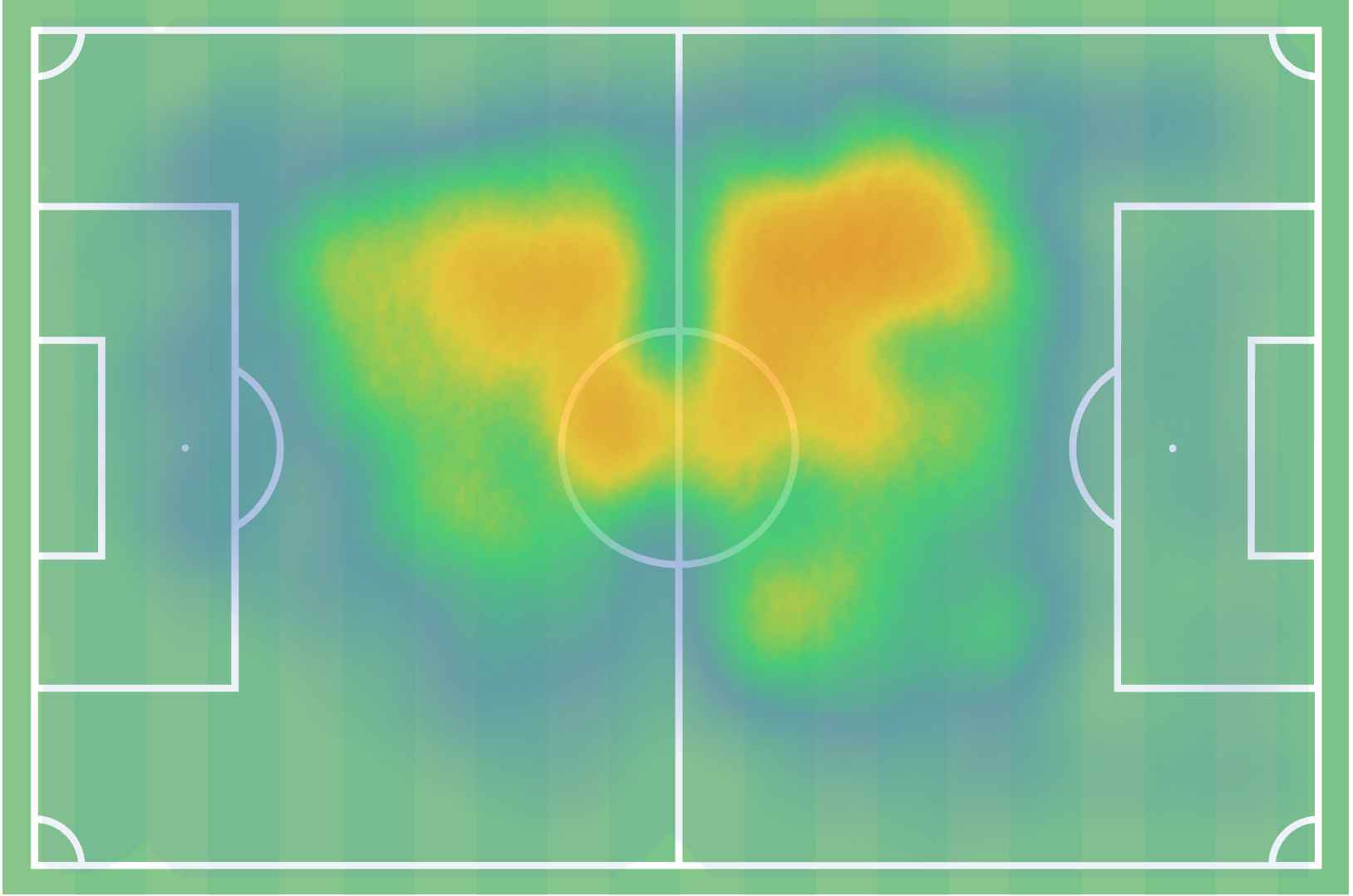
Tielemans’ box-to-box role is immediately apparent from the heat map.
His involvement is primarily concentrated in the half-spaces on either side of the halfway line.
You can expect to see plenty of activity from the 29-year-old across the pitch in between both boxes, with little involvement inside either his own box or the opposing box.
This is probably the main distinction between Tielemans and a traditional box-to-box midfielder.
You’d expect more aggressive runs driving into the box and defending the penalty area from the latter.
Tielemans falls somewhere between a deep-lying playmaker and a box-to-box midfielder.
During the build-up and ball progression phases, he’s comfortable acting as a deep-lying playmaker who can orchestrate play for his side from just in front of the backline.
However, he frequently escapes high pressure with carries that see him burst beyond a defender and into space, progressing into positions you wouldn’t typically associate with that deep-lying playmaker type.
Tielemans also offers some vertical runs and movement beyond the first or second line of opposition pressure, which, again, wouldn’t typically be associated with a deep-lying playmaker.
As the high level of activity in the half-spaces shown on the heat map suggests, he often drifts laterally to create passing angles and provide an outlet in settled possession phases and in transition.
He constantly adjusts his positioning in midfield to provide an option rather than remaining within a fixed zone as a typical No. 6 might, enabling him to influence his side’s possession play in a versatile manner across phases, while also maintaining strong positioning to counterpress aggressively in case of a turnover.
With regard to his in-possession game, Tielemans’ line-breaking quality is widely regarded.
This is undoubtedly a major part of the package he brings to Old Trafford.
Tielemans will frequently demand the ball in front of United’s centre-backs, both in all possession phases and bravely look to pick out teammates between the lines.
If combined effectively with good movement further upfield, this should create favourable scenarios for United’s more advanced midfielders and forwards.
Tielemans ranked in the top 10% among midfielders with at least 800 minutes played in the Premier League last season for forward passes (16.03 per 90).
Forward passes represented 34.4% of the Belgian’s total passes in the 2025/2026 campaign, a relatively high proportion when compared with his Premier League peers.
He also ranked inside the top quartile for both progressive pass volume (6.51 per 90) and progressive pass accuracy (78.91%) last season, highlighting his desirable combination of willingness to take risks to drive his team forward and reliability in completing those risky passes.
Tielemans will quickly earn the trust of his United teammates to take control of the ball in potentially sensitive areas, retain possession and generate favourable conditions further upfield through his vision, decision-making and execution.
Another area of the 29-year-old’s game, which is just as important as his line-breaking ability, however, is his press resistance.
Figure 2 compares dribble success rate with offensive duel success rate across central midfielders who played at least 800 minutes in the 2025/2026 Premier League campaign.
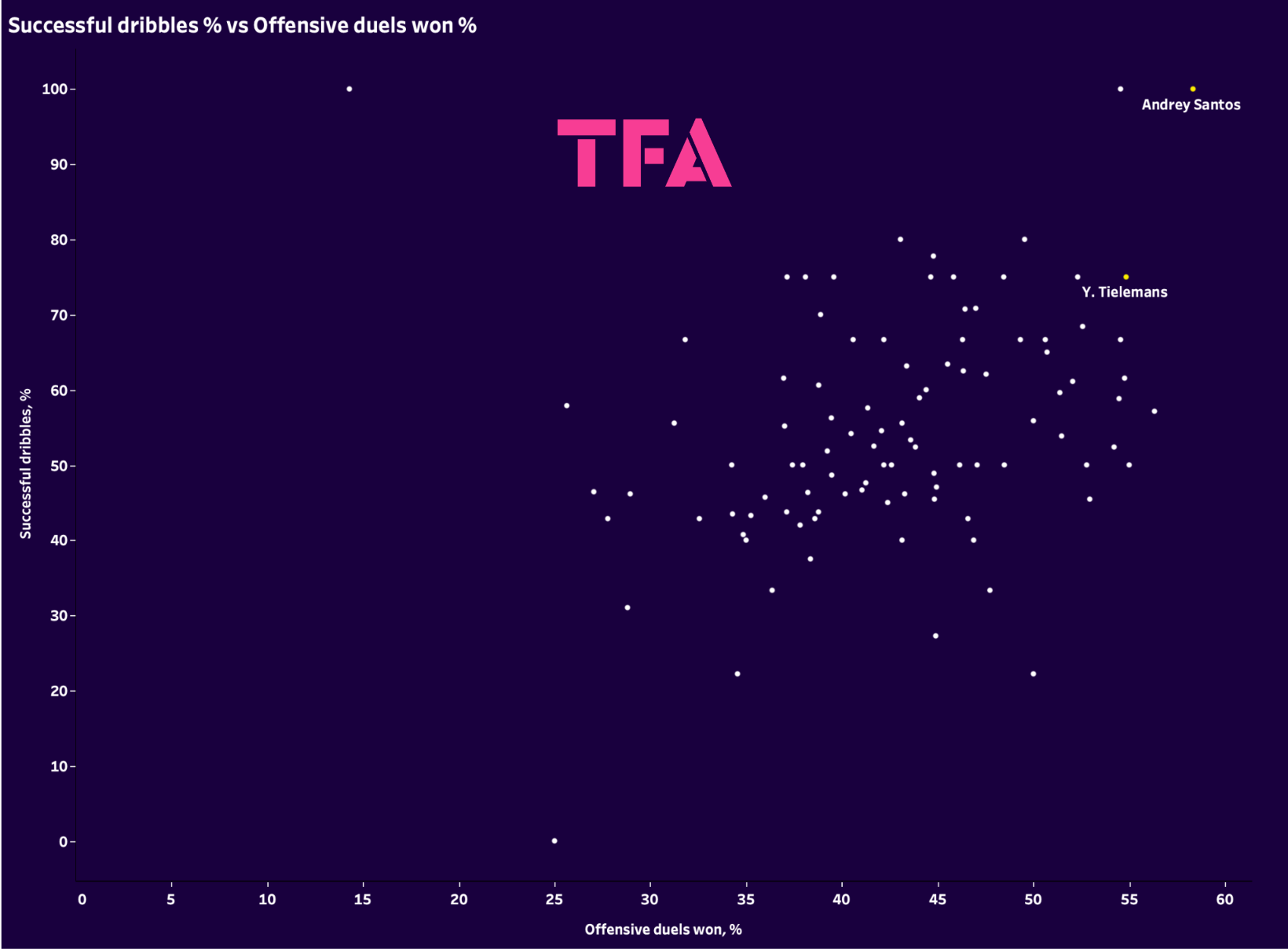
Tielemans occupies one of the strongest positions in the dataset, along with Andrey Santos, who Manchester United also signed this summer.
That’s not by accident; it’s clear that the Red Devils have put a strong emphasis on the ability to retain possession under pressure in their midfield recruitment.
Figure 3 builds on this by incorporating dribble volume alongside efficiency.
In this next graph, the size of the dot corresponding with each player represents dribbles attempted.
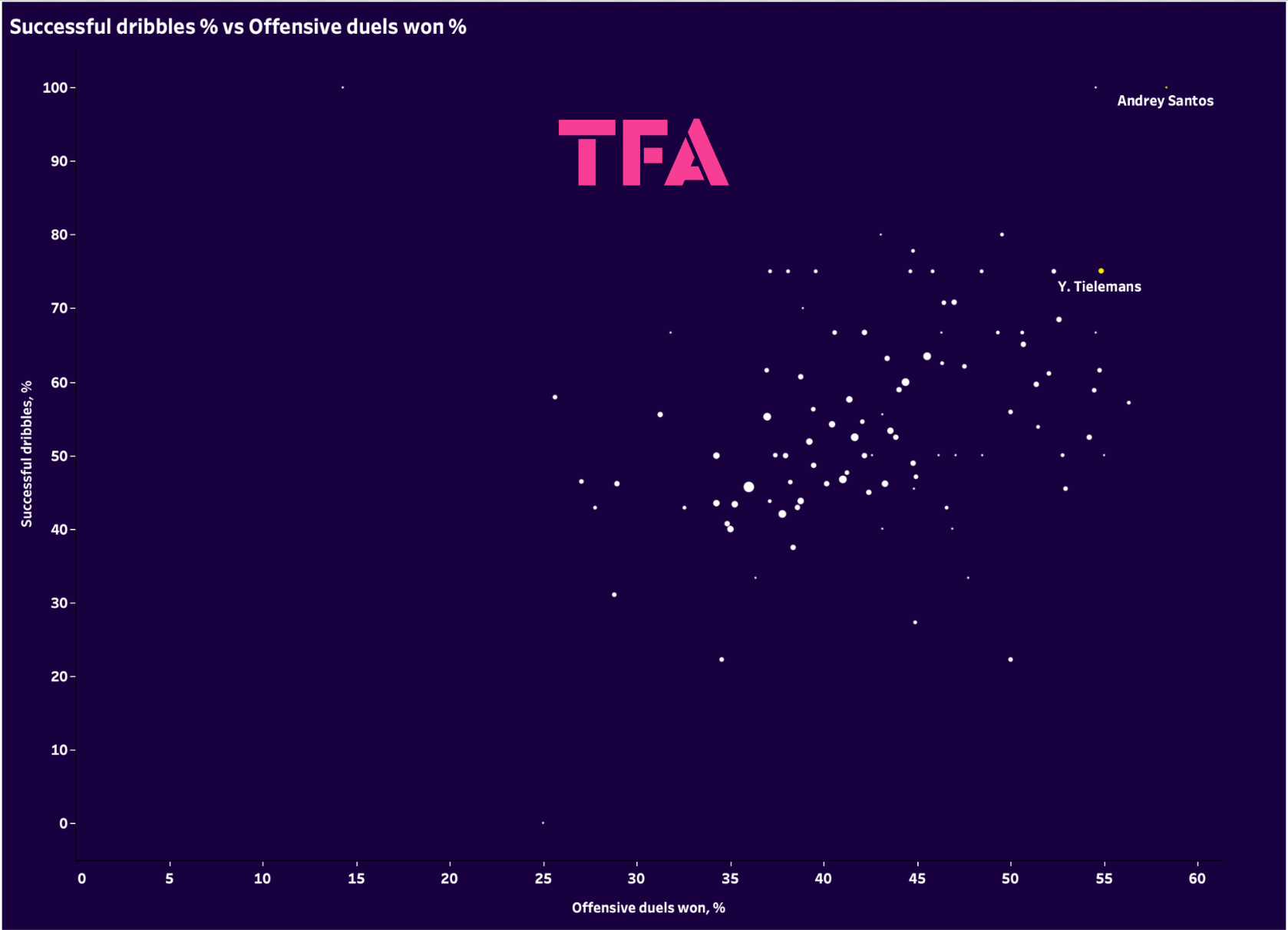
Introducing volume provides additional context.
Many of those with the best success rates attempt relatively few dribbles, making their efficiency somewhat difficult to interpret in isolation.
This is the case for Andrey Santos, who had one of the lowest numbers for dribble attempts per 90 in the English top flight last season (0.25).
Tielemans (1.24) averaged almost five times as many dribbles as Andrey Santos, and while he still doesn’t rank at the very top of the dataset for dribble volume, he does achieve similarly impressive efficiency across a notably higher workload, making his performance perhaps a stronger indicator of repeatable ball security under pressure.
Santos' success rate reflects excellent efficiency, but the limited number of attempts means it should still be interpreted with caution.
In Tielemans’ case, we can be more confident in saying his security in possession is sustainable rather than the product of a small sample.
Figure 4 presents key 2025/2026 percentile ranks using custom-built defensive metrics derived from weighted combinations of Wyscout's raw event data.
The percentile ranks benchmark Tielemans against central midfielders who played at least 800 minutes in the Premier League this past season.
Youri Tielemans Out Of Possession Data 2025/2026
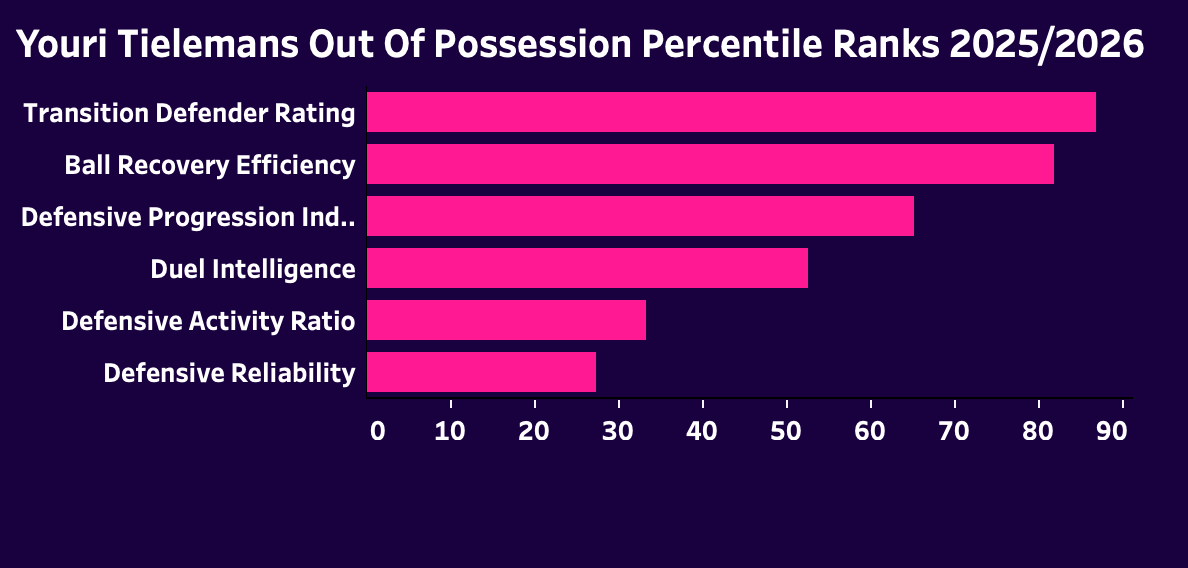
Tielemans is not a specialist ball-winning midfielder, but his defensive contribution is stronger than his reputation often credits him for.
His best performance comes in the Transition Defender Rating, where he ranks comfortably among the strongest midfielders in the sample, while his Defensive Progression Index score falls well above average, too.
These metrics effectively reward players who combine defensive actions with progression after regaining possession, highlighting a defining quality in the ex-Aston Villa man: not just regaining possession, but helping his team transform turnovers into attacks.
Tielemans’ Ball Recovery Efficiency also ranks highly.
A strong score in this metric essentially rewards effective defending over sheer volume.
Duel Intelligence falls around the league average primarily due to a relatively poor defensive duel success rate (56.41%).
This links to the poorest score on the board, Defensive Reliability, which is hurt by Tielemans’ tendency to commit fouls (1.28 per 90).
He’s an aggressive, front-foot defender who will bring strong ball recovery ability, especially in counterpressing, to the Manchester United midfield.
He’s good at spotting opponents who could receive the ball and jumping to close them down aggressively, but that commitment can lend itself to fouls a little too often.
All this data paints the picture of a technically secure, possession-oriented central midfielder.
Tielemans’ greatest strengths lie in his ability to progress play, retain possession under pressure and quickly turn defensive recoveries into attacking transitions.
He can evade pressure effectively without taking unnecessary risk, making him well-suited to possession-dominant systems, where maintaining control of the ball is valued as highly as direct attacking output.
Overall, Manchester United have signed a midfielder whose primary value lies in connecting play through defensive anticipation, ball security and a progressive, calculated risk-taking mentality.
Youri Tielemans Pressing
Tielemans’ natural inclination towards front-foot pressing, both in settled defensive phases and when counterpressing during the defensive transition, will help Manchester United pin opponents in and prevent counterattacks from starting.
The clip below provides a great example of how this aspect of Tielemans’ game can produce high turnovers for his side.