
The Value Of Vertical Runs Like Real Madrid & Aston Villa - Tactical Theory
Modern football increasingly prioritises receiving to feet, but attacking depth remains essential. This tactical theory examines how runs in behind, blindside movement and vertical passing can disrupt defensive structures and turn possession into genuine threat.

The act of receiving the ball to feet has become almost second nature.
From grassroots football to the professional elite, this pass-to-feet dynamic has evolved into the base unit of build-up play.
In this tactical theory piece, we will examine how this stylistic evolution is reshaping attacking behaviour across modern systems.
Forwards drop in, midfielders move closer, wingers tuck inside, everything seems geared towards immediate possession control, even if it means sacrificing attacking depth.
Teams like Real Madrid, with platers susch as Kylian Mbappé, Jude Bellingham, and Vinícius Júnior, embody this trend at the highest level.
Too often, sides focus on neat construction, favouring short combinations and keeping the ball on the ground, even when a single vertical run could dismantle a defensive line.
But if receiving into the feet ensures order, control, and positional superiority, why do so many teams still struggle to generate clear scoring chances?
The answer may lie in what’s missing: the run-in behind, the blind movement, the space attacked before the touch.
In other words, that unstructured but lethal verticality that is often absent in today’s over-orchestrated systems.
How Positional Play Has Reshaped Attacking Behaviour
By 2025, receiving to feet is no longer just an option; it’s a collective reflex, deeply ingrained in the principles of positional play.
Possession revolves around short connections, close support, and continuous rotations, which, while offering stability, often limit attacking variation.
Positional superiority, once a weapon, becomes a constraint.
Even when space is available to exploit, teams remain fixated on the ball.
The outcome is a sterile manoeuvre that struggles to break lines or unsettle defensive blocks.
And it’s precisely this absence of disorder that renders even the most elegant build-up sterile.
El Blancos in 2025 offer a clear example.
Although technically gifted and full of individual flair, Real Madrid's attack can sometimes become hollow due to an excess of connections.
Mbappé, Bellingham, and Vinícius frequently come short, crowding the playmaker’s zone, leaving the box empty and the final pass lacking weight.
The ball circulates but never cuts through.
The players seek feet, not space.
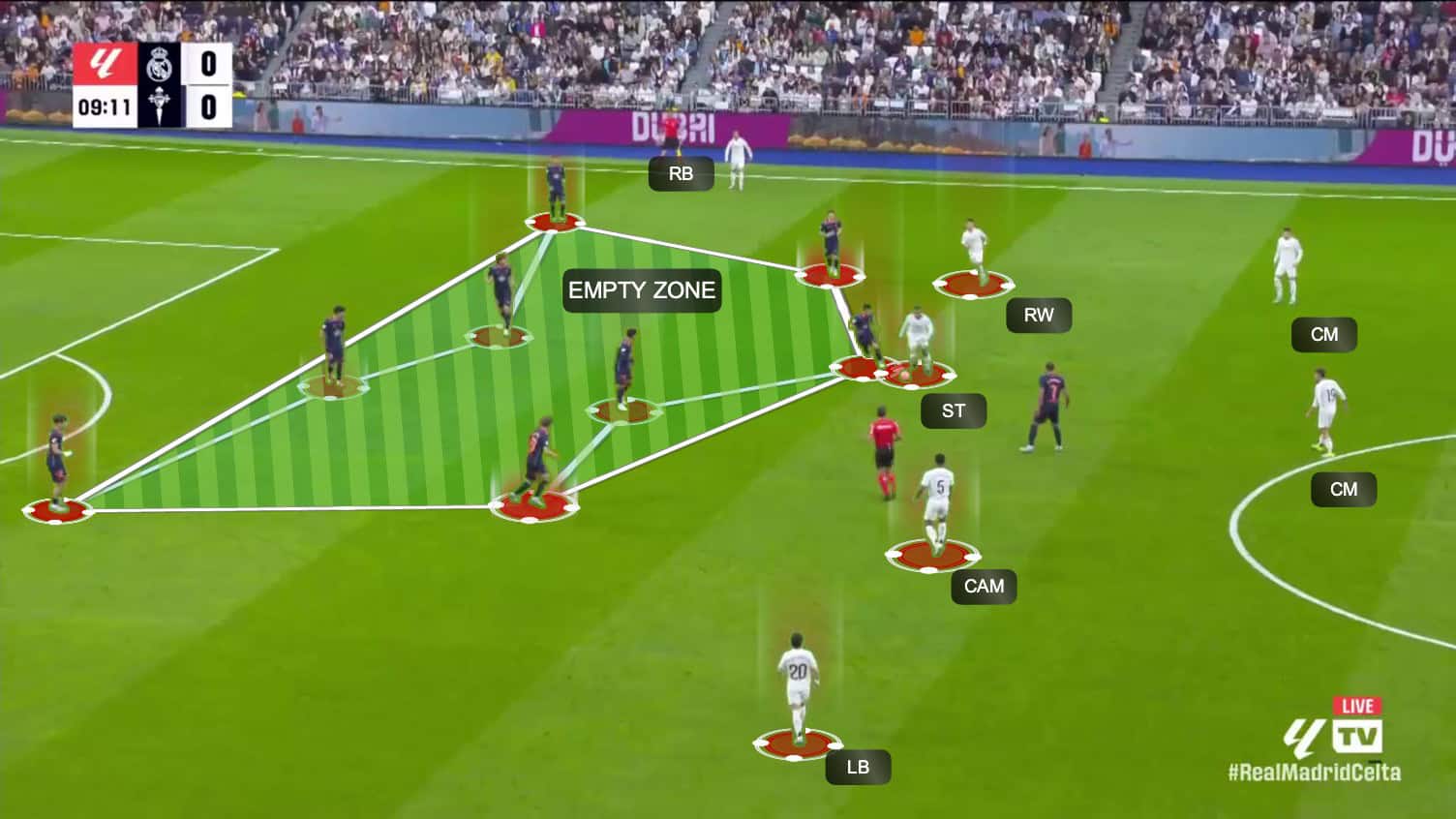
Mbappé comes short to receive the ball, while every teammate around him remains static, offering options only to his feet.
Vinícius stays wide, preparing for a potential one-v-one, but no runner threatens the space in behind.
As a result, a vast central zone remains unoccupied, the positional structure is maintained, but the attack loses any element of depth or surprise.
Yet, when Real Madrid chooses attacking depth, the entire dynamic changes.
Vinícius’ runs in behind, Bellingham’s central surges, and Mbappé’s explosive carries add direction and urgency.
Possession becomes a weapon, no longer just a framework.
Technical quality expresses itself through movement, not merely through control.
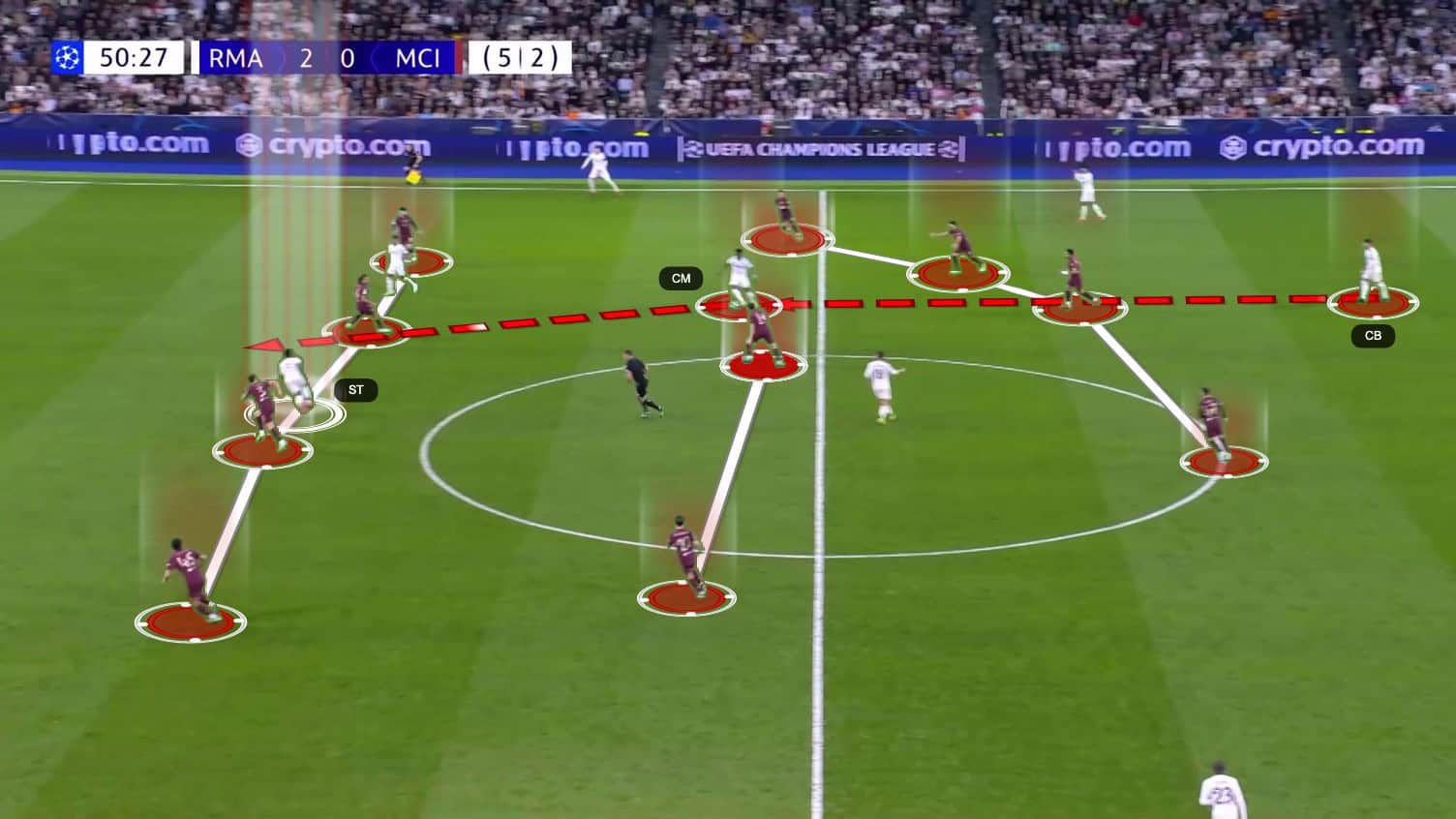
Our Real Madrid tactical analysis shows the true impact of attacking depth.
Raúl Asencio bypasses the first pressing line with a pass to Aurélien Tchouaméni, who quickly plays a line-breaking ball for Vinícius, who makes a diagonal run in behind.
The lack of static reference points, enabled by positional interchange between Vinícius and Mbappé, destabilises the defensive block.
With just two passes, the structure is dismantled, and the attack gains vertical acceleration.
Historical Shift: From Verticality To Structure
It hasn’t always been like this.
In the 1990s, verticality wasn’t a contingency but a guiding principle.
Teams built attacks on the idea that movement must precede the pass.
Players would run into space, and the ball would follow.
Marcello Lippi’s Juventus paired the ball-playing intelligence of Zinedine Zidane and Alessandro Del Piero with Filippo Inzaghi’s relentless runs in behind.
Similarly, Sir Alex Ferguson's Manchester United blended Paul Scholes' vertical vision with the dynamic movement of Ryan Giggs and Dwight Yorke, who constantly looked to break the line.
It was a less codified football, but one capable of striking decisively.
The turning point came with Pep Guardiola.
His Barcelona elevated possession into a philosophy, based on rational occupation of space, manipulation of pressing schemes, and territorial control.
But the founding principle, using the ball to disorganise the opponent, has been diluted in many modern interpretations, where control often replaces incisiveness.
The Tactical Value Of The Run In Behind
In response to this collective tendency, renewed value is found in the action that breaks the pattern: the run in behind.
Far from being an outdated idea, attacking space is one of the most modern and disruptive behaviours in football.
When everything gravitates around the ball, a sudden movement towards goal forces the defensive line to abandon its ideal shape.
The true impact of depth is not measured in metres covered, but in the type of problem it creates: it breaks connections, demands split-second decisions, and unravels what seemed structurally under control.
This principle can manifest in different forms.
One of the most frequent is the diagonal run made by the right-winger or left-winger behind the full-back.
Starting wide, the player cuts inside as the ball reaches the final third, targeting the blindside gap between full-back and centre-back.
Its effectiveness lies precisely in its subtlety, devastating because it often escapes immediate detection.
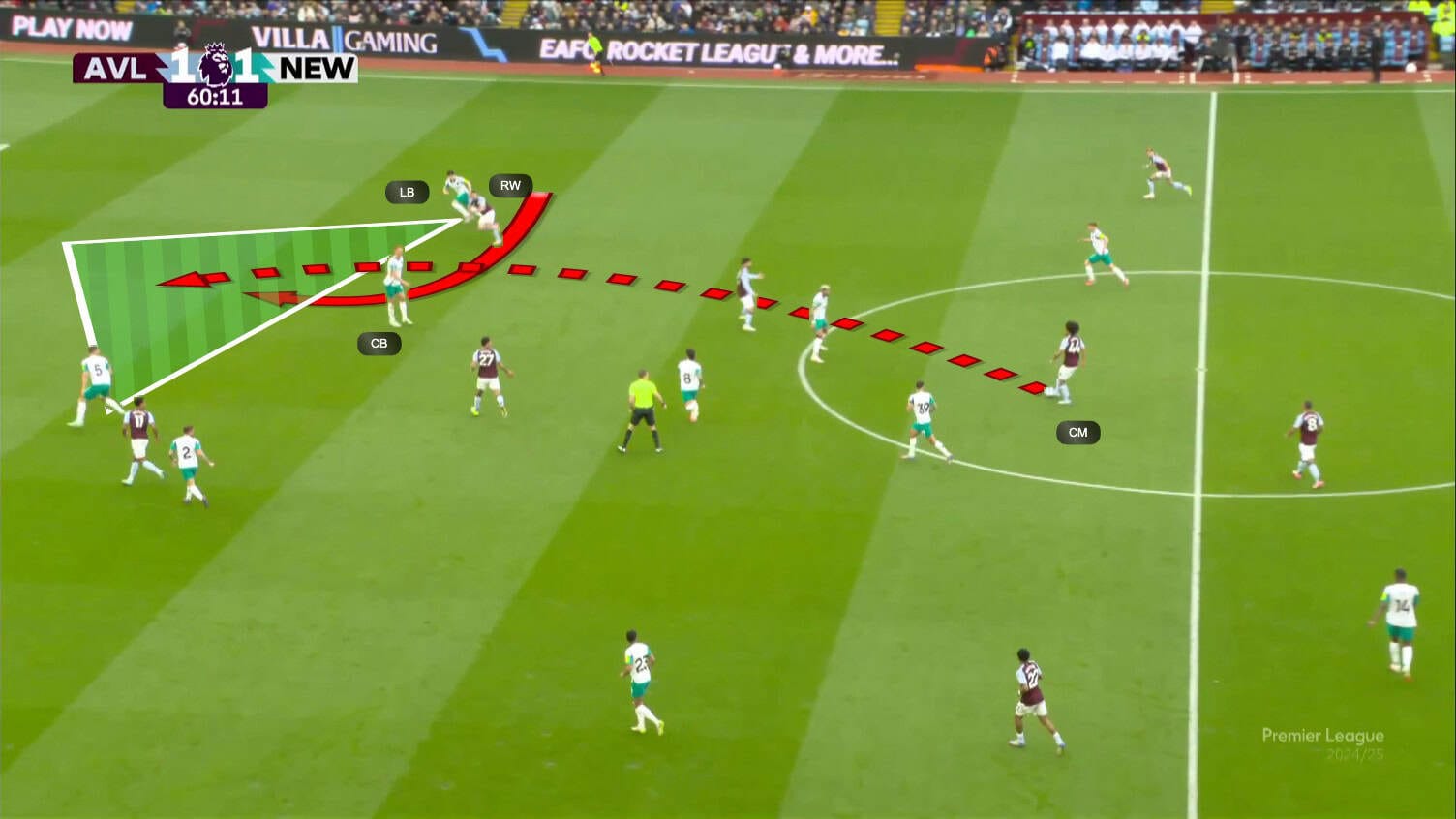
Aston Villa under Unai Emery demonstrate the value of well-timed depth runs.
Boubacar Kamara recognises Morgan Rogers’ blindside movement as the winger cuts across the full-back and into the space behind centre-back Dan Burn.
The run is curved, elusive, and perfectly synchronised with the timing of the pass.
Another typical scenario stems from the third-man run by a central midfielder.
Following a one-two or a pressure-drawing reception, the third player, often arriving from deep, bursts into the space that has been vacated.
This delayed, and well-timed movement catches defences locked in on the ball carrier completely off guard.
It is a form of intelligent verticality, based on reading the game, perfect timing, and bravery.
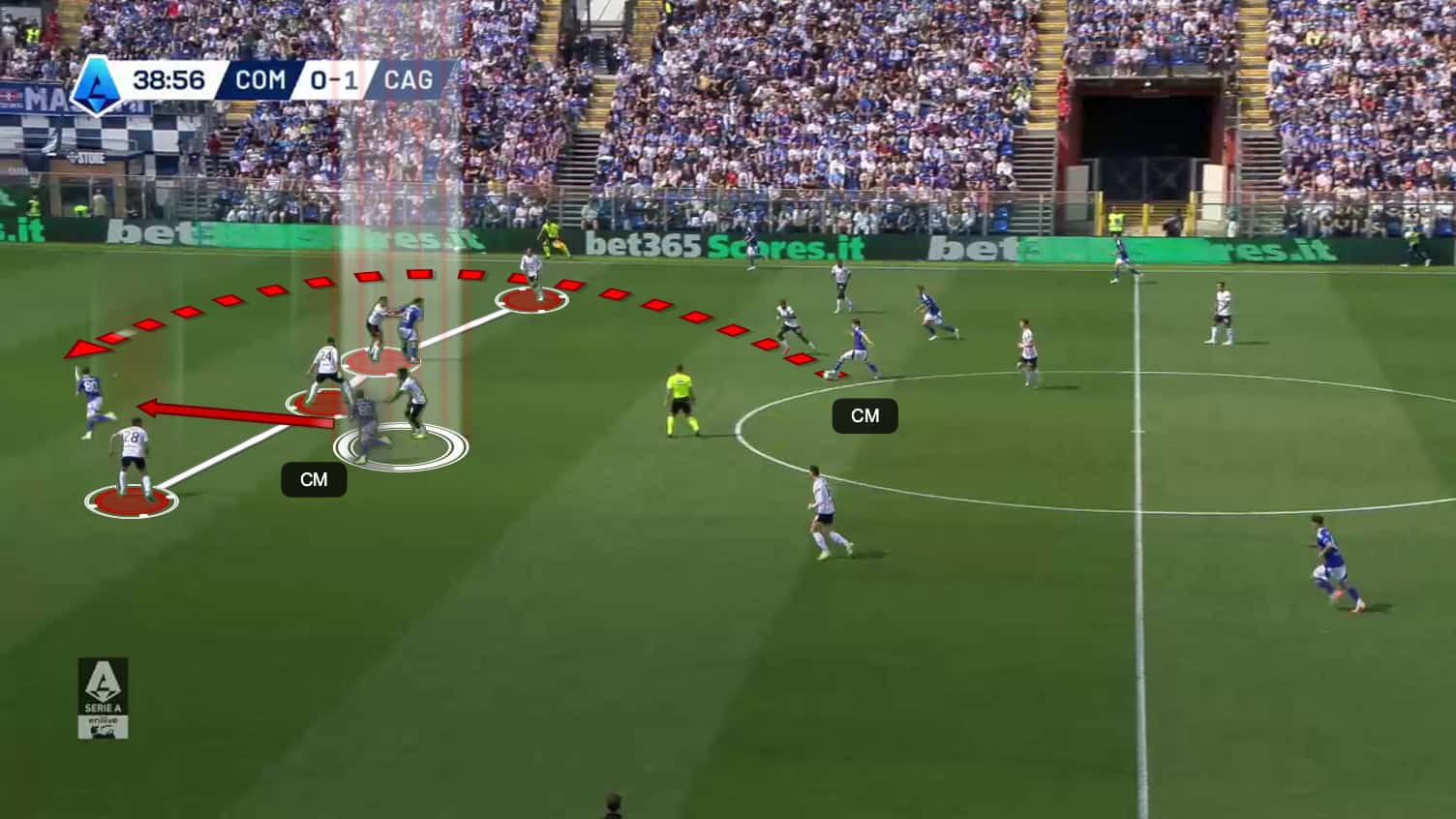
This sequence exemplifies the value of a well-executed third-man run in Como vs Cagliari.
As soon as Máximo Perrone receives the ball, he lifts his head and identifies Maxence Caqueret’s movement.
The midfielder sheds his marker with perfect timing and targets the space between the centre-back and full-back.
His run is explosive, deliberate, and untracked, qualities that transform a simple pass into an assist and positional control into an actual breakthrough.
It’s a clear example of vertical intelligence applied at the right moment, turning possession into an immediate threat.
Lastly, depth can be attacked directly by the ball itself.
A line-breaking pass that pierces the defence, even from deep areas, can prove more valuable than 10 sideways touches.
In these moments, the technical gesture creates the advantage: it anticipates the run, forces a shift in the backline, and ignites an immediate transition.
The pass doesn’t wait for the runner; it leads him.
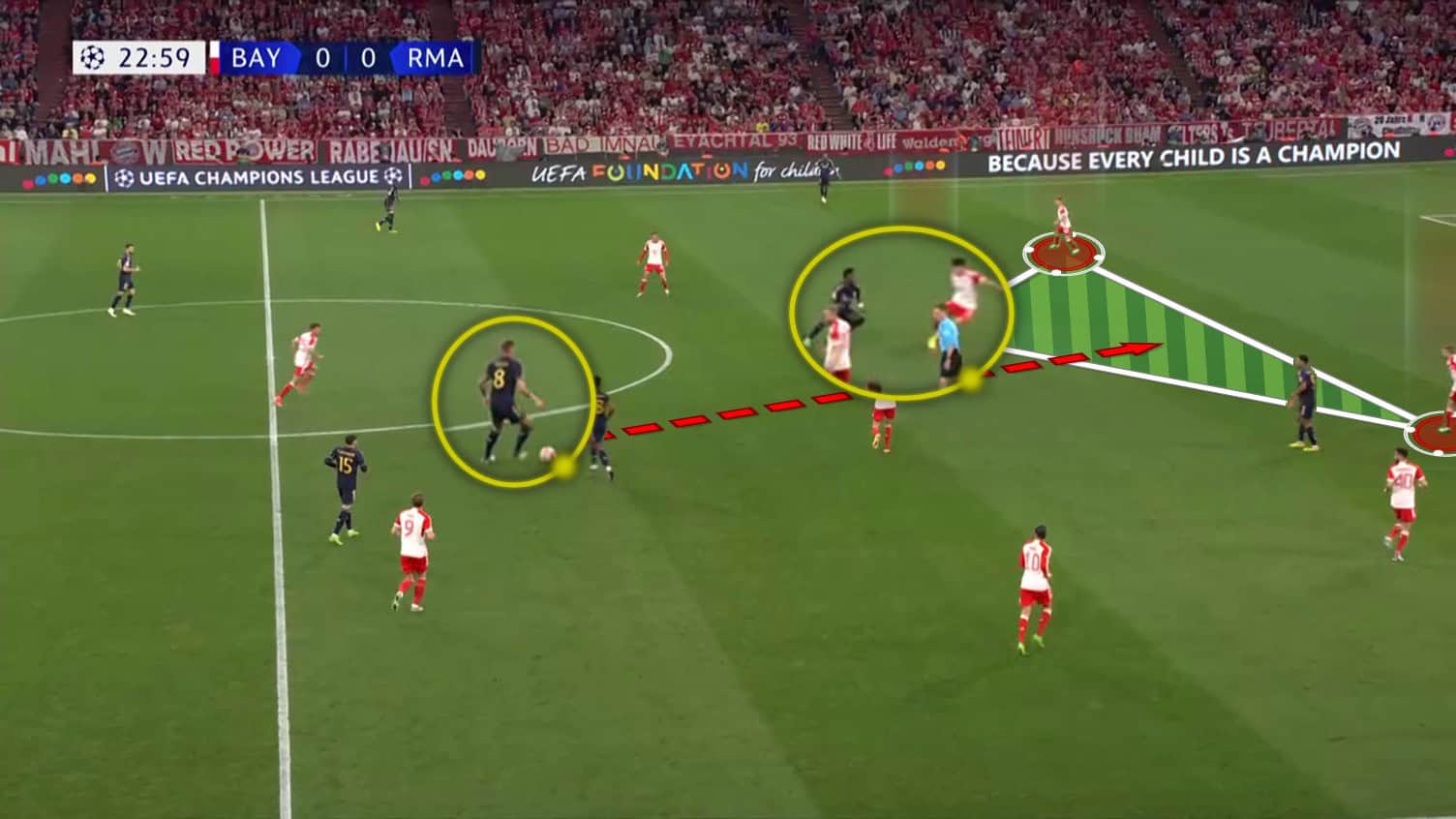
This assist from Toni Kroos in the 2023/2024 UEFA Champions League semi-final against Bayern Munich is a prime example of how vertical threats can be created directly by the ball itself.
As Vinícius initially comes short, Kroos not only holds the ball but also gestures towards the space to be attacked.
The Brazilian responds with a split-second counter-movement, peeling off Kim Min-jae and timing his run in behind to perfection.
The pass slices through the defensive line and unlocks the match.
It’s not the first time this duo has executed such a move.
In the 2020 Clásico at the Santiago Bernabéu, Kroos similarly dictated play and guided Vinícius into space, resulting in the opening goal.
These moments underline the idea that a pass can do more than connect two players; it can anticipate movement and trigger the decisive action.
Attacking Depth In Football: Why It Wins Matches
In all these cases, it’s not just about running, it’s about knowing when to run.
The real edge emerges in the precise instant when the line steps up, slides across, or tries to adjust.
That is where the advantage lies.
Not at the foot, but in the run.
Not in the structure, but in the intelligent disruption.
In a game increasingly governed by structure and rationality, the run in behind feels almost counterintuitive.
It doesn’t show up on heat maps, it doesn’t inflate possession stats, and it rarely fits within the codes of positional play.