How To Coach Defensive Transitions Like Jürgen Klopp - Tactical Theory

Having players quickly react to a loss of possession is an issue that can plague even teams at the highest level in the game.
When coaching this aspect of the game, it is often useful to constantly have transition moments throughout other sessions.
Defensive transition can be a sub-focus in a session on building out from the back, for example.
If we only visit attacking and defensive transitions in those rare sessions where we dedicate the entirety of the practice towards these elements of the game, then not only are we likely to struggle, but teams also have a habit of separating them from the other moments in the game.
Teams that are often slower with their defensive transition, for example, have a habit of looking as if they go through the motion of in possession, to defensive transition, to defence, to attacking transition.
However, incredibly efficient counter-pressing sides like Liverpool will often position players in their attacking phase so that they are ready to move instantly into the defensive transition phase.
They are actually already in defensive transition when they have the ball, anticipating the loss of possession and ready to move into specific areas as soon as the ball is lost.
Using counter-pressing in defensive transition can be highly useful for a number of reasons.
Firstly, if you are a possession side, then you want the ball as often as possible.
Therefore, upon a loss of possession, it makes sense to regain the ball as quickly as you can, rather than dropping back into a deeper defensive shape.
However, former Liverpool manager Jürgen Klopp was often quoted as saying that it can be used as a playmaker.
Teams may strategically turnover possession in certain areas of the pitch before using their players in the immediate vicinity to press, win the ball, and attack quickly as the opponent has transitioned into attack, leaving them open to a direct attack through the centre of the pitch.
Finally, it can be a highly useful approach to prevent a counter-attack.
By providing pressure around the ball, it can delay an attack, preventing the opponent from immediately being able to play through the centre of the pitch.
The intensity of the counter-press can also provide time for defenders further away from the ball to get back into shape and protect the central channel.
Your emphasis on this moment may be slightly different depending on your philosophy and game model, so the practices suggested in the article and your game model can, of course, be tailored to suit your needs.
This tactical analysis provides some ideas for structuring a session on defensive transitions.
It will examine how to coach some of the basic tactics of defensive transition and analyze some of the key moments we may want to highlight in such a session.
Exercise 1
Defensive transitions cannot be effective if we don’t understand how to prevent the opponent from breaking away from our counter-press and entering into the attacking phase.
A good primer activity can be something like a 6v2 or 6v3 rondo, where when one of the two defenders wins the ball, they look to dribble out of the square.
They can combine or go alone.
However, if the attacking team can prevent them from doing this, then they have to continue as defenders.

The area should be made wide enough to give the defending team a decent chance of achieving this, whilst passes along the width of the grid, as shown below, can be stopped to ensure the defensive duo stands a chance in this wider area, and of course, we can therefore force more turnovers.

You want to initially approach the idea of having players immediately react to a loss of possession by pressing the ball, and we can offer it out to the players to decide on which players should be doing this (they will often settle on the person who lost the ball and the next closest player).
You can then build this into a bigger positional game.
For this example, you will use a 4v4 + 5, but it can vary based on the number and quality of the playing group.
Size-wise, you don’t want this area to be too big to give your group a chance to counter-press effectively.
Generally, somewhere in the region of a 16x16 or 20x20 will suffice.
There are four bounce players around the edge of the pitch, and in order to ensure they can’t just easily switch play, we can put these players on one or two touch limits where they provide the option to bounce the ball too, but aren’t going to always break lines.
There is also a central neutral player.
This player will always provide that central passing line option for the attacking transition team, representing the forward pass we most definitely don’t want to allow the opponent to find.

Teams simply want to connect eight passes to score a goal.
However, if the defending team wins possession and can play a pass out of the square to a teammate in which they have won possession within five seconds, then they immediately get the ball.
By rewarding the team in attacking transition for a behaviour, you should bring out a behaviour from the defensive transition team, too.
At times, rewarding the team we aren’t necessarily focusing on can be more powerful than doing so with the focus team.
Here, for example, we might say to the defensive transition team, they get a goal for preventing the opponent from breaking out of the square where the ball was turned over.
It can work well, but there can be times when the possession team isn’t quite at the races.
The defensive transition team may know that, should they just win the ball back whenever, they can dominate in possession and aren’t any worse off.
However, instantly providing a reward for the attacking transition team can ensure intensity from the defensive transition team.

Not only do we want pressure on the ball, but players further away from it should look to support their team around it, getting as close as possible to, if not inside, the square the ball has been lost in.
They should also protect passing lines and look to step forward to cover any easy passes the player in possession may have.
Exercise 2
Following on from this exercise, you can then move on to a 6v6 +3 or something similar.
This positional game is an excellent way to continue to develop defensive transition principles and builds nicely from the previous exercise.
You can see the setup in the image below with four goals positioned around the outside of the pitch.

Just like in any positional game set-up, the team in possession looks to connect passes, using the three central players to provide them with an overload.
Again, the team in possession could look to connect on between 8-12 passes to count as a goal.

Once the ball is turned over, the red team, in this instance look to counter-press and the blue team looks to transition out towards the edge of the pitch.

What you should be looking for is, firstly, to continue seeing a speed of reaction from the team in defensive transition.
However, you can use this practice as a way to fine-tune the defensive transition process.
In order to do this, the team in attacking transition has the opportunity to score in one of the four mini-goals within the first five seconds.
If they can do this, they instantly get a goal, and then get the ball back with them now attacking, where they can seek to score another goal by connecting passes once more.
This immediate option to score should prompt the team in a defensive transition to react quickly, first of all, to the loss of possession.
However, whilst we want pressure around the ball, we are looking for the players further away from the action to still affect the play.
They can do this by covering the other goals away from the loss of possession.
Goals should be positioned at least five yards away from the field so players can’t just stand in front of the goal and block it, and instead are forced to use their positioning to shield the goal.
As a group, the team in defensive transition should look to come to a solution together.
For example, below we can see that the three closest players to the loss of possession are counter-pressing whilst the other players still step into the grid but are looking to block the other three goals available to the opponent.

Exercise 3
Finally, you can move onto an even more game-realistic situation, using a slightly narrower pitch to give your group a good chance of counter-pressing effectively from slightly wider positions.
The pitch will be divided into three areas, with one area being the halfway line to the goal, and another area being the standard 18-yard area, leaving us a much larger central third.
The bulk of the game will be played in this central third, with the halfway line and 18-yard-line acting as offside lines.
The blue team in this example will be the focus side, and they enjoy an outfield overload of 7v6, but the goalkeeper should be encouraged to be an active participant in possession to make it an even more favourable 8v6 overload.

You are looking for the possession team to connect, using outside players, who should be encouraged to play on two touches as a maximum, but three is acceptable if it is fully necessary.
You should prevent your outside players from playing a pass down the line, so the pass must come inside to make it challenging for them to progress the ball.
If a cross is coming in from one side, then the winger on the far side can move into the area to attack the ball as they would do in a game.
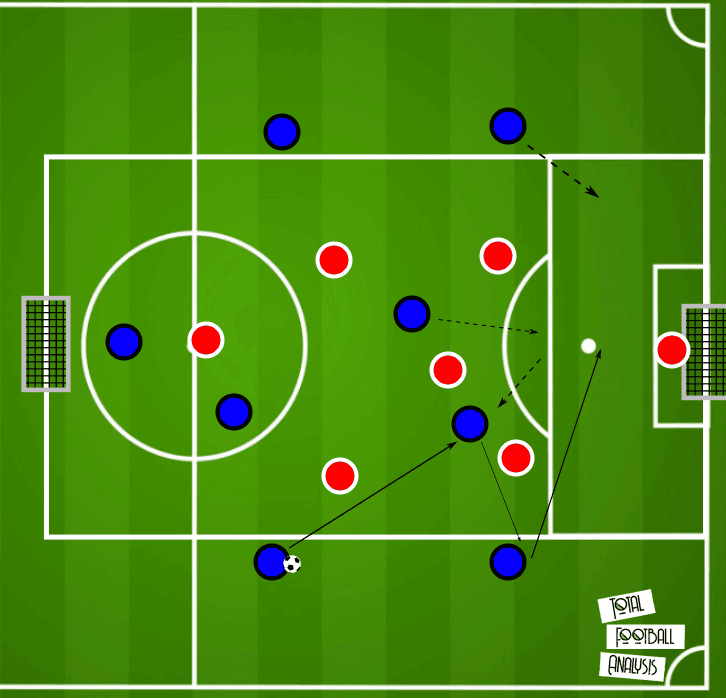
If the red team wins possession, they can be given a time limit within which they must score.
Eight seconds is plenty of time for them to combine and work the ball towards the opposition's goal.

However, building on this session, you should now allow the outside players to move inside to get compact and counter-press when necessary.