How To Develop Midfielders Like Rodri: Coaching Elite Movement And Positioning - Tactical Theory

A team’s chances of success in modern football rely heavily on the qualities of their holding midfielder.
Especially in the build-up phase, the ‘6’ becomes a de facto quarterback whose movements and decisions impact every other player.
Technique, movement and tactical understanding are the core attributes that determine the calibre of these playmakers.
This tactical theory will analyse the movements and traits of one of the highest-performing holding midfielders at the last Euros and the 2024 Ballon d'Or winner.
Rodri will be used in this analysis to highlight the traits that make him one of the best players in his specific position.
The analysis will use examples from the previous European Championship and show how the former UEFA Champions League winner is as instrumental to his country as he has been for Pep Guardiola's Manchester City.
This tactical analysis will suggest how coaches can develop and/or improve their holding midfield players' tactics and technique through example practice exercises.
Rodri’s Timing And Body Shape
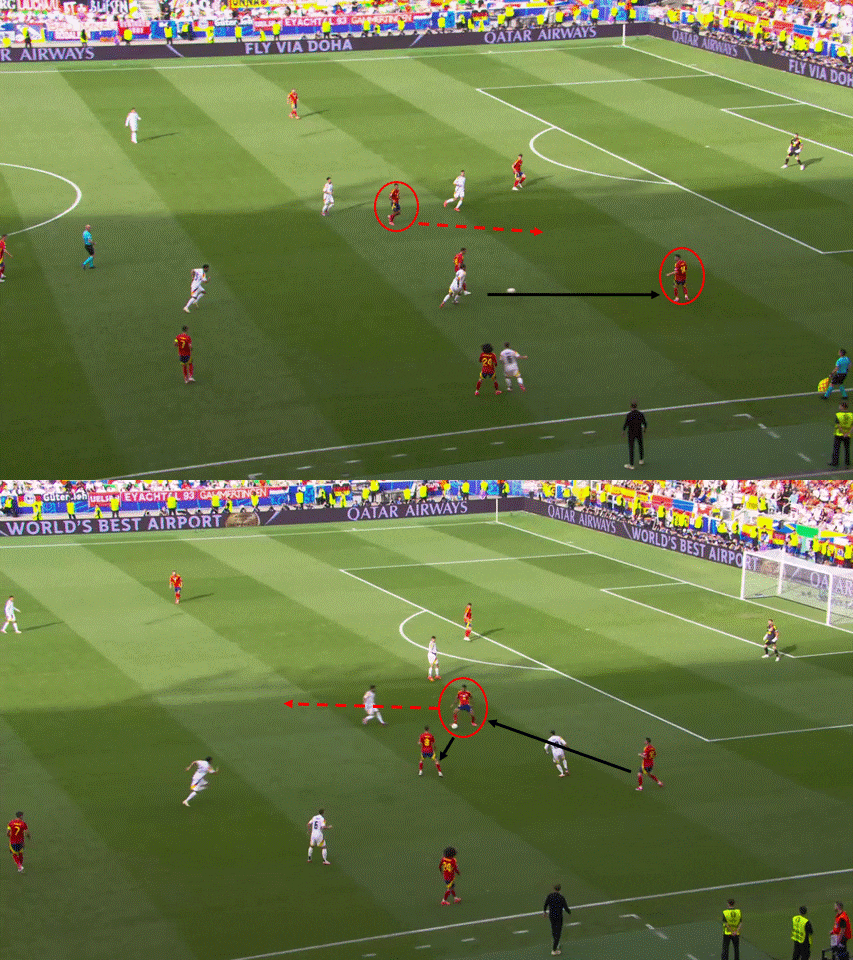
In this example, Rodri proves the effectiveness of simple movements and, importantly, the timing of those movements when progressing the ball.
As Rodri’s midfield partner passed the ball backwards to his left centre-back, the four-time Premier League winner stayed away from the ball, almost looking disinterested in partaking in the play.
Just as the centre-back was about to receive the ball, Rodri burst away from his marker to show for the ball.
By waiting until the last second, Rodri made himself impossible to pick up and created the five yards of space he required to receive the ball.
Rodri, aware of his surroundings and having created enough separation from the nearest defender, knows he can then open up.
Importantly, he does this as the ball is travelling to him.
His previous closed body orientation triggered the nearest opposition player to press him as the ball was passed.
His open body allows him to see his next pass and play first time around the onrushing pressing player.
Although in this example, he does not receive it, Rodri made himself available for a bounce pass (on the now) blindside of the pressing player.
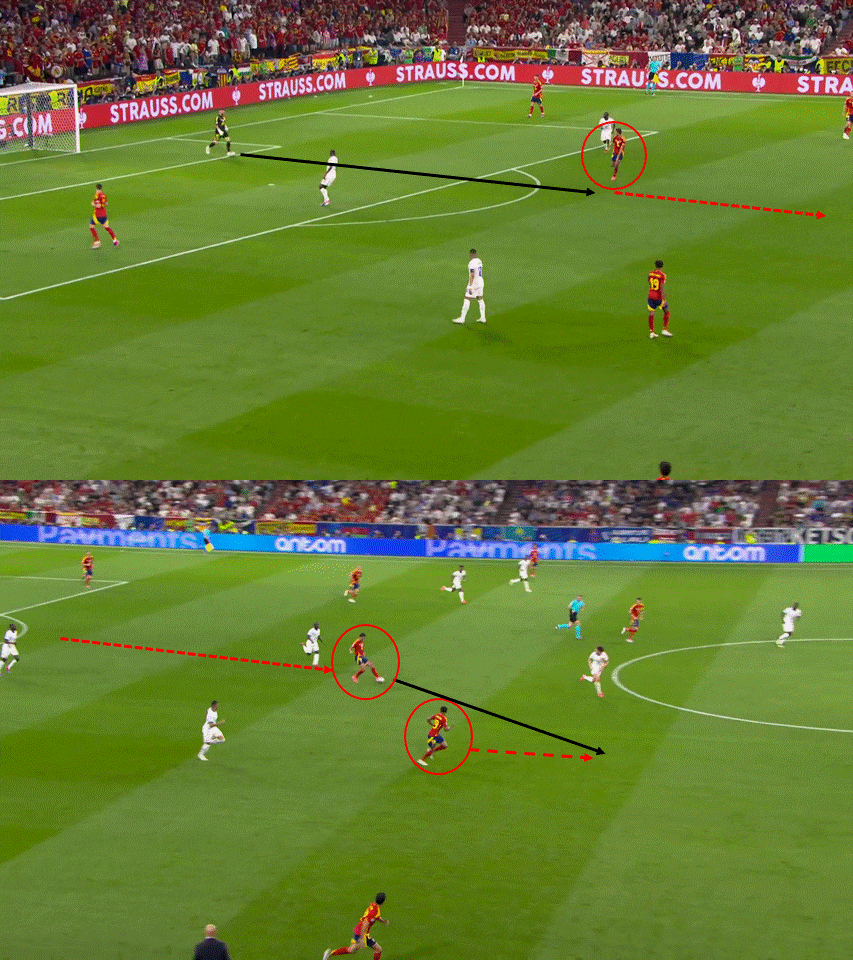
In this example, when receiving from his goalkeeper, Rodri’s simplicity of movement and original positioning, coupled with his awareness obtained through constant scanning, allow the midfielder to let the ball roll across him.
With his back to the nearest pressing player, his initial body orientation allows him to keep the ball on his safe side.
He can cleanly advance the ball 20 yards higher up the pitch without even touching it.
At this point, while on the move, he plays the ball into the path of Lamine Yamal, and within two passes, Spain is attacking the opposition's backline.
Standing Still To Receive
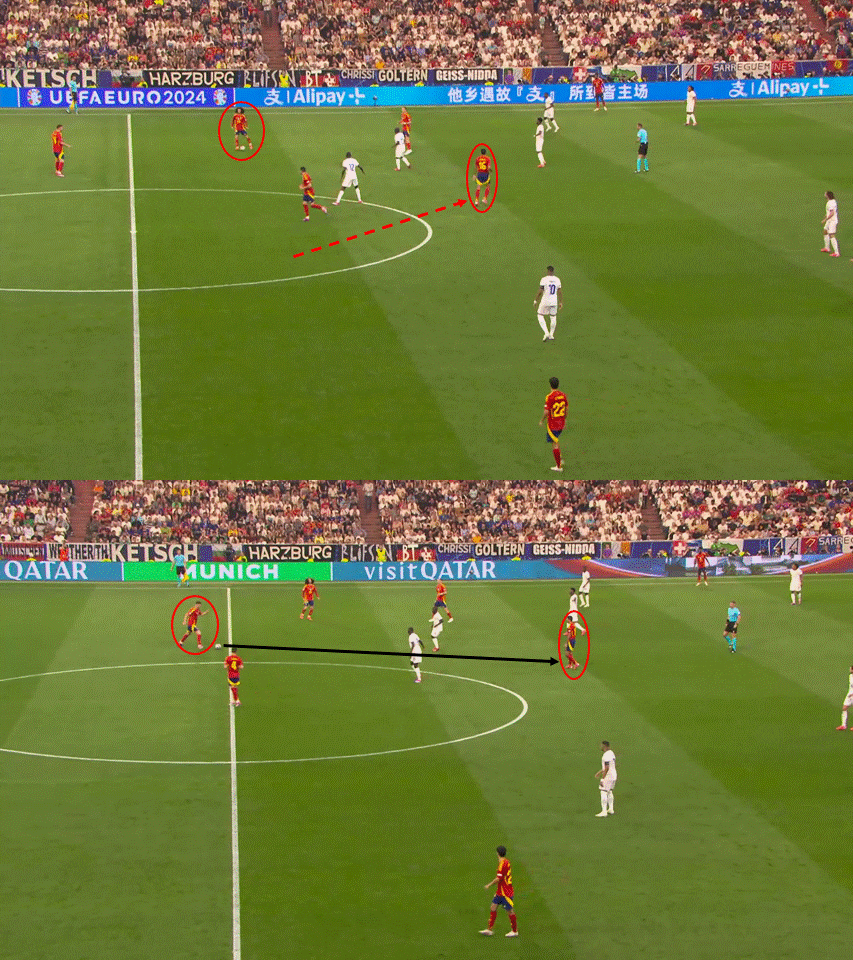
The above images show Rodri arriving from a centre-back position and sneaking behind the opposition's first line of pressure when the ball is in the wide area.
This central zone is an area often deliberately left empty by Spain to allow players to move into it, out of sight of the defending players.
When in this pocket of space, Rodri, instead of constantly moving with the ball, stands still.
Too often in these scenarios, midfielders waste energy by constantly moving and often reduce their own space by making movements towards the ball.
As the ball is passed across his back line, Rodri remains static, allowing passing lanes to open up as his teammates move the ball.
As the ball is moving, Rodri scans continually to take in his surroundings.
When a pass into him becomes available, he is aware enough to receive in this space despite being surrounded by opposition players.
By remaining relatively still, he is comfortable enough to control the ball.
Receiving the ball here attracts pressure from all sides, opening up multiple teammates.
Protecting The Ball
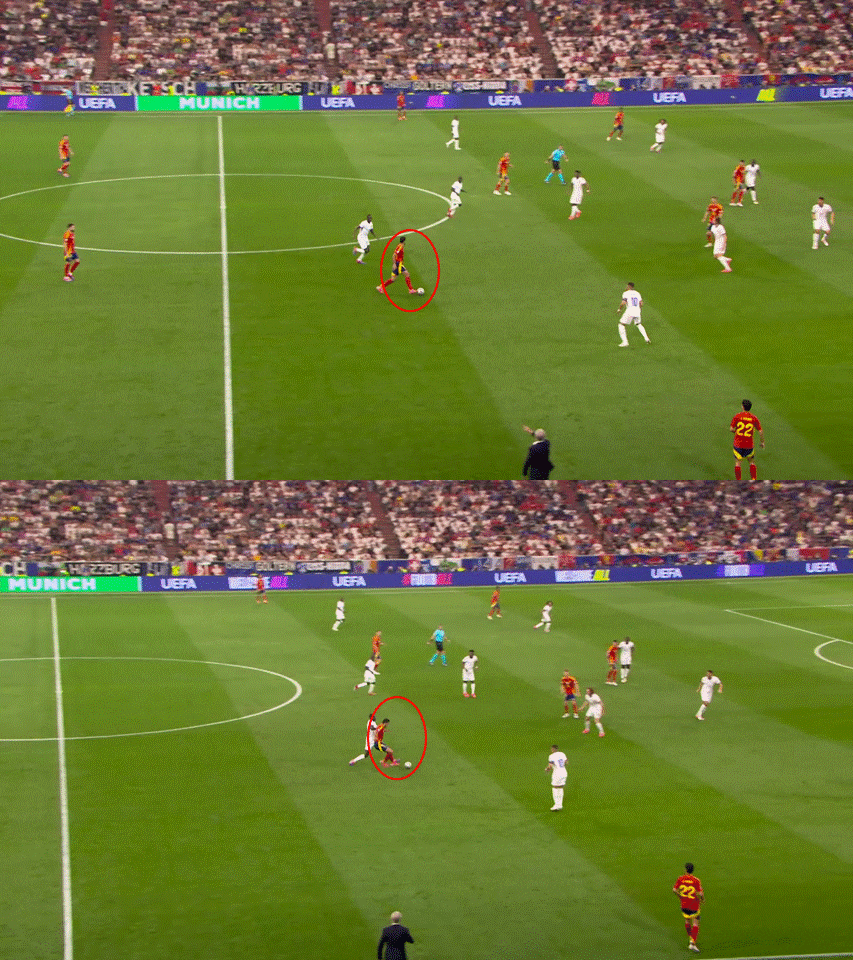
This image, similar to when Rodri received from his goalkeeper, shows his intelligence in protecting the ball.
By initially scanning before receiving the ball and then playing with his head up, Rodri knows where the pressure is going to arrive from.
As he sees he is being pressed, he orientates his body between the pressing player and the ball.
As he is about to take the impact, he braces by lowering his body and bending his knees.
This gives him more stability and allows him to rebuff the challenge whilst keeping the ball safe.
Of course, Rodri possesses height and strength that no doubt aid him in this situation.
However, it is how he uses the physical attributes that make him so hard to dispossess.
‘6’ Passing Sequence
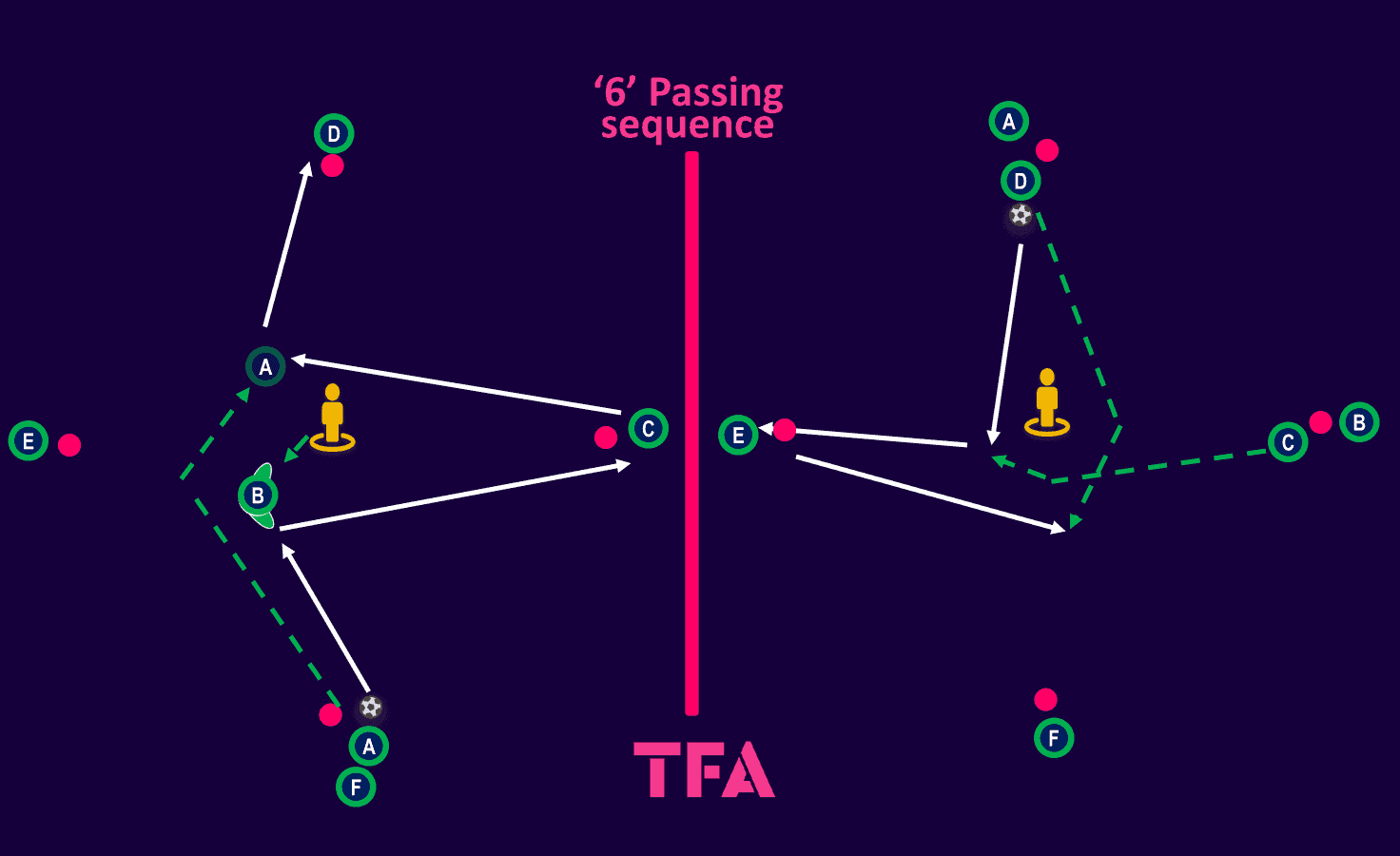
This passing sequence is designed to develop midfield players' receiving and combining abilities.
It embeds the subtle movements, body orientation and timings required to play the holding midfield role.
The sequence begins with player ‘A’ passing into the middle to ‘B’, who has opened their body up to receive and play a first-time pass to ‘C’.
As the ball is bounced wide, ‘A’ makes an overlapping run to receive a bounce pass on the other side of the mannequin.
‘A’ then plays the ball to the other side, with ‘C’ making the central run, and the sequence starts over.
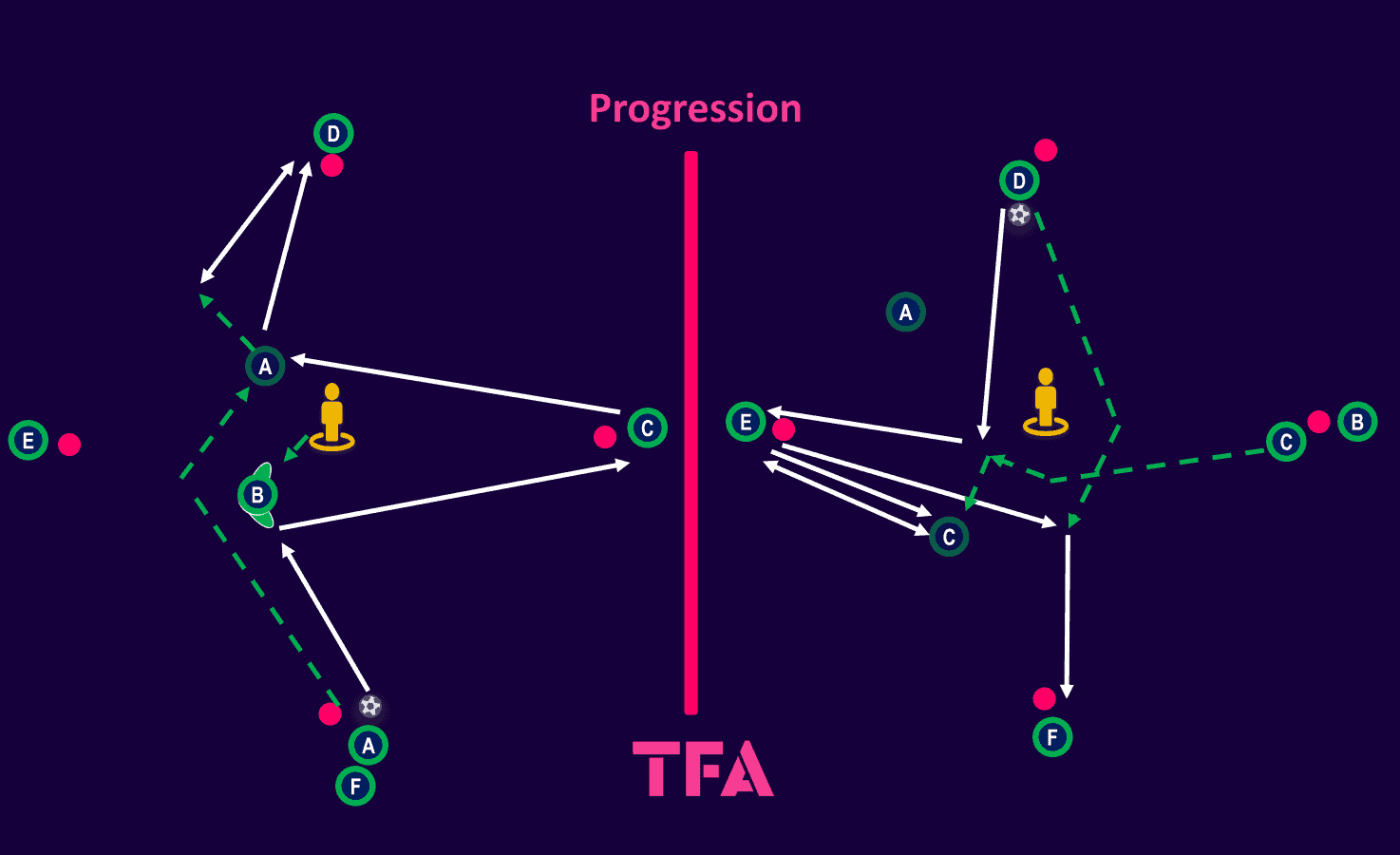
A progression for this exercise is for the player on the outside to receive a bounce pass.
This develops players' ability to create separation from their marker to then exploit the space behind their direct opponent when they jump to the ball.
Coaches should emphasise an initial closed body shape to act as a pressing trigger for the opposition before opening up to provide the possibility of playing forward.
The timing should be to burst into space just as the previous pass is about to reach their teammate.
This makes the working player more difficult to pick up.
‘6’ Transitional Rondo
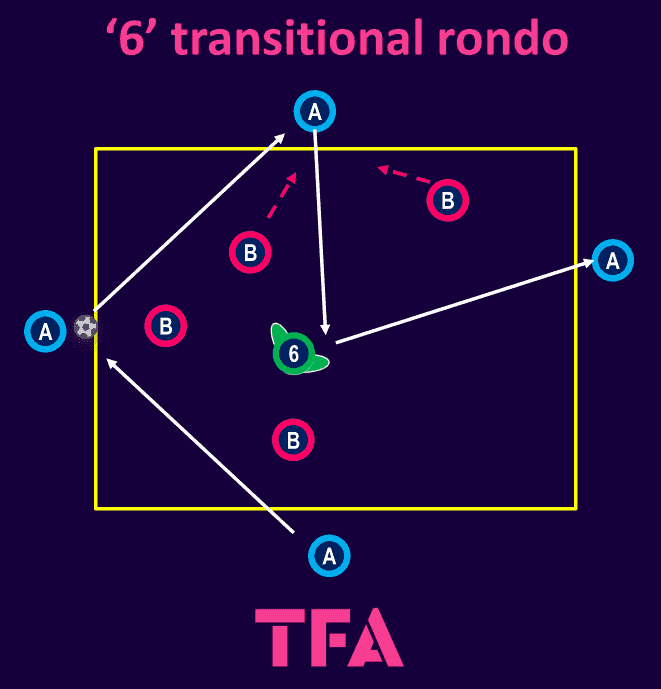
This rondo is designed to work on 6’s receiving in pockets of space surrounded by opposition players.
It simulates the scenario of Rodri receiving standing still beyond the first line of pressure.
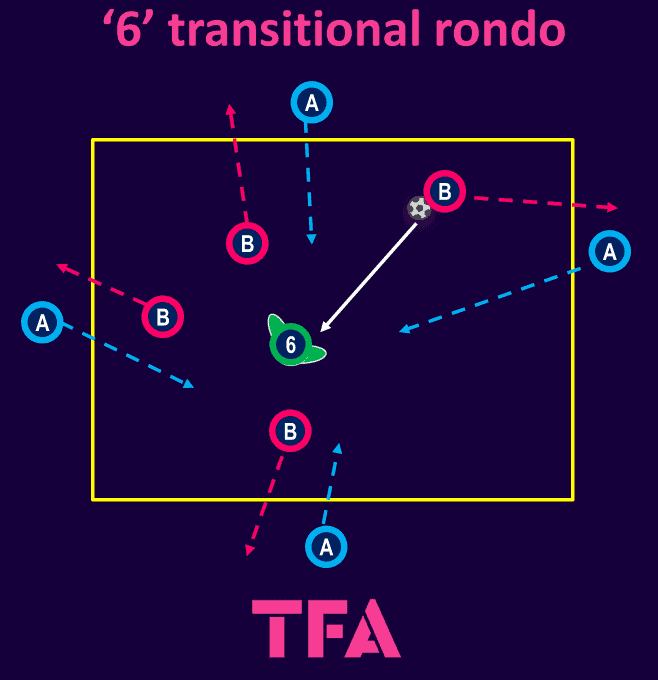
The ‘6’ is a neutral player, playing for whichever team has the ball, in the centre of the box.
The in-possession team is dispersed, with one player on each side.
All four of the defending team players are inside the box.
The attacking team aims to keep possession and score points by finding the ‘6’.
Points are awarded when the ‘6’ receives and plays out to any one of the other side players.
Should the defending team win the ball, they become the attacking team by finding the ‘6’ before replacing the side players.
Whichever team scores the most points in the set time given is the winner.
To encourage the defending team to be aggressive in pressing, points can also be given for a certain number of passes made, regardless if it goes through the ‘6’.
Depending on the level of player working with, a defender can be removed to increase the chances of success.
This can be done by adding a neutral to one of the sides with both teams, then having three players each.
The working player should, as much as possible, allow the ball to do the work and not move too frantically.
This, in a match, would allow the midfielder to receive behind the line of defence and receive calmly.
They should be encouraged to scan to make themselves aware of the positioning of the opposition and their teammates.
Three-Zone Game
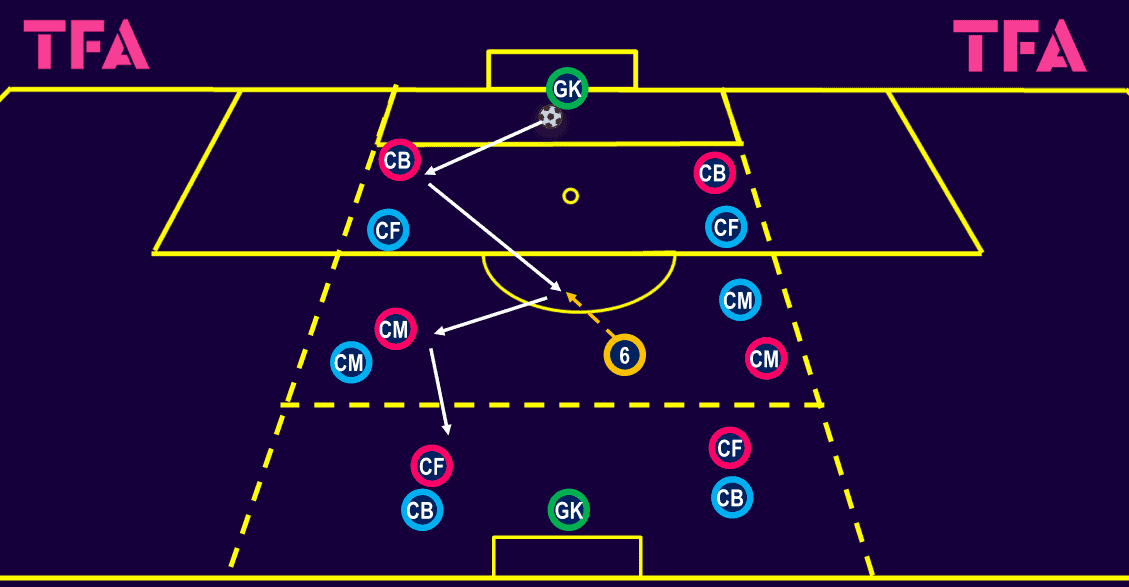
This narrow three-zone game is designed to work on the ‘6’s’ movements in the build-up phase in a game-like scenario.
Each team comprises of a goalkeeper, two centre-backs, two central midfielders, and two forwards—a neutral player, who is a designated ‘6’, plays for the in-possession team.
The ‘6’ can move freely between the in-possession team's defensive and midfield zones, creating an overload in each zone.