
![Chelsea Vs Manchester City [0-1] - FA Cup Final 2025/2026: Control, Patience & A Moment Of Quality – Tactical Analysis](https://cdn.mymidnight.blog/77f959f119f4fb2321e9ce801e2f5163/size/w1000/2026/05/FA-Cup-Final-20252026.png)
Chelsea Vs Manchester City [0-1] - FA Cup Final 2025/2026: Control, Patience & A Moment Of Quality – Tactical Analysis

Manchester City lifted the 2025/2026 FA Cup after a narrow 1-0 win over Chelsea at Wembley, but the final was not defined by attacking dominance or constant chance creation.
Instead, Pep Guardiola's side had to solve a match built around defensive resistance, tight central spaces and very few clear openings.
Antoine Semenyo eventually scored the decisive goal after 72 minutes, turning Erling Haaland's low cross into the bottom corner with an instinctive back-heeled finish.
For Chelsea, the performance was competitive and organised, but also limited.
Calum McFarlane’s side defended with discipline, protected central areas well and frustrated Manchester City for long spells.
However, their conservative approach left them short of threat in the final third, and once City found one moment of quality, Chelsea struggled to respond.
This tactical analysis will examine Chelsea’s defensive structure, Manchester City’s use of width through Jérémy Doku and Semenyo, the role of Nico O’Reilly in the left half-space, and how Erling Haaland’s movement as a provider helped decide the FA Cup Final.
Chelsea Vs Manchester City Lineups & Formations
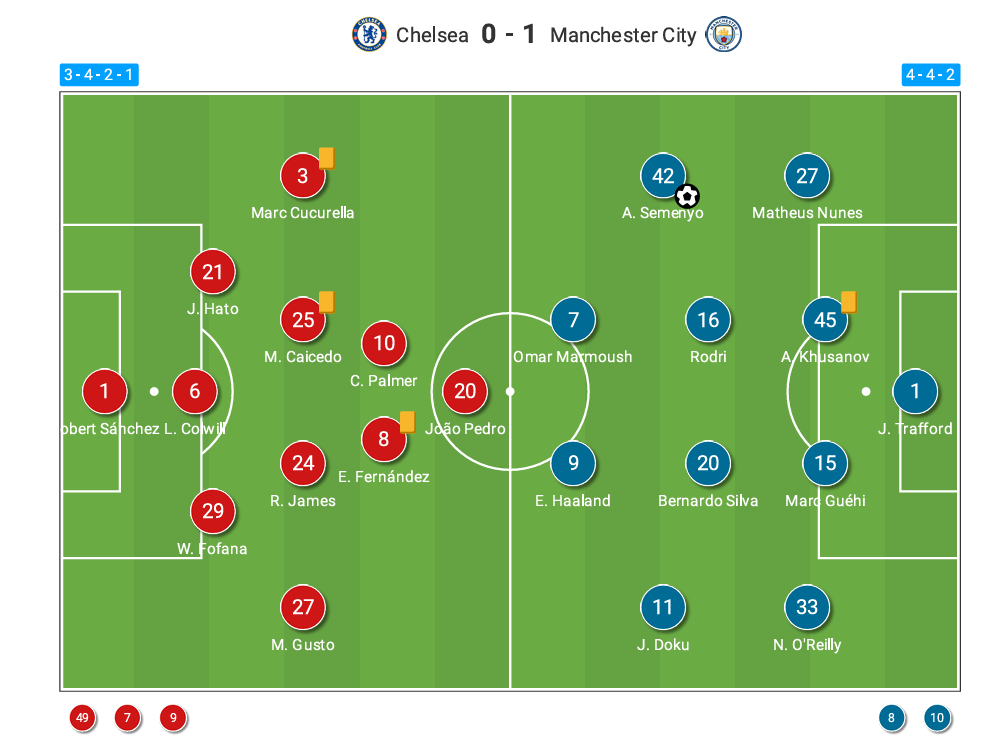
Chelsea Lineup Vs Manchester City
Chelsea started in a 3-4-2-1 formation, with Robert Sánchez in goal.
Wesley Fofana, Levi Colwill and Jorrel Hato formed the back three, while Malo Gusto and Marc Cucurella operated as wing-backs.
Reece James partnered Moisés Caicedo in midfield, with Enzo Fernández and Cole Palmer supporting João Pedro.
Without possession, Chelsea regularly dropped into a 5-4-1 defensive block.
Gusto and Cucurella joined the backline, while Fernández and Palmer narrowed alongside James and Caicedo.
João Pedro remained the highest player, mainly providing an outlet for counterattacks and long passes into the channels.
Manchester City Lineup Vs Chelsea
Man City started from a nominal 4-4-2 shape.
James Trafford started in goal, with Matheus Nunes at right-back, Abdukodir Khusanov and Marc Guéhi as centre-backs, and Nico O’Reilly at left-back.
Rodri and Bernardo Silva formed the midfield base, with Antoine Semenyo on the right and Jérémy Doku on the left.
Ahead of them, Omar Marmoush operated close to Erling Haaland as City’s second forward.
However, City’s structure changed significantly in possession.
Rodri acted as the main positional midfielder, Bernardo Silva moved freely towards the ball, and O’Reilly often stepped inside from left-back to become an additional interior player.
Doku and Semenyo provided the width, while Haaland pinned Chelsea’s centre-backs, and Marmoush looked to occupy spaces between Chelsea’s midfield and defensive line.
Chelsea Defensive Structure & Central Protection
Chelsea’s main priority was to deny Manchester City access through the middle.
McFarlane’s side defended with a compact back five and a narrow midfield line, making it difficult for City to connect with Marmoush, Bernardo Silva or Haaland between the lines.
This was especially important because Guardiola’s teams are at their most dangerous when they can combine through central spaces before releasing runners into the box.
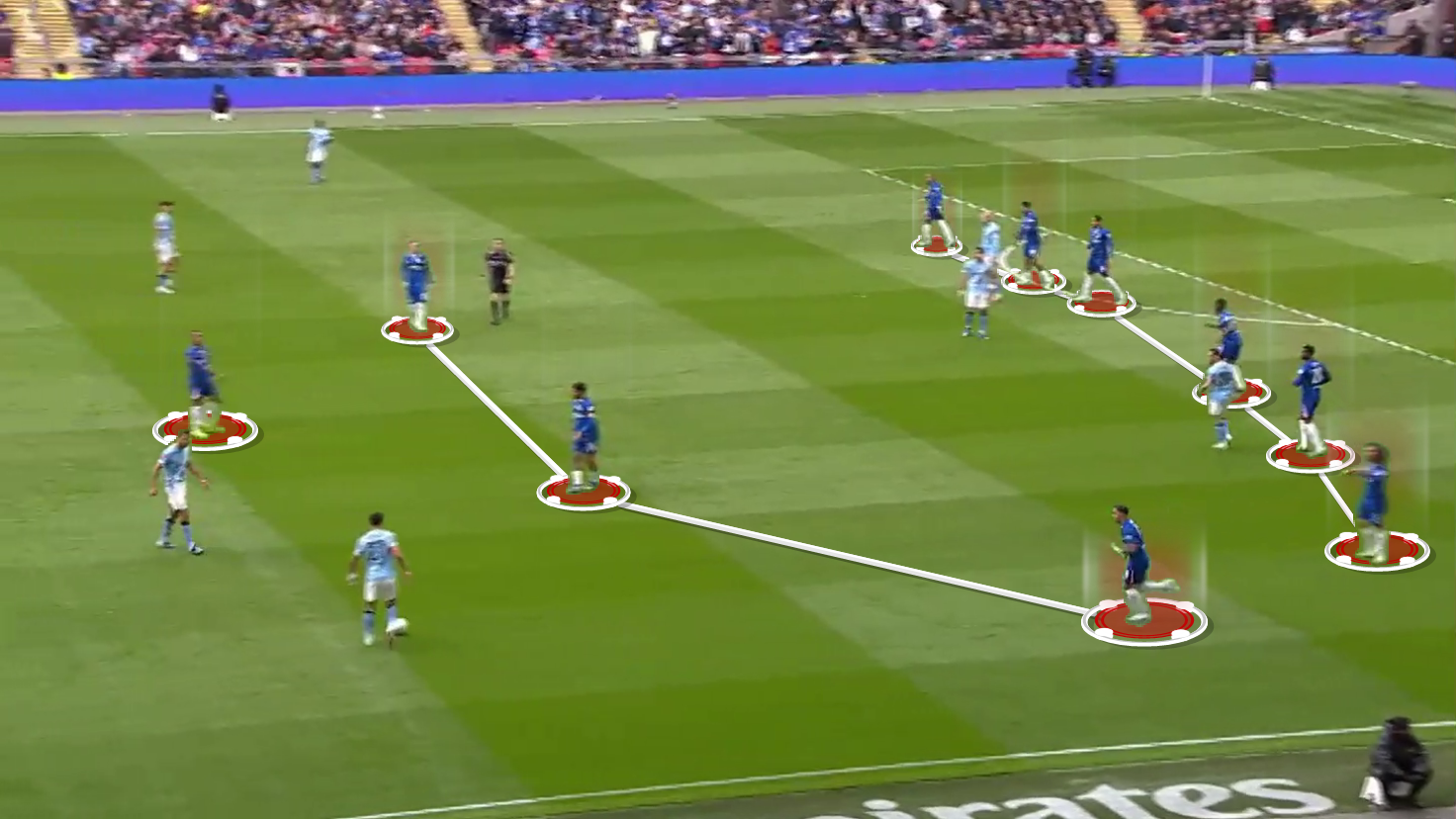
In this sequence, Chelsea briefly form a six-player last line after Cucurella recovers from a higher position.
Rather than immediately reorganising into the usual back five, they prioritise protecting the full width of the defensive line and delaying City’s attack.
Chelsea did not press recklessly from the start.
Instead, they allowed City to have possession in deeper and wider zones, but protected the spaces that mattered most.
James and Caicedo screened the central corridor, while Colwill held an important role in the middle of the back three.
His job was to monitor Haaland, protect the box and step forward when City tried to play into feet.
This structure forced City to move the ball wide.
When Doku received on the left, Chelsea tried to double up with Gusto and Fofana.
When Semenyo received on the right, Cucurella and Hato were responsible for preventing him from driving inside.
The objective was clear: Chelsea wanted City’s wingers to receive under pressure, with limited space to attack behind.
The plan worked well for much of the first half. City had more of the ball, but their possession often lacked penetration.
They could circulate from side to side, but Chelsea’s defensive line shifted across with discipline and rarely allowed clean central combinations.
However, this defensive approach also came with a trade-off.
Chelsea were so focused on compactness and protection that they often lacked attacking presence when they recovered the ball.
João Pedro was frequently isolated, while Palmer and Fernández had to start attacks from deep positions.
Chelsea could escape pressure at times, but they struggled to turn those moments into sustained attacks.
This was the major tension in their performance.
Their defensive structure gave them a platform to compete, but it did not give them enough control of the match.
Manchester City Width & The Role Of Jérémy Doku And Nico O’Reilly
Manchester City’s best attacking route in the first half came down their left side.
Doku held the width and repeatedly forced Chelsea to adjust their defensive shape.
Even when he did not beat his marker directly, his presence changed the way Chelsea defended.
Gusto could not leave him alone; Fofana often had to provide cover, and James was forced to protect the inside lane.
That created space for O’Reilly.
Although O’Reilly started as City’s left-back, he did not behave like a traditional full-back in possession.
He frequently moved inside and higher, attacking the left half-space behind Chelsea’s midfield.
This was one of City’s clearest tactical ideas: use Doku as the wide threat to attract defenders, then find O’Reilly making an underlapping run into the space that opened inside.
In these moments, City were trying to manipulate Chelsea’s back five.
If Gusto stayed tight to Doku and Fofana followed Marmoush or Haaland’s movements, O’Reilly could arrive in the blind-side channel.
If Chelsea stayed narrow to block O’Reilly, Doku had more room to isolate his marker.
This dynamic did not produce a decisive goal, but it was one of City’s most promising patterns.
It also explained why Chelsea were so cautious with their defensive line.
They knew that if one defender jumped too early, City could use the next movement to attack the space behind.
On the opposite side, Semenyo played a different but equally important role.
He was not as constantly involved as Doku in the early phases, but he gave City power, directness and the ability to receive under pressure.
Against Chelsea’s back five, those wide duels became essential.
City’s attacking structure was therefore based on two different wide threats.
Doku attracted pressure and created space for O’Reilly’s interior runs.
Semenyo offered a more physical outlet on the right, capable of protecting the ball and attacking the box when the move developed on the far side.
Still, City were not fully fluent.
Marmoush struggled to influence the game between the lines, and Haaland did not receive enough service inside the penalty area.
This was why Guardiola changed the attacking rhythm at half-time, introducing Rayan Cherki to give City more creativity and technical quality in central spaces.
Chelsea Pressure, City’s Wide Outlets & The Winning Goal
The second half brought a different rhythm.
Chelsea became more aggressive without the ball and pressed higher at times.
Their wing-backs were more willing to jump onto City’s full-backs, while James and Caicedo pushed closer to Rodri and Bernardo Silva.
This created more individual match-ups across the pitch and briefly made City’s build-up less comfortable.
This was where Semenyo’s profile became increasingly valuable.
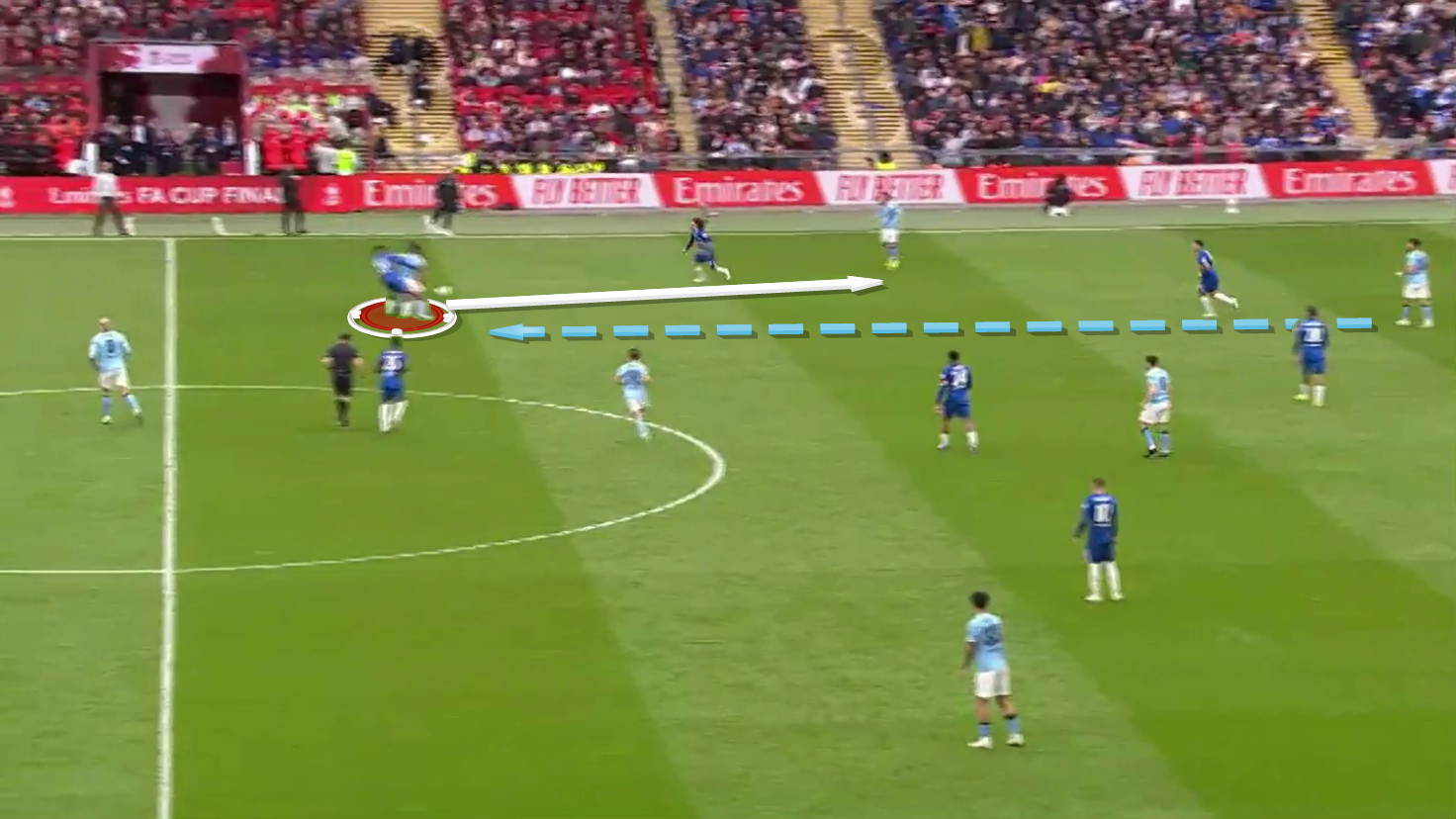
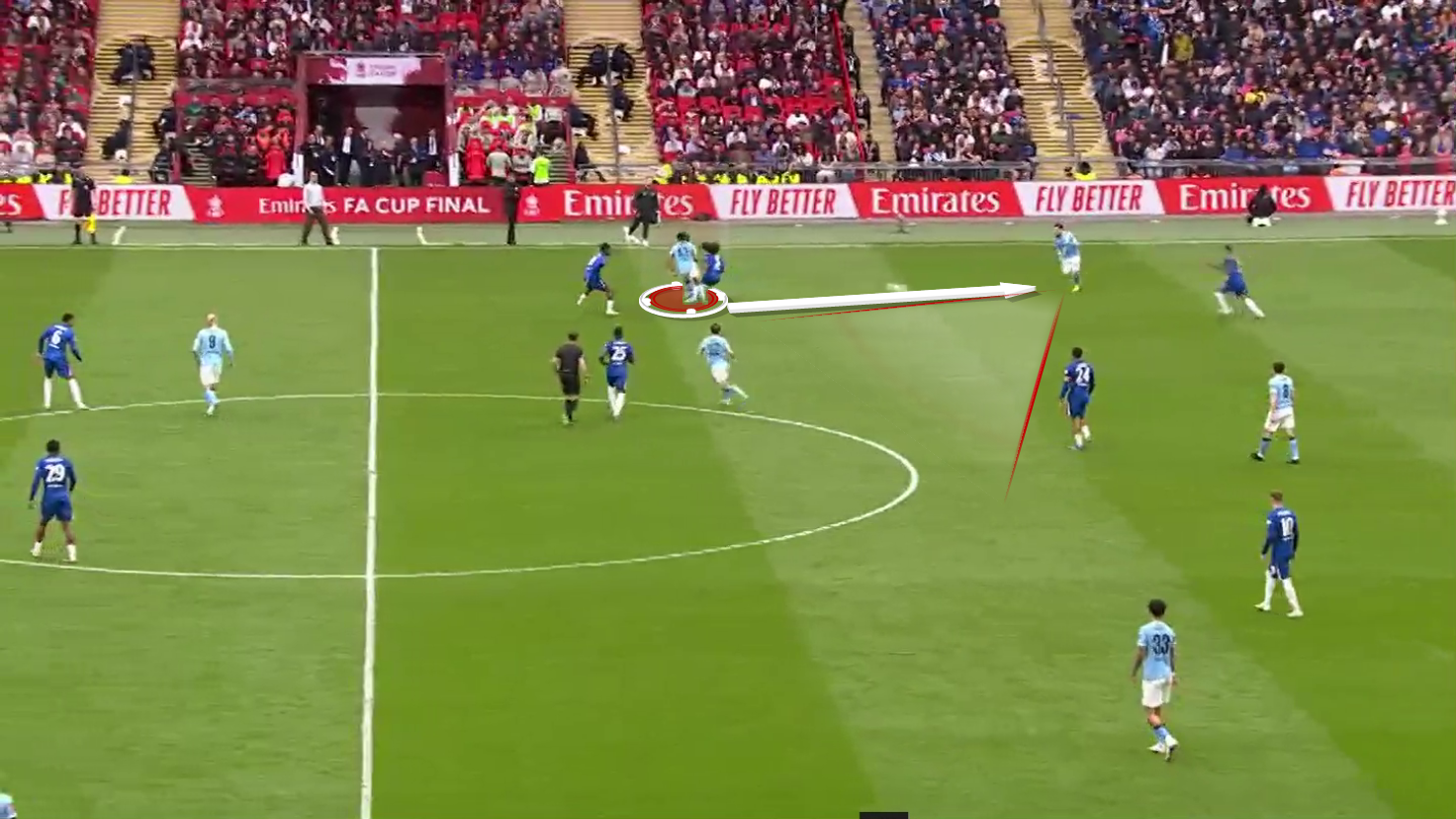
As Chelsea pressed higher and tried to create more individual match-ups, City could use the Ghanaian winger as a direct outlet on the right.
Rather than always progressing through clean central combinations, Guardiola’s side were able to play into Semenyo’s feet, allow him to absorb contact, and then connect with a team-mate facing forward.
Against high pressure, City did not always need a perfect short-passing sequence.
Sometimes they needed a wide player who could receive the ball with a defender tight to him, protect the ball, and help the team move up the pitch.
Semenyo and Doku both offered that quality.
They are not only dribblers in open space but also pressure-release players.

![Scotland Vs Switzerland [0-3] UEFA Nations League 2026/2027: How Aggressive Pressing Backfired & Murat Yakin Took Advantage - Tactical Analysis](https://cdn.mymidnight.blog/77f959f119f4fb2321e9ce801e2f5163/size/w600/2026/10/Scotland-Vs-Switzerland-20262027---Tactical-Analysis.png)
![Olympique De Marseille Vs PSG [1-2] Ligue 1 2026/2027: How Bruno Génésio Transitions Troubled PSG - Tactical Analysis](https://cdn.mymidnight.blog/77f959f119f4fb2321e9ce801e2f5163/size/w600/2026/09/Marseille-Vs-PSG-2026_2027---Tactical-Analysis.png)
![Fulham Vs Manchester United [1-1] Premier League 2026/2027: How Álvaro Arbeloa Tactics Exposed The Red Devils' Problems - Tactical Analysis](https://cdn.mymidnight.blog/77f959f119f4fb2321e9ce801e2f5163/size/w600/2026/09/Fulham-FC-Vs-Man-United-2026_2027---Tactical-Analysis.png)
![AS Roma Vs Inter Milan [2-2] Serie A 2026/2027: When Undefeated Giallorossi Attack Met Nerazzurri Comeback Resilience - Tactical Analysis](https://cdn.mymidnight.blog/77f959f119f4fb2321e9ce801e2f5163/size/w600/2026/09/AS-Roma-Vs-Inter-Milan-2026_2027---Tactical-Analysis.png)
![Real Sociedad Vs Bournemouth [1-2] Europa League 2026/2027: How Do Marco Rose Pressing Tactics Work? - Tactical Analysis](https://cdn.mymidnight.blog/77f959f119f4fb2321e9ce801e2f5163/size/w600/2026/09/Real-Sociedad-Vs-Bournemouth-20262027---Tactical-Analysis-1.png)
![AC Milan Vs Benfica [0-2] Europa League 2026/2027: How Marco Silva Tactics Exposed Rúben Amorim Defensive Problems - Tactical Analysis](https://cdn.mymidnight.blog/77f959f119f4fb2321e9ce801e2f5163/size/w600/2026/09/AC-Milan-Vs-Benfica-20262027---Tactical-Analysis.png)
![Sunderland Vs AZ Alkmaar [1-0] Europa League 2026/2027: Why The Black Cats Make Better Underdogs - Tactical Analysis](https://cdn.mymidnight.blog/77f959f119f4fb2321e9ce801e2f5163/size/w600/2026/09/Sunderland-Vs-AZ-Alkmaar-20262027---Tactical-Analysis.png)