
Franck Haise Tactics At Stade Rennais 2026/2027: Can Attacking Firepower Compensate For Defensive Fragility? - Tactical Analysis
Ever since Franck Haise has taken charge of Rennes, they have had a good turn of fortune. In this coach analysis, we take a look at his attacking 3-5-2 system with a blend of relationist and positionalist principles.

Franck Haise looks to build on his sixth-place finish last season with Stade Rennais in 2026/2027, his first full season in charge.
He started well with a 2-2 draw against Paris Saint-Germain before winning three in a row to become a contender for a top-three finish and direct qualification for the UEFA Champions League.
Even in the UEFA Europa League, Rennes have played four games where they have attained three draws and one win, a remarkable result given they have faced teams of the quality of Olympiacos and Juventus.
But can Rennes keep punching above their weight this season as well?
In this tactical analysis, we take a look at how Rennes behave in and out of possession, as well as their statistical profile.
Rennes Formations & Players Used
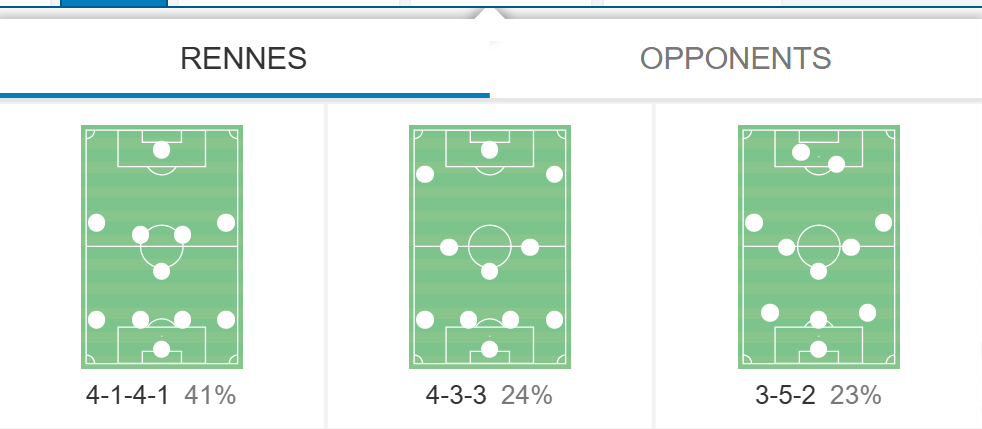
Haise uses a base formation of 3-5-2 but can also transition into a 4-1-4-1 in possession, which we will see later in the article.
The 3-5-2 gives Haise added defensive security, with the wing-backs collapsing to form a back five and creating a clear balance between attack and defence.
Rennes Formations 2026/2027
Former Leeds United midfielder Aaron Cresswell, French midfielder Valentin Rongier, Jordan international striker Mousa Al-Tamari and full-back Mahamadou Nagida form the core of Haise’s team.
Veteran goalkeeper Brice Samba and former Lazio player Boulaye Dia, Rennes' top scorer this season with five goals, have 11 appearances each.
Rennes On The Ball
On the ball, Rennes like to use an asymmetric system where the wing-backs have a one-up, one-down structure.
This means that while one wing-back advances to help in attack, the other tends to stay back and maintain the defensive structure.
If the right wing-back stays back to support, the left centre-back pushes wide, acting as a quasi-full back and sometimes keeping a back four during build-up.
In possession, their formation tends to shift between a 4-1-4-1 and 3-1-4-2, depending on the game's demands and the opposition's approach.
However, no matter what formation Rennes use in possession, Haise has a strict principle: always keep three players at the back.
This reflects the idea of a three-man backline, ensuring sufficient defensive cover to deal with counterattacks.
Rennes midfielder Rongier operates between the lines as a pivot, trying to connect defence to attack.
He could position himself in front of two centre-backs to form a passing triangle, or drop between the centre-backs and allow both wing-backs to push up.
The method of advancing play depended solely on how the opposition set up its press and how Rongier sought a solution against it.
Perhaps Rongier's ability to receive on the turn is why he is best suited to this role.
It allows him to receive between the lines and escape the shadow of the opposition player.
Higher up the pitch, Rongier's duties are different: he could join his teammates on a particular flank to create overloads on the wing and passing combinations, or he could stay central and help facilitate switches of play.
When playing against teams that press high and aggressively, Rennes look to bait the press by playing back passes to the goalkeeper.
This draws the opposition forward, creating separation between the second and third lines of press, while Dia and Al-Tamari pin the last line back.
Then Samba is asked to play chipped passes to either forward, thereby bypassing the press.
Dia, like Rongier, is a key piece in the system.
When Rongier drops between the lines from midfield to advance the play, Dia occupies the space the French player vacated.
He combines with either Camara or Thomasson to exploit the opposition team's weaknesses in the wide areas.
Dia, given a free role as mentioned above, looks to create passing combinations in the wide areas with the corresponding wing-back and the No. 8 to create an overload.
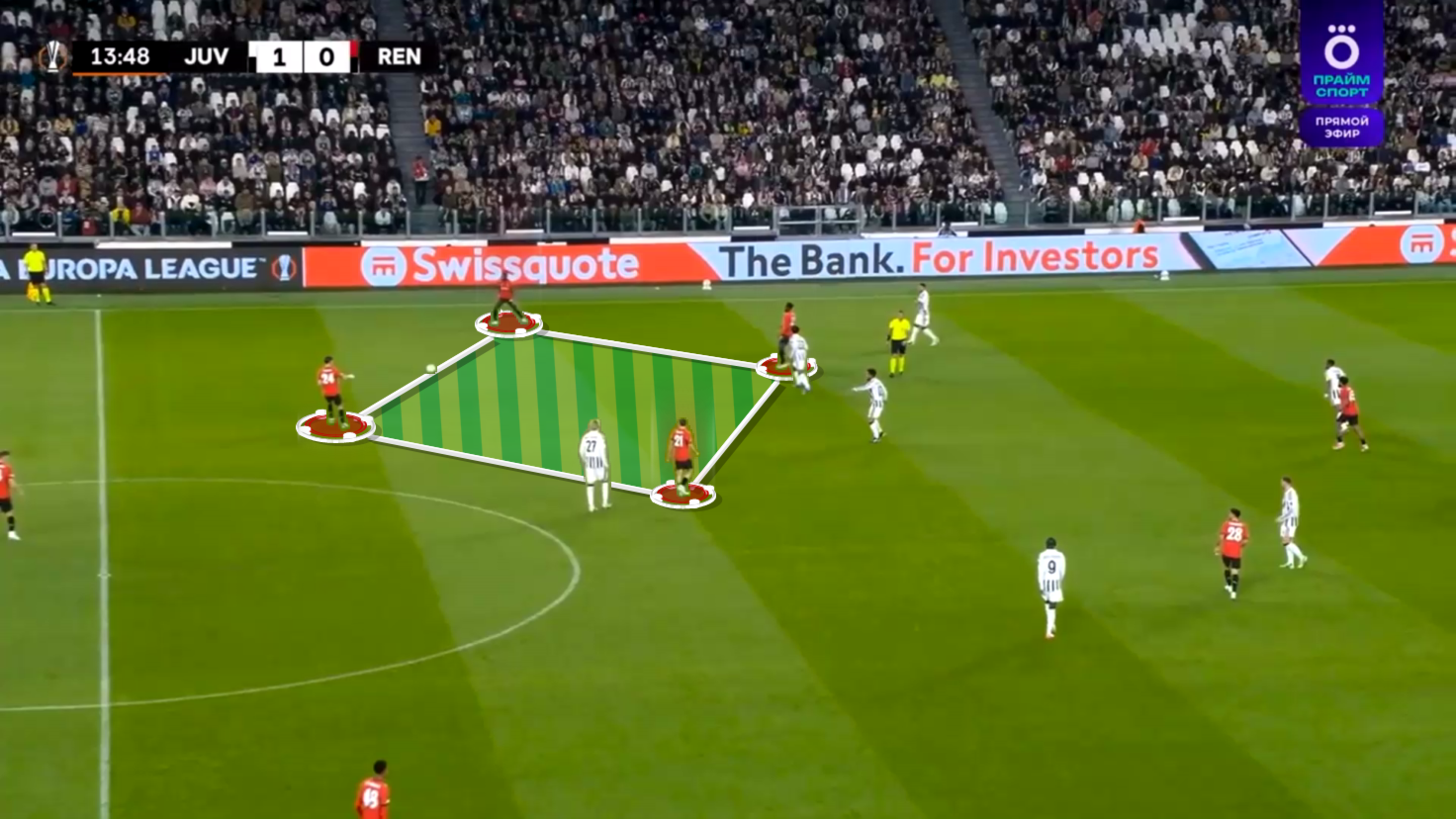
Together with Rongier, they can also form a passing diamond (as seen in Figure 1) with two main objectives.
One is to create third-man combinations and play a pass into the half-spaces behind the opposition defence for a third man to pick up, while the second is to use quick one-touch passes to release the wing-back in wide areas behind the opposition defence, allowing him to cross.
Rennes have two methods of creating chances.
One is a direct approach to progression, where defenders look to angle direct passes into striker Al-Tamari, who acts as the reference point.
Putting himself between the ball and the opposition defender, Al-Tamari will look to lay off or flick the ball to a faster attacker, who can then attack the space vacated by the defender trying to dispossess the Jordanian striker.
The second method is by crossing the ball into the box.
Rennes would suck the opposition into pressing them to the flank and then have either Rongier or one of the centre-backs switch play into the opposite flank and then cross into the box.
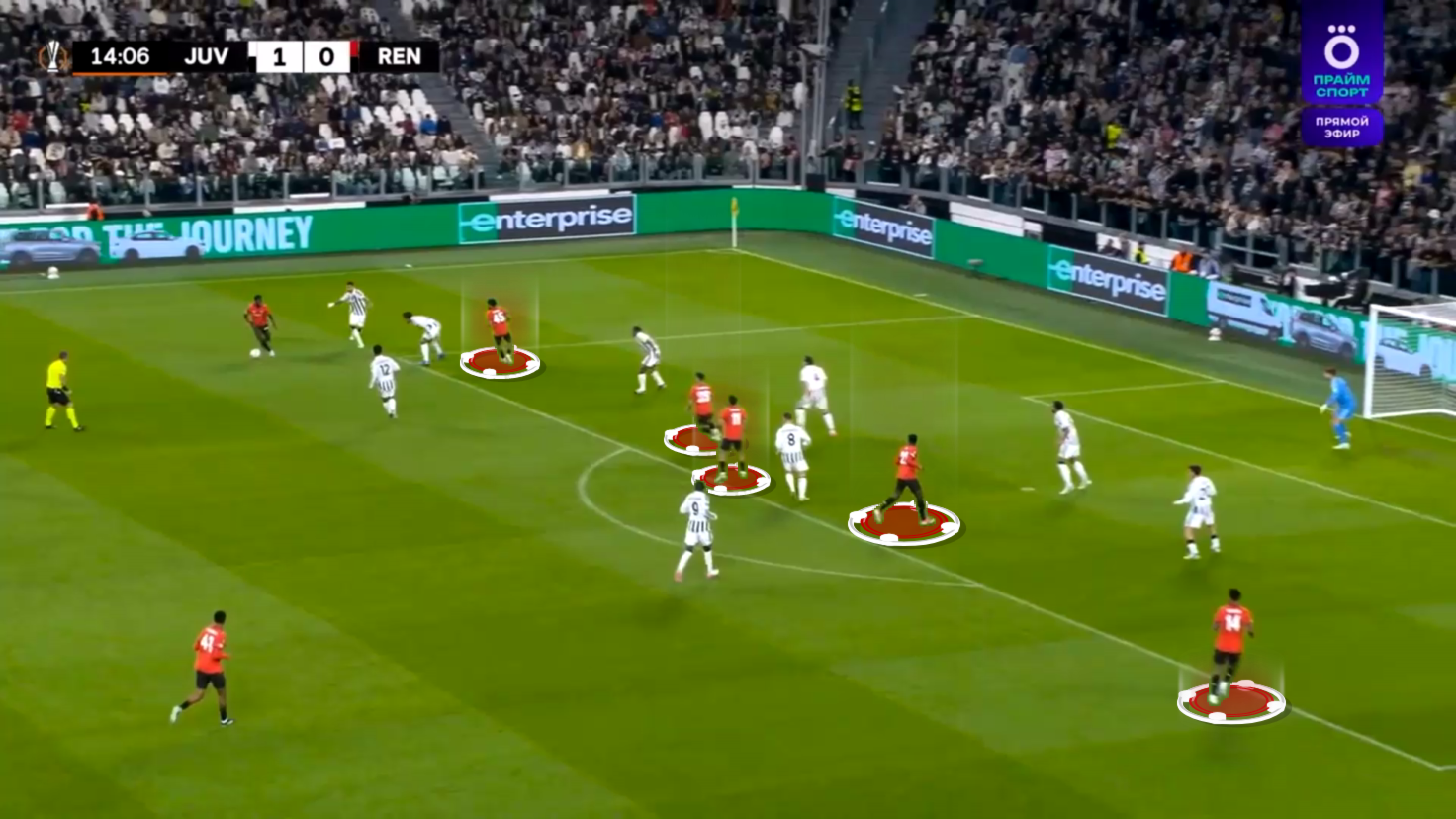
Before crossing into the box, Rennes tend to overload it with three or four players.
With almost four players to defend, it confuses the opposition defenders and gives Rennes a strong chance to score, as seen in Figure 2.
Most importantly, I noticed Haise’s positional and relational principles in Rennes' approach.
When building out from the back, Rennes use positional play principles, spreading out and occupying each zone, or fluid positional rotations to confuse the opposition's man-marking.
However, once the ball crosses the middle third, then Rennes do not have a structured shape or approach to scoring.
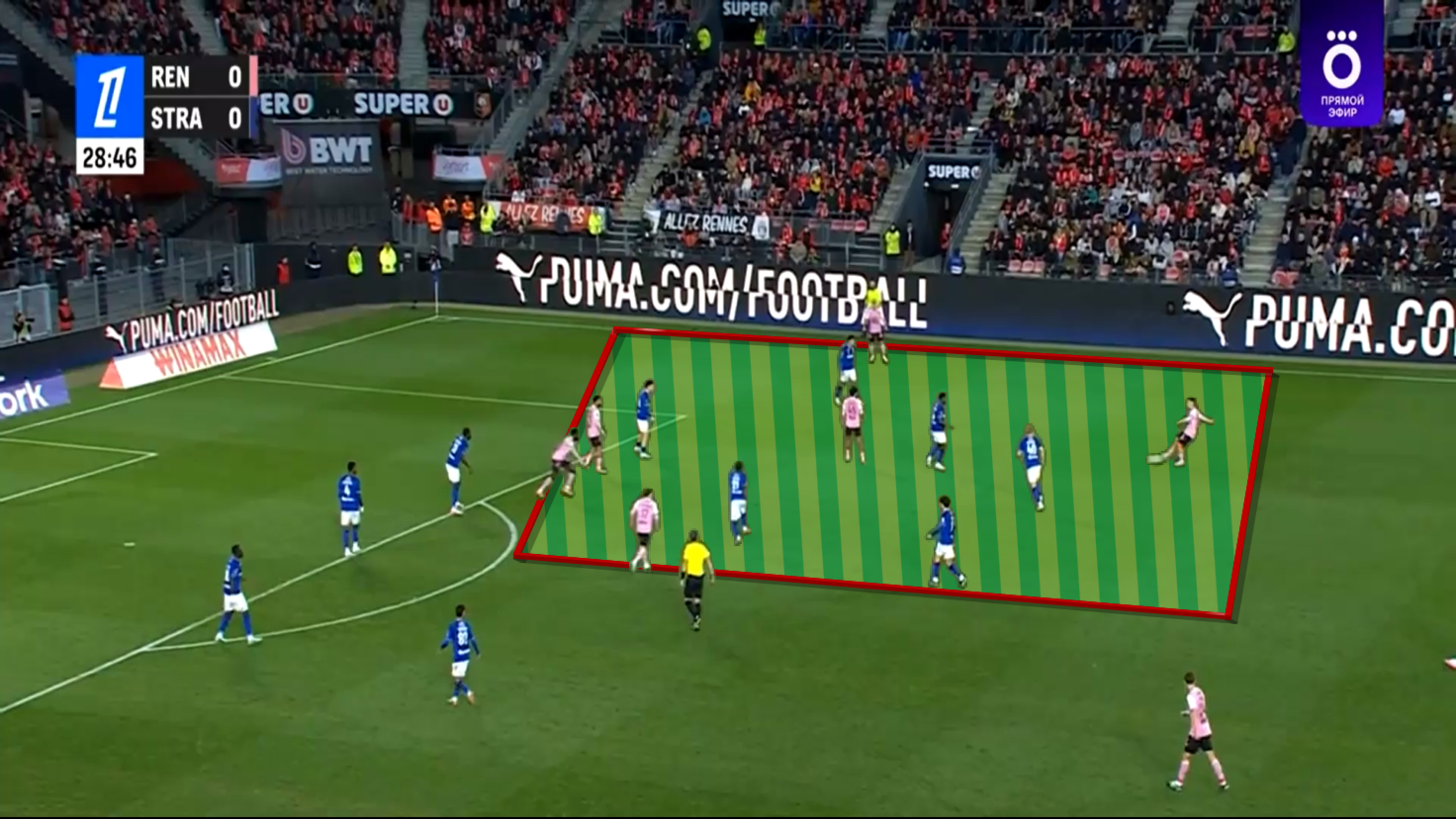
As seen in the example below (Figure 3), Rennes demonstrate a very common principle in relationism called field tilt.
They suck the opposition into a particular flank by creating an overload, and sometimes they look to play through the crowd rather than always switch play like positionalist teams.
Rennes Off The Ball
Out of Possession, Rennes adopt a man-oriented approach under Haise, where each player marks their man.
By doing so, they adopt a 3-4-1-2 formation, which suits the man-to-man marking style and allows Rennes to press high up the pitch, restrict passes to the opposition No. 6, and maintain presence across the pitch.
Rennes’ main approach was to create pressing traps by leaving the wide passing option free; when the pass was made to the free player, Rennes employed horizontal pressing and reduced the side of the playing area, using the touchline as an extra man, as seen in Figure 4.